

All You Need To Know About Auto Transport Claims
Discovering damage to your vehicle after shipping is a ni...
21 February 2023
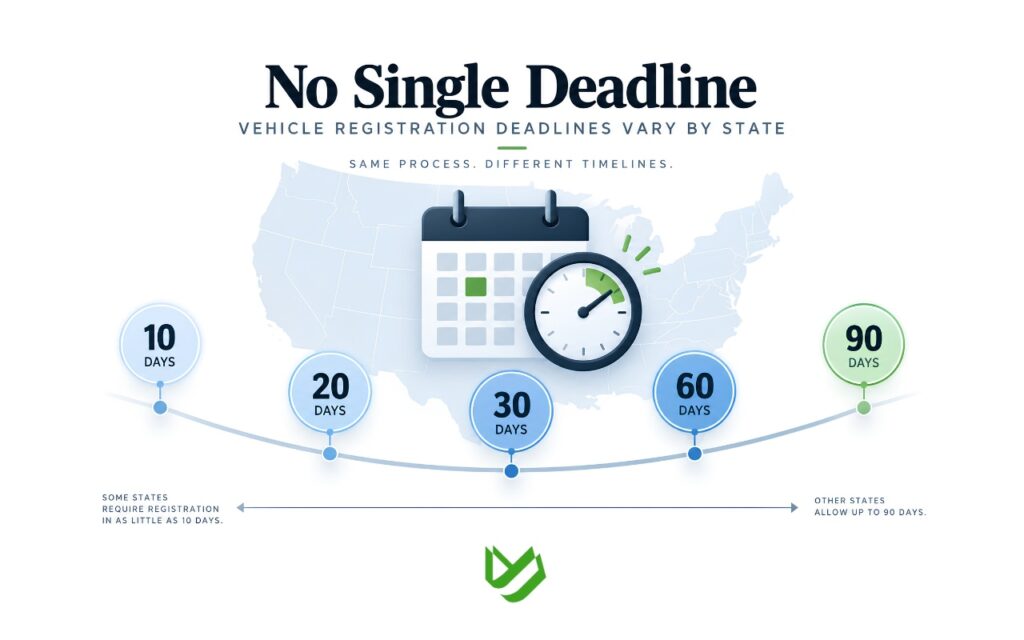
When you move to a new state, you generally need to transfer your vehicle registration, update your driver’s license, get in-state auto insurance, and complete any required VIN, safety, or emissions inspections. Most states give new residents about 30 days to register a vehicle, but deadlines differ widely, from as little as 10 days in some to 90 days in others. The deadline is generally tied to when you establish residency, though the exact trigger varies by state. Your registration and license are usually two separate tasks with two separate deadlines.
Calculate Shipping Quotes
I’ve seen thousands of interstate moves from the dispatch side, and the same problem keeps coming up. It’s never the couch, the boxes, or indeed the move itself that causes the difficulty. The trouble is the DMV paperwork, which no one has put on the calendar. Once you get the keys to your new home, you unpack and start your new job, yet three weeks later you’re still using out-of-state plates, an out-of-state license, and registration that lists an address you no longer occupy.
That’s where the fines, failed inspections, and insurance problems come in. The guide explains exactly what you are responsible for when you move to a new state: updating your registration, changing your address, transferring your driver’s license, and handling inspections so your vehicle is legal to drive the day it arrives.
In this guide
Here is the first misconception I correct for people. Changing the address on your driver’s license does not automatically update your vehicle registration, and vice versa. In some states, the DMV lets you handle both in one visit. In plenty of others, different offices handle them on different timelines. Florida is a clear example: new residents get 30 days to get a driver’s license but only 10 days to register the vehicle. Miss the shorter one because you assumed they were the same task, and you are already late.
Treat them as two boxes to check:
Another easy-to-overlook box is your mailing address, as it is recorded with both the U.S. Postal Service and your insurance company. Should your registration renewal notice, recall notice, or toll bill be sent to your previous address, you will not receive it, and the fact that ‘I never received the notice’ cannot be used as a defense to escape a lapsed registration.
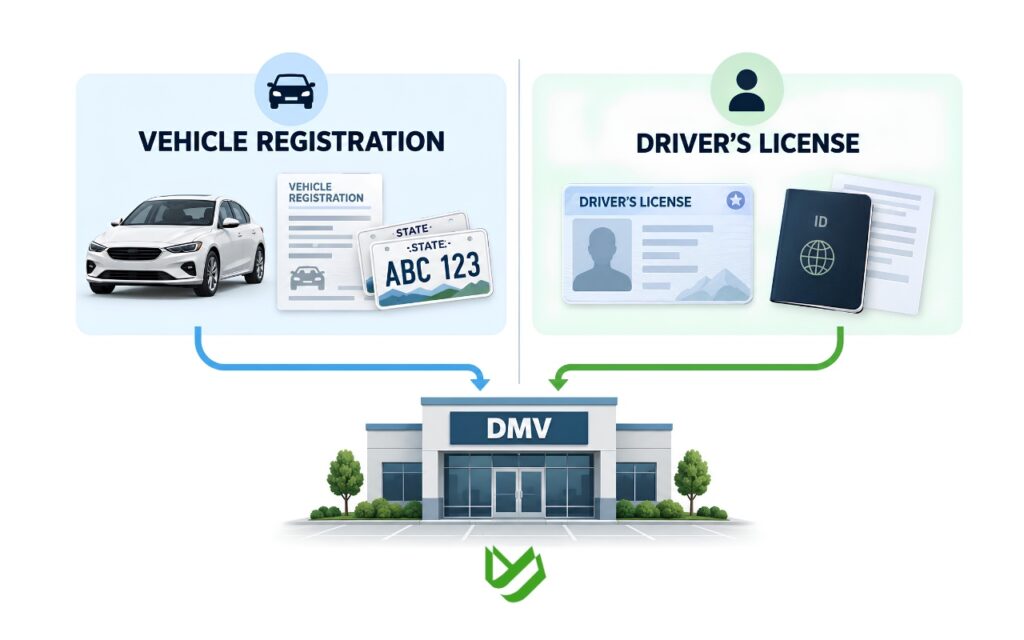
Each state sets its own deadline, which can extend further than most people anticipate, ranging from “immediately” to 90 days. Moreover, in the same state, the deadlines for the vehicle and the license are often different, which is why these are two distinct tasks.
State DMV rules differ, and some requirements vary by county. The deadlines listed below are only a quick reference and should not replace checking your state’s current DMV requirements.
| State | Register vehicle within | Transfer license within | Key requirement |
| Massachusetts | On residency | Promptly on residency | Among the strictest; tied to getting your MA license |
| New Mexico | On residency | Promptly on residency | Register promptly after establishing residency |
| Florida | 10 days | 30 days | Free VIN inspection required |
| California | 20 days | 10 days | Smog check + VIN verification required |
| Texas | 30 days | 90 days | Inspection in many counties; $90 new-resident use tax |
| New York | 30 days | 30 days | Vehicle inspection required |
| Georgia | 30 days | 30 days | Emissions test in metro Atlanta counties |
| Illinois | 30 days | 90 days | Register through the Secretary of State |
| Nevada | 30 days | 30 days | Emissions in Clark (Las Vegas) & Washoe (Reno) counties |
| Washington | 30 days | 30 days | No emissions test statewide |
| Virginia | 30 days | 60 days | Safety inspection required |
| Colorado | Up to 90 days | 30 days | Emissions in Front Range counties; VIN verification |
The key point is that 30 days is the usual guideline, but you should never assume it will apply to your situation. For example, moving from Georgia to Florida reduces your registration period from 30 days to 10. Moreover, within a single state, the two time periods can go in opposite directions. In Texas, you have 30 days for the vehicle but 90 for the license, or in California, the license deadline (10 days) is stricter than the registration one (20 days). If your destination isn’t listed in the table, check the details before you get there, not after.
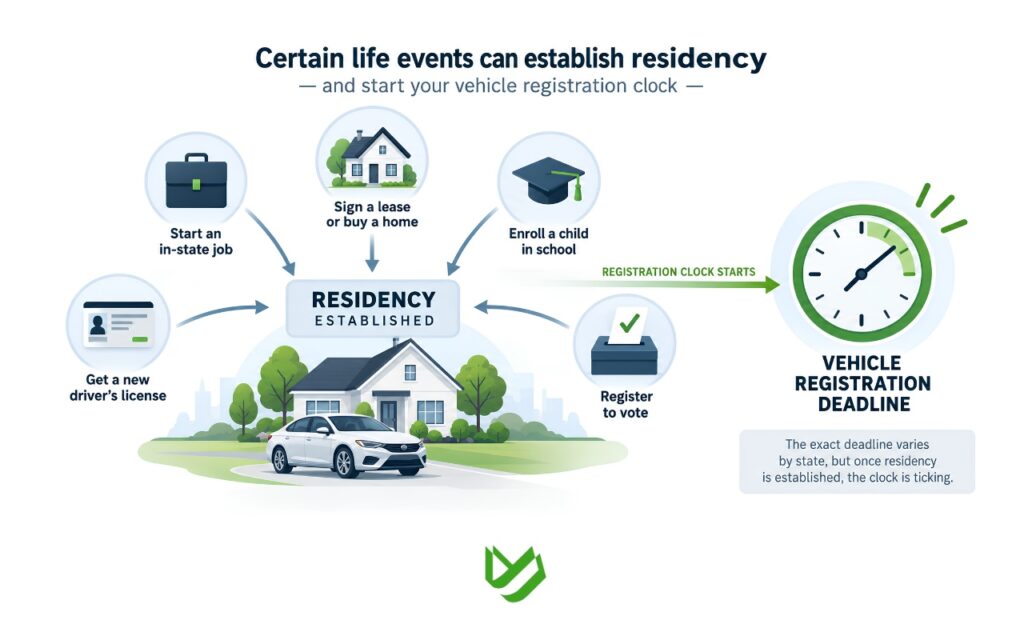
This is the part that catches even careful people. States use different factors to decide when you become a resident, so the registration clock does not always start on the day your moving truck arrives. It generally starts the day you establish residency, which many states tie to your actions rather than a single lease date.
States use different factors to determine when someone becomes a resident. Depending on the state, these can include:
Nevada provides a clear example. A person who has just moved to Las Vegas may still be using license plates from Arizona, which are valid for another eight months and therefore may think there’s no rush. However, as soon as he signs a lease and takes up a job in the area, the registration clock in Nevada can begin to run even if the old plates still qualify.
The key point to take away is to determine the first residency trigger that applies in your case, then count from that date and check the precise deadline with your state’s DMV. If you don’t know when your residency started, it’s best to look up the relevant rules on your state’s DMV website or to contact the agency itself rather than guessing a specific date.
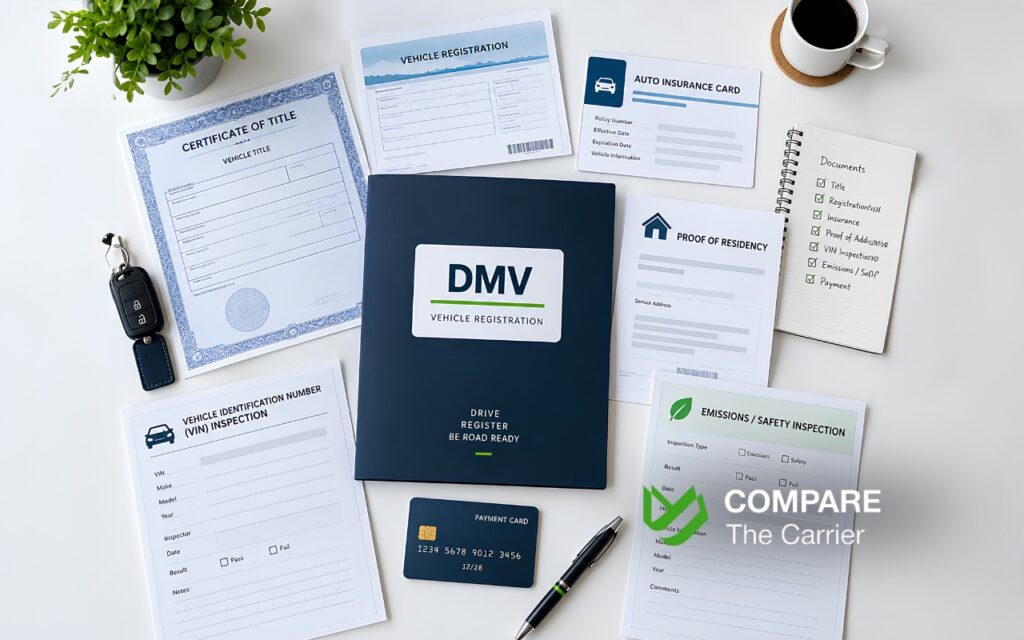
The biggest time-waster I see is people making a second or third trip because they showed up missing a document. Gather everything before you go. Requirements vary by state, but almost every DMV asks for some combination of the following.
| Document | Why it is required |
| Out-of-state title (or lienholder info if financed) | Proves ownership; if you have a loan, the lender holds the title, so bring their authorization |
| Current out-of-state registration | Establishes the vehicle’s prior record and identity |
| Valid driver’s license or state ID | Confirms your identity |
| Proof of in-state auto insurance | Must meet your new state’s minimum coverage; an out-of-state policy usually will not do |
| Proof of residency | Utility bill, lease, mortgage statement, or bank statement showing your new address |
| VIN verification / odometer disclosure | Required in many states for out-of-state vehicles |
| Emissions or smog certificate | Where the county or state requires it |
| Payment | Registration, title, and plate fees, plus any use tax |
If your car is financed or leased, that title line matters more than you might think. The lienholder physically holds your title, so you may need a lienholder authorization to register in a new state. If you are also shipping a financed car, our lienholder authorization guide walks through the paperwork. For a full pre-move paperwork list, keep our vehicle shipping document checklist handy.
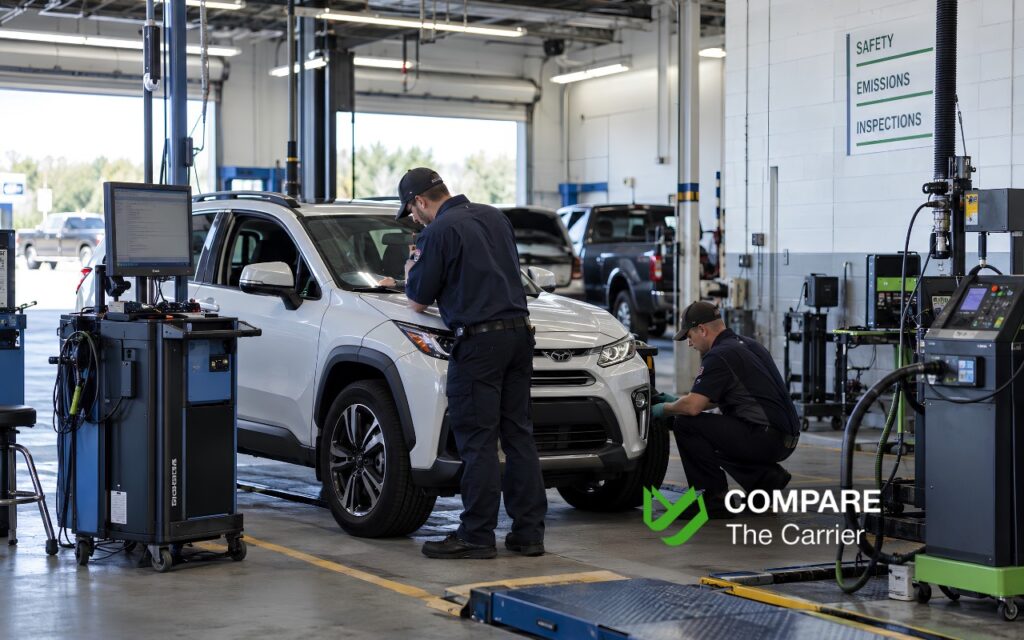
Registration will not be given out in several states until your vehicle has passed one or more inspections, so make sure to allow sufficient time for them, since if an inspection fails or is missed the entire process will be halted.
If you are shipping your car rather than driving it, schedule any required inspection for shortly after it arrives so you still land inside your state’s deadline. A car that shows up early gives you breathing room; a car you are still driving cross-country does not.
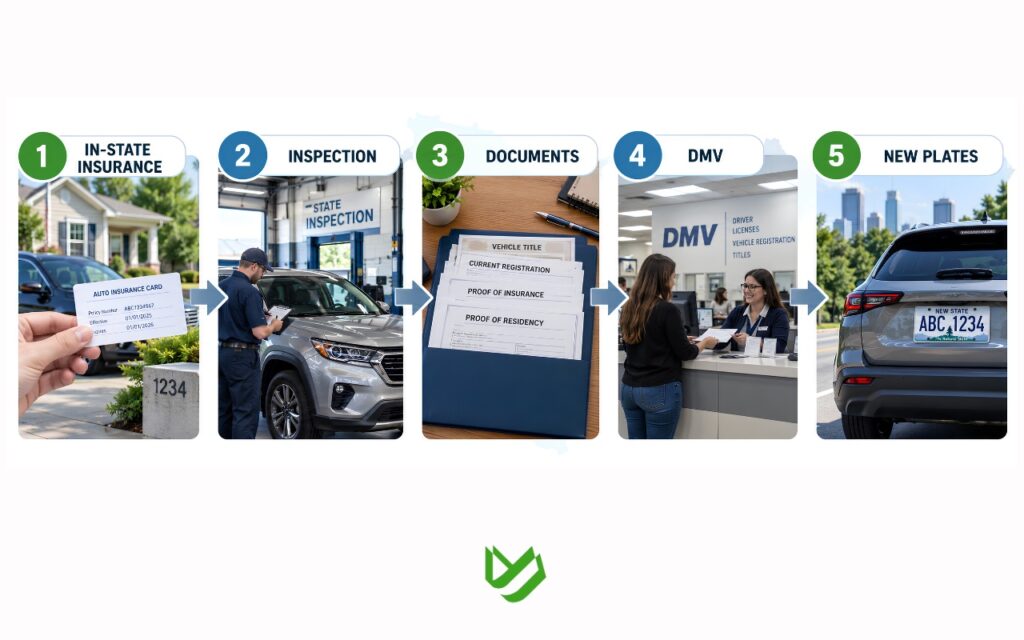
Once you know your deadline and have your documents, the process itself is simple. It varies by state, but the shape is the same.
When you register in a new state, you will almost always get new license plates. What happens to your old plates depends on your former state. Your former state may require you to surrender them at a DMV, mail them back, destroy them, or keep them until the new registration is active. Some states, including California, let you keep your old plates as a souvenir and don’t want them back.
This step is not just housekeeping. A few states keep charging registration taxes or insurance-related penalties until your old plates are officially surrendered. Follow your former state’s instructions so you don’t pay two states for one car.
The cost of registration varies a great deal. When you add up the fees for the title, the plate and registration, the total is usually around $50 to a few hundred dollars, and in states where the fee is based on the value of the vehicle the amount can be higher. Furthermore, some states impose a use tax on a car that you are bringing in, but in some cases this tax is waived or reduced depending on how long you had owned the car before making the move. Refer to your state’s rules to find out the current threshold.
The bigger cost question for a long-distance move is whether to drive the car yourself or ship it. Driving looks free until you add it up: fuel, a few nights of lodging, meals, the wear and depreciation of adding a thousand-plus miles, and the days of your own time behind the wheel. For a genuinely long haul, shipping is often more economical and far less exhausting, and it keeps those miles off a car you may be about to inspect and register. We break down the math for car shipping vs. driving.
If you decide to ship, the cost depends on distance, vehicle size, transport type, and season. The fastest way to see a real number for your route is our auto transport calculator – it gives you a live estimate rather than a vague range. For how pricing is built and what a fair quote looks like, read our deeper guide on how much it costs to ship a car to another state.
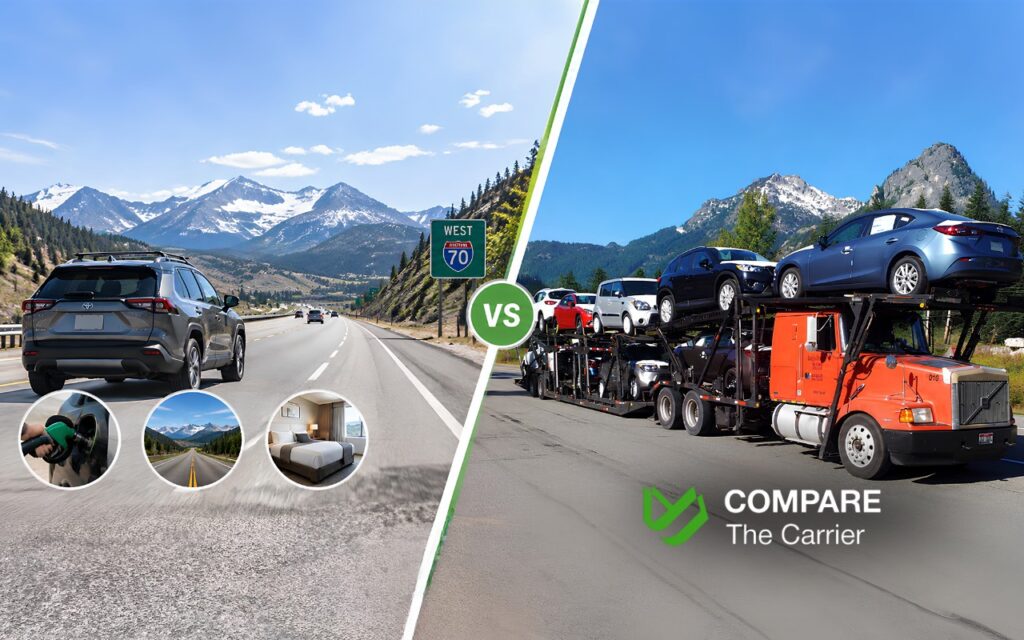
On transport type, you have two main choices:
For booking a state-to-state relocation, our state-to-state car shipping service is built specifically for interstate moves, and our main car shipping page covers door-to-door logistics end to end. One thing I steer people away from is towing the car behind a rental truck to save a few dollars; the added liability, the fuel penalty, and the strain on your own vehicle usually erase the savings. We lay out why in state-to-state car towing.
The sequence matters more than people think, and getting it right removes most of the last-minute stress.
The order I recommend for a cross-country move:
Shipping the vehicle ahead of, or alongside, the moving van is often the smoother play, and it means your car is ready for the DMV the moment you need it. We cover the timing tradeoffs in shipping your car before the moving van.
For the bigger relocation picture beyond the car, our guide to shipping a car during an out-of-state move ties the vehicle logistics into the rest of the move.
You must not overlook the registration deadline set by your new state. If you continue to drive with an expired or out-of-state registration after the allowed time period, you could face fines, citations, and other penalties, according to the state in question. The late registration fees also differ and tend to rise the longer you delay. In addition, a few states might charge extra fees or impose back charges if a new resident registers after the deadline has passed.
A few problems can follow if you put off the paperwork:
These problems can generally be avoided. You should check the requirements of your state before you move, collect the necessary documents, carry out any inspection or emissions testing, and register the vehicle by the relevant deadline.
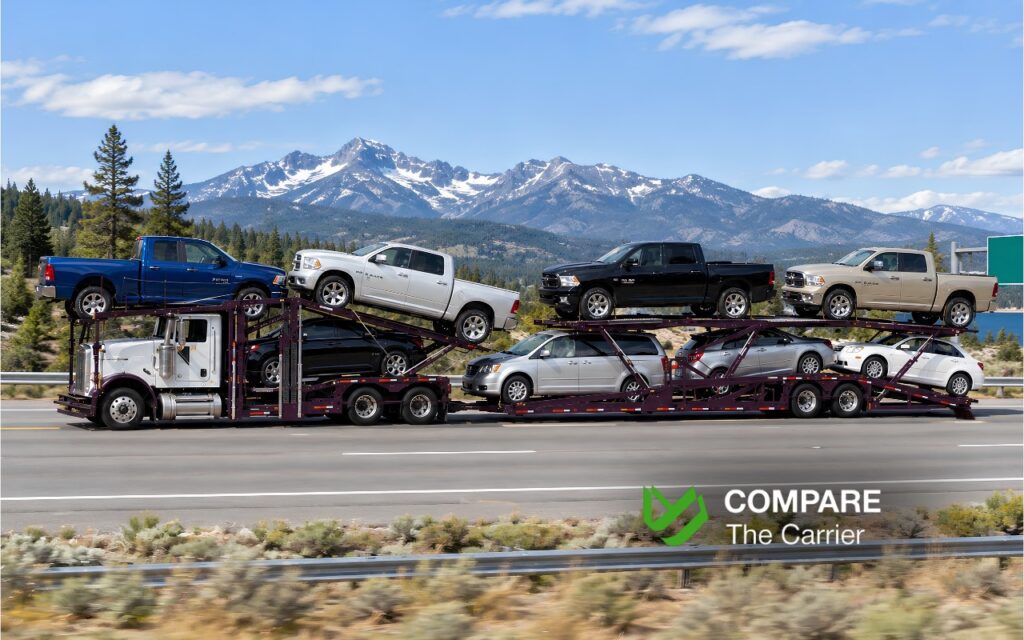
Moving between states involves a great many different tasks, and it’s the ones related to the DMV that are most likely to be overlooked. The best approach is to keep it simple: find out the deadline in your state and start counting from the day you settle in, remember that you have to deal with registration and obtaining a license as two separate matters, collect all your documents before you leave, and carry out any necessary inspections as early as possible. You should also deal smartly with the car itself; if the move is a long one, sending the car instead of driving it can be a sensible alternative when you take into account the cost of fuel, accommodation, mileage, and your own time.
If shipping is part of your plan, use our auto transport calculator for a real estimate for your route, or explore our state-to-state car shipping service to help arrange an interstate vehicle move. We will handle the transport logistics while you focus on the rest of the move.
This guide is general information, not legal advice. Registration rules, deadlines, fees, and inspection requirements change and vary by state and county. Always confirm current requirements with your state’s official DMV or motor vehicle agency before relying on this information.
The deadline depends on the state. Thirty days is common, but some states give new residents less time. Florida, for example, generally requires new residents to register within 10 days, while California gives new residents 20 days. Some states tie rules to establishing residency, while others allow up to 90 days. Always check your destination state’s official DMV or motor vehicle agency for the current deadline.
The deadline is generally tied to when you establish residency, but the exact trigger varies by state. Your move-in date, employment, lease, school enrollment, voter registration, or other actions may be relevant depending on the state’s rules. Check your destination DMV to confirm which date applies to your situation, rather than assuming the clock starts the day you arrive.
Usually not automatically. Some states let you update your driver’s license and vehicle registration during the same visit or online, while others treat them as separate transactions. Check both requirements so you do not miss a registration or license deadline.
Usually, yes. Your policy should meet your new state’s minimum insurance requirements and reflect your new address. Depending on your insurer, this may mean updating your existing policy or getting a new policy in the destination state. You will generally need proof of insurance when registering the vehicle. See our [auto transport insurance guide] for more coverage information when moving.
Possibly. Some states require an out-of-state vehicle to pass VIN verification, a safety inspection, an emissions or smog test, or a combination of these before registration. Requirements vary by state and, in some cases, by county or local area. California, New York, Texas, Virginia, and certain metro areas have inspection or emissions requirements. Check your destination DMV for the specific requirements that apply to your vehicle.
It depends on the state. Some states require you to obtain an in-state driver’s license first, while others allow vehicle registration based on other proof of residency. Check your state’s required steps before visiting the DMV so you have the documents you need.
You may be able to drive using your valid out-of-state registration for a limited period, but the rules depend on your new state’s residency and registration requirements. Once you become a resident, the registration deadline still applies. Continuing to drive after that deadline can result in fines, citations, or other penalties. Check your state’s rules before relying on your old registration.
Not necessarily. Some states offer exemptions that let qualifying students keep their vehicle registered in their home state while attending school. The rules depend on the student’s residency status and the destination state’s requirements. Check with the DMV in the state where you attend school to see whether an exemption applies.
Not always. Many states provide registration exemptions or other accommodations for qualifying service members stationed in the state under military orders. Rules can differ for service members and their spouses and may depend on military orders, legal residency, and the state involved. Check with your base legal assistance office and the state DMV before registering or keeping an out-of-state registration.
For shorter moves, driving may be more practical. For a long-distance move, compare fuel, lodging, meals, mileage, vehicle wear, and your own time with the cost of auto transport. Shipping can be a practical alternative when you want to avoid adding hundreds or thousands of miles to the vehicle. The best choice depends on your route, vehicle, timing, and budget.
Use your current residential or mailing address according to your state’s DMV requirements. You should also update your address with your auto insurer and the USPS. For a broader moving checklist, you can use the official USA.gov.












Don't have time to fill out the form?
Call a transport company directly to get a quote now!
Select the category you need
Partner with Compare The Carrier & Grow!
We're open to collaborations, partnerships, and mutual growth! Whether you're an individual or a business, we offer exciting opportunities to work together. Fill out the form below to explore how we can collaborate.
Something Went Wrong
We're sorry, but something went wrong. Please briefly describe the problem you experienced in the text area below. Providing your contact information will allow us to follow up if needed.

Thank you,
your form has been accepted.
Your form has been successfully submitted. We appreciate your effort — our team will review it shortly and take the next steps.


