

Last-Minute Car Shipping: Costs, Timelines & How to Book
Yes, last-minute car shipping is possible – but it costs ...
26 May 2026
Most people planning a cross-state move lose between $200 and $400 simply because they choose the wrong transport method or fall for “low-ball” quotes that balloon at the last minute. In 2026, the auto transport market is more transparent than ever, but only if you know where the hidden savings live. The difference between a budget-friendly move and a logistical nightmare often comes down to timing, carrier type, and knowing which “industry standards” are actually negotiable.
Calculate Shipping Quotes
This guide breaks down every legitimate way to move your vehicle, from DIY towing to professional open auto transport, with real cost data and expert “insider” hacks to keep your budget intact. Whether you are moving a beat-up sedan or a family SUV, we have compared the numbers so you don’t have to. We analyzed hundreds of Reddit threads, thousands of customer reviews, and current 2026 fuel-to-labor ratios to give you the most accurate breakdown available.
If you are looking for a broader overview of the logistics involved, check out our comprehensive state-to-state car towing guide.
This is the most debated topic on Reddit and specialized moving forums. At first glance, driving seems “free” because you already own the vehicle. However, once you factor in the “hidden” costs of a long-distance trip in 2026 – including the rising cost of roadside maintenance and the premium on travel time – the gap between driving and shipping narrows significantly.
To make an informed decision, you need to look at the Total Cost of Ownership (TCO) for the trip, not just the price at the gas pump.
The True Cost Formula for Driving
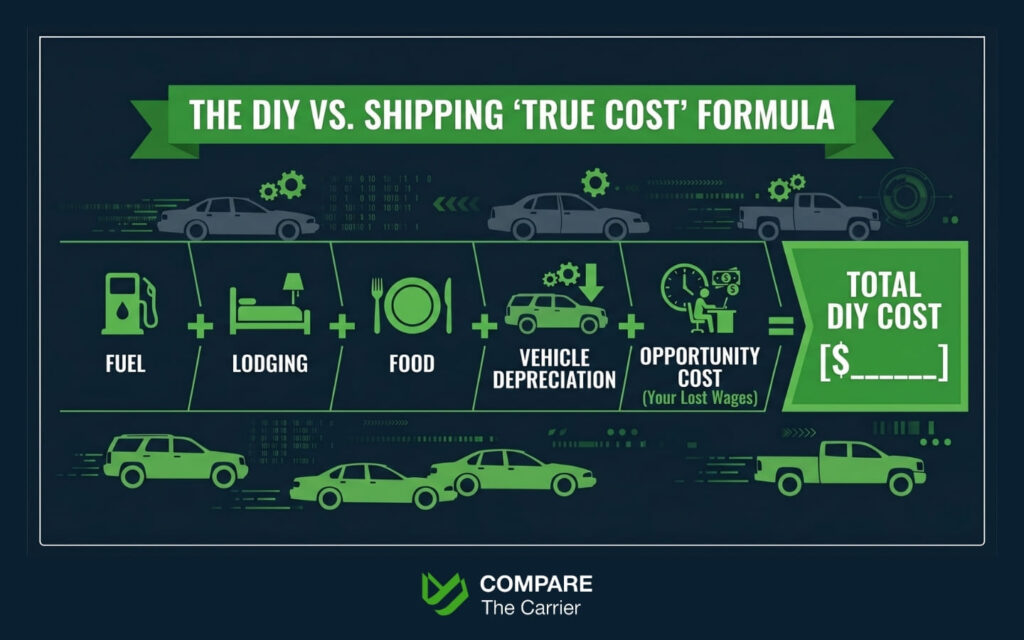
When calculating the DIY route, most people forget about depreciation and the “opportunity cost” of their own time. Here is the formula we use at Compare The Carrier:
Total DIY Cost = [Fuel] + [Lodging] + [Food] + [Vehicle Depreciation] + [Your Daily Income x Days] + [Return Logistics]
Let’s look at three common 2026 scenarios to see how the math actually plays out.
Example 1: The “Snowbird” Route (New York, NY to Miami, FL – 1,280 miles)
Example 2: The Cross-Country Trek (Los Angeles, CA to Austin, TX – 1,380 miles)
Example 3: The Midwest Move (Chicago, IL to Denver, CO – 1,000 miles)
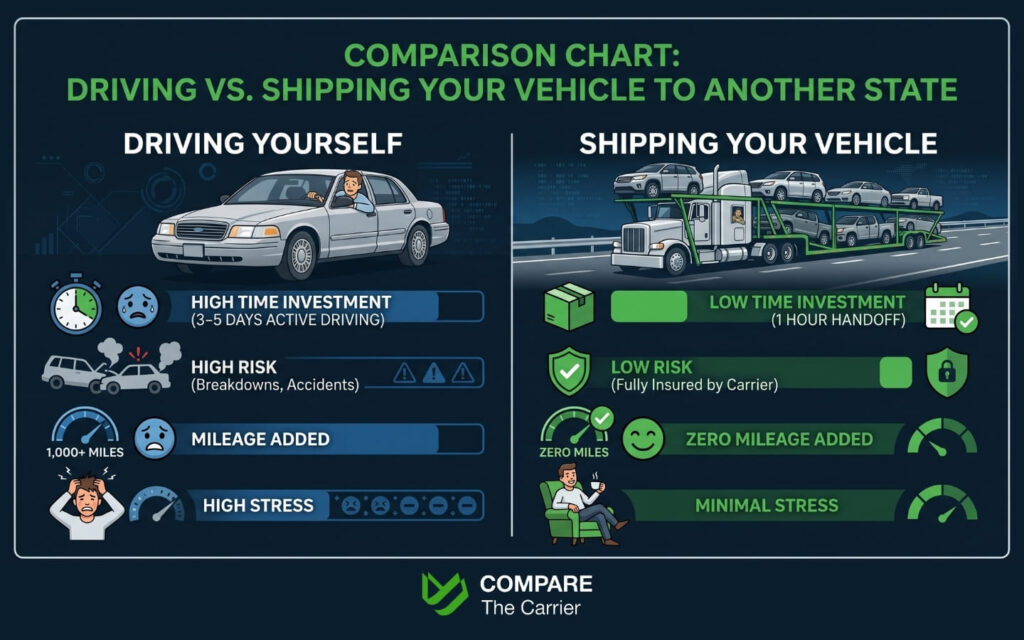
Beyond the dollar amount, there are risks that a shipping company absorbs so you don’t have to:
| Factor | Driving Yourself | Shipping (Open Carrier) |
| Out-of-Pocket Cost | $572–$944 | $750–$1,250 |
| Mileage Added | 1,000+ miles | Zero |
| Time Investment | 2–5 days of active driving | 1 hour (total for handoff) |
| Risk Factor | High (accidents, breakdowns) | Low (fully insured by carrier) |
| Stress Level | High | Minimal |
| Best For | Road trip enthusiasts | Professionals, families, and busy movers |
Want to see the exact cost for your route? Use our free auto transport calculator
The Verdict: If the move is over 800 miles, the cost difference is often negligible. When you factor in the value of your time and the 1,000+ miles of wear on your engine and tires, professional shipping is almost always the smarter financial move in 2026.
If you have decided that driving the car yourself isn’t the best use of your time or money, you have several professional and semi-professional options. We have ranked these from the most common/reliable to the most niche.
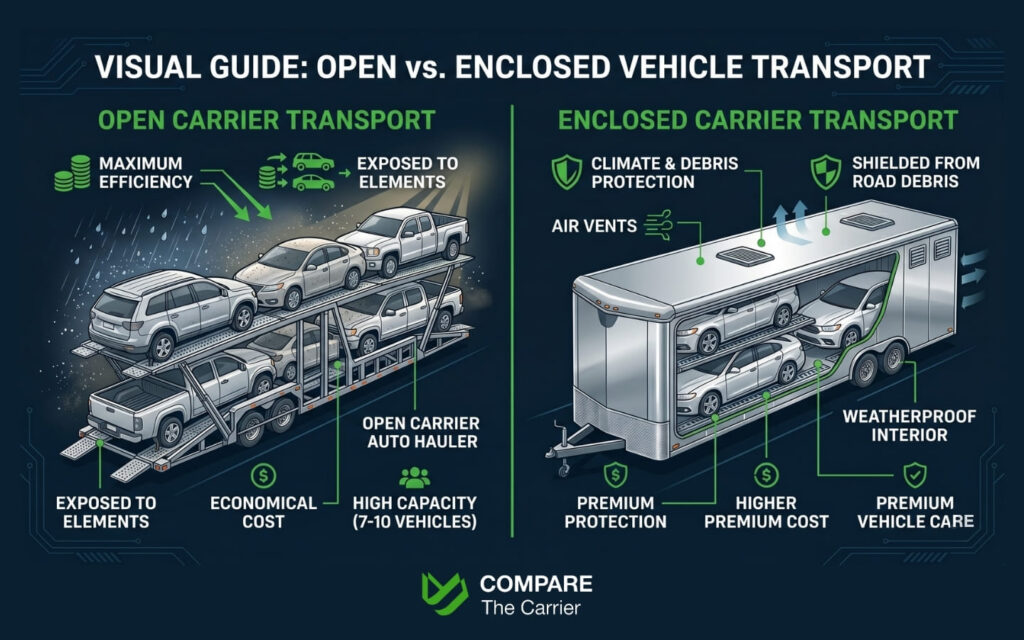
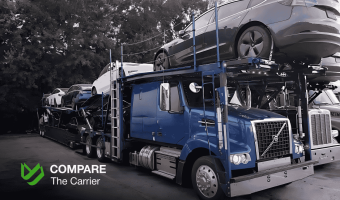
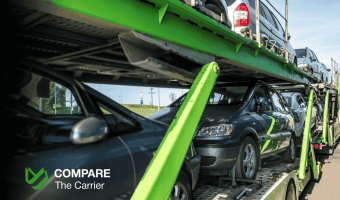
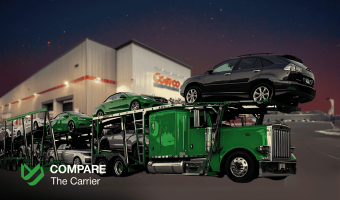
Open carrier transport is the backbone of the auto shipping industry. If you’ve ever seen a large double-decker trailer on the highway carrying 6 to 10 cars, you’ve seen an open carrier. This is the cheapest professional way to ship a car because the operational costs (fuel, tolls, driver salary) are split across multiple customers.
Your vehicle is loaded onto a specialized trailer. Depending on the route and the carrier, your car might be on the “top rack” (protected from some road debris but exposed to low-hanging branches) or the “bottom rack” (protected from trees but potentially exposed to fluid drips from the car above).
Get an instant quote for open carrier transport
When to Choose Open Carrier
Potential Drawbacks
If you have a vehicle with a tow hitch (like a truck or a large SUV) and you need to move a second car a relatively short distance, a tow dolly is the undisputed champion of the “dirt cheap” category. However, in 2026, many DIYers realize too late that “cheap” doesn’t always mean “easy” or “safe.”
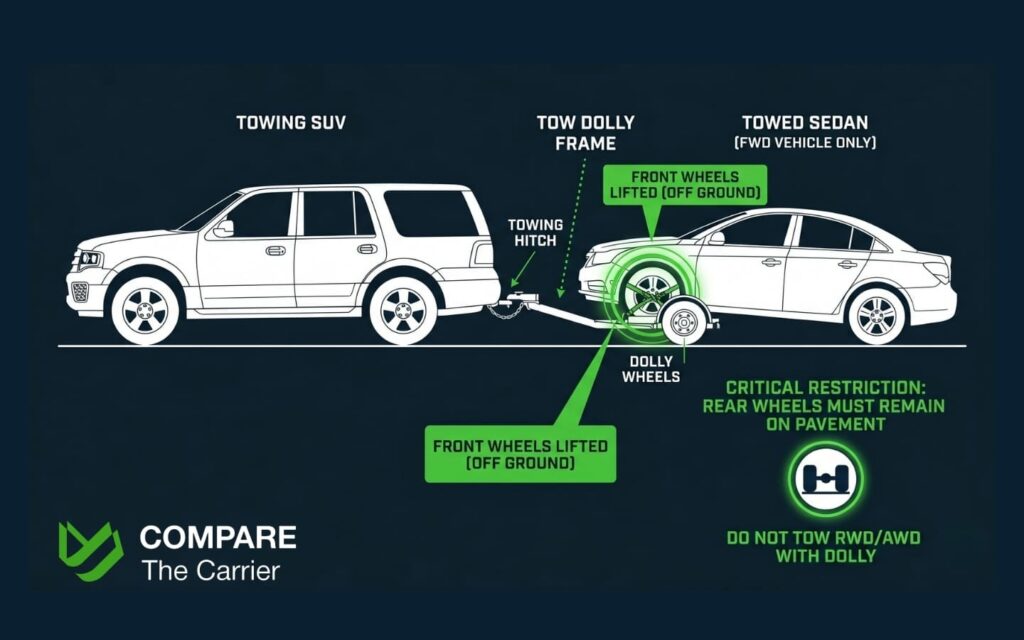
A tow dolly is a small, two-wheeled trailer that lifts the front wheels of your car off the ground while the rear wheels remain on the pavement.
Critical Restrictions (The “Fine Print”):
When to Choose:
In the past, terminal-to-terminal shipping was the go-to for budget travelers. In 2026, it has become a niche service, but for the right person, it offers a solid 10–15% discount over door-to-door open auto transport.
Instead of a carrier coming to your driveway, you drive your car to a central shipping hub (often located near major airports or industrial zones). On the other end, the car is dropped off at a similar hub, and you have a 24-to-48-hour window to pick it up.
Expert Tip:
Before booking, ask your broker for the exact address of the terminals. If the “nearest” terminal is 60 miles away, the gas and time spent getting there will completely negate the $100 you saved on the shipping quote.
A driveaway service is effectively “crowdsourced” car moving. You hire a company to find a professional or semi-professional driver to sit in your car and drive it to your destination.
The Driveaway “Math”:
When to Consider:
We mention enclosed auto transport primarily as a “what to avoid” for budget seekers. These trailers have hard or soft walls that shield vehicles from wind, rain, and road debris.
Budget Advice: Unless your car is worth more than $50,000 or has custom paint that cannot be easily repaired, stick to the open carrier. The “protection” of an enclosed trailer is rarely worth the $500+ price jump for a daily driver.
| Method | Best For | Average Cost (1,000 miles) | Vehicle Wear | Availability |
| Open Carrier | Everyone / Daily Drivers | $800–$1,200 | None | High |
| Tow Dolly | DIY / FWD / Under 300mi | $250 – $450 | Rear Wheels/Axle | High |
| Terminal | Major City to Major City | $750 – $1,000 | None | Medium |
| Driveaway | Speed / High-Mileage Cars | $300 – $700 | Odometer Increase | Low |
| Enclosed | Luxury / Classic Cars | $1,100–$1,600+ | None | Medium |
Not sure which method fits your situation? Calculate your shipping cost in 30 seconds
At Compare The Carrier, we see thousands of quotes daily. The people who pay the least aren’t just “lucky” – they follow a specific set of rules. Here is how to manipulate the market to your advantage in 2026.
The auto transport industry operates on a “load board” system, similar to an auction. When you post a request for cross-country car shipping, brokers put your order on a board where carriers “bid” on it.
Rigid dates are the enemy of a low quote. If you tell a broker, “My car must be picked up on Monday, June 12th,” they have to find a driver who is exactly in your area on that exact day.
Seasonality is the single most powerful factor affecting the cheapest way to ship a car.
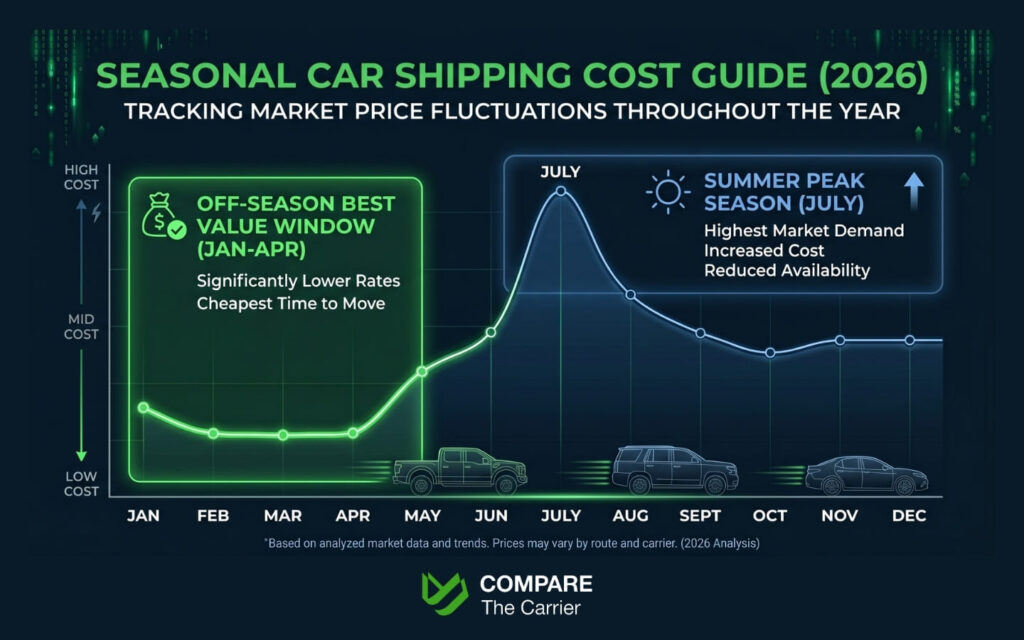
| Month | Estimated Cost (Sedan) | Demand Level |
| January | $780 | Low (Best Price) |
| March | $850 | Moderate |
| July | $1,150 | Peak (Highest Price) |
| October | $900 | Moderate |
| December | $1,050 | High (Snowbird Season) |
See current pricing for your route
Carriers are essentially “fuel-to-distance” mathematicians. Every mile they drive away from the interstate costs them time, diesel, and potential log-book hours.
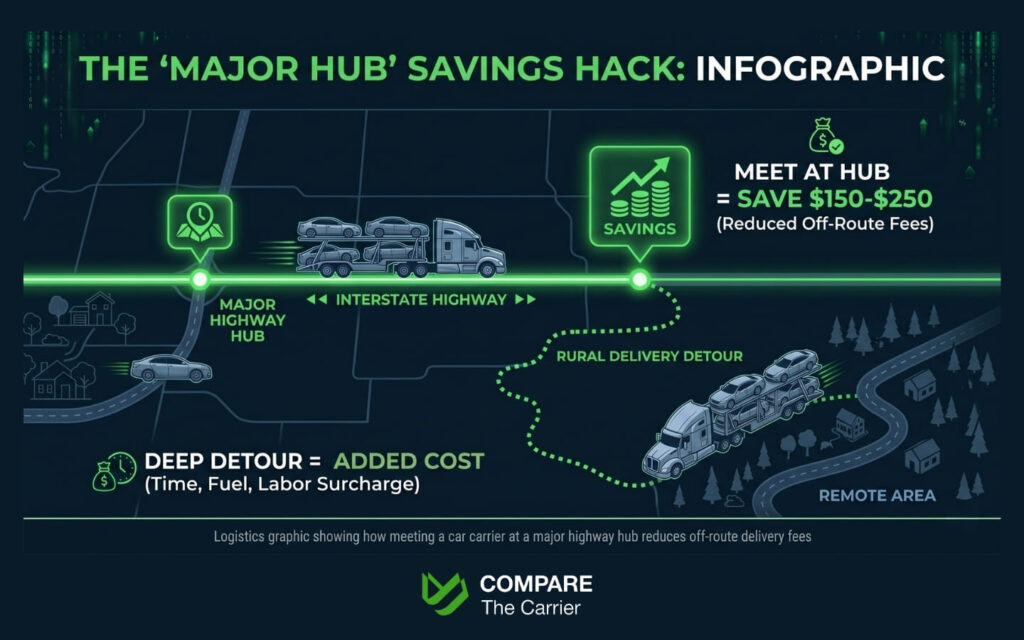
In the car shipping world, the cheapest quote is often the most expensive. This is the #1 pain point reported on Reddit.
As we discussed in the methods section, shifting your logistics from “Door-to-Door” to “Terminal-to-Terminal” is one of the most reliable ways to slash $50 to $150 off your bill. In 2026, this is particularly effective in massive transport hubs like Atlanta, Chicago, or Dallas.
If you have the luxury of time, scheduling your move during the “dead months” is the single most impactful financial decision you can make.
Understanding the “why” behind your quote allows you to identify where a company might be overcharging you. Here are the core variables that carriers use to calculate your rate in 2026.
It’s a common misconception that cost is purely linear based on mileage.
In 2026, fuel prices remain a major operational expense. A heavier car requires more diesel to transport.
Can the driver drive your car onto the trailer?
As we’ve established, open auto transport is the cheapest. Choosing enclosed auto transport is an elective “luxury” cost that adds 40–60% to your total.
In 2026, many carriers utilize a “Fuel Surcharge” model. If diesel prices spike in the week leading up to your move, your broker may notify you of a slight price adjustment. To avoid this, look for “Price Lock” guarantees from reputable brokers.
This is perhaps the most requested topic on Reddit, and the answers are often conflicting. Let’s look at the 2026 Industry Reality.
The Department of Transportation (DOT) and FMCSA strictly prohibit auto carriers from acting as “household goods movers.” Their license is for the vehicle, not its contents.
While the law is strict, the industry has a “gentleman’s agreement.” Most drivers will allow you to pack up to 100 lbs of personal items, provided they follow these 3 rules:
What NOT to pack:
Pro Tip:
If you absolutely must ship items in the car, use soft-sided duffel bags rather than heavy plastic bins or cardboard boxes. They are easier for the driver to work around and add less weight to the overall load.
The auto transport industry is unfortunately rife with “lead generators” – websites that look like shipping companies but simply sell your phone number to 50 different telemarketers. Here is how to verify a real company in 2026.
Every legitimate broker and carrier must have a Motor Carrier (MC) number.
Don’t rely on Google Reviews alone, as these are easily faked.
If you see these signs, run the other way:
Ready to book with a verified carrier? View our car shipping services
Let’s apply everything we’ve learned to four real-world 2026 moving scenarios.
Scenario 1: The “Starving Student” (Boston, MA → Los Angeles, CA)
Scenario 2: The Family Relocation (Chicago, IL → Houston, TX)
Scenario 3: The Short Distance DIY (Seattle, WA → Portland, OR)
Scenario 4: The Collector’s Dream (Miami, FL → Scottsdale, AZ)
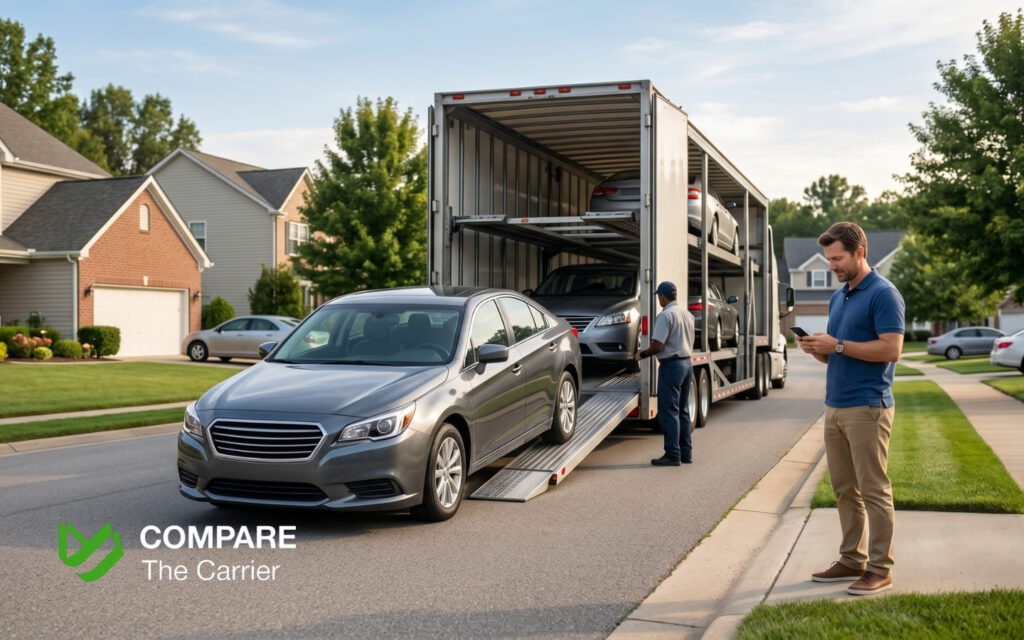
Finding the cheapest way to move a car to another state in 2026 doesn’t mean you have to settle for poor service or high-risk “lead generators.” It’s about being a strategic consumer. By choosing an open carrier, staying flexible with your dates, and verifying your broker’s MC#, you can secure a professional move at a DIY price point.
Remember: the goal isn’t just to find the lowest number – it’s to find the lowest number that actually results in a car being picked up on time and delivered safely.
Use our vehicle shipping calculator to get an exact quote for your route
Or, if you’re still weighing your options, check out our state-to-state car towing guide for more logistical insights.
The cheapest professional option is open carrier transport, especially when booked 2–3 weeks in advance during off-season months (January–February) with a flexible 5–7 day pickup window. For FWD vehicles under 300 miles, a tow dolly rental ($45–$80/day) is the cheapest DIY alternative. Combining terminal-to-terminal delivery with open carrier saves an additional $50–$150 on most routes.
In 2026, open carrier transport for a standard sedan on a 1,000-mile route costs $800–$1,200. The exact price depends on vehicle size, current diesel prices, route popularity, and season. SUVs and pickup trucks run 15–25% higher. Booking during January-April and choosing a flexible pickup window can bring the cost closer to the lower end of that range.
For moves under 500 miles, driving is often cheaper. For 800+ miles, the gap closes quickly once you add fuel ($3.20–$3.50/gal average in 2026), one or two hotel nights ($150–$160 each), meals, and approximately $0.20/mile in physical wear on your vehicle. For moves over 1,000 miles, professional open carrier shipping is typically the smarter financial decision.
Transit times depend on distance. Under 500 miles: 1–3 days. Between 500 and 1,500 miles: 3–7 days. Over 1,500 miles: 7–14 days. Carriers provide a 1–3 day delivery window rather than an exact date. Expedited dedicated transport completes any route in 2–5 days but costs 30–50% more than standard open carrier rates.
FMCSA regulations prohibit carriers from transporting personal belongings – their license covers the vehicle only. In practice, most carriers allow up to 100 lbs of personal items in the trunk, below the window line. However, these items are not covered by cargo insurance and are shipped entirely at your own risk. Never pack valuables, electronics, cash, or flammable items.
The ideal window is 14–21 days before your desired pickup date. Booking within this range gives carriers enough time to plan your order into their routes, which increases competition and lowers your price by $100–$200 compared to last-minute bookings. Booking more than 6–8 weeks out provides no additional savings, as most carriers only plan routes 2–3 weeks ahead.
Terminal-to-terminal shipping means you drop your vehicle off at a central transport hub and pick it up at a hub near your destination, rather than door-to-door service. This typically saves $50–$150 because it eliminates the carrier’s “last-mile” navigation through residential streets. The main drawbacks are potential storage fees ($35–$75/day if you’re late) and the need to arrange your own transportation to and from the terminal.
January and February are consistently the cheapest months, with prices at or below base rate due to low post-holiday demand. March and April are also reasonable. Prices rise 10–20% from May through August (summer peak), then spike another 15–30% from September through December due to snowbird season. If your schedule is flexible, shipping in January versus July can save $300–$400 on the same route.
Open carriers haul 6–10 vehicles on an exposed double-deck trailer and are used for approximately 95% of all shipments. Cost: $0.60–$1.10 per mile. Enclosed carriers hold 2–6 vehicles inside a covered trailer, protecting them from weather and road debris. Cost: $1.00–$2.00 per mile – roughly 40–60% more. Choose enclosed only for vehicles valued over $50,000, classic cars, or custom paint that cannot be easily repaired.
All FMCSA-licensed carriers are required to carry cargo insurance, typically $100,000–$250,000 per load, which covers damage caused during transport. Your personal auto insurance policy generally does not cover shipping damage – confirm this with your provider before booking. For high-value vehicles, ask the carrier for a declared-value supplement. Always request a Certificate of Insurance (COI) from the carrier before confirming your shipment.







Don't have time to fill out the form?
Call a transport company directly to get a quote now!
Select the category you need
Partner with Compare The Carrier & Grow!
We're open to collaborations, partnerships, and mutual growth! Whether you're an individual or a business, we offer exciting opportunities to work together. Fill out the form below to explore how we can collaborate.
Something Went Wrong
We're sorry, but something went wrong. Please briefly describe the problem you experienced in the text area below. Providing your contact information will allow us to follow up if needed.

Thank you,
your form has been accepted.
Your form has been successfully submitted. We appreciate your effort — our team will review it shortly and take the next steps.


