Texas Auto Transport – Get Free Shipping Quotes
- Free Quotes – No Sign-Up Needed
- Compare Rates, Save Up to 30%
- Compare 100+ Vetted Providers

Choosing the Right Car Shipping Company for Texas Auto Transport
Texas moves high volume on I-10, I-35, and I-45 year-round, but seasonal demand spikes around snowbird season and summer relocations can leave customers stuck in quote limbo with no confirmed pickup date. Compare The Carrier's vetted network of 100+ pre-screened transport companies includes partners with active runs on Texas corridors, so your shipment gets matched fast – not left waiting on a board.



Prior Route Experience
I-10 through West Texas runs nearly 900 miles of open highway with extreme summer heat that can exceed 110°F, while I-35 through Dallas and San Antonio stacks some of the heaviest commercial traffic in the country. A transport company without active runs on these corridors will underestimate transit time, miss fuel stop planning, and get caught in Austin or DFW metro congestion during peak hours. That costs days. A company with live Texas dispatch knows which staging yards to use, where weigh stations cluster along I-20, and how to route around construction delays on the I-35 corridor. They also know when to avoid I-10 east of Houston during hurricane season. Compare The Carrier matches every customer with network partners who have documented, active runs on the specific Texas route requested – not companies guessing at a lane they rarely touch.
Customer Reviews and Ratings
Picture this: a transport truck breaks down outside San Antonio on a long-haul run from the Northeast. The vehicle is sitting. The customer has a flight booked. What happens next tells you everything about the company handling the load. A reliable transport company calls the customer within the hour, contacts a backup dispatch partner, and reroutes the vehicle with a revised delivery window. A poor operator goes silent for 36 hours. When reading reviews for Texas interstate hauls, look past star counts. Look for mentions of communication during delays, how the company handled damage claims, and whether the final delivery matched the quoted window. One-line five-star reviews mean little. Detailed accounts of problem resolution mean everything. Every transport company in Compare The Carrier's network is pre-screened for this track record before they are listed – so customers are matched with partners who have already proven they handle disruptions professionally.
Pricing Transparency and Fairness
A transport company on a load board will skip a job priced below market rate every time a better-paying run appears on the same board. That is not bad faith – it is basic dispatch economics. On Texas routes, high-volume corridors like I-35 between Dallas and San Antonio or I-10 between Houston and El Paso generate strong competition for loads, which keeps rates competitive. But thinner routes – say, a pickup in the Panhandle or a delivery to a rural East Texas zip – can push rates higher due to deadhead miles back to a major hub. Open transport on most Texas routes runs $900-$1,200 for a standard sedan, depending on distance, season, and current fuel costs. To protect against a price adjustment at pickup, get your rate confirmed in writing before dispatch is assigned, and verify the quote includes fuel surcharges. Never hand over a vehicle on a verbal-only agreement. Use our calculator above for a real-time quote.
Say Goodbye to Car Shipping Stress with Compare The Carrier
Compare The Carrier matches customers with transport companies from our vetted network of 100+ pre-screened providers, all evaluated for reliability on Texas routes. With I-35 corridor congestion and summer demand spikes pushing pickup windows out by days, working with pre-screened network partners – not unknown operators – keeps your shipment on schedule from day one.

Say No to Hidden Fees

Save Time and Effort

Access Verified & Trusted Carriers

Wide Range of Options
How It Works
Your Simple 3-Step Vehicle Shipping Process

Get Your Free Texas Quotes in Seconds
Enter your origin and destination zip codes plus your vehicle details, and the calculator returns real-time rates in seconds. Quotes factor in current fuel costs, route distance, and applicable tolls for your specific Texas corridor. No waiting on callbacks, no ballpark estimates. You get accurate numbers based on live market conditions so you can make a real decision fast.

We Send Your Request to the Texas Top-Rated Carriers
Compare The Carrier selects from a network of 100+ vetted, FMCSA-licensed transport companies with active runs on Texas routes – not a mass blast to unknown operators. Partners familiar with I-10, I-35, and the SH-130 toll corridor know staging points, weigh station locations, and metro congestion windows. That lane knowledge is part of the match criteria, not an afterthought. This is active selection, not passive listing.

Compare Offers, Choose Your Carrier & Save!
When comparing quotes, weigh price against transit time for your specific Texas route. A rate that looks low may reflect a company with no active run scheduled for your lane, meaning pickup slips by days. Fuel price swings and seasonal demand – especially during summer relocation peaks – can push rates up quickly. Locking in your rate early protects you from that shift. Use our calculator above for a real-time quote.
Average Texas Shipping Rates & Delivery Time
Shipping Distance
Transit time
| Origin | Destination | Average cost | Cost per mile |
|---|---|---|---|
| Houston, TX | Los Angeles, CA | $763 | $0.40 |
| San Antonio, TX | Jacksonville, FL | $613 | $0.49 |
| Dallas, TX | New York City, NY | $763 | $0.40 |
| Austin, TX | Philadelphia, PA | $794 | $0.40 |
| Chicago, IL | Fort Worth, TX | $616 | $0.49 |
| Columbus, OH | El Paso, TX | $786 | $0.40 |
| Atlanta, GA | Arlington, TX | $599 | $0.52 |
| Charlotte, NC | Corpus Christi, TX | $750 | $0.49 |
Origin
Houston, TX
Destination
Los Angeles, CA
Average cost
$763
Cost per mile
$0.40
Origin
San Antonio, TX
Destination
Jacksonville, FL
Average cost
$613
Cost per mile
$0.49
Origin
Dallas, TX
Destination
New York City, NY
Average cost
$763
Cost per mile
$0.40
Origin
Austin, TX
Destination
Philadelphia, PA
Average cost
$794
Cost per mile
$0.40
Origin
Chicago, IL
Destination
Fort Worth, TX
Average cost
$616
Cost per mile
$0.49
Origin
Columbus, OH
Destination
El Paso, TX
Average cost
$786
Cost per mile
$0.40
Origin
Atlanta, GA
Destination
Arlington, TX
Average cost
$599
Cost per mile
$0.52
Origin
Charlotte, NC
Destination
Corpus Christi, TX
Average cost
$750
Cost per mile
$0.49
*Shipping costs are estimated and based on national shipping averages, which are subject to change. For the most accurate quote, please use our calculator.
| Mileage | Average transit time | |||
|---|---|---|---|---|
| 0 - 799 Miles | 1 - 4 Days | |||
| 800 - 1499 Miles | 4 - 7 Days | |||
| 1500 - 2399 Miles | 6 - 10 Days | |||
| 2400 Miles and Up | 10 - 15 Days |
Mileage
0 - 799 Miles
Average transit time
1 - 4 Days
Mileage
800 - 1499 Miles
Average transit time
4 - 7 Days
Mileage
1500 - 2399 Miles
Average transit time
6 - 10 Days
Mileage
2400 Miles and Up
Average transit time
10 - 15 Days
*Transit times are estimated and based on national shipping averages, which are subject to change.


Ready To Ship Your Vehicle to or from Texas?
Looking for reliable Texas car shipping? We’ve got you covered with trusted carriers and competitive quotes.
Texas car Shipping routes
Select a route below for more information about shipping along that route:
 Shipping to Texas
Shipping from Texas
Shipping to Texas
Shipping from Texas

Ship a Car to Texas with Compare The Carrier
Average Cost: $900-$1,200 for open transport on most Texas routes. Estimated Delivery Time: typically 3-14 days depending on pickup location. Best Shipping Method: open transport for standard vehicles; enclosed for high-value, classic, or modified vehicles.
Texas is the second-largest state by area, and that geography shapes every shipment. I-10 runs nearly 880 miles across the state from El Paso to the Louisiana border, while I-35 splits into two major corridors through Dallas-Fort Worth and San Antonio before merging near Laredo. Transport companies running loads into Houston deal with some of the most congested urban freight traffic in the country, particularly around the I-610 loop and I-45 south. Shipments into West Texas or the Panhandle face long deadhead miles back to a major hub, which pushes rates higher on those legs. To offset this, book early and confirm your rate includes fuel surcharges in writing before dispatch is assigned.
Seasonal demand hits Texas hard twice a year. Snowbird migration from the Midwest and Northeast into South Texas and the Rio Grande Valley peaks between October and December, filling southbound loads fast and compressing pickup windows. Summer relocation season driven by military PCS orders at Fort Cavazos, Joint Base San Antonio, and Dyess Air Force Base creates a second demand surge. During these windows, transport companies with active Texas runs get their loads picked up first. Compare The Carrier matches customers with network partners who have confirmed dispatch activity on the requested corridor, not companies that will sit on a load waiting for a better-paying run to fill the truck.
Port access at Houston and Galveston adds another layer for vehicle imports and exports, but for domestic shipments the bigger factor is metro hub proximity. Dallas, Houston, San Antonio, and Austin all serve as staging points for multi-vehicle loads. A shipment to a rural zip code outside these hubs may require a short drive to a terminal or an agreed meeting point where the transport truck can safely maneuver. This is standard practice and does not affect the quoted rate. The Bill of Lading inspection at pickup documents your vehicle's condition before it moves, giving you a clear record if any damage is claimed on delivery.
Advantages of Shipping with Compare The Carrier for Texas Auto Transport
Why pay to ship when you could just drive the car yourself? Run the numbers first. A 1,500-mile drive to Texas burns roughly 50-60 gallons of fuel at current prices – that is $175-$240 at the pump alone. Add one or two motel stops at $100-$150 per night, meals, and the wear on your vehicle: tires, oil, brakes, and highway miles that reduce resale value. On a trip over 1,000 miles, driving often costs more than open transport once you account for all of it – and that is before factoring in your time.
For a job relocation, every day spent driving is a day not working or settling into the new city. For a military PCS move to Fort Cavazos or Joint Base San Antonio, the timeline is fixed and the logistics are already stacked. Shipping the vehicle frees you to fly, handle housing paperwork, and report on time. For snowbirds making a seasonal move from the Midwest to South Texas, shipping both vehicles means neither driver takes a solo long-haul trip twice a year. In each of these scenarios, the practical case for shipping over driving is straightforward: lower total cost, less physical wear, and time back in your hands.
Before your vehicle is loaded, the driver completes a Bill of Lading inspection with you present. Every existing scratch, dent, and chip gets documented on the form. Both parties sign it. At delivery, inspect the vehicle against that same record before signing off. If damage appears that was not on the original BOL, you have a signed record to support a claim against the company's cargo insurance. Without a signed BOL at pickup, that recourse disappears. Do not sign a blank or incomplete form.
Car Shipping Services
Simplify your Texas car transport with Compare The Carrier. We connect customers with vetted transport companies from our network of 100+ pre-screened providers, matched specifically for your Texas route, vehicle type, and timeline.
Open and Enclosed Car Shipping
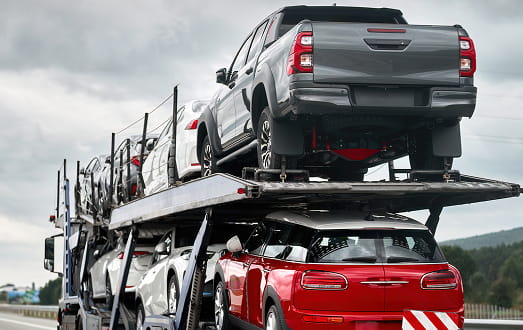
Open transport is the standard method for the vast majority of Texas shipments and the right call for most daily drivers. Vehicles load onto a multi-car open trailer – the same method dealers use to move new inventory. It is widely available across Texas corridors, cost-effective, and reliable. Most sedans ship in the $900-$1,200 range on this route. If you are moving a commuter car, a family SUV, or a standard pickup, open transport is the practical choice.
Enclosed shipping uses a fully enclosed hard-sided trailer that blocks road debris, weather, and UV exposure throughout transit. It typically runs $300-$500 more than open on the same route. That premium is worth it for high-value vehicles, classics, exotics, or modified builds where any paint or body damage matters financially. If your vehicle's condition directly affects its value or is irreplaceable, enclosed is the right call. Compare The Carrier matches customers with network partners who offer both options on active Texas runs.

Door-to-Door and Terminal-to-Terminal Car Delivery
Door-to-door service picks up and delivers directly to the addresses you provide. If an 80-foot transport truck cannot safely access a tight residential street or a low-clearance neighborhood in Texas, the driver contacts you to agree on a nearby open meeting point – a wide parking lot or shopping center entrance works fine. This is standard practice across the industry and does not change the quoted price. At pickup, the driver completes a Bill of Lading inspection documenting your vehicle's condition before it moves.
Terminal-to-terminal shipping saves $100-$200 compared to door-to-door. You drop the vehicle at a designated lot near your origin and collect it at a terminal near your Texas destination. This option works best for customers with flexible schedules who are not on a tight delivery window and want to reduce the base shipping cost. Storage time at the terminal is limited, so confirm the pickup window before booking. Compare The Carrier matches customers with network partners offering both delivery options on Texas routes.

Expedited Car Shipping
On standard dispatch, your load competes with every other vehicle on the board. If the rate is tight or the route runs into a deadhead zone – common on thinner Texas corridors outside the major metro hubs –pickup can slip by several days while the transport company waits for a better-paying run to fill the truck. Expedited shipping eliminates that wait. Your vehicle gets first-on, first-off priority loading, bypassing the typical 1-5 day pickup window and moving to the front of the dispatch queue.
Expedited service runs $200-$400 more than standard on most Texas routes. The reason is mechanical: a higher rate makes your load the most attractive option on the dispatch board. Transport companies in our network prioritize it over competing runs on the same I-10, I-35, or I-45 corridor because the economics favor it. If you have a fixed move date, a job start deadline, or a military report date, that premium buys you a confirmed pickup window instead of a best-guess estimate. Use our calculator above for a real-time quote.
Ready to Get Your Free Car Shipping Quotes?
Stop searching for reliable auto transport! Compare top car shipping companies and save on your vehicle transport costs. Get your free, no-obligation car hauling quotes now!
Shipping Across The Entire USA
Select needed state below for more information and carrier availability in that area
Alabama Shipping Services
Carrier Availability
4/5
Average Pickup Time
3-5 days
FAQ
How much does it cost to ship a car to or from Texas?
Rates on Texas routes shift with fuel surcharges, seasonal demand spikes during snowbird migration and summer PCS moves, and route volume. High-traffic corridors like I-35 and I-10 keep rates competitive, while rural or Panhandle pickups run higher due to deadhead miles. Open transport on most Texas routes runs $900-$1,200 for a standard sedan. Enclosed adds $300-$500. Use our calculator above for a real-time quote.
How long does it take to ship a car to or from Texas?
Transit time depends on route distance and DOT driving hour limits, which cap drivers at roughly 500 miles per day. Estimate typically 3-14 days depending on pickup location and season. Texas-specific factor: snowbird season between October and December fills southbound loads fast, compressing pickup availability and adding 1-3 days to standard windows on South Texas routes. Book early during peak periods.
Is my car insured when it is being shipped to or from Texas?
The transport company's cargo insurance covers your vehicle during transit. Before booking, request the company's certificate of insurance, confirm the coverage limit matches your vehicle's value, and check whether your personal auto policy provides any supplemental coverage during transport. Do not assume coverage – verify it in writing. Gaps in coverage are most common with smaller operators who carry minimum FMCSA-required limits.
Can I put personal belongings in my car when shipping it to Texas?
DOT weight scale rules impose a strict 100 lb limit on personal items left inside a vehicle during transport. Exceeding that limit can delay pickup at a weigh station and, more critically, void the transport company's liability coverage for the vehicle itself. Keep the trunk light, remove valuables entirely, and do not pack items in the passenger cabin where they can shift and cause interior damage.
Is it better to use a quote-matching platform or book directly with a single company for Texas auto transport?
Booking a single transport company directly means you are limited to their scheduled runs. If they have no active load heading to your Texas destination for two weeks, your pickup waits. Compare The Carrier's network of 100+ pre-screened transport companies gives you access to multiple active Texas runs at once. The practical result: faster pickup, competitive rates, and companies already vetted for reliability on this specific lane.
How does pickup and delivery actually work when shipping a car to Texas?
An 80-foot transport truck cannot always access tight residential streets or low-clearance neighborhoods in Texas. The standard solution: the driver contacts you to agree on a nearby open lot – a shopping center or wide parking area works well. This is routine, costs nothing extra, and does not change your quoted price. The Bill of Lading inspection happens on the spot at the agreed location, documenting the vehicle's pre-transit condition. At delivery, inspect the vehicle against that same record before signing off.
What is the most reliable way to ship a car to or from Texas?
Compare The Carrier is an active quote-matching platform that connects customers with vetted, FMCSA-licensed transport companies from a network of 100+ pre-screened partners. Unlike booking a single company directly – where you depend on their schedule – or using a standard broker that blasts requests to unknown operators, Compare The Carrier matches you with companies that have active runs on your specific Texas route. Get a free quote using the calculator above.
23 May 2024
12 min video

Think you can’t afford your dream car? Think again. We’re spilling the beans on how to buy cars at auction, even if it’s your first time at the auction block.
14 August 2024
15 min read

Does looking for your next car leave you feeling like you’re in the dark? Carfax’s vehicle history reports can help…but can Carfax deliver car straight to your door?
05 April 2024
15 min read

Buying a car at the Manheim auction is a great solution for anyone who wants to buy a good car at an affordable price, while spending a minimum of nerves and time. Having bought a sedan or wagon, expensive or cheap, with a large engine capacity or a small engine capacity, the question arises: “Who to entrust the delivery of the car?” After all, many cars, despite the fact that they are in better condition than cars that are purchased at other auctions, still cannot be driven by the new owner on their own and require repair.
06 January 2023
15 min read