

Car Shipping from Florida to Puerto Rico – Costs, Ports & Timelines [2026]
Shipping a car from Florida to Puerto Rico typically cost...
16 July 2026
Moving to Puerto Rico from the mainland does not require a passport, a visa, or customs clearance – Puerto Rico is U.S. territory, and any U.S. citizen can relocate there the same way they would move between two states.
Calculate Shipping Quotes
What catches most newcomers off guard isn’t the paperwork of entry – it’s four decisions that quietly determine how the first 90 days go. Do you formally establish residency, or just live there informally? Do you ship your car or replace it locally? Are utilities and banking sorted before you land, or scrambled together after? And does your health coverage actually follow you, or does it stop at the water? This checklist walks through each of those decisions in order, including the one cost almost every relocation guide glosses over – the excise tax charged on any vehicle brought in from the mainland. If you already know you’re bringing your car, you can get a free vehicle shipping quote now and come back to the rest of the checklist.
Puerto Rico residency is a formal legal status, not just a mailing address. Getting it right affects your voter registration, your state tax obligations back on the mainland, and – if it applies to you – eligibility for the island’s tax incentive programs.
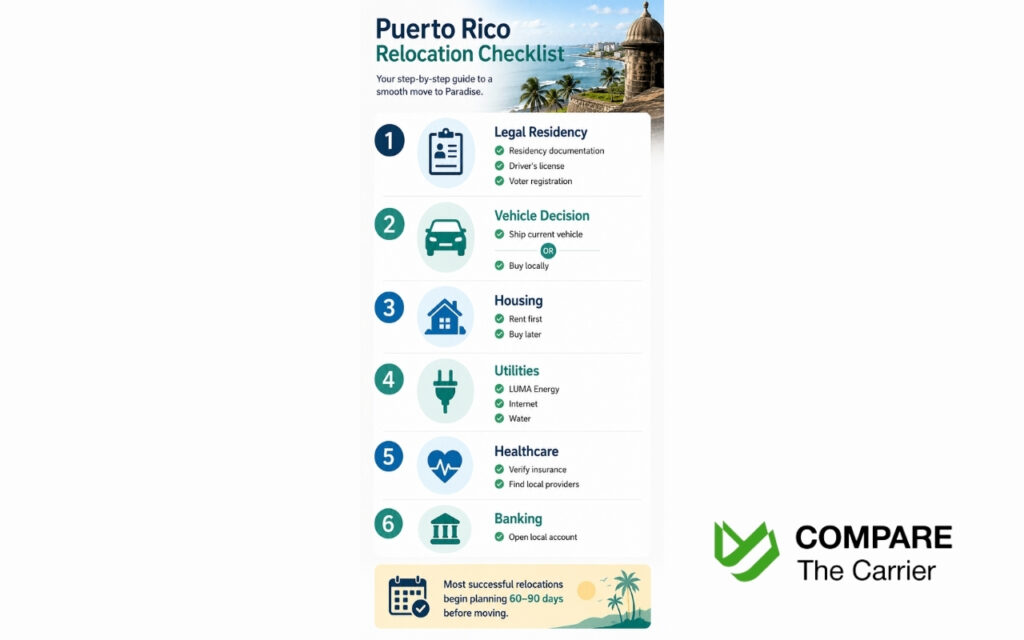
To be treated as a bona fide Puerto Rico resident, you generally need to spend at least 183 days a year on the island, hold your closest connections there (home, driver’s license, voter registration, primary bank accounts), and formally document the change with your mainland state. Several states, particularly high-tax ones, will ask for a declaration of non-domicile or a similar filing to cleanly close out state tax residency. People relocating to Puerto Rico from California or New York tend to face more scrutiny on this point than someone moving from Florida to Puerto Rico, where there is no state income tax to unwind in the first place.
Puerto Rico residents do not vote in mainland presidential elections and are represented in Congress by a non-voting Resident Commissioner. Local elections are a different matter, and registration is handled through the island’s State Elections Commission. If you register locally, you will need to cancel your mainland voter registration, which most states require before you can establish residency elsewhere.
This is the question behind most searches about moving to Puerto Rico taxes, and the short answer has a long footnote. Bona fide residents generally do not owe federal income tax on income sourced within Puerto Rico, but they still owe federal tax on mainland-sourced income, still pay Social Security and Medicare, and still file a territorial return with Hacienda. Federal employees and members of the military are treated differently again. The IRS guidance for individuals with income from U.S. territories is the authoritative reference here, and it is worth reading before you assume the move is a clean tax reset.
If your relocation to Puerto Rico is tied to the Act 60 incentive program (successor to the former Acts 20 and 22), the paperwork has to happen before you move, not after. That means securing your tax exemption decree through the Department of Economic Development and Commerce, obtaining a criminal background check from your current state, and – for the individual resident incentive specifically – purchasing residential property on the island within two years of receiving the decree. Requirements and thresholds are revised periodically, so confirm current terms with a Puerto Rico-licensed tax attorney or CPA rather than relying on an older guide.
Most people underestimate an island move because they price it like an interstate one. The distance is comparable to a long domestic haul, but the ocean leg changes the cost structure. Instead of one moving company invoice, you end up with several separate bills arriving at different times, and a couple of them are payable to the government rather than to a vendor.
The moving expenses worth building into a Puerto Rico budget usually break down like this:
The two variables that move the total most are the value of the vehicle you bring and how much of your household you decide to ship. A relocation with one mid-value car and a shared container looks very different from one with two higher-value vehicles and a full container of furniture. Before you can budget the first of those, you need to know what shipping actually costs on this route – you can compare quotes from carriers running the Puerto Rico lane and work backward from a real number.
This is the most expensive single decision in the move, and it is rarely explained clearly. Moving your vehicle keeps a car you already know and trust, but importing a vehicle triggers a government tax that has nothing to do with your transport company’s invoice.
Because Puerto Rico is a U.S. territory, cargo moving between the mainland and the island by sea – personal vehicles included – must travel on U.S.-built, U.S.-flagged, U.S.-crewed vessels under the Merchant Marine Act of 1920, better known as the Jones Act. That is why you cannot simply book a foreign container line the way you might for an international relocation. Your car moves through a small set of Jones Act-compliant carriers, usually sailing from ports in Florida, New Jersey, or Texas and arriving at the Port of San Juan. A licensed vehicle transport comparison platform can confirm which partner carriers currently run the route and how their transit windows compare before you lock in a date.

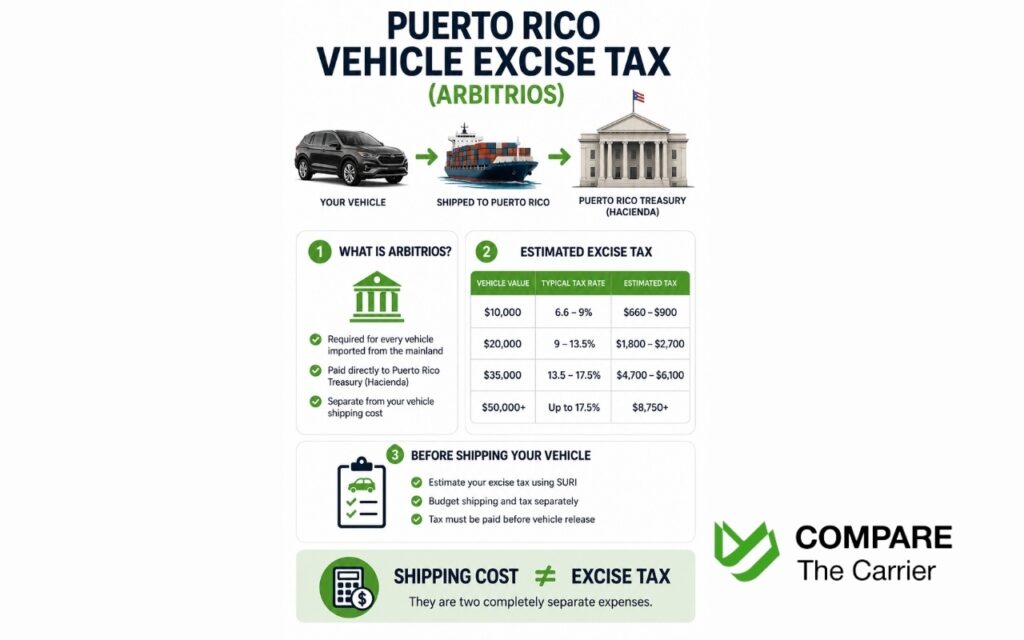
Every vehicle imported from the mainland – new, used, or one you have driven for a decade – is subject to Puerto Rico’s excise tax, known locally as arbitrios. It is a territorial tax rather than a customs duty, paid directly to Puerto Rico’s Treasury Department (Hacienda) and completely separate from your auto shipping bill. Assessment is based on the vehicle’s value, generally the purchase price plus transport and insurance, using a tiered rate structure that runs from roughly 6.6% at the low end to 17.5% for higher-value cars. There is no blanket exemption for electric or hybrid vehicles.
A rough sense of what that looks like in dollars:
| Assessed vehicle value | Typical excise tax range | Approx. tax owed |
|---|---|---|
| $10,000 | 6.6% – 9% | $660 – $900 |
| $20,000 | 9% – 13.5% | $1,800 – $2,700 |
| $35,000 | 13.5% – 17.5% | $4,700 – $6,100 |
| $50,000+ | up to 17.5% | $8,750+ |
These figures are illustrative. Rate tiers and thresholds are set by the Treasury Department and do change, so run your specific VIN through the official SURI excise tax calculator for a binding estimate. The tax is not payable in advance – it is assessed once the bill of lading is issued at the port, and you generally need to be ready to pay before your car is released.
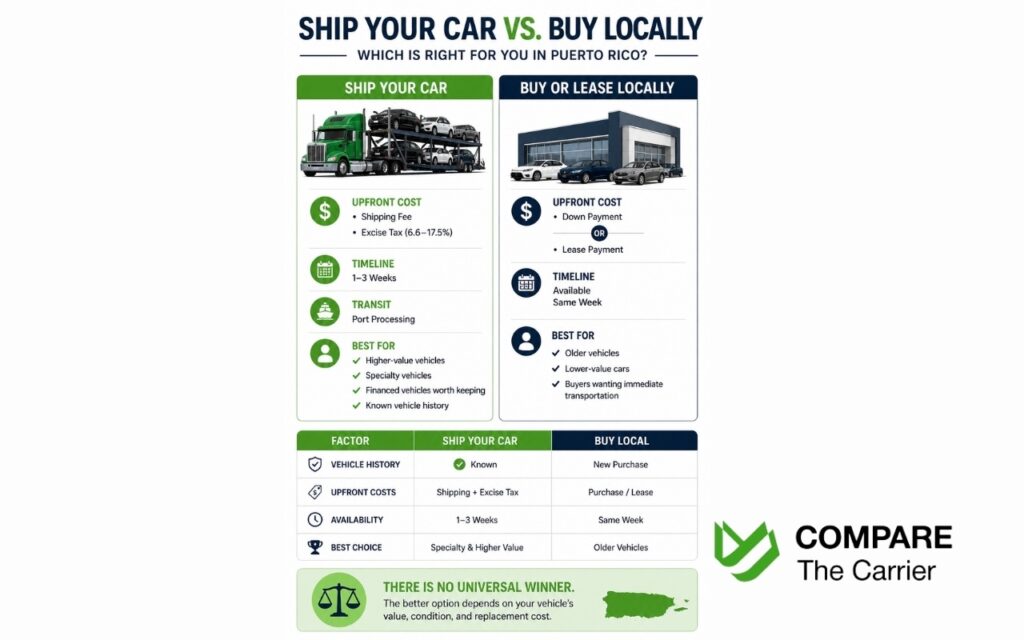
For a mid-value car, transport plus excise tax often lands in the same range as buying or leasing something comparable on the island. That is exactly why so many people rent short-term on arrival and decide once they have real figures in front of them. Shipping tends to win when you own the car outright, when it holds resale or sentimental value, or when it is a specialty vehicle that would be expensive to replace. Buying locally tends to win when your current car is older and low in value, or when you would need meaningful modifications for island driving anyway.
| Factor | Ship your car | Buy or lease locally |
|---|---|---|
| Upfront cost | Transport fee + excise tax (6.6–17.5% of value) | Down payment or lease payment |
| Timeline | 1–3 weeks at sea plus port processing | Available same week |
| Vehicle condition | Known history, already yours | New negotiation, local market pricing |
| Best for | Higher-value, specialty, or financed vehicles worth keeping | Older or low-value vehicles |
Puerto Rico’s equivalent of the DMV is DTOP (Departamento de Transportación y Obras Públicas). Once your car clears the port and the excise tax is paid through SURI, you have a narrow window – commonly cited as three days – to register with local plates before mainland plates stop being valid on the road. Registration requires your original title, the bill of lading from the transport company, proof of excise tax payment, and a passed safety inspection. If the vehicle is financed or leased, call your lender before it ships; most require written authorization to move a financed car to a new jurisdiction, and the port is a bad place to learn that.

Household belongings travel separately from your car, usually through container freight rather than a traditional mainland moving company. Full and shared containers both exist. A shared container costs less but takes longer, since the carrier waits to consolidate loads before sailing. Given the extra handling an ocean leg involves, it is worth understanding how moving insurance works before your container leaves.
Because this is domestic U.S. territory, you are not filing customs paperwork the way an international move would require, but agricultural and biosecurity rules still apply. Live plants, soil, and most produce are restricted to protect local agriculture. Firearms need separate advance permitting. Anything hazardous should be cleared with your mover well before packing day.
Almost every relocation advisor gives the same advice: rent for the first several months rather than buying sight-unseen. Commute patterns, flood zones, hurricane exposure, and neighborhood character vary sharply between municipalities, and a short-term lease buys you the time to get that right before signing a mortgage. If your move is tied to Act 60’s individual resident incentive, the two-year property purchase clock runs from the date of your decree rather than your move-in date, so renting first does not put the deadline at risk as long as you buy inside the window.
Electric service is handled by LUMA Energy, and setup routinely takes longer than a mainland utility hookup, particularly outside the San Juan metro area. Start the application as soon as you have a confirmed address instead of waiting for move-in week. Water service runs through PRASA, the island’s public water authority, and follows a similar pattern.
Major mainland banks including Banco Popular operate locally, so you are not starting a banking relationship from zero. Even so, a local checking account makes life easier – LUMA bills, rent, and DTOP fees are all simpler to handle with a local account or in person. If setup costs are stacking up faster than planned, these tips for moving on a budget apply just as well to an island relocation as a mainland one.

A large share of people relocating to Puerto Rico now work remotely, which makes connectivity a housing criterion rather than an afterthought. Fiber and cable service is solid across most of the San Juan metro area and the larger coastal towns, and noticeably patchier in mountain municipalities. Check the actual address, not the municipality, before signing anything – coverage can differ street by street.
The bigger practical issue is power stability rather than bandwidth. Outages are more frequent than most of the continental U.S., so remote workers commonly budget for a battery backup or small generator, and satellite internet as a fallback link. If your income depends on being online during business hours, treat that redundancy as part of the moving cost rather than a later upgrade.
Confirm with your current insurer whether your plan includes network coverage on the island before you move. Many mainland PPO and HMO plans do not, and permanent residents are generally expected to move onto a plan with a local network. Medicare works in Puerto Rico, though Advantage plan availability varies by municipality. Research hospital networks where you actually intend to live, since specialist access differs meaningfully between San Juan and the more rural parts of the island.
Families tend to have the sharpest learning curve here. Public schools operate primarily in Spanish, which works well for younger children who pick up the language quickly and is harder on teenagers arriving mid-curriculum. Private and bilingual schools are concentrated in the San Juan metro area, Guaynabo, and Dorado, and the well-regarded ones fill early – start inquiries several months out rather than after you arrive.
Higher education is anchored by the University of Puerto Rico system, and mainland students moving for university face many of the same logistics as a full relocation, minus the household container.

Hurricane season runs from June 1 through November 30, and it shapes more of the practical calendar than newcomers expect. Insurance quotes, container schedules, and vehicle sailings all shift with storm activity. Moving during the quieter months from December through May generally means fewer schedule disruptions and a less stressful arrival.
Once you live there, preparedness is routine rather than dramatic: a stocked supply of water and non-perishables, a plan for power loss, and an understanding of your flood zone before you choose a neighborhood. The same logic applies to anything you own with wheels – it is worth knowing how to prepare a vehicle for natural disasters whether your car is still in transit or already parked outside.
English is widely used in corporate, government, and administrative settings, but Spanish is the language of daily life. Basic conversational Spanish makes a measurable difference in ordinary tasks – DTOP paperwork, calling about a utility bill, settling into a neighborhood – even in areas where English is common. Most newcomers describe the first six months as the adjustment period and the pace of bureaucracy as the thing that takes longest to get used to.
Every honest relocation guide has to include the trade-offs, because the same features show up on both sides of the ledger depending on what you value.
| What people like | What people struggle with |
|---|---|
| No passport, visa, or customs process for U.S. citizens | Shipping costs and excise tax make bringing a car and household expensive |
| Federal income tax treatment for bona fide residents on locally sourced income | Imported goods and groceries often cost more than on the mainland |
| Warm climate year-round and genuine access to the coast | Hurricane season affects insurance, schedules, and peace of mind |
| Strong food, music, and community culture | Spanish is essential for daily life outside professional settings |
| Familiar U.S. currency, postal service, and banking | Power reliability and slower bureaucracy require patience |
The move works well for remote workers with stable income and flexible hours, retirees who want warm weather without leaving the U.S. system, entrepreneurs whose business genuinely qualifies under Act 60, and anyone with existing family ties to the island. In all of those cases the friction is logistical and temporary.
It works less well when the plan depends on finding local employment at mainland salary levels, when the household requires frequent specialist medical care, when nobody is willing to learn Spanish, or when the entire financial case rests on a tax benefit that has not been confirmed with a licensed professional. It is also a difficult fit for people who need infrastructure to behave predictably every single day.
The most reliable test is a long visit during hurricane season rather than a week in February. Living in Puerto Rico in August tells you far more about whether the move suits you than any checklist can.
Even well-planned relocations run into the same handful of costly missteps. Knowing them in advance is the cheapest insurance available.
Not budgeting for the excise tax separately. The most expensive mistake is treating auto transport as a single line item. People get a quote, hear a number they are comfortable with, and only learn the excise tax exists when their car is sitting at the Port of San Juan. Run the VIN through SURI before you ship.
Missing the 3-day registration window. Mainland plates stop being valid a few days after excise tax payment, and DTOP appointments book up faster than expected, especially outside San Juan. Schedule the inspection and registration slot as soon as your sailing date is confirmed.
Bringing mainland-rated electronics and appliances. The grid runs on the same 120V standard, but outages and voltage swings after storms are more common than on most of the continental U.S. Appliances without surge protection, and anything not rated for humid coastal conditions, fail sooner than owners expect.
Assuming mainland health insurance transfers automatically. Plenty of people only discover their PPO has no island network when a first appointment gets rejected. Confirm with your insurer before the move, not after you need care.
Underestimating lead time during hurricane season. Vessel schedules on the Jones Act route shift with tropical storm activity between June and November. Booking vehicle transport with a wide buffer, rather than right against your move date, avoids waiting on the next available sailing.
Buying property before living there. Neighborhoods that look identical on a map differ enormously in flood exposure, commute time, and water pressure. Renting first costs less than an expensive correction later.
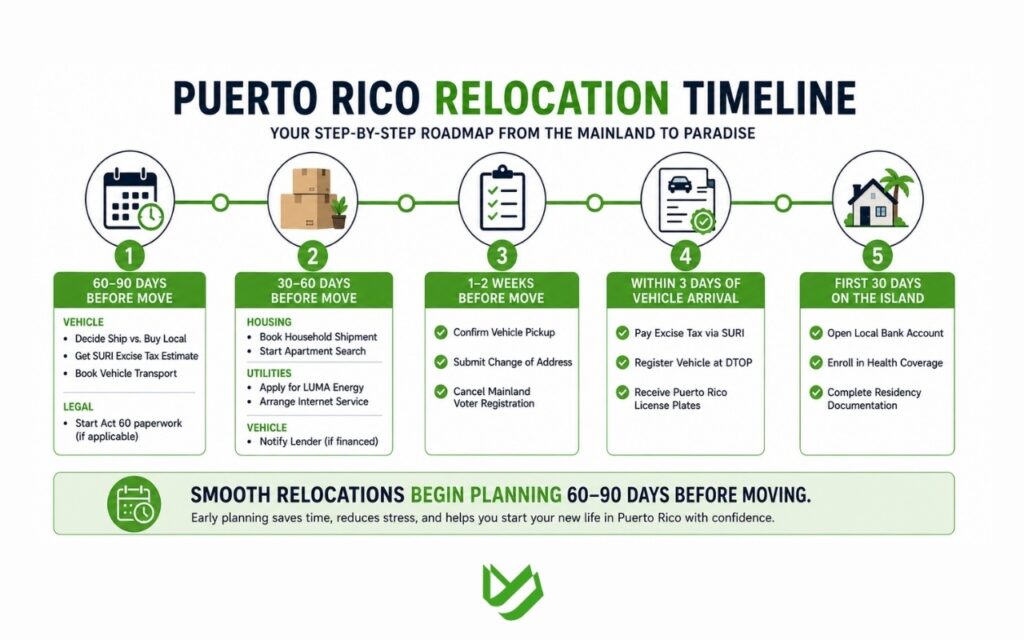
Relocating to Puerto Rico involves more than packing your belongings. From arranging vehicle transport to setting up utilities and completing residency paperwork, the timing of each step can make the process much smoother. The timeline below outlines the key tasks to prioritize before and after your move.
| Timeframe | Priority tasks |
|---|---|
| 60–90 days before move | Decide ship vs. sell vehicle; get excise tax estimate from SURI; book vehicle transport; start Act 60 paperwork if applicable; begin school inquiries |
| 30–60 days before move | Book household container; start LUMA and internet applications; begin apartment search; notify lender if the vehicle is financed |
| 1–2 weeks before move | Confirm vehicle pickup with the carrier; file mainland change-of-address; cancel mainland voter registration |
| Within 3 days of vehicle arrival | Pay excise tax via SURI; complete inspection, registration, and plates at DTOP |
| First 30 days on the island | Open a local bank account; enroll in local health coverage; complete residency declaration paperwork |
If auto shipping makes sense for your situation, the process runs smoothest when you separate the two costs from day one: the transport company’s fee, and Puerto Rico’s excise tax, which is paid to Hacienda directly and never appears on a shipping invoice. Compare licensed, FMCSA-registered carriers with experience on this route, choose between open and enclosed transport based on the value of the car, and run the VIN through SURI early enough that the tax bill is expected rather than sprung on you.
You can get shipping prices through Compare The Carrier’s network of vetted transport partners, or browse the full range of shipping services if more than one vehicle is moving. For a deeper cost breakdown specific to the mainland-to-Puerto Rico lane, see our companion guide, Puerto Rico Auto Transport: Costs, Taxes & Shippers.
No. Puerto Rico is U.S. territory, so U.S. citizens need no passport, visa, or customs clearance. The process resembles a domestic interstate move far more than an international one.
Enough to cover transport and excise tax on any vehicle, container freight, flights, a short-term rental, lease and utility deposits, and two to three months of living costs while income and paperwork settle. Building in a buffer for replacement appliances is sensible, since several items are cheaper to rebuy than to ship.
The vehicle excise tax (arbitrios) generally runs from about 6.6% to 17.5% of assessed value under a tiered rate structure. Use the official SURI calculator with your VIN for a binding estimate before you ship.
It depends on the car’s value. For lower-value vehicles, excise tax often makes buying or leasing locally comparably priced to importing a vehicle. For higher-value, financed, or specialty cars you already own outright, shipping usually still wins.
No. Under the Jones Act, cargo moving by sea between the mainland and Puerto Rico must travel on U.S.-built, U.S.-flagged, U.S.-crewed vessels, which limits the route to a specific set of compliant carriers rather than any general auto transport company.
Ocean transit typically runs one to two weeks depending on departure port and sailing schedule, plus additional time for port processing, excise tax payment, and DTOP registration before the vehicle can legally be driven.
You can drive on a valid mainland license short-term, but establishing residency means converting to a Puerto Rico license through DTOP. Holding a local license is also one of the connection factors used to demonstrate bona fide residency.
You can live on the island without formally declaring residency, but full residency status – generally 183+ days a year plus your primary connections there – affects voter registration, mainland state tax obligations, and eligibility for programs like Act 60.
Housing is often less expensive outside the San Juan metro area, while imported groceries, electricity, and vehicles tend to cost more. The overall comparison depends heavily on whether you rent or own and how much of your consumption is imported.
For the move itself: vehicle title and registration, bill of lading, proof of excise tax payment, driver’s license, insurance documents, birth certificates or Social Security cards for anyone enrolling in school, and medical records. No immigration paperwork is involved.
Mainland plates remain valid only for a short window, commonly cited as three days, after excise tax payment. Driving past that point without local registration and plates can result in fines, which is why booking the DTOP visit in advance matters.











Don't have time to fill out the form?
Call a transport company directly to get a quote now!
Select the category you need
Partner with Compare The Carrier & Grow!
We're open to collaborations, partnerships, and mutual growth! Whether you're an individual or a business, we offer exciting opportunities to work together. Fill out the form below to explore how we can collaborate.
Something Went Wrong
We're sorry, but something went wrong. Please briefly describe the problem you experienced in the text area below. Providing your contact information will allow us to follow up if needed.

Thank you,
your form has been accepted.
Your form has been successfully submitted. We appreciate your effort — our team will review it shortly and take the next steps.


