

Best Overseas Auto Transport In 2026
Many countries are separated by sea, so it is important t...
11 May 2022
Shipping a car from Florida to Puerto Rico typically costs between $1,100 and $1,900, depending on the carrier, vehicle size, and how far inland your pickup address is from the departure port. Most shipments leave from Jacksonville’s JAXPORT, the single largest gateway for mainland-to-island vehicle traffic, with ocean transit running anywhere from about 55 hours on the fastest direct sailings to 5 to 7 days on standard service.
Calculate Shipping Quotes
Florida is, by a wide margin, the easiest mainland state from which to ship a car to Puerto Rico, simply because of its geography and infrastructure. Roughly 85% of everything moving between the mainland and the island passes through Jacksonville, which means more sailing frequency, more carrier choice, and shorter overland legs than shipping from almost anywhere else in the country. That said, this specific route still has its own quirks: a tightly regulated drop-off process, a Hacienda excise tax that catches many buyers off guard, and documentation rules stricter than those for a typical mainland-to-mainland move.
This guide walks through exactly what to expect when shipping a car from Florida to Puerto Rico in 2026: real carrier rates, the actual ports involved, how the Jones Act affects your options, what Hacienda will charge you on arrival, and the paperwork your shipment can’t move without.
Key Takeaways
Table of Contents
Shipping a car from Florida to Puerto Rico is generally faster and more affordable than shipping from most other mainland states. Here’s a quick overview of the average costs, transit times, departure ports, and other important details you’ll need before booking your shipment.
| Detail | What to Expect |
| Average total cost | $1,100–$1,900 |
| Primary departure port | Jacksonville (JAXPORT) |
| Secondary departure option | Port Everglades (Fort Lauderdale) |
| Ocean transit time | 55 hours to 7 days, carrier-dependent |
| Total door-to-door time | 7–14 days including overland legs |
| Shipping method | Roll-on/Roll-off (RoRo) or enclosed auto rack |
| Legal classification | Domestic, but governed by the Jones Act |
| Biggest extra cost | Hacienda excise tax (paid separately, on arrival) |
These numbers give you the shape of the route, but your actual quote depends on your specific vehicle, pickup address, and chosen carrier. Get an exact quote for your Florida-to-Puerto Rico shipment before you book.
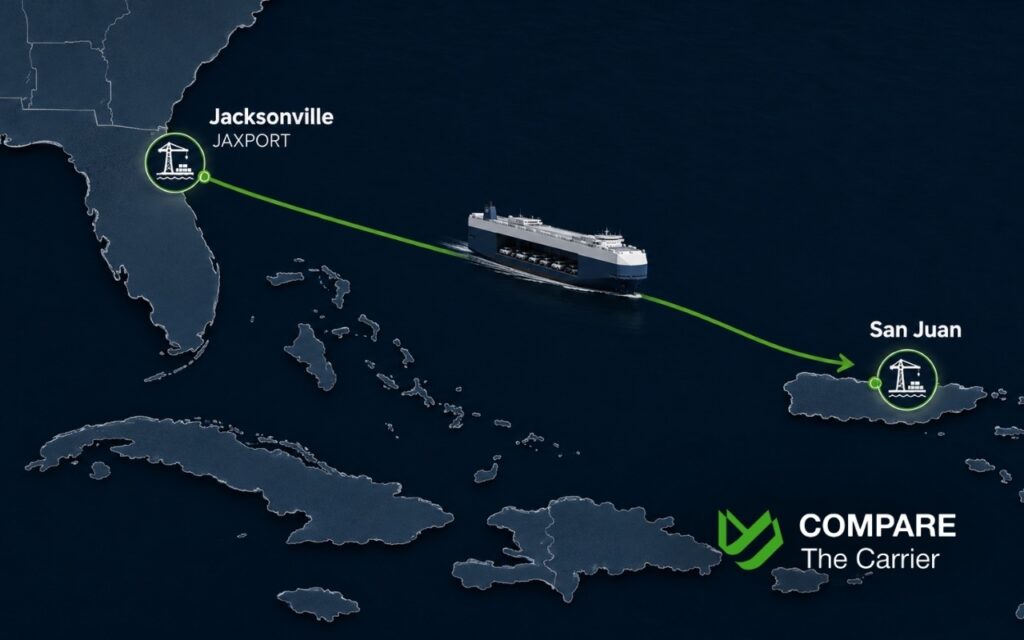
If you’re shopping around for how to ship a car to Puerto Rico, Florida has a structural advantage that most other states simply don’t. Jacksonville accounts for more than 85% of goods moving between the mainland and Puerto Rico, and that volume means the port supports far more frequent vehicle sailings than secondary departure points further north.
Three ocean carriers operate dedicated Puerto Rico vehicle service out of JAXPORT: Crowley, TOTE Maritime Puerto Rico, and Trailer Bridge. Having three competing direct carriers at one port is unusual in this trade lane, and it’s the main reason Florida-origin shipments tend to be both cheaper and faster than shipments originating from states like Colorado, New Jersey, or North Carolina, where the vehicle first has to be trucked to a coastal port before the ocean leg even starts.
If you’re coming from somewhere else in Florida and need the car trucked to Jacksonville first, that overland leg is usually short and inexpensive compared to states further from the coast. A car already sitting in Miami, Orlando, or Tampa adds relatively little to the total cost compared to, say, a vehicle starting out in Denver. If you’re not sure how your specific pickup city affects the quote, Compare The Carrier can match you with carriers that regularly run the Jacksonville lane.
![Car Shipping from Florida to Puerto Rico 3 1 Car Shipping from Florida to Puerto Rico – Costs, Ports & Timelines [2026] 2](https://comparethecarrier.com/wp-content/uploads/2026/07/Car-Shipping-from-Florida-to-Puerto-Rico-3-1-1024x640.jpg "CTC B2C - Blog Article Illustrations - 284")
Real published and reported rates for this specific lane cluster fairly tightly, which makes it easier to budget than some other overseas routes.
| Source / Scenario | Reported Rate |
| TOTE Maritime, Jacksonville to San Juan (standard sedan, door-to-port) | Around $1,206 |
| Industry average, Miami/Florida to Puerto Rico | Roughly $1,275 |
| General Florida to Puerto Rico range (multiple carriers) | $1,100–$1,600 |
| Broader range including oversized vehicles, enclosed transport | Up to $1,900–$3,000 |
Several factors push your specific quote up or down within that range.
Vehicle size and weight. A standard sedan or compact SUV sits at the lower end of the range. Larger trucks, vans, or vehicles exceeding standard width and height thresholds (commonly around 82 inches wide) get bumped into a higher rate tier, since the carrier has to allocate more space on the vessel.
Shipping method. Most personal vehicles travel RoRo (roll-on/roll-off) or in below-deck auto racks, which is the standard, most economical method. Enclosed container shipping for classic, luxury, or high-value vehicles costs meaningfully more, sometimes 30 to 50% above standard RoRo pricing.
Pickup location within Florida. Dropping the car off yourself at the Jacksonville terminal is the cheapest option. If you need door-to-port pickup from somewhere else in the state, that overland leg adds a modest trucking fee on top of the ocean rate.
Carrier choice. Crowley, TOTE, and Trailer Bridge each price slightly differently based on vessel type, sailing frequency, and service tier. Getting quotes from more than one is worth the extra few minutes, since the difference can run into hundreds of dollars on this route.
It’s worth being clear about one thing upfront: none of these figures include the Puerto Rico excise tax, which is a separate government charge, not a shipping cost. We’ll break that down in detail further down.
Get a Free Quote for Your Florida to Puerto Rico Shipment
For this specific route, the choice mostly comes down to two terminals.
| Port | Best For | Notes |
| Jacksonville (JAXPORT) | Most shippers | Highest sailing frequency, all three major carriers operate here |
| Port Everglades (Fort Lauderdale) | South Florida residents | Shorter overland leg if you’re already in Miami/Broward area |
JAXPORT is the dominant gateway for this trade lane and is where Crowley, TOTE Maritime, and Trailer Bridge all run scheduled vehicle service to San Juan. Unless you have a strong reason to use a South Florida departure, Jacksonville is almost always going to give you more sailing options and more competitive pricing, simply because of how much volume runs through it.
If you live in or near Miami, Fort Lauderdale, or the Keys, it can sometimes make more sense to ship through Port Everglades instead, purely to shorten the overland trucking distance, even if the ocean-side carrier options are more limited there. Whichever port you choose, it’s worth confirming current vessel cut-off times directly with your carrier, since these can shift seasonally, and missing a cut-off pushes your vehicle to the next scheduled sailing. You can also run both ports through Compare The Carrier’s calculator to see which one comes out cheaper for your specific pickup address.
These are the three names you’ll see repeatedly when researching this route, and they each have a slightly different value proposition.
| Carrier | Transit Time (Jax to San Juan) | Vehicle Storage Method | Sailing Frequency |
| Crowley | About 2.5 days | Below-deck, weatherproof enclosed garages | Weekly |
| TOTE Maritime | About 55 hours (just over 2 days) | Proprietary below-deck auto racks | Twice weekly |
| Trailer Bridge | Varies by service | Standard RoRo / container | Scheduled, varies |
A detail worth knowing before you book: many companies that advertise “car shipping to Puerto Rico” are brokers, not the actual ocean carrier. Crowley and TOTE both own their vessels outright, which matters in practice because a carrier that owns its ships has more control if something goes wrong mid-process, whereas a broker is dependent on a separate ocean carrier actually getting paid and processing the booking correctly on their end.
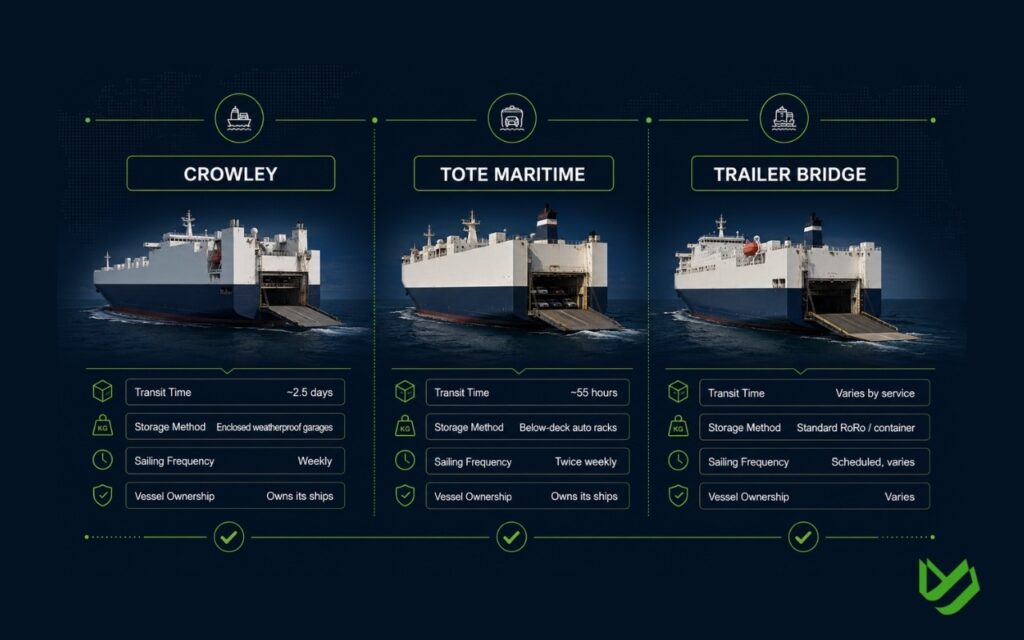
Crowley markets itself specifically around fully enclosed, weatherproof auto garages below deck, which protect vehicles from salt spray and weather exposure during the crossing, something open-air container racks on other services don’t offer. TOTE’s pitch centers on frequency and speed, with sailings leaving Jacksonville twice a week and one of the shortest published transit times in the trade lane.
If your priority is getting the car there as fast as possible, TOTE’s roughly 55-hour crossing or Crowley’s 2.5-day option are both strong choices. If your priority is protecting a higher-value vehicle from weather exposure, Crowley’s enclosed garage approach is worth the inquiry. Rather than contacting each carrier separately, you can compare quotes across all three options to see speed, storage method, and price side by side.
The number that gets quoted most often, “7 to 14 days,” is a reasonable average, but it bundles together several separate steps that are worth breaking apart so you know what’s actually happening at each stage.
| Stage | Typical Time |
| Overland pickup to Jacksonville (if not self-delivered) | 1–3 days within Florida |
| Terminal processing and paperwork | Same day, but budget 45+ minutes per visit |
| Waiting for next scheduled sailing | 0–4 days depending on cut-off timing |
| Ocean transit (Jacksonville to San Juan) | 55 hours to 7 days, carrier-dependent |
| Port clearance and Hacienda tax payment in San Juan | 1–3 days |
| Total door-to-door estimate | 7–14 days |
The single biggest variable most people don’t account for is the gap between when you drop the car off and when the next sailing actually departs. TOTE and Crowley run multiple sailings per week, but if you miss a specific cut-off time, your vehicle simply waits for the next one, which can add several days even though the ocean crossing itself might only take 55 hours.
The other commonly underestimated stage is what happens after the ship docks. Your car doesn’t get handed to you the moment it’s offloaded. It has to clear Hacienda’s tax process first, and that office isn’t open 24/7, so timing your pickup around their hours (and around your own travel plans, if you’re flying down to collect the vehicle) matters more than people expect. You can check current hours and payment options directly through Hacienda’s SURI portal before you schedule your trip.
This is, by a wide margin, the part of this process that catches mainland buyers off guard, because it has nothing to do with your shipping invoice. Every vehicle entering Puerto Rico from the mainland is subject to an excise tax (officially “Arbitrios”) collected by the Puerto Rico Department of Treasury, locally known as Hacienda.
![Car Shipping from Florida to Puerto Rico 6 Car Shipping from Florida to Puerto Rico – Costs, Ports & Timelines [2026] 3](https://comparethecarrier.com/wp-content/uploads/2026/07/Car-Shipping-from-Florida-to-Puerto-Rico-6-1024x640.jpg "CTC B2C - Blog Article Illustrations - 287")
A few things to understand about this tax before you ship:
It’s not included in your shipping quote, ever. Your auto transport company or ocean carrier cannot pay this on your behalf. It’s a completely separate government transaction that you handle directly with Hacienda after the vehicle arrives, and you cannot legally take possession of the vehicle from the dock until it’s paid for.
The rate is tiered, not flat. Reported figures for this tax vary widely depending on the source and year, generally within a broad range tied to the vehicle’s assessed value, age, and engine size, with the structure increasing in tiers as the vehicle’s value climbs. Because the system is genuinely complex and has been updated over time, manual back-of-envelope math tends to underestimate the real number. The only reliable way to get an accurate figure for your specific vehicle is to use Hacienda’s own online tool through the SURI portal, entering your vehicle’s year, make, and model directly.
It applies regardless of how the vehicle is being shipped or why. Whether you’re relocating permanently, sending a car to a family member, or shipping a vehicle you bought specifically to resell on the island, the excise tax applies the same way.
You get a short grace period to drive on mainland plates. Most current guidance puts this window at around 3 days after paying the excise tax, after which you’re required to complete local registration with Puerto Rico’s Departamento de Transportación y Obras Públicas (DTOP) and switch to island plates.
Because the exact dollar amount depends heavily on your specific vehicle, don’t rely on a flat percentage you saw quoted online. Run your actual VIN or vehicle details through the official Hacienda calculator before you ship, so the number on arrival isn’t a surprise on top of everything else you’ve already paid.
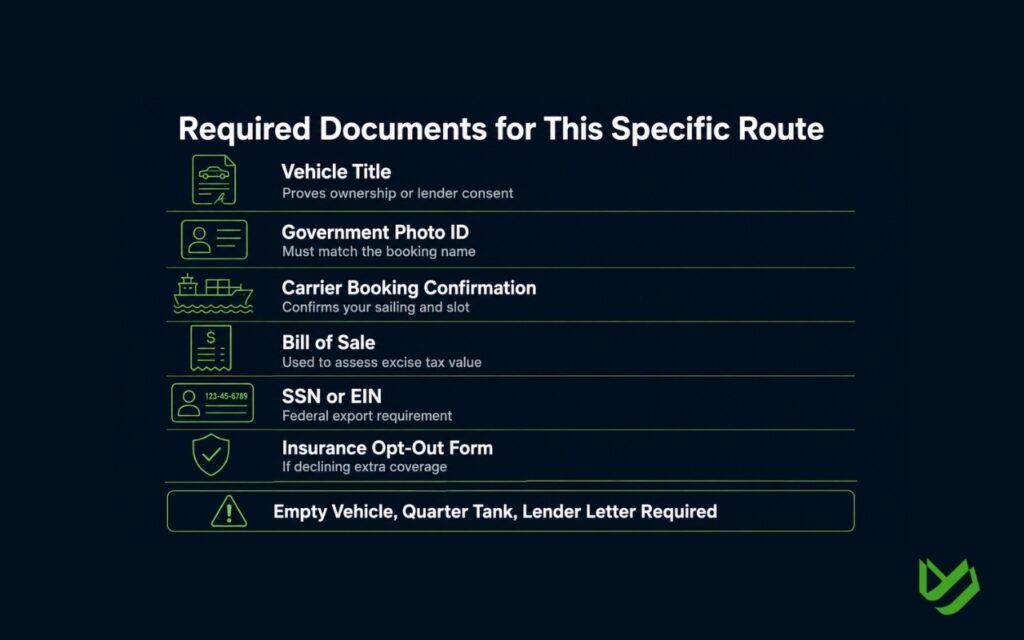
Port terminals on this lane are strict, and incomplete paperwork is one of the fastest ways to get turned away at drop-off, which then pushes your vehicle to a later sailing. Here’s what you’ll typically need.
| Document | Why It’s Required |
| Original vehicle title (or notarized lienholder authorization if financed) | Proves ownership / lender consent to export the vehicle |
| Valid government-issued photo ID | Must match the name on the title and booking |
| Carrier booking confirmation | Confirms your reserved sailing and terminal slot |
| Bill of Sale or commercial invoice | Used by Hacienda to help establish the vehicle’s value for excise tax |
| Social Security Number or EIN | Federal requirement for vehicle export documentation |
| Cargo Insurance Opt-Out form (if declining optional coverage) | Required acknowledgment if you choose not to purchase additional coverage |
A few additional rules specific to this route are easy to miss:
The vehicle must be completely empty. No personal items of any kind, including boxes, suitcases, or loose items in the trunk. Carriers and terminal staff will physically inspect the vehicle before accepting it for shipment, and packed items are routinely rejected on the spot.
Fuel level matters. Keep the tank at roughly a quarter or less. A fuller tank adds unnecessary weight and is treated as a minor safety consideration during loading.
If the vehicle is financed, get lender authorization in writing and get it early. This is one of the most common delays buyers run into. Banks and credit unions don’t always process export-authorization letters quickly, so request this the moment you decide to ship, not the week before your booking.
Title and lien documentation requirements vary by where you bought the car, similar to how Power of Attorney rules differ across mainland states when shipping a vehicle from a Copart auction. If your vehicle came from a salvage auction rather than a private sale or dealership, you’ll want both the auction’s release paperwork and your Puerto Rico-bound shipping documents in order, since you’re effectively layering two separate document checklists on top of each other.
For a broader breakdown of what’s needed across different shipping scenarios, our vehicle shipping document checklist covers the general requirements that apply beyond just this specific route.
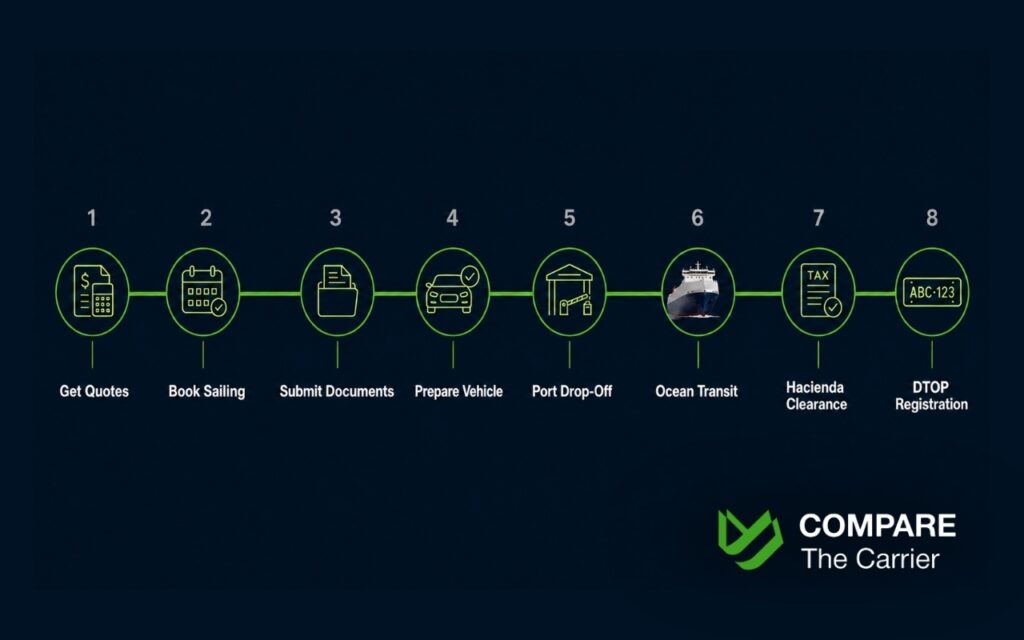
1. Get quotes and choose a carrier or broker. Compare rates from Crowley, TOTE Maritime, and Trailer Bridge directly, or use a platform like Compare The Carrier to get matched with vetted transport providers experienced in this specific lane.
2. Book your sailing and confirm the cut-off time. Vessels depart on fixed schedules. Confirm exactly when your vehicle needs to be at the terminal to make your intended sailing, not just the general “drop off this week” window.
3. Gather and submit documentation in advance. Title or lienholder letter, photo ID, Bill of Sale, and booking confirmation should all be ready before you arrive at the terminal, not assembled on the spot. Our vehicle shipping document checklist covers the general paperwork applicable to most shipping scenarios.
4. Prepare the vehicle. Remove every personal item, drop the fuel level to roughly a quarter tank, and make sure the vehicle is reasonably clean, since some carriers and inspection processes are stricter than others about exterior condition.
5. Drop off at the terminal (or arrange door-to-port pickup). If self-delivering, budget real time for this step. Terminal paperwork processing commonly takes 45 minutes or more per customer, longer if there’s a line ahead of you.
6. Track your shipment during ocean transit. Most carriers offer online tracking using your booking or customer ID number, so you can follow the vessel’s progress toward San Juan.
7. Clear the vehicle through Hacienda once it arrives. This is the step most people forget to plan for. You cannot collect the vehicle from the port until the excise tax is paid in full, so build this into your travel plans if you’re flying to Puerto Rico to pick it up.
8. Register the vehicle with DTOP within the grace period. Once the excise tax is settled, the clock starts on switching from mainland plates to Puerto Rico plates, generally within a few days.
Assuming the shipping quote includes the excise tax. It never does. Budget for both separately, or the final cost on arrival will be a real shock.
Booking a flight home the same day the vehicle is dropped off. Terminal paperwork takes time, and rushing this step risks missing both your sailing cut-off and your flight.
Waiting until the last minute to request lienholder authorization. If the vehicle is financed, this single document is the most common bottleneck in the entire process. Request it the day you decide to ship.
Packing personal items in the vehicle “just this once.” Inspectors check, and a vehicle with items inside gets rejected at drop-off, not flagged for a warning. If you’re unsure what’s actually allowed, our guide on car shipping with personal items breaks down the rules carriers typically follow.
Not confirming which port and carrier actually serve your specific pickup area best. A buyer in Tampa might save real money and time by checking Port Everglades as an alternative to Jacksonville, depending on current rates and schedules, rather than defaulting to whichever port is most commonly mentioned online.
“How much does it cost to ship a vehicle from Florida to Puerto Rico?” Most shipments fall between $1,100 and $1,900, depending on vehicle size, carrier, and pickup location within Florida, not including the separate Hacienda excise tax.
“How much does it cost to import a car from the US to Puerto Rico overall, including taxes?” Beyond the shipping cost itself, expect a separate excise tax payment to Hacienda based on your specific vehicle’s assessed value, plus standard DTOP registration fees once you switch to local plates. Total all-in costs vary significantly by vehicle, which is why running your VIN through Hacienda’s own calculator before shipping is worth the few minutes it takes.
“What is the best car shipping company for this route?” Crowley and TOTE Maritime both own their vessels and run frequent, direct Jacksonville-to-San Juan service, which generally makes them more reliable than broker-only services for this specific lane. The right choice often comes down to whether you prioritize Crowley’s enclosed weatherproof storage or TOTE’s slightly faster, more frequent sailings. If you’d rather work through a broker that compares multiple carriers for you, our list of top auto transport companies covers vetted options beyond just this route.
“Can you drive from Florida to Puerto Rico by car?” No. Puerto Rico is an island, and there’s no road or bridge connection to the mainland. The only ways to get a vehicle there are ocean freight or, for some smaller specialty cases, air freight at significantly higher cost. This is also why the shipment falls under the Jones Act, which requires the ocean leg of any point-to-point US shipment to use US-flagged, US-built, and US-crewed vessels.
Florida genuinely is the most straightforward mainland state to ship a car from to Puerto Rico, thanks to Jacksonville’s dominant position in this trade lane and the choice between three established ocean carriers running direct, frequent service. The shipping cost itself, typically $1,100 to $1,900 depending on your vehicle and chosen carrier, is fairly predictable once you get a couple of quotes. The part that trips people up almost every time is everything that happens after the ship docks: the Hacienda excise tax, the registration grace period, and the documentation that has to be airtight before the vehicle is ever allowed onto the vessel in the first place.
The smartest approach is to treat this as two separate budgets from day one, the actual transport cost and the Puerto Rico tax obligation, and to get your lienholder paperwork (if applicable), moving the same day you decide to ship. Compare The Carrier can connect you with experienced auto transport providers for this specific Jacksonville-to-San Juan lane, so you’re not navigating carrier comparisons and terminal requirements alone. And if the vehicle you’re shipping came from a salvage auction rather than a dealership or private sale, our guide on how to ship a car from Copart covers the additional release paperwork and storage deadlines you’ll need to clear before the vehicle is even ready to head to the port.
For a broader look at shipping vehicles to Puerto Rico from other mainland states, not just Florida, see our complete Puerto Rico auto transport guide.
Ready to compare real quotes for your Jacksonville-to-San Juan shipment? Get a free auto transport quote from Compare The Carrier and see what licensed carriers charge for your specific vehicle and route.
Most shipments cost between $1,100 and $1,900, depending on vehicle size, carrier choice, and your specific pickup location within Florida. This figure covers ocean transport and standard port handling, but does not include Puerto Rico’s separate excise tax, which is paid directly to Hacienda on arrival.
Total cost includes the shipping fee ($1,100–$1,900 from Florida) plus the Hacienda excise tax, which is calculated based on your vehicle’s assessed value, age, and engine specifications, plus standard DTOP registration fees once you switch to local plates. Because the tax structure is tiered, it’s worth calculating your specific number through Hacienda’s official SURI tool rather than estimating.
Crowley and TOTE Maritime are generally considered the strongest options for this route because both own their vessels and operate frequent, direct sailings from Jacksonville to San Juan. Crowley emphasizes enclosed, weatherproof vehicle storage, while TOTE emphasizes speed and sailing frequency.
No. There is no land or bridge route between the US mainland and Puerto Rico. Vehicles must travel by ocean freight (the standard method) or, in limited cases, air freight at a significantly higher cost. Ocean shipments on this route are governed by the Jones Act.
Ocean transit alone runs from about 55 hours on the fastest direct sailings up to roughly 5 to 7 days on standard service. Including overland pickup within Florida, terminal processing, and port clearance with Hacienda on the Puerto Rico side, total door-to-door time typically runs 7 to 14 days.
No customs clearance is required since Puerto Rico is a US territory, and this is treated as domestic transport. However, you do need a valid US government-issued photo ID, your vehicle title or lienholder authorization, and you may need to file Electronic Export Information (EEI) if the vehicle’s declared value exceeds $2,500.
Yes, but you’ll need a notarized authorization letter from your lender explicitly permitting the vehicle to be exported to Puerto Rico. Request this as early as possible, since processing times at banks and credit unions vary, and this is one of the most common causes of shipping delays on this route.
No. It’s classified as domestic transport since Puerto Rico is a US territory, which means no international customs process. However, it is still governed by the Jones Act (requiring US-flagged vessels) and by Puerto Rico’s local tax authority, Hacienda, for the excise tax on arrival.









Don't have time to fill out the form?
Call a transport company directly to get a quote now!
Select the category you need
Partner with Compare The Carrier & Grow!
We're open to collaborations, partnerships, and mutual growth! Whether you're an individual or a business, we offer exciting opportunities to work together. Fill out the form below to explore how we can collaborate.
Something Went Wrong
We're sorry, but something went wrong. Please briefly describe the problem you experienced in the text area below. Providing your contact information will allow us to follow up if needed.

Thank you,
your form has been accepted.
Your form has been successfully submitted. We appreciate your effort — our team will review it shortly and take the next steps.


