

Everything You Need to Know About Hot Shot Car Transport
Hot shot car transport is a specialized vehicle shipping ...
21 April 2026
Shipping a car to a rural area is entirely possible – auto transport carriers reach small towns and remote addresses every day. But a rural location does add a layer of planning that a city-to-city shipment doesn’t need. Road access, distance from major highways, and how easy your address is to reach can all affect rural car shipping costs and the pickup experience.
Calculate Shipping Quotes
This guide covers what rural shipping actually costs, how pickup and delivery work when a big rig can’t reach your driveway, and what to have ready before the carrier arrives.
Ready to Ship Your Car to a Rural Area?
Get quotes from auto transport companies for your route and vehicle. Compare your options, discuss pickup access, and find a transport solution that fits your location.
Questions about access to your rural address? Call 1 (321) 294-0589 to discuss your transport options.
In this guide
Rural shipments can cost more than a comparable-distance shipment between two major cities, but “rural” doesn’t automatically mean “expensive.” What actually drives the price is accessibility, not just population density.
A few things push a rural quote higher:
Carriers don’t price a shipment just because a ZIP code is technically classified as rural. What they’re really looking at is how the pickup and delivery locations fit into a route they’re already running. A house five miles off the interstate can actually be easier to serve than a small town that sits 40 miles from the nearest major highway – even though the town has a bigger population.
That’s why two rural shipments covering a similar distance can come back with noticeably different quotes. One might sit close to a regular carrier corridor; the other might need a real detour off the main route to reach it. Vehicle size, transport type, the season, and how flexible you can be with pickup dates all factor in on top of that.
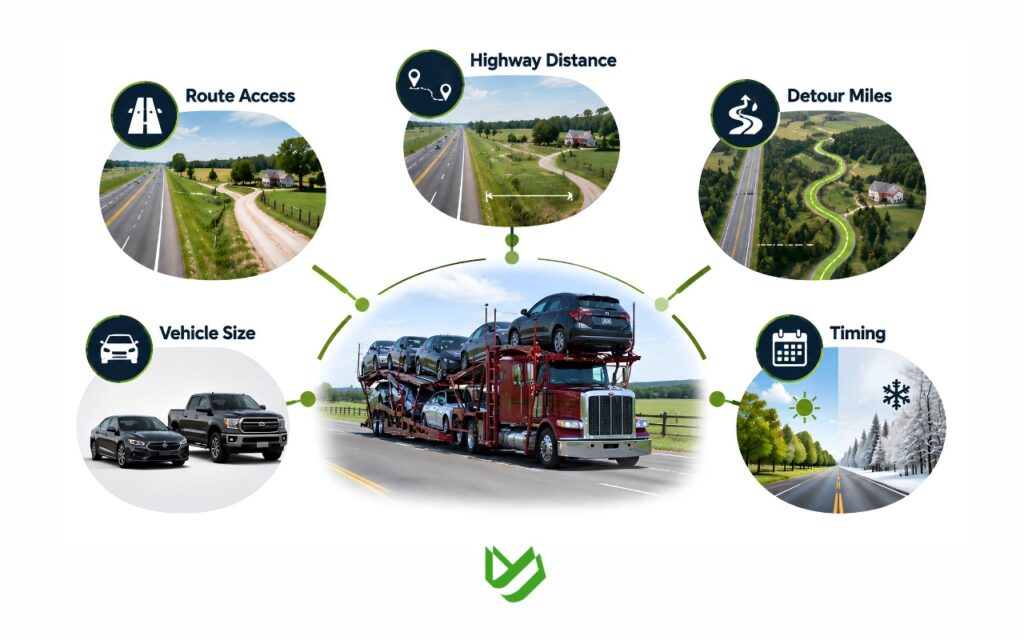
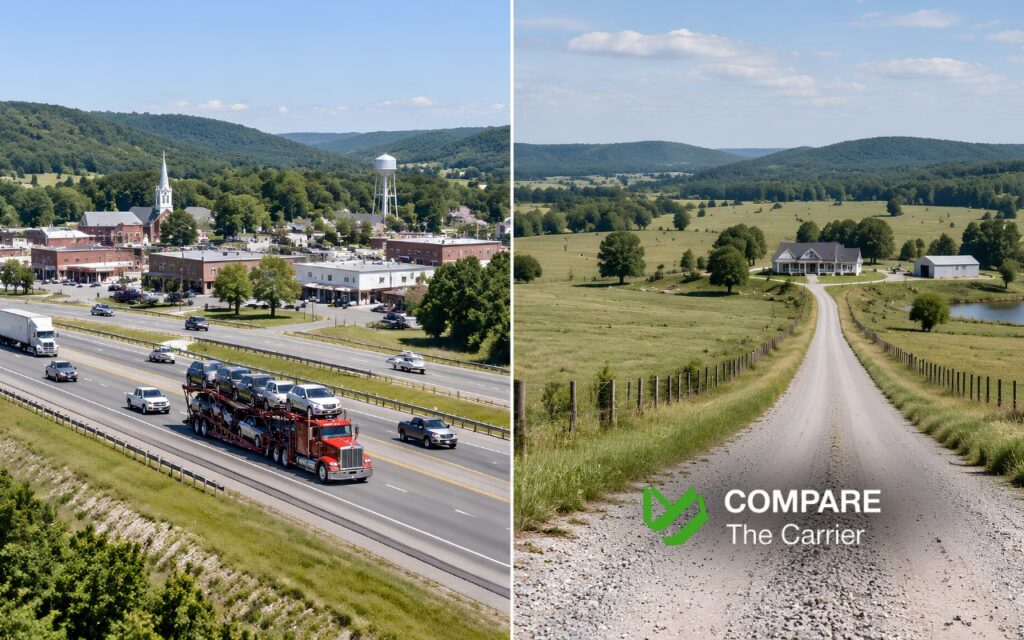
It’s worth separating these two ideas, because they get treated as the same thing more often than they should be. A rural ZIP code doesn’t necessarily mean your shipment will be hard to serve – plenty of small towns sit directly along a major interstate and see regular truck traffic every day. Others are genuinely several miles from anything resembling a main road, and that’s a very different situation for a carrier to plan around.
So the more useful question isn’t “is this a rural area?” It’s “how accessible is this specific pickup or delivery location to the routes carriers actually run?” Two towns with similar populations can have completely different answers to that question, which is exactly why one quote might surprise you by coming in lower than you expected, and another higher.
Seasonality also affects pricing beyond just rural access, so timing your shipment can help offset some of the rural premium.
In most cases, yes – but it depends on what the road leading to your property looks like. Auto transport trucks and trailers are much less maneuverable than passenger vehicles, so they need enough room to turn, stop, and safely access the property.
| Road/Access Type | Likely Outcome |
| Paved public road | Door delivery is often possible |
| Wide gravel road | Depends on condition and truck access |
| Narrow gravel road | Carrier may request a nearby meeting point |
| Dirt road | Carrier may ask for an alternate location |
| Private road | Access may depend on permission and road quality |
| Steep grade | May require a nearby, flatter location |
| Snow or mud | Can delay pickup or require an alternate spot |
Rural road access is a recognized planning challenge beyond just auto transport – the Federal Highway Administration notes that rural areas often involve narrower roads, weight-restricted bridges, and other access considerations that don’t come up on a typical urban or interstate route. Those same road-access factors can matter when a car carrier is planning a rural pickup.
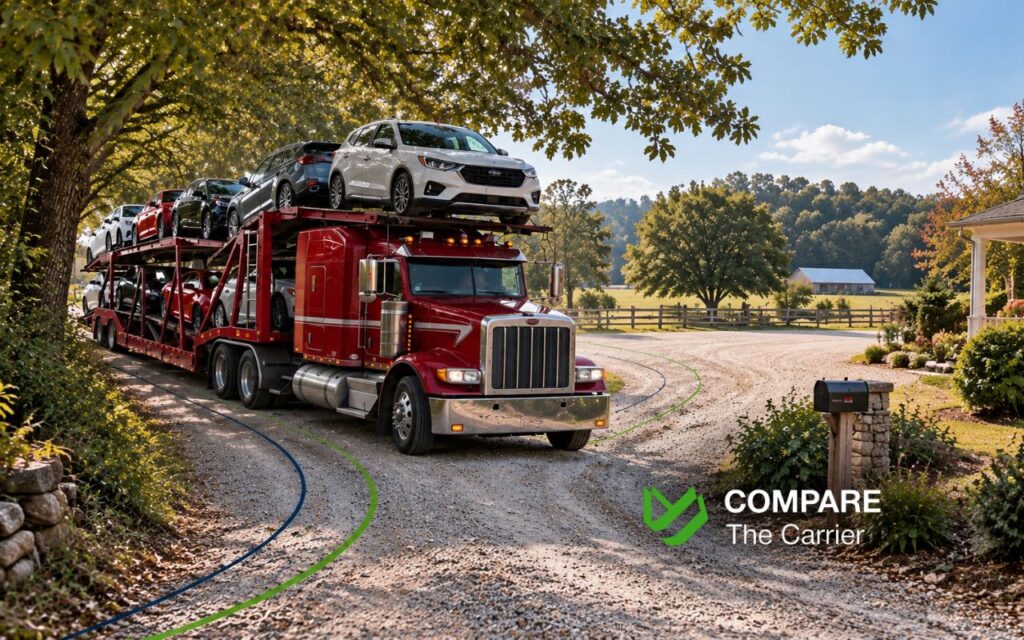
Say you’re shipping a sedan to a house a few miles down a gravel road. The road itself might be perfectly drivable for a normal car – that doesn’t mean a large car hauler can use it the same way. If there’s nowhere for the truck to turn around, the driver may ask you to meet at the end of the road, or in the nearest town instead.
The shipment can still be completed locally, but the actual handoff happens at a location that works safely for the truck rather than at your front door. It’s a small adjustment, and one most rural customers end up making without much hassle once the driver explains the reasoning.
None of the outcomes in the table above are hard yes-or-no rules. A lot comes down to the individual driver’s judgment about what’s safe for their equipment on the day of pickup. If your road is questionable, mentioning it when you book saves everyone a headache later.
Private roads deserve their own mention, since they come with a wrinkle beyond just width or surface. Even if a private road is technically wide enough for a carrier, the driver may need permission to use it, or may simply not be comfortable bringing a fully loaded truck onto someone else’s property.
If your pickup or delivery involves a gated community, a farm road, a long private driveway, or any other restricted access, say so when you’re arranging the shipment – don’t leave it for pickup day. In a lot of cases, the simplest fix is meeting the carrier at the nearest public road instead of trying to route the truck all the way in. It’s rarely a dealbreaker; it just needs to be part of the plan from the start rather than a surprise on the morning of pickup.
There isn’t just one way rural pickups work. Depending on your address, you may end up with one of a few arrangements:
Door-to-door pickup. If your road is paved, wide enough, and has room for the truck to turn around, the driver can typically come right to your property – the same as any door-to-door service elsewhere.
Nearby meeting point. When the address itself isn’t reachable, the driver will often ask you to meet at a safe, accessible spot close by – a gas station, a store parking lot, or a wide pull-off near a main road.
Meeting in the nearest town. For more isolated properties, meeting in the closest town center can be more practical than trying to route a full-size hauler down miles of backcountry road. This comes up a lot with farms, cabins, and other properties well off the beaten path – you still get your vehicle locally, you’re just picking a spot that’s realistic for a large truck.
Terminal pickup. If your area is genuinely hard to service, dropping off or picking up your vehicle at a terminal may reduce the extra cost associated with reaching a remote address – worth comparing against door-to-door vs. terminal-to-terminal pricing for your specific route.
In practice, you don’t have to figure this out entirely on your own. Give the carrier your actual address and an honest description of the road conditions, and the dispatcher or driver can usually tell you whether the truck can get there safely. If it can’t, they’ll help coordinate a location that works, before pickup day arrives.
One thing worth keeping in mind: try not to lock in a specific delivery point before the route’s been planned. A spot that looks fine on a map can turn out to be a poor fit once a driver actually sees the road in person – so treat your first choice as a starting point, not a fixed decision.
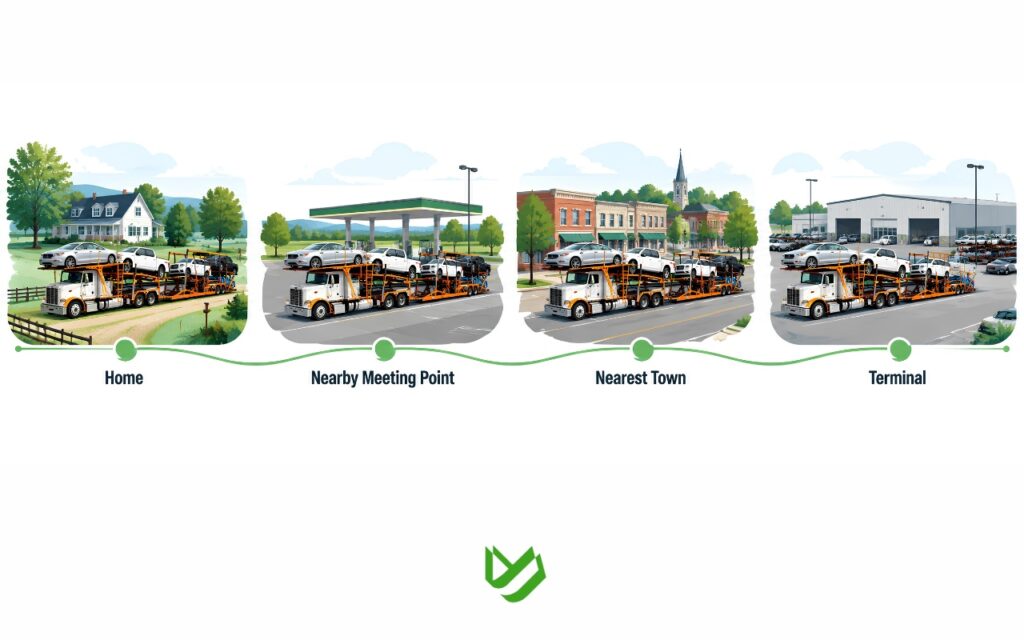
This is more common than people expect, and it’s a normal part of rural shipping – not a sign something’s gone wrong. If your driver calls ahead and says the road isn’t workable, they’ll usually suggest a nearby alternative themselves.
A good meeting point typically has:
Common choices include gas stations, big-box store lots, or wide shoulders near a highway exit. It’s worth having a backup location in mind before pickup day, in case the first spot doesn’t pan out – a quick phone call the morning of usually sorts it out.
There’s no fixed rule for how far off the highway a carrier will go to reach you. Some drivers are comfortable taking a truck well off the main route; others would rather keep to established roads. That’s really why the specific location and road conditions matter more than any general “X miles from the interstate” guideline.
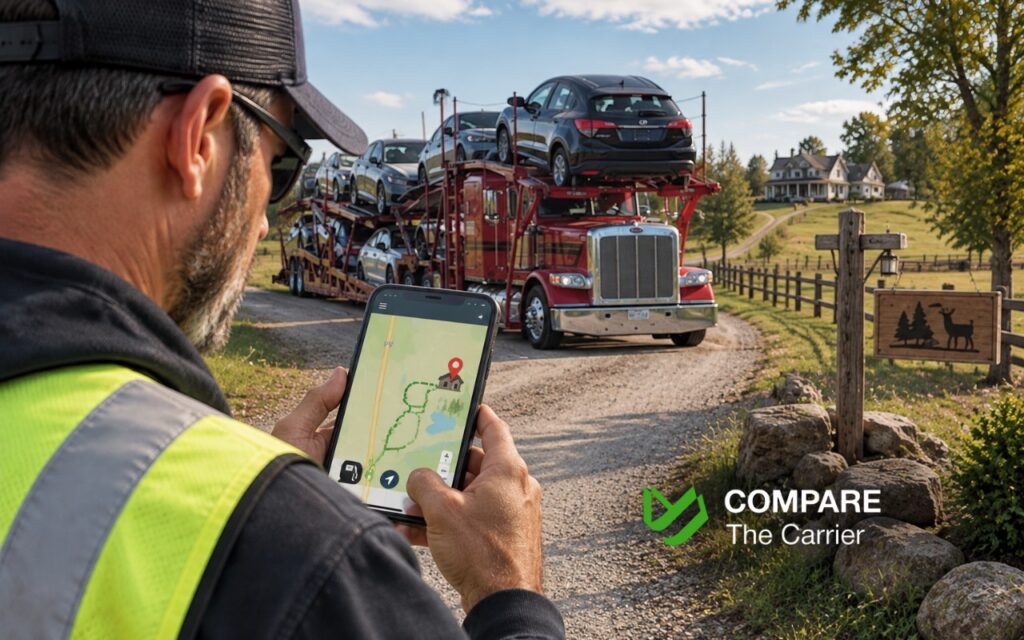
Some rural properties use a PO Box, a rural route number, or an address that doesn’t map cleanly. USPS itself maintains specific formatting rules for rural route addresses, which is part of why these addresses can be tricky for navigation apps and delivery drivers alike.
A couple of things worth knowing:
This is one reason rural shipments benefit from a little advance communication. If your home doesn’t show up clearly in navigation apps, don’t wait until the driver is already nearby to explain where the property is – send the correct physical address and any useful directions ahead of time. If there’s a gate, a long private driveway, or a road that changes names partway along, mention that too. None of this needs to be complicated; the goal is simply to give the driver enough to work with to decide where the truck can safely meet you.
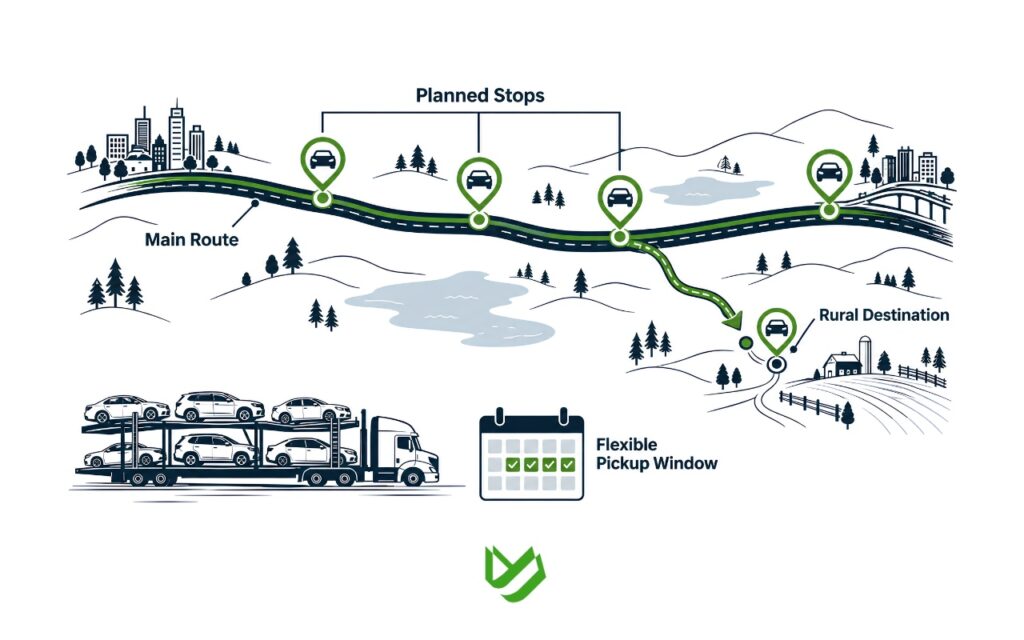
Rural shipments sometimes come with a wider pickup window than a city-to-city move, and that’s usually not a red flag – it reflects how carriers actually plan their routes.
Here’s the logic: a carrier may already have pickups lined up along a major interstate, but your rural address sits 30 or 40 miles off that route. Rather than sending a separate truck just for one shipment, the dispatcher may wait until your vehicle can be worked into a route that’s already running. That’s a big part of why rural pickups sometimes need more scheduling flexibility, even when the actual driving distance to your address isn’t unusual at all.
Weather and road conditions play into this too – how carriers plan routes in general applies to rural shipments as much as anywhere else, just with a bit less margin for error.
Giving a wider pickup window rather than insisting on one exact date gives the dispatcher more room to fit your shipment into a route that already makes sense. That flexibility can also make it easier to match your shipment with an existing route, which may help keep the quote lower.
Both options are available for rural shipments, though availability can look a little different than in a major metro.
| Open Transport | Enclosed Transport | |
| Cost | Lower | Usually higher |
| Availability | Generally more widely available | Fewer trucks on rural routes, may take longer to schedule |
| Protection | Standard | Shields from weather, dust, and debris |
| Best for | Most everyday vehicles | Classic, luxury, or exotic vehicles |
The bigger issue in a rural area usually isn’t whether enclosed transport exists at all – it’s how often an enclosed carrier actually travels your specific route. If only a handful of enclosed trucks serve the area, you may have fewer pickup dates to pick from, even if the price itself isn’t dramatically different from what you’d see elsewhere.
There’s no universal “best” choice here – open car shipping is generally suitable for most everyday vehicles, while enclosed auto transport is worth the extra cost and scheduling patience if your vehicle genuinely needs the protection.
Most of what applies to rural shipping holds regardless of what you’re moving, but a few vehicle types are worth calling out:
SUVs and pickup trucks. These can cost more than a standard sedan to ship, depending on their size, weight, and the route – rural or not.
Oversized or lifted vehicles. These can further limit which trucks are able to take the job, which matters more in areas with fewer carrier options to begin with.
Inoperable or non-running vehicles. A car that doesn’t start needs winching equipment to load, which takes more time and effort – worth mentioning upfront regardless of destination, but especially in a rural setting where the carrier may already be working with a tighter logistical plan.
A little preparation goes a long way toward a smooth pickup day, and most of it takes just a few minutes:
None of these steps are unique to rural shipping – they’re just worth taking a bit more seriously when the pickup location itself needs some planning.
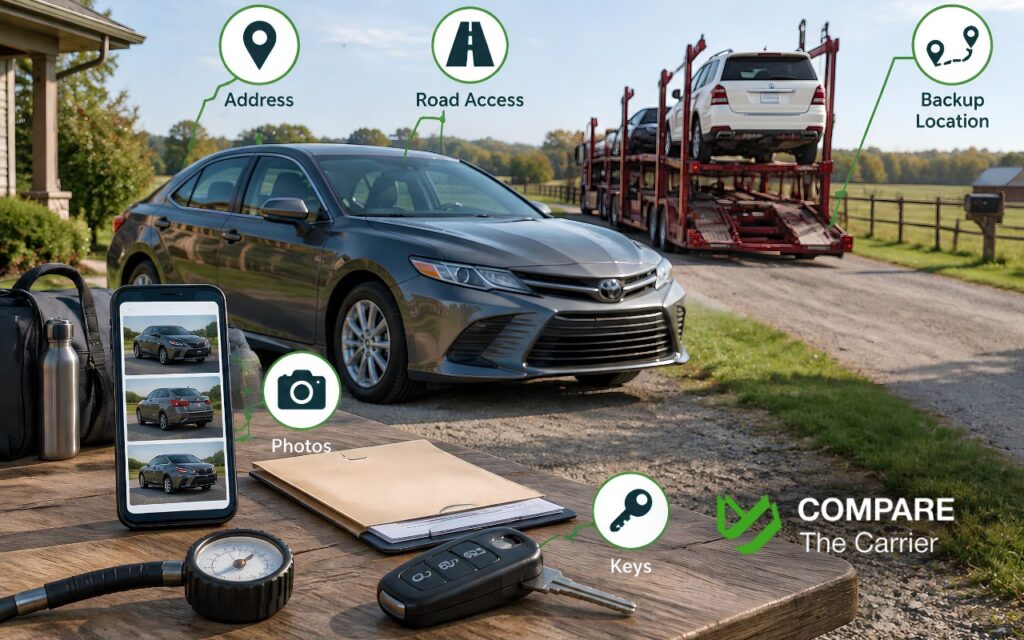
Giving your carrier the full picture upfront is the single best way to avoid surprises. That includes:
The more of this you can answer before the driver shows up, the less likely you are to need a last-minute change of plans on either end.
Because rural routes sometimes involve independent operators or smaller carriers, it’s worth doing a quick check before booking – confirming whether you’re working with a broker or a carrier and verifying the company’s MC number. You can also verify an interstate auto transporter or broker directly through the Federal Motor Carrier Safety Administration (FMCSA), which recommends confirming a company’s registration and understanding whether you’re dealing with a broker or the carrier that will actually transport your vehicle. It’s also worth knowing what red flags to watch for before you commit to a quote.
Saving money on rural auto transport usually comes down to making your shipment easier to fit into a route a carrier’s already running. You don’t necessarily need to give up door delivery or default to a terminal – often, a little flexibility on your end is enough:
Offer a flexible pickup window. A few days of flexibility instead of one fixed date gives dispatchers more room to route your shipment efficiently.
Consider meeting the driver partway. If your road access is limited, offering to meet at a nearby accessible spot from the start can save time – and sometimes cost – rather than waiting for the carrier to ask.
Compare more than one quote. Pricing for the same rural route can vary between providers, so it’s worth checking a few – see how to read a car shipping quote to know what you’re actually comparing.
Book ahead when possible. More lead time gives a carrier a better shot at working your rural stop into a route they’re already running.
Skip enclosed unless you need it. Open transport is both cheaper and more widely available in areas with less carrier traffic.
The more specific you can be, the more accurate your quote will be. A car shipping calculator is a good starting point, but for a rural address, be ready to provide:
If you’re shipping cross-country to a rural destination, it’s also worth reviewing how much cross-country shipping typically costs so you have a baseline before the rural-specific factors get added in.
Ready to get a rural shipping estimate? Use the auto transport calculator with your exact ZIP code and vehicle details, or explore shipping services for more on how the process works.
Yes. Most rural locations can be served by auto transport carriers, though the driver may need a nearby pickup or delivery point if the road is too narrow, steep, unpaved, or otherwise unsuitable for a large truck.
It can. Price tends to rise when a pickup or delivery point is far from major highways, sees limited carrier traffic, or requires extra driving to reach.
Sometimes – it depends on the road’s width and condition. A wide, well-maintained gravel road is often manageable; a narrow or rutted one usually isn’t.
You’ll typically meet at a nearby, accessible location – a parking lot, gas station, or a spot along a major road.
No. A carrier needs a physical location to load or unload the vehicle, so a PO Box alone won’t work as a pickup or delivery point.
Transit time is generally similar to other shipments covering a comparable distance, though the pickup window itself may be wider to give the carrier flexibility in routing.
Open transport is generally more available and less expensive in rural areas. Enclosed makes sense if your vehicle needs the extra protection, but expect it to take a bit longer to schedule.
Yes, but let the carrier know in advance – an inoperable vehicle needs winching equipment, which adds time to the pickup.
Offer a flexible pickup window, consider meeting the driver at a nearby accessible location, compare multiple quotes, and book ahead when you can.





Don't have time to fill out the form?
Call a transport company directly to get a quote now!
Select the category you need
Partner with Compare The Carrier & Grow!
We're open to collaborations, partnerships, and mutual growth! Whether you're an individual or a business, we offer exciting opportunities to work together. Fill out the form below to explore how we can collaborate.
Something Went Wrong
We're sorry, but something went wrong. Please briefly describe the problem you experienced in the text area below. Providing your contact information will allow us to follow up if needed.

Thank you,
your form has been accepted.
Your form has been successfully submitted. We appreciate your effort — our team will review it shortly and take the next steps.


