

State-to-State Car Towing & Shipping: Complete 2026 Guide
State-to-state car towing costs $300–$1,400 depending on ...
27 July 2025
Still making payments on your car? That doesn’t usually stop you from shipping it. A financed or leased vehicle can be transported just like any other car, and for most moves within the continental U.S., you won’t need to get permission from the bank or leasing company before the carrier picks it up.
Calculate Shipping Quotes
The situation can be different when the car is being shipped to Hawaii, Alaska, Puerto Rico, or another country. Port and customs requirements may call for written authorization from the lienholder, and your loan or lease agreement may have its own rules about moving the vehicle. Those are two separate issues, so it’s important to check both before booking transport.
The good news is that having a loan or lease doesn’t normally change the shipping price. Your quote is based on things like the route, vehicle size, transport method, and timing – not on whether you still owe money on the car.
This guide explains when you actually need lender authorization, how to request it, what the letter should contain, and what to expect when shipping a financed or leased vehicle.
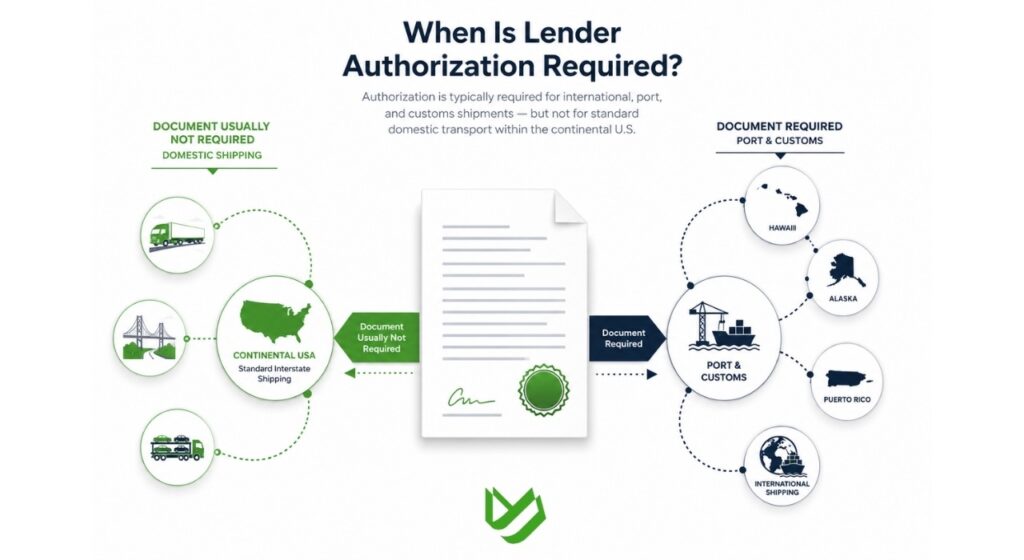
In short, almost never for a standard domestic move – but almost always for these four situations:
The section below explains why, plus how to get one quickly if your move falls into one of these categories.
Table of Contents
Yes. A loan or lease means your lender – the title holder or lienholder – holds a lien on the title, not that they control the physical vehicle. As long as your account is in good standing, transporting the car doesn’t require a loan payoff or a formal lien release. The carrier’s job is to move the vehicle safely from point A to point B – ownership status doesn’t change how the truck, the driver, or the paperwork at pickup and delivery works, whether you’re the registered owner, a borrower, or a lessee.
Where lenders do have a say is in your loan or lease contract itself. Some agreements include a relocation or geographic-restriction clause that requires you to notify the finance company before moving the vehicle across state lines, especially for a permanent vehicle relocation rather than a short trip. That’s a matter between you and your lender – separate from anything a shipping company or transport broker requires – so it’s worth a five-minute read through your agreement before you book.
This is the part that causes the most confusion, because the honest answer is: it depends on where your car is going and which carrier you book with.
| Destination | Typically Required? | Why |
|---|---|---|
| Continental U.S. (standard interstate move) | Usually not | No port, customs, or ocean-carrier involvement – most carriers only need the keys |
| Hawaii or Alaska | Almost always | Vehicles move by ocean carrier, and port processes generally require proof the lender has authorized the shipment |
| Puerto Rico or other U.S. territories | Almost always | Same port-based process as Hawaii and Alaska |
| International destinations | Almost always | Customs clearance abroad typically requires lienholder sign-off, sometimes notarized |
If your move is a standard state-to-state shipment within the continental U.S., don’t assume you need a letter just because you’ve seen the requirement mentioned elsewhere online – a lot of that content is written with port and international shipments in mind. Nearly all domestic shipments within the continental U.S. don’t require lender authorization, while shipments involving ports almost always do. Ask your specific carrier directly what they require; a straight answer is a good sign you’re working with a reputable transport broker. If you’re shipping to Hawaii, Alaska, or Puerto Rico, plan on the letter being part of the process from the start.
Expert Tip from Ryan Foster: Even when a lienholder letter isn’t required by the carrier, I’d still recommend a quick call to your lender if you’re relocating permanently rather than just visiting. It costs you five minutes and protects you from a relocation-clause issue you didn’t know was in your contract.
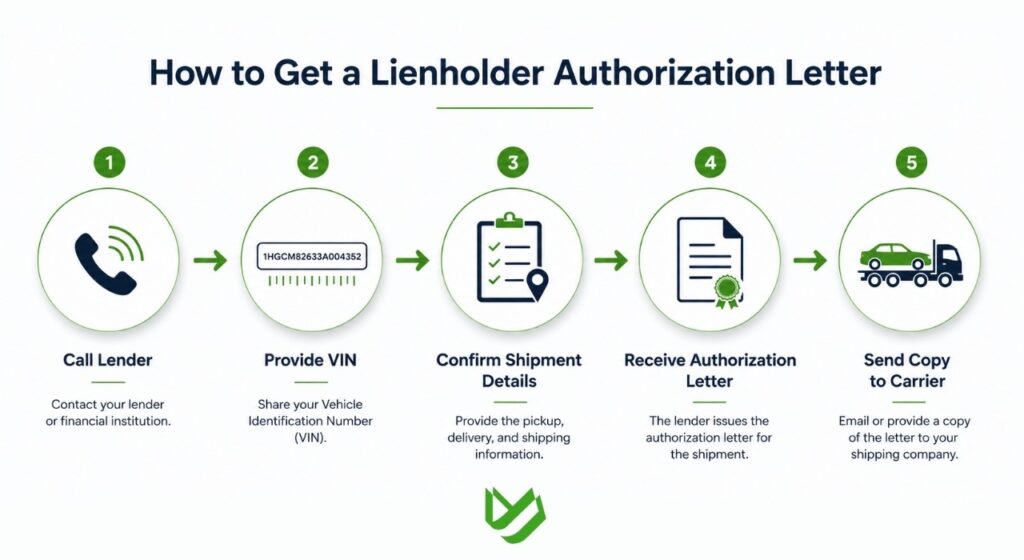
The lienholder authorization process is similar across finance companies – you’re asking a customer service line for a specific letter, not negotiating something unusual. Major auto lenders like Chase Auto, Capital One Auto Finance, Ally Financial, Bank of America, Toyota Financial Services, and Ford Credit all handle these requests routinely; call the number on your loan statement and ask for their auto transport or relocation authorization process by name. On the shipping side, the relevant regulator is the Federal Motor Carrier Safety Administration (FMCSA), a division of the U.S. Department of Transportation (DOT), which licenses and monitors the carriers who’ll actually move your car.
If your shipment does require one – or you’d rather have it on hand just in case – here’s how to get it:
Expert Tip from Ryan Foster: Start this process the moment you know your shipping window, not the week before pickup. A slow lender is the single most common reason a financed-vehicle shipment gets pushed back.
A proper lienholder authorization letter is typically issued on the lender’s official letterhead and should include:
Keep a copy for your own records alongside your other paperwork – see our vehicle shipping document checklist for everything else worth having on hand before pickup.
For shipping purposes, the process is essentially identical – a lienholder is a lienholder whether the vehicle is financed or leased. The one practical difference worth knowing about is what happens at the far end of the contract: a leased vehicle has mileage limits built into the agreement, while a financed vehicle doesn’t. That distinction matters more for the drive-vs-ship decision than for the shipping process itself, which we cover below.
| Financed Vehicle | Leased Vehicle | |
|---|---|---|
| Keys required at pickup | Yes | Yes |
| Extra cost vs. a standard shipment | No | No |
| Lienholder letter required for continental U.S. moves | Usually not | Usually not |
| Lienholder letter required for HI/AK/PR/international | Yes | Yes |
| Loan payoff required before shipping | No | No |
| Worth checking your contract for restrictions | Recommended | Recommended – especially mileage terms |
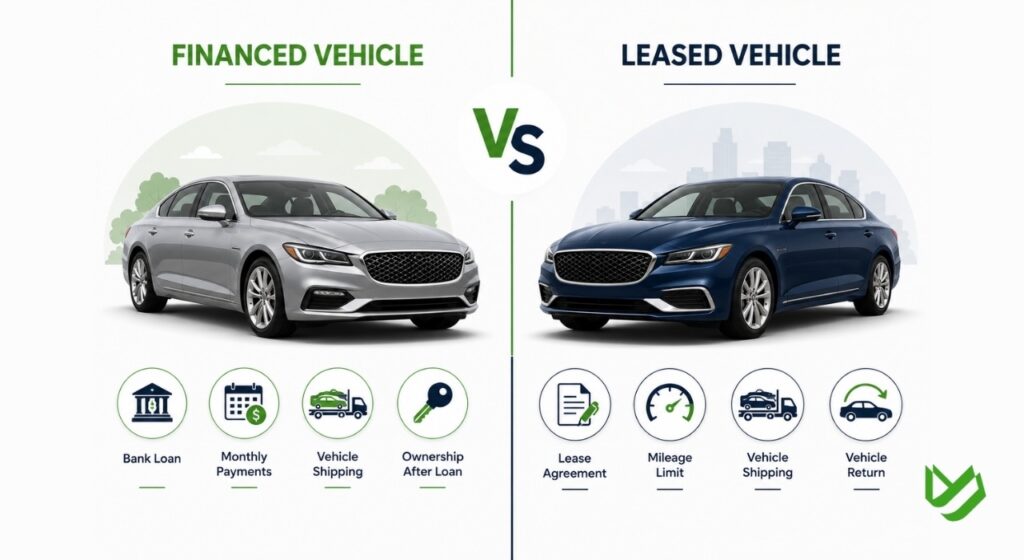
Side by side, the practical differences between shipping a financed vehicle and one you own free and clear come down to paperwork, not process:
| Factor | Financed / Leased | Owned Outright |
|---|---|---|
| Title holder | Lender (lienholder) | You |
| Authorization needed | Sometimes – port/international moves | No |
| Shipping price | Same | Same |
| Cargo insurance during transit | Same | Same |
| Documentation at pickup | Slightly different for HI/AK/PR/international | Standard |
| Keys required at pickup | Yes | Yes |
No. Your loan or lease status has no effect on the shipping rate. Pricing is based on the same factors as any other vehicle:
Typical rates for a standard domestic move run roughly $350–$1,500 depending on those factors – the same range you’d see for a vehicle with no lien at all. Use our auto transport calculator for a number specific to your route.
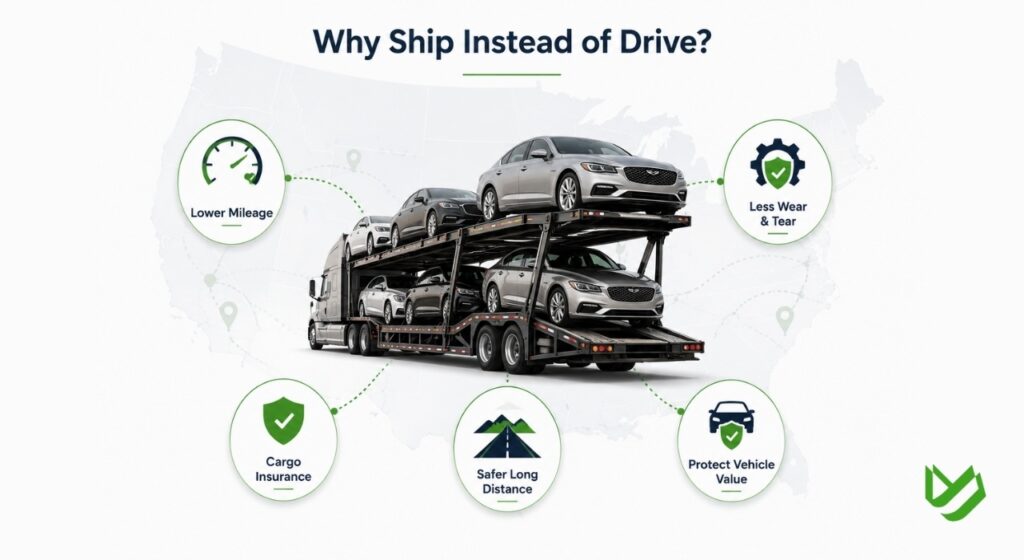
Driving a car you’re still paying off long-distance carries a few risks that shipping avoids entirely – this matters even more for a cross-country move than a short regional relocation:
Comes with cargo insurance: every carrier shipment includes coverage for the vehicle in transit, with condition documented at both pickup and delivery on the Bill of Lading.
Shipping a financed or leased vehicle follows the same steps as any other state-to-state car shipment – the loan or lease doesn’t add extra stages, only an optional paperwork step if your destination requires it:
Most of this route runs on standard timelines – see our guide on how long car shipping takes for what to expect. If you need something moved faster than a standard multi-car carrier allows, our hot-shot transport option and our full range of shipping services cover faster and more specialized options.
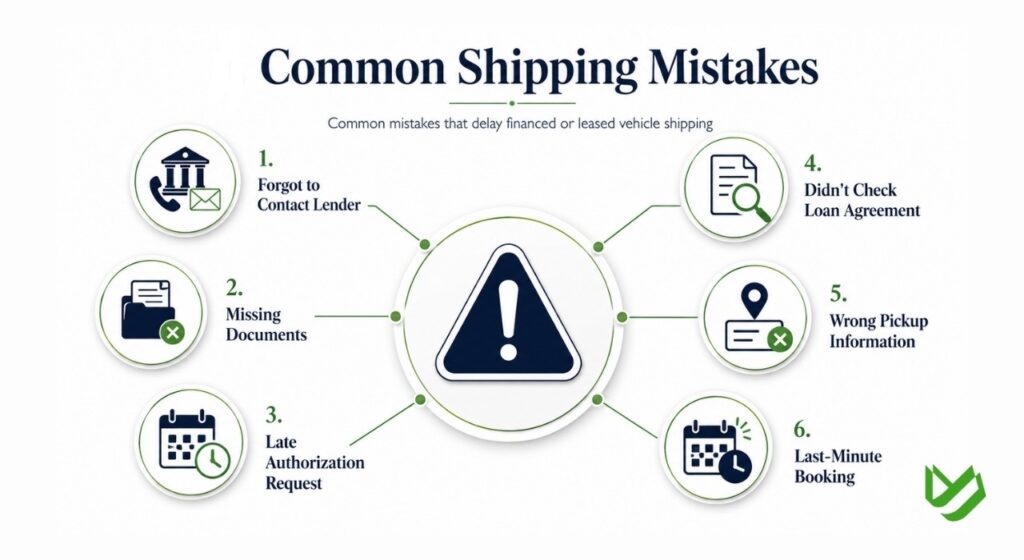
Before you book, a few simple mistakes can turn an otherwise straightforward shipment into a scheduling problem. Most delays happen because owners either request paperwork they don’t need or overlook requirements that apply to their specific destination.
Myth: You can’t ship a car you’re still financing.
Reality: You can. A lien on the title doesn’t prevent transport as long as your account is in good standing.
Myth: Shipping a financed or leased vehicle costs more.
Reality: It doesn’t. Price is based on distance, vehicle size, transport type, and season – not loan status.
Myth: You need to hand over the title to ship the car.
Reality: Usually not. Your lender holds the title until the loan is paid off, and most domestic carriers never ask to see it.
Myth: Your lender has to approve every shipment.
Reality: Only for port-based and international moves. Standard domestic shipments typically don’t involve the lender at all.
The short version:
Shipping a car you’re still paying off is more straightforward than it sounds – the lien on your title doesn’t stop the transport, and for the vast majority of domestic moves, the only thing your carrier needs is the keys. The one place to plan ahead is a port-based destination like Hawaii, Alaska, Puerto Rico, or overseas, where a lienholder authorization letter is standard practice and worth requesting early. Get a rate for your specific route with our auto transport calculator, and compare quotes from FMCSA-verified carriers through our car shipping service before you book.
Yes. A financed vehicle ships the same way as any other car. For a standard domestic move, the carrier typically just needs the keys at pickup.
Usually not for a standard move within the continental U.S. You will almost always need one for Hawaii, Alaska, Puerto Rico, or international destinations, since those moves go through a port.
No. The rate is based on distance, vehicle size, transport type, and season – not on whether you still owe money on the car.
No. The lender holds a lien on the title, but this doesn’t prevent transport. You can ship the vehicle with the loan still active, as long as your account is in good standing.
Yes, the shipping process is identical. The one thing to check separately is your lease’s mileage terms if you were considering driving instead – shipping avoids mileage penalties entirely.
Typically a few business days to two weeks, depending on the lender. Request it as soon as you know your shipping window, especially for Hawaii, Alaska, or international moves.
This is uncommon if your account is in good standing, but lenders can decline. It happens most often when payments are behind. If you’re relocating for a job or similar verifiable reason, explaining the circumstances to your lender can help.
No. Since the lienholder – not you – holds the title until the loan is paid off, carriers don’t need it for a standard domestic shipment. Title copies are sometimes requested for Hawaii, Alaska, or international moves.
Yes. Every carrier shipment includes cargo insurance for the vehicle in transit, verified through the FMCSA. Your own auto policy is separate and generally doesn’t need to be shown to the carrier.
Yes – this is the most common scenario, and it’s treated as a standard shipment. Just double-check your loan agreement for any relocation-notification clause before a permanent move.
Yes, but international shipments almost always require a lienholder authorization letter, and sometimes a notarized title copy, for customs clearance on the other end.
Not automatically, for a standard domestic move – carriers don’t report shipments to lenders. If your destination requires a lienholder letter, then yes, your lender is directly involved in approving that specific shipment.
Yes, with a notarized authorization letter from you naming that person, their contact information, and the vehicle’s VIN. Without it, most carriers won’t release the vehicle to anyone but you.










Don't have time to fill out the form?
Call a transport company directly to get a quote now!
Select the category you need
Partner with Compare The Carrier & Grow!
We're open to collaborations, partnerships, and mutual growth! Whether you're an individual or a business, we offer exciting opportunities to work together. Fill out the form below to explore how we can collaborate.
Something Went Wrong
We're sorry, but something went wrong. Please briefly describe the problem you experienced in the text area below. Providing your contact information will allow us to follow up if needed.

Thank you,
your form has been accepted.
Your form has been successfully submitted. We appreciate your effort — our team will review it shortly and take the next steps.


