

Cheapest Way to Move a Car to Another State – Every Option Compared
Most people planning a cross-state move lose between $200...
29 May 2026
Florida to Texas car shipping is one of the busiest southern corridors in the country, moving vehicles for tech and energy-sector relocations to Austin and Houston, military transfers between Gulf Coast bases, snowbirds returning west in spring, and buyers picking up cars from Florida auctions and dealerships. The route runs almost entirely along I-10, which keeps carrier density high and pricing more predictable than routes that cut through less-traveled corridors.
Calculate Shipping Quotes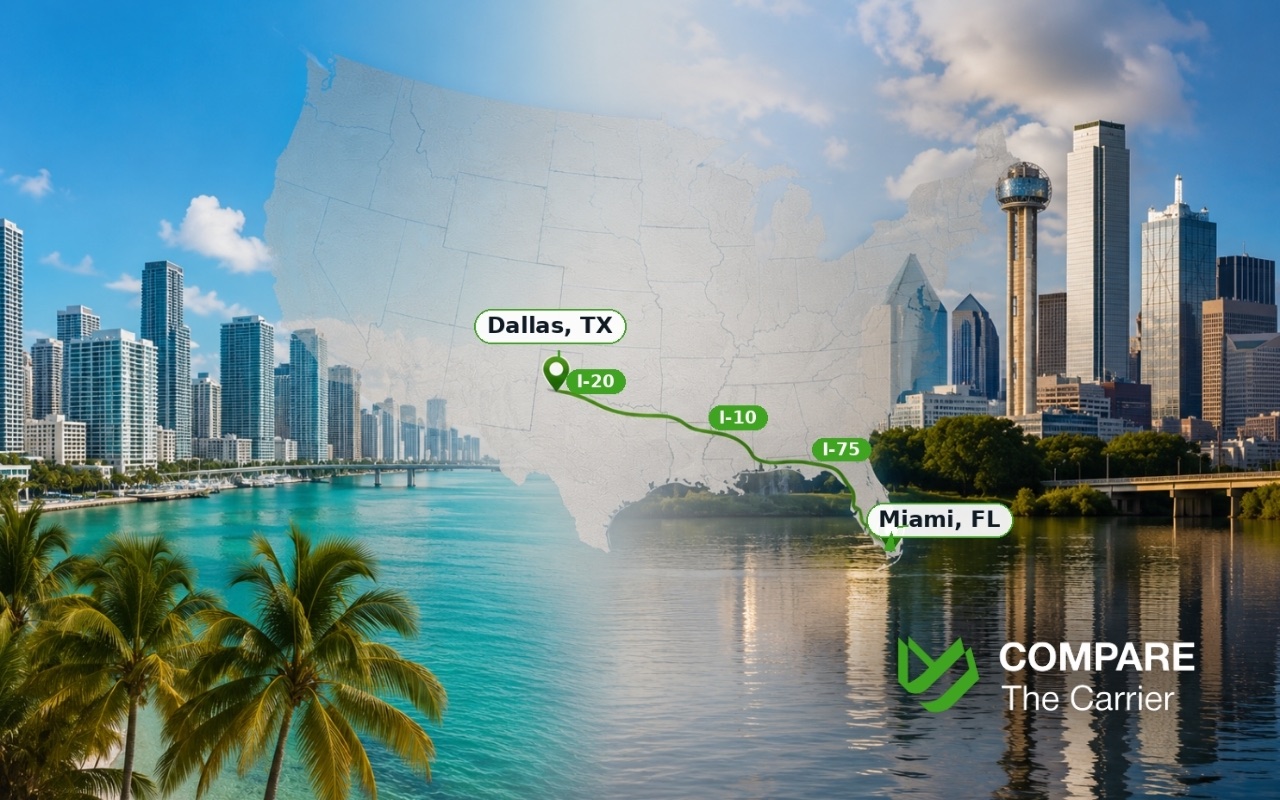
This guide breaks down real 2026 pricing by city pair, what actually drives your quote up or down, and how to avoid the two mistakes that cost people the most money on this route: booking during peak snowbird season with no flexibility, and skipping carrier verification on an unusually low quote. If you already know your dates, you can get a free shipping quote now and use the rest of this guide as a reference.
Quick Comparison
Table of Contents
Four distinct groups keep this lane consistently busy year-round, which is unusual for a route this long. Tech and energy-sector professionals relocate from Florida to Austin and Houston for jobs that simply don’t exist at the same scale back home. Military families transfer between Gulf Coast installations – MacDill, Eglin, and NAS Jacksonville on the Florida side, Fort Cavazos, JBSA, and Lackland on the Texas side – on a near-constant rotation tied to PCS orders. Snowbirds move the opposite direction twice a year, south into Florida for winter and back to Texas in spring. And a steady stream of buyers pick up vehicles from Florida auto auctions and dealerships for shipment home to Texas.
That combination of overlapping, non-seasonal demand is why carrier availability on this corridor rarely drops the way it does on quieter, single-purpose routes – and why dispatch times stay short even during the year’s busiest weeks.
Before the city-by-city breakdown, here’s the quick snapshot: shipping a car from Florida to Texas covers roughly 1,200 to 1,500 miles along I-10 and typically takes 1 to 4 days once your vehicle is picked up – one of the fastest cross-country transit windows in the country. Standard open transport runs $700 to $1,200 depending on vehicle size and exact cities, with enclosed transport running higher.
| Metric | Typical range |
| Distance | 1,200 – 1,500 miles |
| Transit time (open carrier) | 1 – 4 days |
| Transit time (enclosed carrier) | 3 – 8 days |
| Open transport cost | $700 – $1,200 |
| Enclosed transport cost | $1,400 – $1,950 |
| Main highway corridor | I-10 |
Most shipments on this corridor run between a handful of high-volume city pairs. Carrier density is highest on these routes, which generally means faster pickup and more competitive pricing than less common origin-destination combinations.
| Route | Distance | Open transport | Enclosed transport |
| Jacksonville, FL → Houston, TX | 1,000 mi | $771 – $1,205 | $1,450 – $1,850 |
| Miami, FL → Dallas, TX | 1,310 mi | $793 – $1,238 | $1,500 – $1,900 |
| Orlando, FL → Houston, TX | 1,150 mi | $750 – $1,150 | $1,450 – $1,850 |
| Tampa, FL → San Antonio, TX | 1,190 mi | $775 – $1,180 | $1,500 – $1,900 |
| Miami, FL → Austin, TX | 1,370 mi | $850 – $1,250 | $1,550 – $1,950 |
Shipping the reverse direction? Texas to Florida runs the same I-10 corridor and generally lands slightly cheaper per mile, since backhaul demand from Texas toward Florida’s dense population centers tends to run higher – worth checking both directions if your dates are flexible.
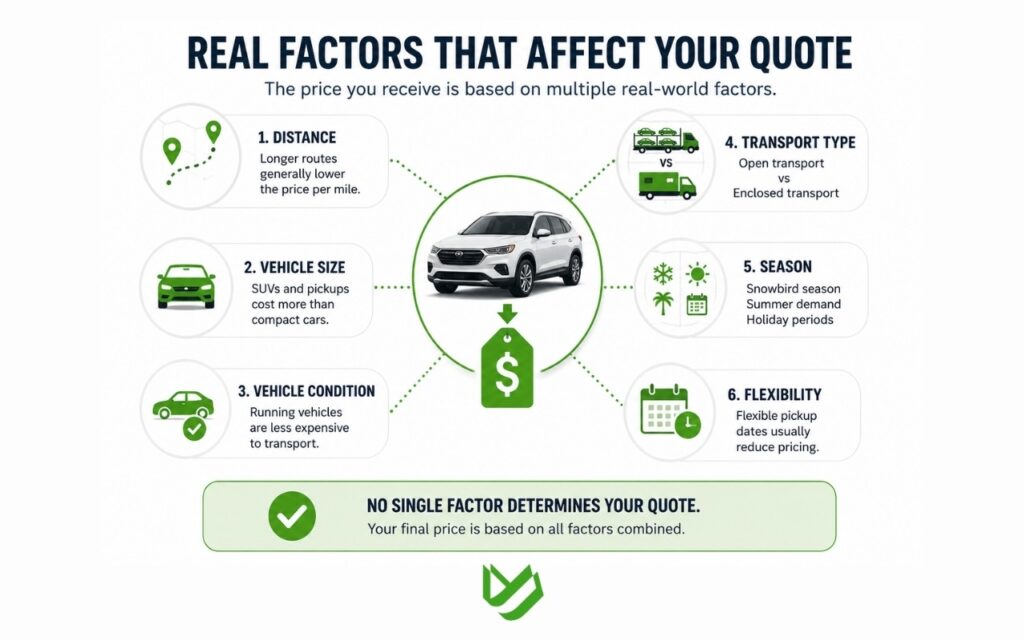
1. Distance and Exact ZIP Codes
Carriers price by mileage between the specific pickup and delivery ZIP codes, not the general Florida to Texas distance. A shipment between two metro hubs on I-10 costs less than the same trip to a rural address requiring a detour off the main corridor.
2. Vehicle Size and Weight
A standard sedan takes up one slot on a multi-car trailer. A full-size SUV or pickup truck takes up more deck space and adds weight, which reduces how many vehicles a carrier can load – that capacity loss typically adds 15–30% over sedan rates on this route. Larger vehicles like vans, commercial trucks, and RVs and travel trailers are quoted separately from standard car-shipping pricing.
3. Open vs. Enclosed Transport
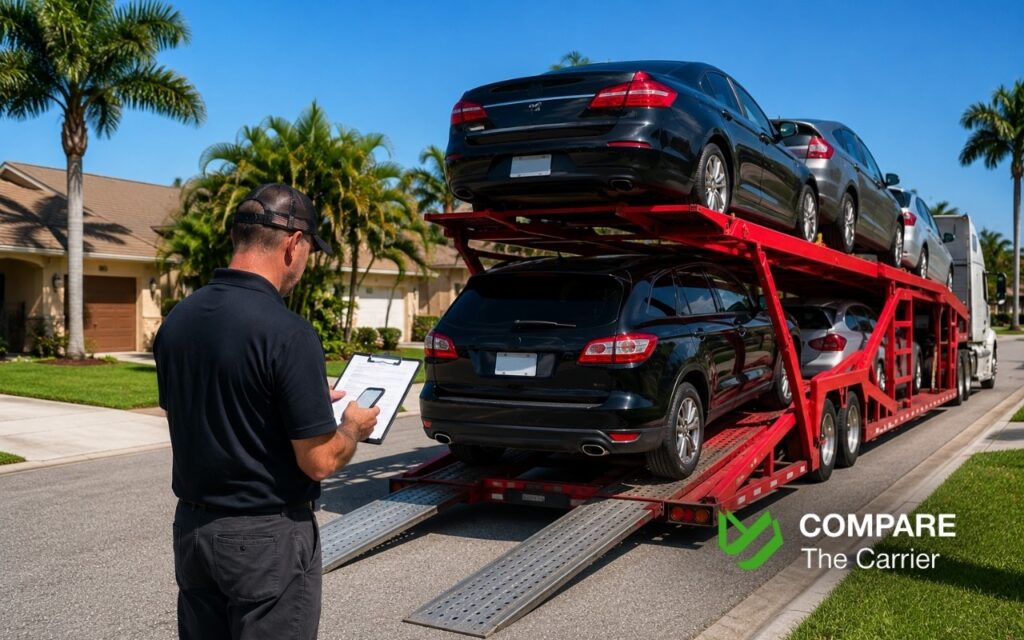
Open transport is the standard, most affordable option and covers the large majority of shipments on this corridor. Enclosed transport protects the vehicle from road debris and weather, which matters more during Gulf Coast hurricane season than on a dry-weather route – but it typically costs 60–90% more and takes longer, since enclosed trailers carry fewer cars per load.
4. Season and Timing
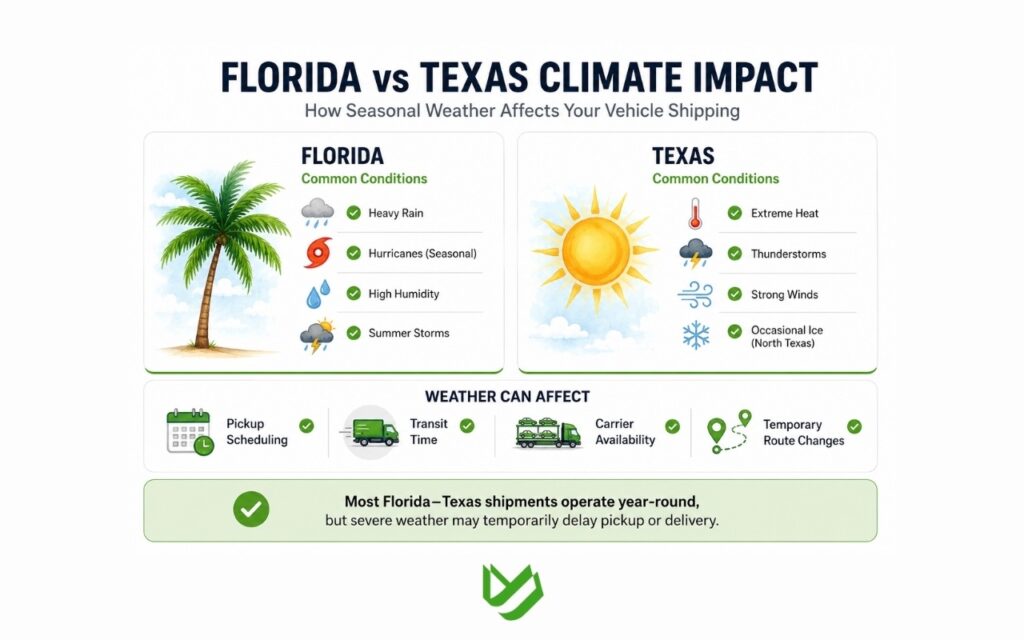
Snowbird season drives the biggest seasonal swing on this corridor: demand – and prices – climb heading into Florida in fall and winter, and again heading back toward Texas in spring. Hurricane season (June through November) can also affect Gulf Coast scheduling. Late spring and summer, outside of hurricane disruptions, tend to be the cheapest windows.
5. Pickup Window Flexibility
A rigid same-day pickup requirement costs more than offering a 3–5 day flexible window. The wider your window, the easier it is for a carrier already running the I-10 corridor to slot your vehicle in without an empty detour.
Carriers on this lane run almost entirely on I-10, passing through the Florida panhandle, Mobile, and New Orleans before reaching Houston, then fanning north to Dallas-Fort Worth via I-45 or west toward San Antonio and Austin. This is one of the most direct major interstate corridors in the country, which is why transit is unusually fast for the distance – most open-carrier shipments complete in 1 to 4 days once picked up, and dispatch itself often happens within 1 to 3 days thanks to consistently high carrier density on this lane.
Enclosed carriers move slower, typically 3 to 8 days, since they run smaller, less frequent routes with fewer available trucks.
At roughly 1,200 to 1,500 miles, driving the route yourself is an 18–22 hour trip behind the wheel, not counting stops. Towing with a dolly or trailer cuts some of that cost but carries its own risks – not every vehicle can be flat-towed without drivetrain damage, and rental tow equipment adds daily costs that stack up over a multi-day haul. Our state-to-state car towing guide walks through which vehicles can and can’t be towed safely.
| Driving yourself | Towing (dolly/trailer) | Professional shipping | |
| Your time | 18–22+ hours driving | 18–22+ hours driving | 0 hours – you fly or drive unloaded |
| Added mileage/wear | 1,200+ miles on your car | None on towed car, tow vehicle wears | None |
| Estimated cost* | $280–$450 (fuel, food, lodging) | $350–$600 (rental + fuel + lodging) | $700–$1,200 (open transport) |
| Risk | Driver fatigue, breakdown risk | Drivetrain damage on some vehicles | Carrier handles all driving and liability |
*Estimates assume solo travel at standard fuel prices; costs rise with tolls, repairs, or a second driver’s flight home. On a route this fast – often under 4 days by carrier – the time savings alone make shipping worth the price gap for most people.
There’s also a logistics question driving and towing don’t solve on their own: getting yourself back to your starting point, or getting to your new city ahead of the vehicle. Shipping lets you fly directly to Texas and have the car arrive within days, rather than spending a full day and a half on the road and arriving exhausted the same time your belongings do.
A handful of concrete choices actually move the price on this route:
For a broader rundown of savings tactics that apply beyond this specific route, see our full guide: Cheapest Way to Move a Car to Another State.
Unlike a lot of cross-country lanes, Florida-to-Texas pricing follows two distinct seasonal patterns rather than one flat summer peak – because it’s driven by snowbird migration in both directions, not just general relocation season.
| Season | Demand direction | Typical price impact |
| Fall (Sept – Nov) | Snowbirds heading into Florida | Above average, rising toward winter |
| Winter (Dec – Feb) | Peak snowbird season in Florida | Highest of the year, book 3–4 weeks ahead |
| Spring (Mar – May) | Snowbirds returning to Texas | Above average, especially March–April |
| Summer (Jun – Aug) | General relocations, some hurricane risk | Moderate – lower than snowbird peaks, but Gulf storms can add delays |
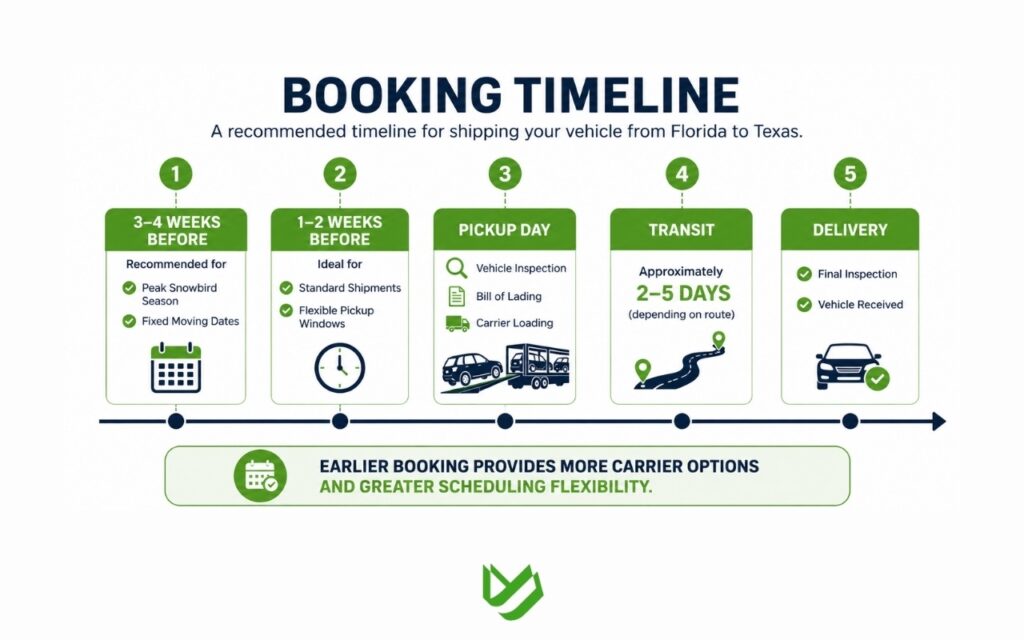
If your dates are flexible, late spring after the snowbird return rush (typically May) and late summer before fall demand builds tend to offer the most competitive combination of low pricing and reliable transit times. If you must ship during a peak window, booking 3 to 4 weeks ahead – rather than the 1 to 2 weeks that’s often enough off-season – protects both your price and your pickup date.
Every quote you receive on this route comes from either a direct carrier – a company that owns and operates its own trucks – or a broker, who coordinates your shipment through a network of independent carriers rather than running trucks themselves. Neither option is inherently better; the right choice depends on what you’re optimizing for.
A direct carrier gives you a single point of contact for the entire shipment and, on a route this dense, often a tighter pickup window since you’re not waiting for a broker to match you with an available truck. A broker, on the other hand, can tap a much larger pool of vetted carriers competing for your business, which tends to produce more competitive pricing and faster dispatch precisely because Florida-to-Texas is such a high-volume lane – brokers have more trucks to choose from on this corridor than almost any other. The tradeoff is an extra layer of coordination between you and the truck that ultimately moves your car.
Whichever you choose, the verification steps are the same: confirmed FMCSA registration, documented insurance coverage, and a price locked in writing before your vehicle is picked up.
A handful of avoidable missteps account for most of the bad experiences on this corridor:
If you’re relocating rather than just sending a car to family, Texas has requirements that apply as soon as your vehicle arrives:
None of these are shipping-company requirements – they’re state DMV rules that apply once your car is in Texas, so budget the inspection and registration fees separately from your transport quote.
Even on a fast route like this one, a few minutes of prep the day before pickup prevents most of the disputes that come up during transit. None of these steps are optional extras – they’re what protects you if something does go wrong.
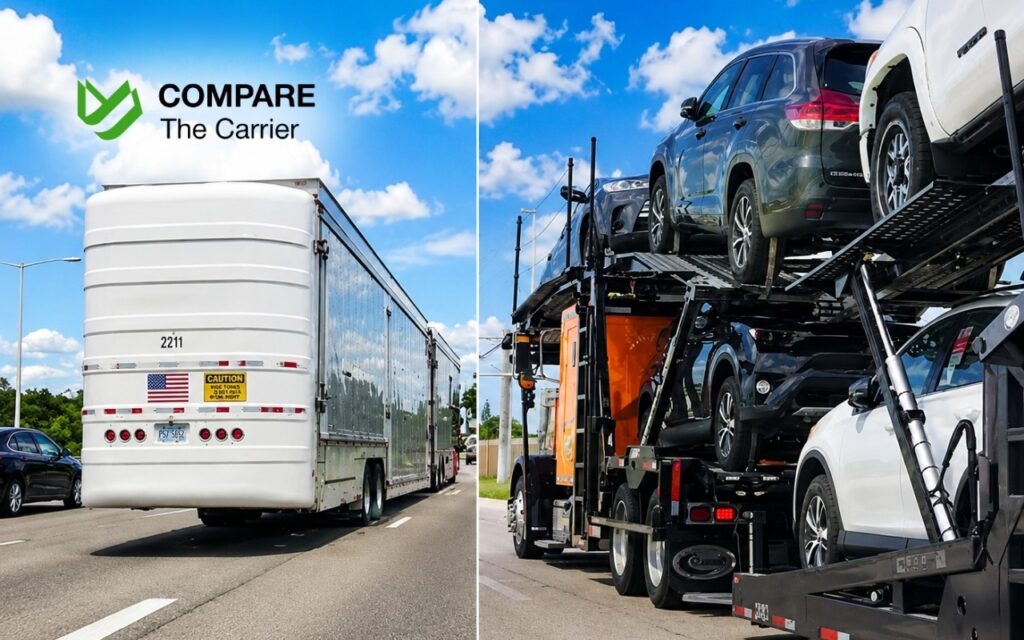
| Open transport | Enclosed transport | |
| Best for | Standard daily-driver vehicles | Classic, luxury, or high-value cars |
| Cost vs. open | Baseline | 60–90% higher |
| Weather exposure | Fully exposed | Fully protected |
| Availability on this route | High – most common option | Lower – fewer trucks, longer lead time |
Compare both directly through open car shipping or enclosed auto transport before booking.
Because this is a high-volume corridor, you’ll see a wide range of quotes – and the gap between the cheapest and most expensive offer is usually a signal, not a bargain. Run through this checklist before you book:
Start with the FMCSA SAFER system to confirm licensing, then compare multiple state-to-state car shipping quotes side by side.
Given how fast this corridor moves, delivery often arrives sooner than people expect – sometimes within 48 hours of pickup on a direct-route shipment. Your driver will typically call 24 to 48 hours ahead to confirm an arrival window, and again the morning of delivery once they’re within a few hours of your address. Have your ID and the original Bill of Lading ready, walk the vehicle with the driver before signing anything, and check it against the same points documented at pickup – tires, glass, body panels, and undercarriage if the vehicle rode on the bottom deck of an open trailer. Any new damage needs to be noted directly on the Bill of Lading before you sign; a verbal mention to the driver afterward carries no weight with a carrier’s insurance claim.
Shipping from Florida to Texas is one of the fastest and most reliably available cross-country corridors in the industry – the direct I-10 route keeps carrier density high and dispatch times short. Avoid the two biggest cost traps on this lane: booking during peak snowbird season with zero flexibility, and accepting an unrealistically low quote without verifying the carrier’s FMCSA status first. Compare real quotes from vetted, licensed carriers on Compare The Carrier’s shipping page, browse the full range of shipping services if you’re moving more than one vehicle, or run your exact route and dates through the auto transport calculator for a personalized estimate.
Open transport typically runs $700 to $1,200 for a standard sedan or SUV, while enclosed transport runs $1,400 to $1,950. Exact pricing depends on your specific pickup and delivery cities, vehicle size, and season.
Open carrier shipments typically take 1 to 4 days door-to-door – one of the faster cross-country windows, thanks to the direct I-10 corridor. Enclosed transport takes longer, usually 3 to 8 days.
Open transport is the most affordable option. Booking outside snowbird season, offering a flexible multi-day pickup window, and choosing suburban pickup or delivery points over dense downtown areas all help lower the price.
Pricing runs close in both directions, but Texas-to-Florida shipments sometimes land slightly cheaper per mile due to stronger backhaul demand toward Florida’s dense population centers. Check both directions if your dates are flexible.
Jacksonville to Houston and Miami to Dallas are among the highest-volume city pairs on this corridor. High-volume routes generally mean faster pickup and more competitive pricing.
It can. Gulf Coast weather from June through November occasionally affects scheduling and routing along I-10, so building in a few extra days of flexibility during hurricane season is worth considering.
Yes, most carriers on this route can transport inoperable vehicles using a winch or forklift, but this requires specialized equipment and typically adds to the cost – let your broker know upfront.
Yes, or you need to designate another adult to stand in for you. Someone needs to inspect the vehicle, confirm its condition against the Bill of Lading, and sign off at both pickup and delivery.
For standard timing, 1 to 2 weeks ahead is usually enough given how dense carrier availability is on this route. During peak snowbird season or with inflexible dates, book 3 to 4 weeks out.
You’ll need your vehicle’s registration or title, a valid ID, and – if the car is leased or financed – written authorization from your lender. If you’re relocating, Texas requires registration and a safety inspection within 30 and 90 days respectively of establishing residency.








Don't have time to fill out the form?
Call a transport company directly to get a quote now!
Select the category you need
Partner with Compare The Carrier & Grow!
We're open to collaborations, partnerships, and mutual growth! Whether you're an individual or a business, we offer exciting opportunities to work together. Fill out the form below to explore how we can collaborate.
Something Went Wrong
We're sorry, but something went wrong. Please briefly describe the problem you experienced in the text area below. Providing your contact information will allow us to follow up if needed.

Thank you,
your form has been accepted.
Your form has been successfully submitted. We appreciate your effort — our team will review it shortly and take the next steps.


