

Best East Coast Auto Transport Companies of 2026
Whether you're a car dealer or intend to ship your car to...
12 September 2022
Most RV owners planning a relocation make a critical mistake: they calculate the cost of fuel, add a bit for snacks, and assume driving themselves is the “budget” choice. In 2026, the math has shifted. With rising maintenance costs for heavy-duty trucks and the increased premium on personal time, the DIY route often ends up costing more than a professional carrier, while adding thousands of miles of wear to your transmission and tires.
Calculate Shipping Quotes
The real question isn’t just “What is the cheapest way to move an RV?” but rather, “At what point does the cost of my time and vehicle depreciation exceed the price of a professional transport?” This article provides a full cost breakdown for every RV class, from lightweight travel trailers to massive Class A diesel pushers, to help you find that tipping point.
For vetted RV shipping companies and real customer ratings, see our top RV shipping companies guide.
If you are towing a 30-foot bumper pull 1,500 miles, you aren’t just paying for diesel. You are paying for a hotel room every night, the accelerated maintenance schedule for your tow vehicle, and the opportunity cost of being away from work and family for four or five days.
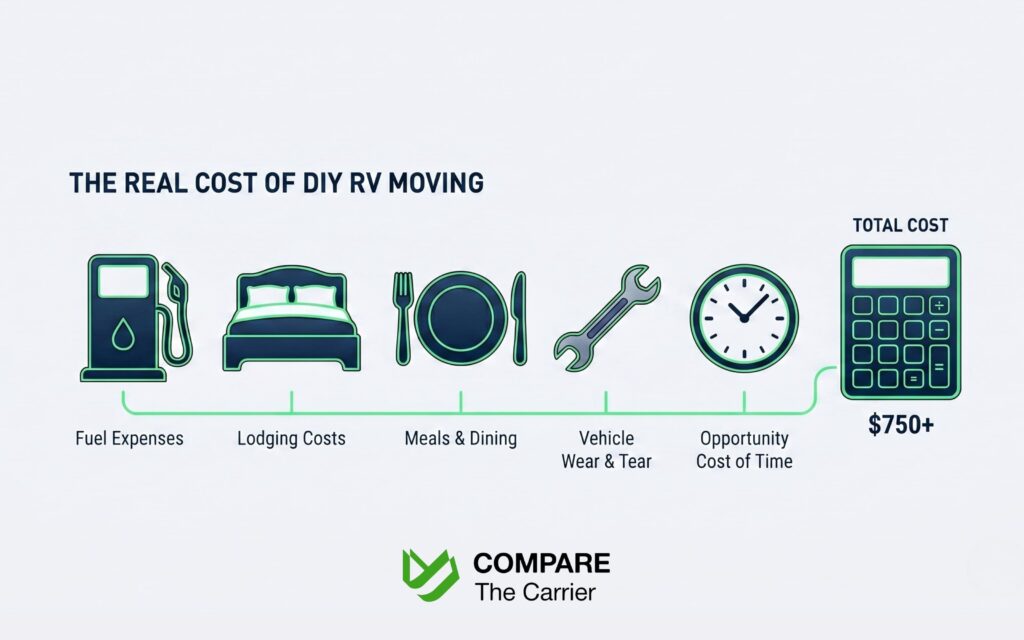
The Full DIY Towing Cost Formula
To get an honest number, use this formula:
Total DIY Cost = [Fuel] + [Lodging] + [Meals] + [Tow Vehicle Wear] + [Lost Income] + [Risk Premium]
Real-world example: Florida to California (~2,500 miles), moving a Class C motorhome or large 5th wheel.
| Expense | 2026 Calculation | Estimated Total |
| Fuel (diesel/gas) | 2,500 mi ÷ 9 MPG × $3.50/gal | $972 |
| Lodging | 4 nights × $150/night | $600 |
| Meals | 4 days × $60/day | $240 |
| Tow vehicle wear | 2,500 mi × $0.15/mile | $375 |
| Lost income | 4 work days × $250/day | $1,000 |
| Total DIY | ~$3,187 | |
| Professional shipping | FL → CA carrier quote | $2,500–$3,500 |
On any distance exceeding 1,500 miles, the financial difference between doing it yourself and shipping is almost negligible. The difference is that shipping lets you fly to your destination in 4 hours, while driving takes 4 to 5 days of high-stress highway navigation.
On forums like r/RVLiving, experienced towers consistently point out that a 2,500-mile trip while maxing out your towing capacity is not “just another drive.”
Transmission stress: Towing a heavy load creates extreme heat in the transmission. Experts estimate that 2,500 miles of heavy towing can be equivalent to 37,000 miles of normal unladen driving in terms of transmission fluid oxidation and gear wear.
Brake glazing: Navigating mountain passes on the way to California can glaze brake pads and warp rotors, often leading to a $600–$1,200 repair bill shortly after arrival.
Tire lifespan: Towing significantly increases heat and friction on rear tires, typically shortening their lifespan by 15–20% on a single cross-country trip.
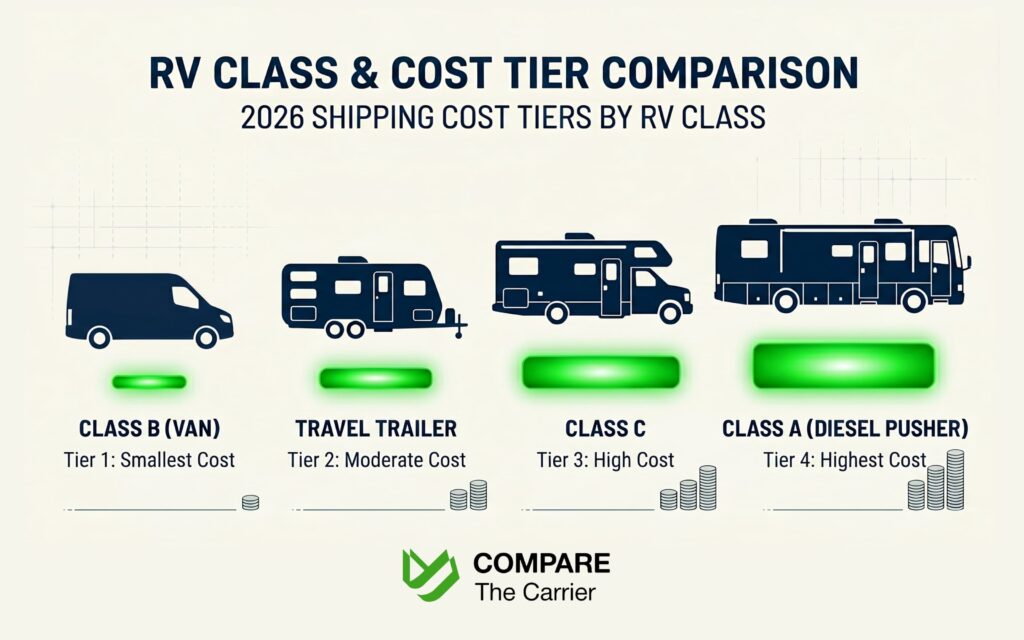
Professional RV transport prices vary based on the size of the unit and the method used. In 2026, tow-away remains the most common method for trailers, while drive-away is standard for motorhomes.
| RV Type | Under 500 mi | 500–1,000 mi | 1,000–2,000 mi | 2,000+ mi |
| Travel Trailer (under 30 ft) | $800–$1,200 | $1,200–$1,800 | $1,800–$2,500 | $2,500–$3,500 |
| 5th Wheel | $1,000–$1,500 | $1,500–$2,200 | $2,200–$3,000 | $3,000–$4,500 |
| Class C Motorhome | $1,200–$1,800 | $1,800–$2,500 | $2,500–$3,500 | $3,500–$5,000 |
| Class A Motorhome | $1,500–$2,500 | $2,500–$3,500 | $3,500–$5,000 | $5,000–$7,000+ |
| Class B (Van) | $700–$1,000 | $900–$1,400 | $1,200–$2,000 | $2,000–$3,000 |
The rate per mile drops as distance increases, which is why long-distance shipping is often more economical than it first appears – for a full breakdown of how distance affects car and RV transport pricing, see our state-to-state car towing guide.
Note: Per-mile rates above apply to travel trailers and Class B/C units. Class A motorhomes run 2–3x higher due to size, weight, and permit requirements.
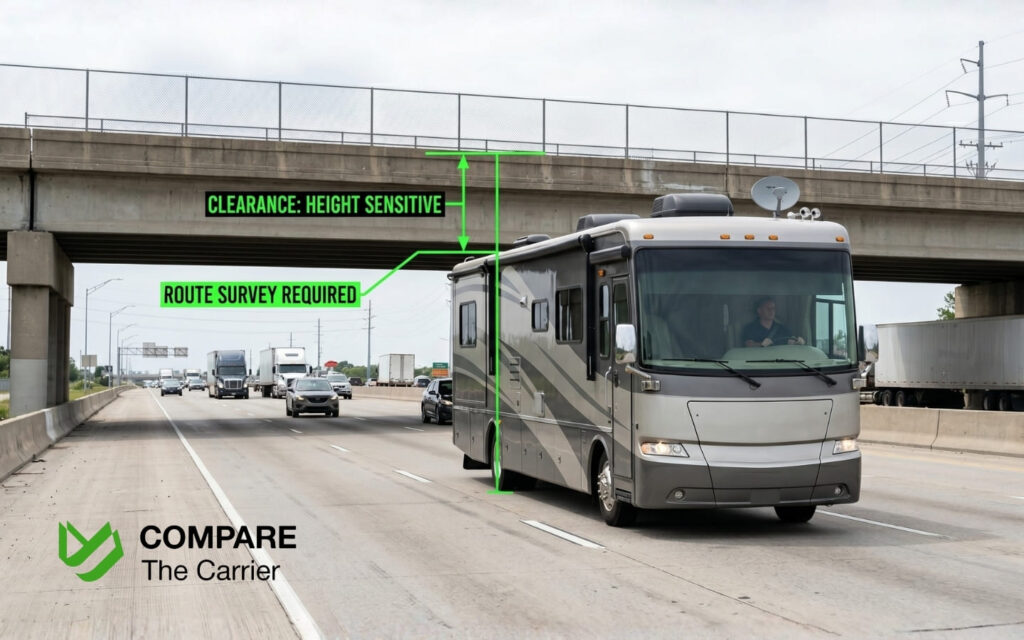
Height clearance and route surveys: Most Class A motorhomes are tall, but if your unit exceeds 13’6″, it cannot pass under many standard highway bridges. The carrier must conduct a route survey and obtain specialized permits, which add $200–$500 to the quote.
Oversize permits: If your RV is wider than 8’6″ – common for luxury 5th wheels with wide-body designs – it is legally an oversize load. This requires state-specific permits for every state the truck passes through, with rates varying significantly by state.
Drive-away vs. tow-away: Drive-away is often slightly cheaper than flatbed but adds mileage to your odometer. Tow-away is the baseline rate for trailers. If your trailer is inoperable, you need a flatbed, which increases cost by 30–50%.
Stuck slide-outs: Carriers assume slide-outs are fully functional and can be retracted. A slide-out stuck in the open position requires a lowboy trailer and potentially an escort vehicle, which can double the cost.
The 1,000-Mile Rule (With 2026 Nuances)
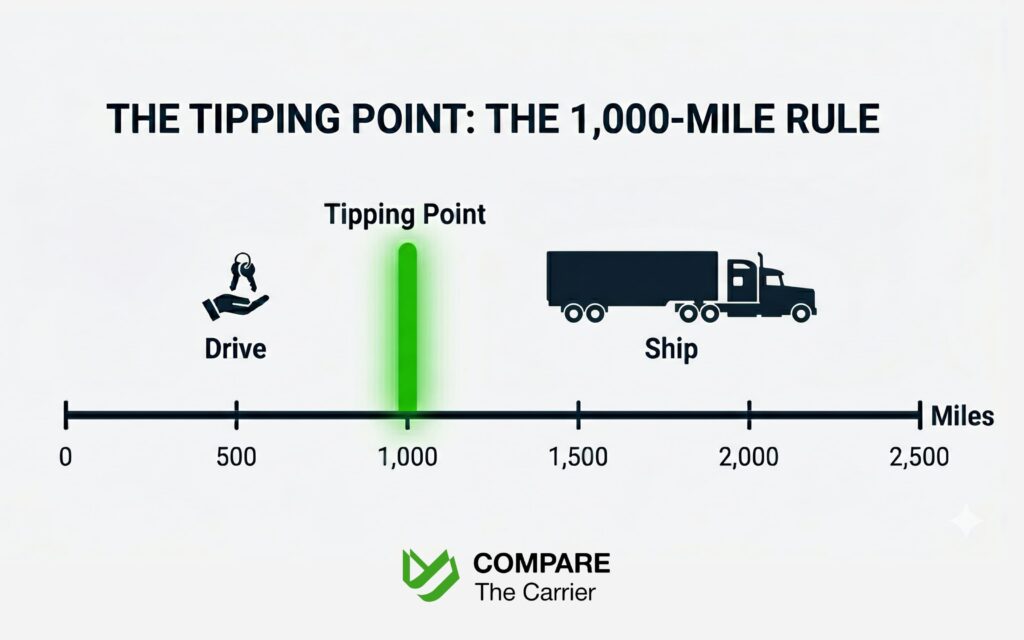
For most Class C motorhomes and travel trailers, 1,000 miles is the break-even point where hard DIY costs equal the price of a professional service.
| Distance | Verdict | Why |
| Under 400 miles | Drive/Tow | Carrier minimum load fees (~$800) exceed your DIY cost for a 6-hour drive |
| 400–1,000 miles | It’s a Wash | Run the full DIY formula. If you have a capable truck and love the road, drive. If you have a deadline, ship. |
| 1,000–1,500 miles | Lean Toward Ship | A 3–4 day commitment. Two nights of hotels and $600 in diesel makes shipping highly competitive |
| 1,500+ miles | Ship (Clear Winner) | Cross-country adds massive wear to tires and transmission. Shipping preserves value and saves 5+ days |
You lack the right tow vehicle. If you just bought a 12,000 lb 5th wheel but own a half-ton truck, do not attempt the move. Renting a 3/4-ton truck costs $120–$180/day plus a towing surcharge – shipping is almost always cheaper than renting.
Time is money. If you earn $300+/day and would lose 5 days of work, you have effectively spent $1,500 on time alone before touching fuel or hotels.
Heavy Class A motorhomes. Large diesel pushers can require a non-commercial Class B or even a CDL license in some states if they exceed 26,000 lbs. If you are not licensed or are not comfortable driving a 40-foot unit through mountain passes, a professional drive-away is a safety necessity, not just a convenience.
The snowbird backhaul. Moving from the North to Florida in October or November? Hundreds of carriers are heading south and competing for loads. You can often find a backhaul rate that beats the combined cost of fuel and hotels. See our snowbirds auto transport guide for seasonal logistics.
Under 400 miles with a capable tow vehicle. The carrier’s minimum fee makes short-haul shipments expensive. If you already own the right truck, a one-day drive beats the quotes.
You can eliminate lodging costs. Reddit’s most-cited cost-saver: if you can stay with friends or family along the route, you remove the biggest DIY expense. On a 600-mile move with free overnight accommodation, driving wins.
You enjoy the journey. If you have flexible timing and want to stop at campgrounds along the way, the drive itself becomes part of the relocation experience rather than a burden.
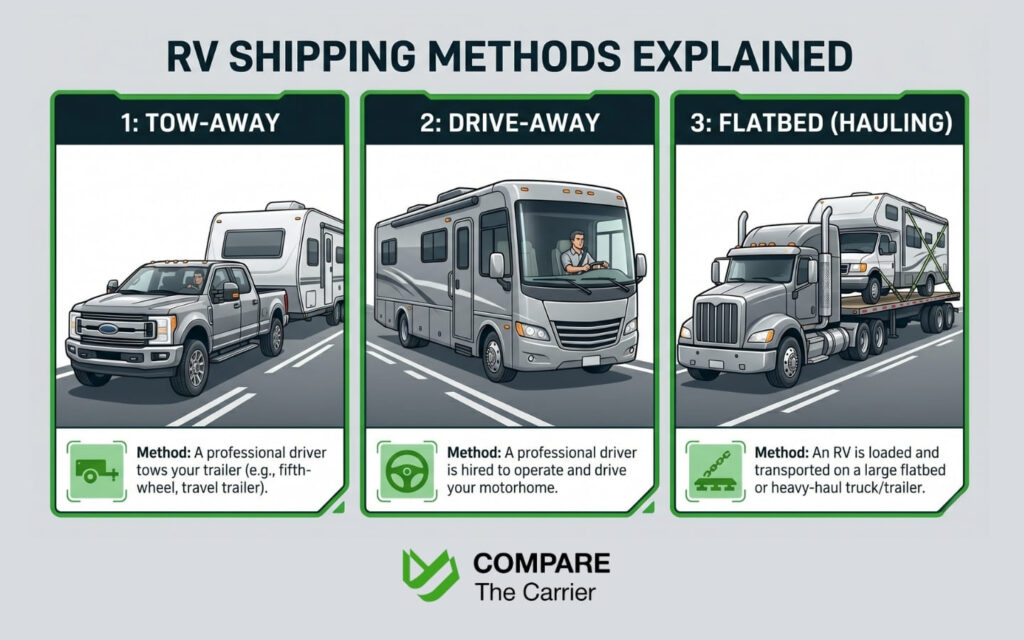
Tow-Away (Most Common – ~60% of Shipments)
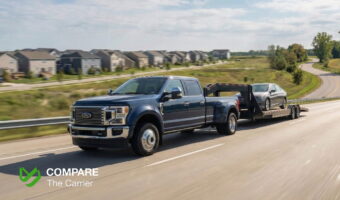
Standard for travel trailers, 5th wheels, and pop-up campers. A professional driver uses a heavy-duty dually (typically a RAM 3500 or Ford F-350) to tow your RV using its own hitch.
Drive-Away
Used exclusively for motorhomes (Class A, B, and C). A licensed, background-checked driver sits in your driver’s seat and drives the RV to the destination.
Flatbed / Lowboy
The RV is physically loaded onto a specialized trailer. Only option for inoperable RVs or ultra-premium units where the owner wants zero road miles and zero undercarriage exposure.
| Method | Best For | Cost Premium | Odometer Impact |
| Tow-Away | Travel trailers, 5th wheels | Base rate | None |
| Drive-Away | Class A, B, C motorhomes | +15–25% | Yes – adds miles |
| Flatbed / Lowboy | Inoperable, oversized, high-value | +30–50% | None |
For more on tow-away logistics for travel trailers and 5th wheels, see our RV shipping guide.
| Season | Months | Demand | Price Impact | Strategy |
| Off-Peak | Jan–Feb | Low | 10–15% below base | Best time to ship north or west |
| Spring | Mar–Apr | Moderate | Standard rates | Snowbirds returning north; book 3 weeks out |
| Peak | May–Aug | Highest | +20–30% | Summer movers; expect delays |
| Snowbird | Sept–Dec | Very High (FL routes) | +25–35% | Avoid North → South if possible; book 4–6 weeks ahead |
Key insight: Shipping FL→Northeast in November is one of the cheapest RV moves in the calendar – carriers are heading home empty and competing for backhaul loads. Shipping Northeast→FL in November is one of the most expensive – every retiree is heading south at the same time. Expect to pay $400–$600 more on that corridor during peak snowbird season. To find carriers who specialize in seasonal Florida routes, see our top RV shipping companies.
Poor preparation is the most common reason transport insurance claims are denied. Because RVs are essentially houses on wheels, they contain hundreds of loose components that can become projectiles during highway-speed vibrations.

The RV Prep Checklist
Slide-outs – fully retracted and locked. Mechanical slide-outs are not designed to withstand lateral G-forces during transport. Retract fully and engage all travel locks. A slide-out that shifts even one inch during transit can cause thousands of dollars in structural damage.
Propane – closed and confirmed off. All propane valves must be closed before carrier arrival. For flatbed transport, many carriers require tanks to be physically disconnected. Confirm requirements with your driver in advance. A carrier will refuse the load if the propane is open.
Awnings – retracted and double-secured. Wind resistance at 70 mph can unfurl an unsecured awning. Use zip ties or heavy-duty Velcro straps on the awning arms as a secondary measure beyond the standard latch.
Water tanks – completely drained. A full 50-gallon fresh water tank adds over 400 lbs of sloshing weight. This affects carrier stability, stresses tank mounts over long distances, and risks freeze damage in cold-weather transit. Drain fresh, grey, and black tanks before pickup.
Interior cabinets – latched, taped, and cleared. Remove all fragile items. Tape cabinet doors shut as a secondary measure. Most carriers allow up to 100 lbs of RV-related gear (hoses, leveling blocks) stored on the floor over the axles – not stacked in overhead compartments.
Exterior – TV antennas, dishes, and accessories secured. Ensure antennas are in travel position. Check solar panel mounting brackets. Remove bicycle racks and exterior grill attachments that can catch wind or vibrate loose.
House batteries – disconnected for long hauls. For transport lasting more than 5 days, disconnect the house batteries to prevent CO2 and propane detectors from creating a parasitic drain that kills your batteries in transit.
Tires and bearings – for tow-away only. Inflate tires to the maximum cold pressure shown on the sidewall. Confirm wheel bearings have been serviced within the past 12 months. The carrier’s insurance does not cover damage caused by pre-existing tire or bearing failure.
What NOT to Do
The decision to drive or ship your RV when relocating comes down to one clear rule: under 400 miles with the right tow vehicle, drive. Over 1,000 miles, ship. Between 400 and 1,000 miles, run the full formula – your time, your tow vehicle’s wear, and your lodging costs determine the answer.
For most long-distance relocations, professional transport preserves your RV’s mechanical condition, eliminates travel fatigue, and often costs the same or less once every hidden DIY expense is counted.
Get a free quote for your RV route using our vehicle shipping calculator
For more on choosing the right carrier for your specific RV type, see our comprehensive RV shipping guide.
For most RVs, the tipping point falls between 800–1,200 miles. Below that distance, fuel and time costs of driving usually stay lower than a shipping quote. Beyond it, hidden DIY costs – fuel, hotels, meals, and tow vehicle wear – typically catch up to or exceed professional shipping rates, especially for Class A motorhomes averaging 8–10 MPG.
Travel trailers and 5th wheels typically ship for $1.50–$3.00 per mile via tow-away, since no special driver license or odometer cost applies. A 1,000-mile move usually falls between $1,800 and $3,200, depending on trailer length and route demand.
No – tow-away and drive-away RV shipping use the carrier’s truck or driver, not your personal vehicle. This is one of the main cost advantages over DIY towing, where your own vehicle absorbs the mileage, fuel cost, and mechanical wear.
A broker arranges transport by matching your shipment to available carriers and typically charges no extra fee – the carrier’s rate is built into the quote. A carrier owns the trucks and drivers and handles the move directly. Brokers often offer more carrier options and competitive pricing; direct carriers may offer more control over scheduling.
A Class A motorhome shipped 2,000+ miles typically costs $5,000–$7,000+ in 2026. Units exceeding 13’6″ in height require specialized route permits, adding $200–$500 to the base price.
For moves under 400 miles with a capable tow vehicle already owned, driving is almost always cheaper. For moves over 1,000 miles, the total DIY cost – fuel at $3.50/gal with 8–10 MPG, hotels, meals, and $0.15/mile tow vehicle wear – typically equals or exceeds professional shipping.
Travel trailers and 5th wheels: 3–7 days for regional moves, 7–14 days cross-country. Class A drive-away: 3–10 days. Plan for an additional 2–5 business days after booking for carrier assignment.
Carriers are not licensed as household goods movers. Most allow up to 100 lbs of items stored on the floor, but these are not insured against theft or damage. Never leave electronics or valuables inside.
January and February are consistently the cheapest months. September through December is the most expensive period for Florida-bound routes due to snowbird demand. If you need to ship south in November, book 4–6 weeks in advance and budget for a 25–35% premium on standard rates.









Don't have time to fill out the form?
Call a transport company directly to get a quote now!
Select the category you need
Partner with Compare The Carrier & Grow!
We're open to collaborations, partnerships, and mutual growth! Whether you're an individual or a business, we offer exciting opportunities to work together. Fill out the form below to explore how we can collaborate.
Something Went Wrong
We're sorry, but something went wrong. Please briefly describe the problem you experienced in the text area below. Providing your contact information will allow us to follow up if needed.

Thank you,
your form has been accepted.
Your form has been successfully submitted. We appreciate your effort — our team will review it shortly and take the next steps.


