

Car Shipping Tax Deductions 2026: What You Can Claim
For the 2026 tax year, car shipping costs are primarily d...
12 May 2026
Car shipping in the US takes 3 to 14 days, depending on distance, route, and transport type. Cross-country routes average 7–10 days; short regional moves can be done in 3–5 days. Factors like weather, carrier availability, and seasonal demand can push these timelines by 2–5 extra days in either direction.
Calculate Shipping Quotes
What most people don’t realize is that the number a broker quotes and the number of days you actually wait are rarely the same thing. Transit time – the hours your car spends on a truck – is only part of the story. The total shipping window begins when you’re ready to hand over the keys and includes pickup scheduling, loading, and final delivery. That distinction is where most timelines go wrong.
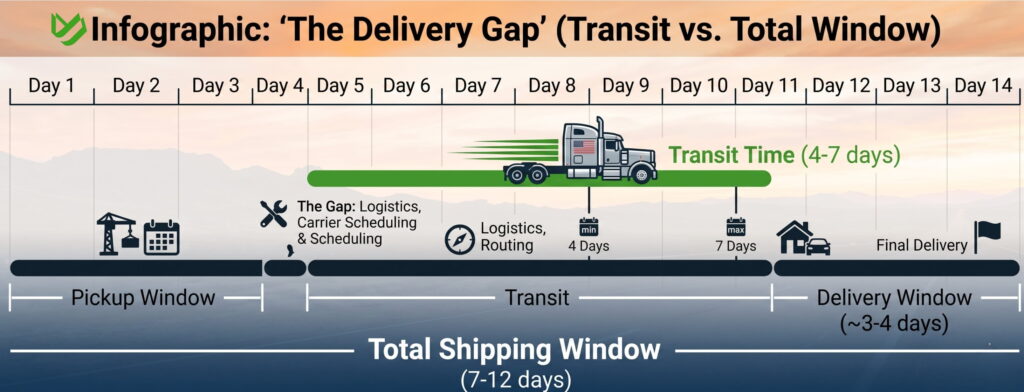
When a broker quotes you “5 days,” that’s usually the driving time – not the full picture. Your car might sit at a pickup hub for 2 days before the truck even leaves. The biggest source of frustration in the auto transport industry comes from a simple misunderstanding of industry terminology. Customers often hear a number from a sales representative and immediately mark their calendar, assuming the vehicle will arrive exactly on that date. To avoid this trap, you need to understand the fundamental difference between “transit time” and the “total shipping window.”
Transit time is strictly the duration your vehicle spends physically moving down the highway. It begins the moment the driver secures your car to the trailer and ends the moment they unstrap it at your destination. This timeline is constrained by federal law. The Department of Transportation strictly regulates how many hours commercial drivers can operate daily (usually around 11 hours of driving within a 14-hour workday). A driver cannot legally drive through the night without sleep, which limits their daily progress to roughly 400-500 miles.
The total shipping window, however, represents your actual start-to-finish experience. It begins the day you tell the transport company your car is ready to go, and it includes the “pickup window.” The pickup window usually spans 1 to 5 days, representing the time it takes the dispatcher to find a carrier driving your route with an open slot on their trailer. After the pickup window, there is physical loading, the actual transit time, any overnight stops, unloading at delivery hubs if you are not using door-to-door service, and finally, the drop-off. If a company promises you a 4-day transit time, you should realistically prepare for a total shipping window of 6 to 9 days from the moment you hand over the keys.
Distance provides the most reliable baseline for calculating your schedule. While exceptions always exist, the sheer mileage between point A and point B establishes the minimum physical time required to move a 9-car hauler across the map.
| Distance | Typical Transit Time | Total Shipping Window |
| Under 500 miles | 1–3 days | 2–5 days |
| 500–1,500 miles | 3–5 days | 5–8 days |
| 1,500–3,000 miles | 5–8 days | 7–12 days |
| Cross-country (3,000+ miles) | 7–10 days | 10–14 days |
You might naturally assume that a shorter distance always guarantees a faster delivery, but logistics rarely follow a straight line. Why would a massive cross-country haul sometimes finish faster than a modest 1,000-mile trip? It all comes down to the quality of the route.
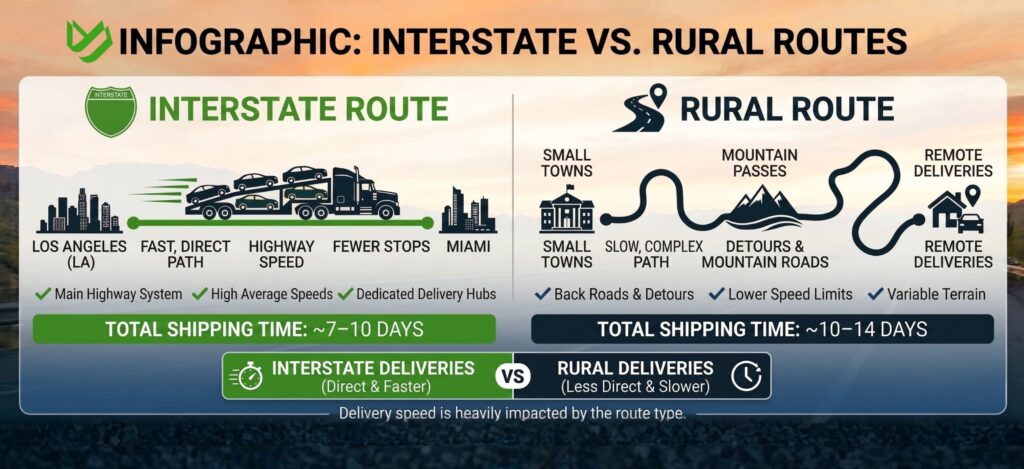
A truck driving 3,000 miles from Los Angeles directly to Miami spends almost its entire journey on Interstate 10. The driver sets the cruise control, avoids major detours, and racks up maximum daily miles. Now compare that to a 1,000-mile route from a small town in North Dakota down to a rural suburb in Arkansas. The driver has to navigate two-lane country highways, slow down for small-town speed limits, take complex detours to avoid low bridges, and waste hours just getting on and off the main interstate network. Over the years, Compare The Carrier has seen countless customers surprised that a massive interstate journey finishes faster than a winding regional route. When you evaluate your timeline, look at a map. If your route connects two major cities via a straight interstate, you will fall on the shorter end of these estimates. If your move requires winding through mountains or deep into the countryside, you must plan for the longer end of the spectrum. Exploring various car shipping services will show you how different transport companies tackle these varied terrains.
These estimates assume open transport, a standard sedan, and door-to-door delivery. Rural pickup or delivery adds 1–3 days to any route.
| From → To | Estimated Transit Time | Notes |
| New York → Florida | 3–5 days | High-frequency route |
| California → New York | 7–10 days | Cross-country, busy corridor |
| Texas → Illinois | 3–5 days | Central corridor, frequent carriers |
| Florida → California | 8–12 days | Long + demand imbalance westbound |
| Washington → Arizona | 4–6 days | Pacific coast corridor |
| Michigan → Georgia | 3–5 days | Midwest to Southeast, well-served |
| Colorado → New Jersey | 5–7 days | Mountain detours possible |
| Oregon → Texas | 5–8 days | Mid-frequency route |
| New York → Chicago | 2–4 days | Short, very high frequency |
| Georgia → Washington State | 8–12 days | Full coast-to-coast |
| Ohio → Florida | 3–5 days | Snowbird corridor, very busy in fall |
| Nevada → New York | 7–10 days | Cross-country standard |
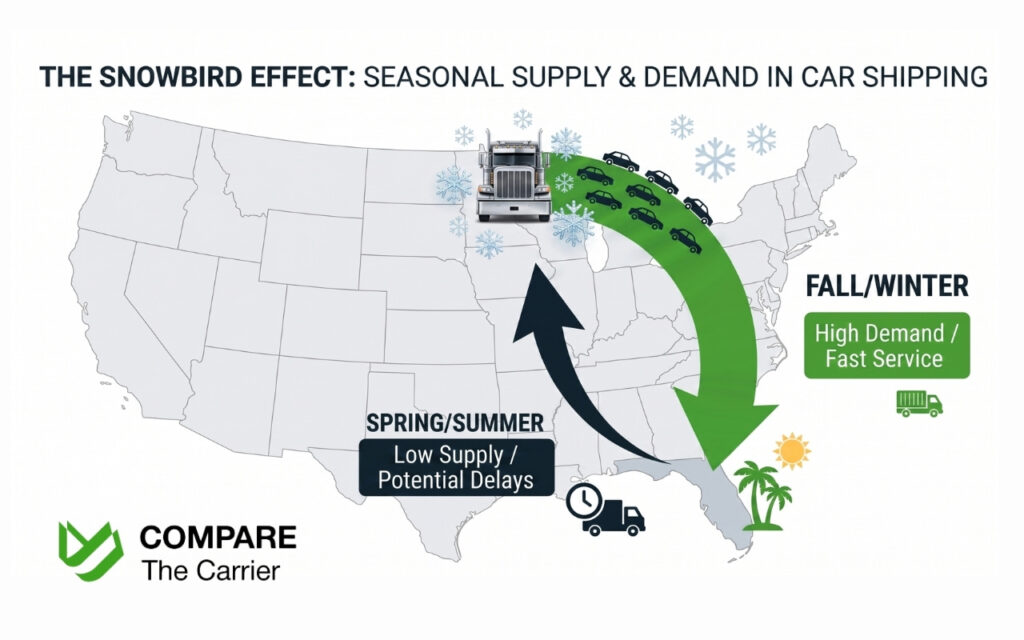
Notice Florida routes are generally faster – it’s one of the most trafficked corridors in the country, especially October through March. If you’re shipping in the opposite direction (Florida → Northwest), expect longer estimates.
Why does a state like Florida experience such wild shifts in its timeline? The auto transport industry operates on supply and demand, and trucks naturally flow toward the money. During the late fall and early winter, millions of retirees – the “snowbirds” – move from the chilly Northeast and Midwest down to Florida. Because so many cars are moving south, carriers run these routes constantly. You can get a vehicle moving from New York to Miami almost instantly. However, once those trucks reach Florida, they need to find cars going back north so they don’t drive empty. Because few people leave Florida in November, a truck might sit in Miami for an extra week waiting to secure a full load going up to New York or the Pacific Northwest. If you are shipping against the current of popular travel patterns, your timeline stretches out. Understanding your specific region’s dynamics, as detailed in our California-to-Florida route guide, helps you predict these delays. You can also research state-to-state shipping trends to see how your local corridor behaves.
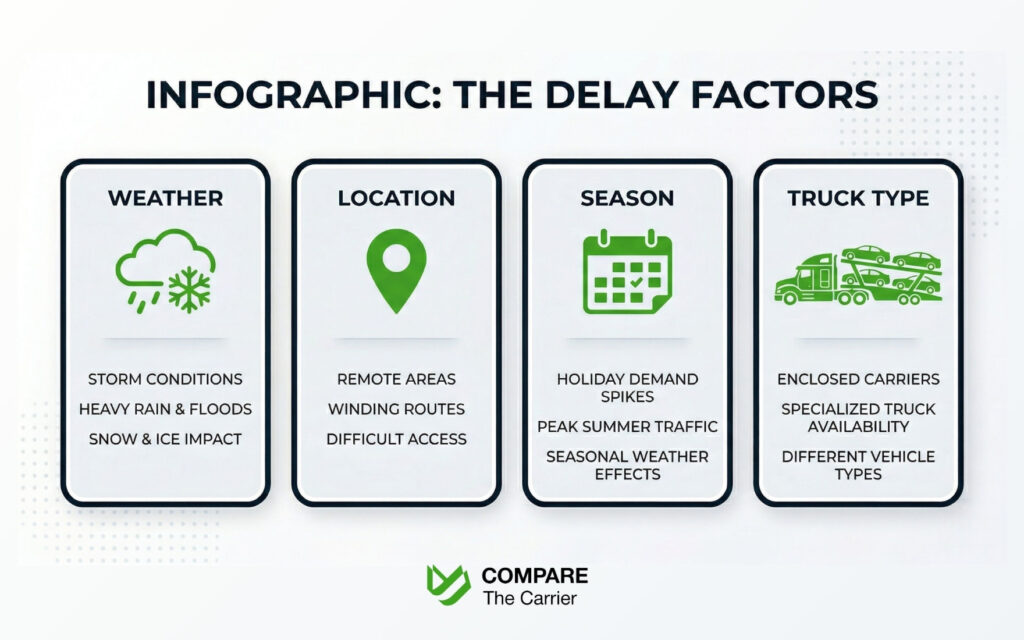
When a timeline stretches from 7 days to 12 days, it rarely means a driver got lost. Delays happen due to structural realities in the trucking industry. Here is what actually slows down your delivery, explained through the real-world logistics that drivers navigate every day.
Let’s say you finalize your booking on a Monday and tell the broker your car is ready to go on Wednesday. Wednesday is simply your “available date.” It does not mean a truck will pull into your driveway on Wednesday morning. The dispatcher now has to search for a carrier passing through your area who has exactly one empty spot left on their trailer. Often, the first available truck won’t pass through until Friday or Saturday. That gap between your ready date and the day the truck physically arrives is the pickup window. Customers frequently confuse the day they sign the contract with the day the clock starts ticking on transit. While you wait for the actual pickup date, you can use the extra days to prepare the vehicle’s interior and double-check what you can leave in the car so you don’t face rejection from the driver at the last second.
The auto transport calendar dictates your timeline more than almost any other factor. If you decide to ship your car between May and August, you step right into the industry’s peak season. Families buy new houses and relocate before the school year starts, college students ship their cars across the country, and military personnel receive their Permanent Change of Station (PCS) orders. Demand skyrockets, but the number of available trucks stays the same. During these summer months, expect carriers to take an extra 2 to 4 days just to accept your load.
Conversely, October and November create regional nightmares due to the snowbird rush. If you need a car moved into Florida during the fall, it happens quickly. If you need a car moved out of Florida during the fall, you face severe delays as drivers wait to consolidate northbound loads. December and January bring the opposite problem: low demand, but heavily reduced carrier capacity because drivers go home for the holidays.
Living off the beaten path brings peace to your life, but it creates massive friction for car shipping. A standard open auto transport truck is an 80-foot-long, 80,000-pound behemoth. They thrive on wide interstates and massive industrial parking lots. If your address sits 50 miles away from the nearest major highway, down a two-lane country road with tight turns and low-hanging branches, a carrier simply cannot drive to your front door.
Furthermore, drivers maximize their profits by moving full loads between major hubs such as Dallas, Chicago, and Atlanta. If a driver in Dallas sees your vehicle listed in a tiny Texas town three hours away, they have to decide if spending six hours of round-trip driving is worth picking up just one car. Often, they wait in Dallas until they find a few more cars heading in your general direction before committing to the detour. This easily tacks 1 to 3 days onto your wait. This detour also forces drivers to burn more fuel and lose driving time, fundamentally changing what car shipping actually costs. The farther you are from a major interstate, the higher your car shipping costs and wait times will be.
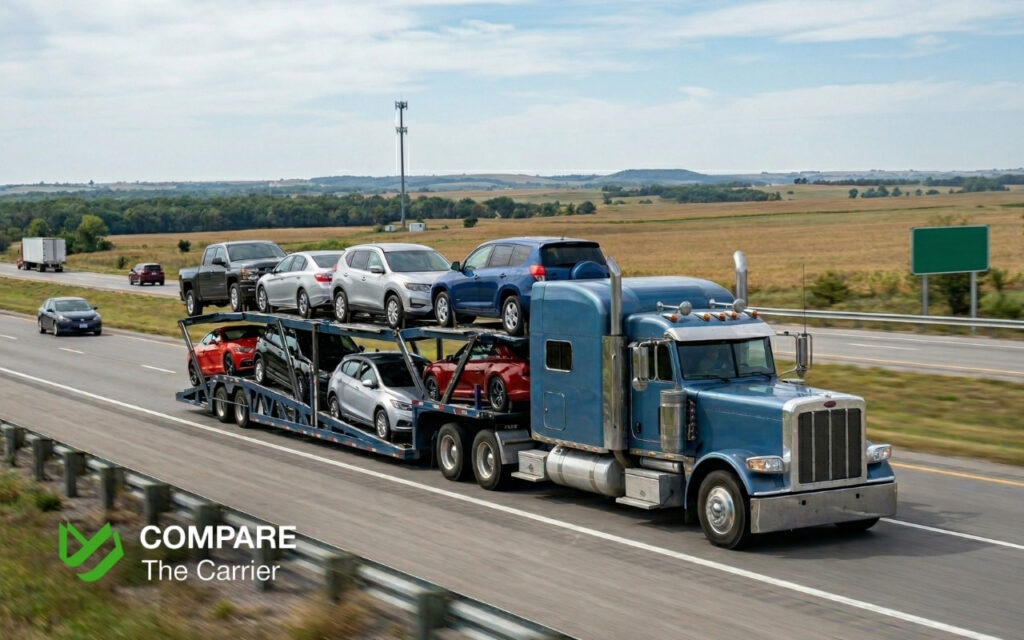
The type of truck you request directly impacts how long you wait. The vast majority of the auto transport fleet consists of open carriers – the skeletal, multi-level trucks you see every day on the highway. Because there are thousands of them crisscrossing the country, securing a spot on one is relatively fast.
Enclosed carriers, which feature hard, solid walls to protect high-value, classic, or luxury cars from weather and road debris, make up a much smaller percentage of the total fleet. Because there are fewer enclosed trucks on the road, they run fewer routes and visit specific cities less frequently. Requesting enclosed transport almost always adds days to your pickup window, since you have to wait for one of these specialized trucks to cycle through your region.
You can perfectly optimize your route and book months in advance, but you cannot negotiate with the weather. Professional auto transport drivers operate incredibly expensive equipment that carries hundreds of thousands of dollars in cargo. They do not take risks. If a freak blizzard dumps two feet of snow on Interstate 80 in Wyoming, the highway patrol shuts down the road to commercial traffic. The driver pulls over at a truck stop and waits. They cannot take a detour through mountainous backroads in a snowstorm.
The same applies to hurricane season in the Southeast. If a named storm approaches the Florida coast or the Gulf of Mexico, dispatchers halt all incoming trucks to avoid stranded assets and damaged vehicles. These delays are beyond the carrier’s control and cannot be expedited. If you live in an area prone to severe seasonal weather that frequently disrupts trucking routes, you might want to consider rail shipping as an alternative, though rail logistics entail their own rigid timelines.
Sometimes standard timelines simply do not work. If you face a strict job relocation deadline, need to finalize a last-minute cross-country move, or have just purchased a highly sought-after vehicle at an auction that demands immediate lot removal, you cannot afford to wait a week for a pickup window to open.
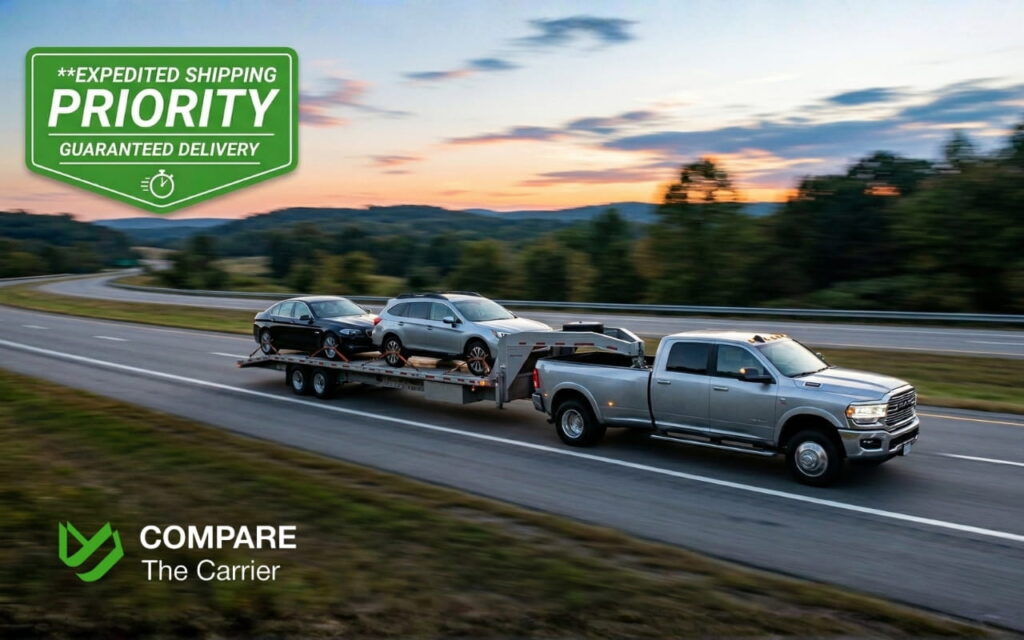
This is exactly where expedited shipping changes the game. When you book expedited car shipping, you effectively buy priority status. Standard logistics require drivers to wait until they can consolidate multiple vehicles going in the same direction. Expedited service bypasses this waiting game. The broker immediately targets carriers willing to deviate from their planned route, guarantees a specific spot on a truck, or even dispatches a dedicated one- to two-car “hotshot” trailer explicitly for your vehicle.
This level of speed requires a premium, usually adding $200-$500 to your base quote. But when you are staring down a non-negotiable deadline, paying for guaranteed priority is often much cheaper than dealing with the fallout of a missing vehicle.
Not all shipping methods move at the same pace. The type of transport you choose directly influences how quickly a carrier accepts your load – not because one truck drives faster than another, but because of how many of each type are actually on the road.
| Transport Type | Effect on Timeline |
| Open car transport | Fastest – most carriers, most routes |
| Enclosed auto transport | +1–5 days wait for carrier availability |
| Door-to-door | Standard timing as above |
| Terminal-to-terminal | Can be faster in transit, but +1–3 days at terminals |
The takeaway is straightforward: open transport wins on speed simply because of volume. With thousands of open carriers running U.S. routes daily, a dispatcher can almost always find one heading your way within a day or two. Enclosed transport narrows that pool dramatically – there are far fewer enclosed trucks on the road, they run less frequent routes, and they tend to cluster around major metro areas where demand for luxury and classic car transport is highest.
Terminal-to-terminal is a common source of confusion. While the truck itself may cover the distance faster by skipping your front door, your car can sit at a pickup or drop-off terminal for several days waiting to be processed. For most people, the time saved in transit gets eaten up at both ends.
Taking control of your shipping schedule requires proactive planning. You cannot change the distance across the country, but you can drastically improve how quickly a driver accepts your load and gets moving.
Not sure how long your specific route will take? Compare The Carrier instant quote calculator shows estimated timelines alongside pricing – so you can plan both your budget and your schedule at once.
Cross-country car shipping – typically coast-to-coast – takes 7 to 10 days in transit, with a total shipping window of 10 to 14 days, including pickup scheduling and delivery. High-demand corridors like California to New York run closer to 7 days. Less-traveled westbound routes (Florida to the Pacific Northwest) regularly hit the 12–14-day mark.
The most common cause is the difference between transit time and total shipping window. Brokers typically quote driving time only. Delays happen at the pickup stage (1–5 days to find a carrier heading your way), during route consolidation, or due to weather. Always ask for a total window estimate, not just transit days.
Open transport is almost always faster because there are significantly more open carriers operating across U.S. routes. Enclosed transport may add 1 to 5 days to your wait time due to lower carrier availability, especially on less common routes or during peak season (May through August).
Late winter and early spring (February through April) typically offer the fastest turnaround times because demand is lower before peak moving season begins. Summer (June through August) is the slowest due to high volume. Fall sees a spike on Florida-bound routes as snowbirds head south, which can delay northbound pickups.
Yes, but only through expedited or guaranteed pickup services, which cost significantly more – typically $200 to $500 above standard rates. These services assign a dedicated carrier or prioritize your vehicle on an existing truck. For standard open transport on short regional routes (under 500 miles), 3 days is achievable at regular pricing.
Most auto transport brokers provide a tracking number or portal where you can monitor your vehicle’s status. In 2026, many carriers now offer GPS-based updates through a mobile app or SMS notifications. For real-time location, some customers place an AirTag inside the vehicle – this is generally permitted, but check with your carrier first, as policies vary.
Yes, but you must disclose this upfront when booking. Non-running vehicles require a winch or forklift to load onto the carrier, which not all trucks are equipped to handle. Most brokers can arrange specialized pickup, but expect to pay an additional $150–$300 above the standard rate, and your pickup window may stretch by 2–4 days while the dispatcher locates a compatible carrier.
In most cases, no – a standard sedan and a mid-size SUV ship on the same timeline. However, oversized or modified vehicles (lifted trucks, wide-body cars, vehicles over a certain height) may be rejected by standard open carriers and require an enclosed or flatbed truck, which adds 1–5 days to your pickup window for the same reasons as enclosed transport: fewer specialized carriers on the road.









Don't have time to fill out the form?
Call a transport company directly to get a quote now!
Select the category you need
Partner with Compare The Carrier & Grow!
We're open to collaborations, partnerships, and mutual growth! Whether you're an individual or a business, we offer exciting opportunities to work together. Fill out the form below to explore how we can collaborate.
Something Went Wrong
We're sorry, but something went wrong. Please briefly describe the problem you experienced in the text area below. Providing your contact information will allow us to follow up if needed.

Thank you,
your form has been accepted.
Your form has been successfully submitted. We appreciate your effort — our team will review it shortly and take the next steps.


