

Auto Transport Companies To Avoid in 2026: Scams & Red Flags
Dozens of auto transport companies operating in the US in...
9 December 2022
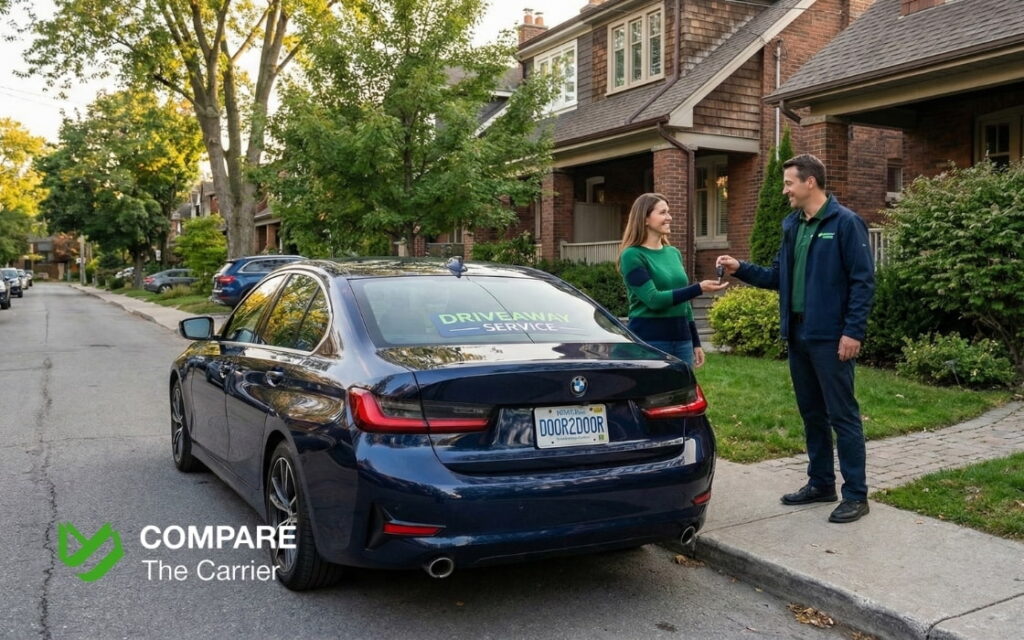
A driveaway service is a vehicle transport method where a professional or contracted driver physically drives your car from the pickup location to its destination. Unlike traditional auto transport on a trailer, your vehicle travels under its own power, offering a personalized, door-to-door solution often favored for its speed, convenience, and the ability to transport personal belongings or pets alongside the car.
Calculate Shipping Quotes
Quick answer: A driveaway service costs $1.00–$2.00 per mile, delivers your car door-to-door in 4–6 days coast-to-coast, and lets you pack the trunk –something no car carrier will allow.
Get an instant driveaway quote: Use our free vehicle shipping calculatorto compare driveaway and carrier rates for your exact route in seconds.
Moving a vehicle across the country usually brings to mind those massive double-decker trailers you see on the interstate. They are the workhorses of the industry, but they aren’t the only way to get a car from Point A to Point B. Sometimes, the best way to move a car is exactly how it was designed to be moved: by driving it.
This is where driveaway services come into play. It’s a niche but highly effective corner of the logistics world that trades the “industrial” feel of a car carrier for a more “concierge” experience. If you’ve ever wondered how to get your car to a winter home in Florida or a new job in Seattle without putting yourself behind the wheel for 20 hours, this guide is for you.
At its core, a driveaway service is exactly what it sounds like. You hire a company, they provide a driver, and the driver takes your keys and drives your car to your destination.
It sounds simple, and in practice, it is but the logistics behind it are quite specialized. Unlike a truck driver who has 9 or 10 other cars to worry about, a driveaway driver is focused solely on your vehicle. It’s a one-on-one service. Your car isn’t being winched onto a ramp or sitting in a dusty terminal waiting for a trailer to fill up. It stays on the road, moving steadily toward its destination from the moment the driver pulls out of your driveway.
Common driveaway use cases: long-distance relocation, snowbird seasonal moves, vehicle purchases from out-of-state dealers, fleet delivery, and elderly drivers who need professional assistance on long road trips.
If you are considering this for the first time, you might feel a bit of “key-handover anxiety.” That’s natural. Your car is likely one of your most valuable assets. Understanding the step-by-step process helps peel back the curtain on how professional agencies manage the risk and the timing.
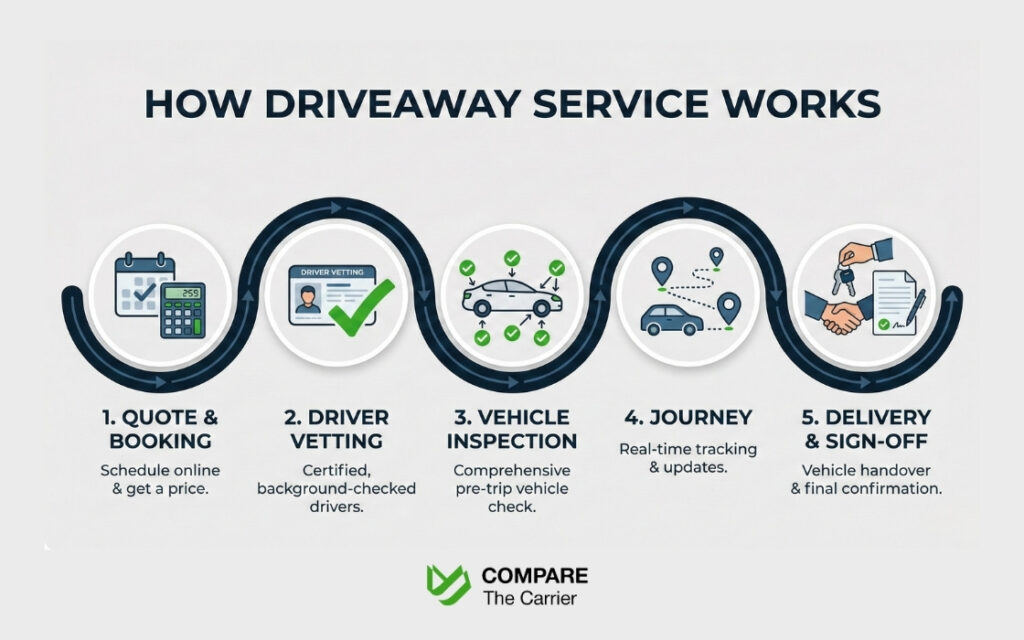
Everything starts with the data. You’ll provide the make and model of the car, the origin and destination, and your preferred dates. Because driveaway services rely on human schedules rather than truck routes, they can often be more flexible with dates than a standard carrier.
This is the “secret sauce” of a good driveaway company. Not all drivers are created equal. Depending on the company you choose, your driver might be:
A reputable agency will vet these drivers through background checks, driving record reviews, and sometimes drug testing.
When the driver arrives at your door, the first order of business isn’t driving it’s documenting. You and the driver will perform a walk-around of the vehicle. You’ll note every scratch, paint chip, or interior blemish on a Bill of Lading (BOL).
💡 The BOL is your insurance policy. Never skip this step – it is the only proof of your car’s condition before it left your sight.
Think of this as your insurance policy. In the rare event that something happens on the road, this document proves the condition of the car before it left your sight. Many modern services now use digital apps to take high-resolution photos of the car at this stage, creating a permanent, timestamped record.
Once the paperwork is signed, the journey begins. The driver follows a planned route. One of the unique perks here is communication. Because it’s one person in one car, you can often stay in direct contact with the driver. They can text you updates when they stop for gas or reach a specific milestone.
Upon arrival, you (or your designated representative) meet the driver. You’ll perform a second inspection, comparing the car’s current state to the initial BOL. If everything looks good, you sign off, the driver hands over the keys, and the job is done.
You might be thinking, “Why would I put miles on my car if I can just put it on a truck?” It’s a fair question. While trailer transport is excellent for many, driveaway services offer several specific “human-centric” advantages that a truck simply can’t match.
Car carriers are like buses – they have multiple stops. A truck picking up your car in New York might have to stop in Philadelphia, DC, and Charlotte before it ever heads toward your destination in Atlanta. This can add days or even weeks to the delivery window. A driveaway driver is like a taxi; they go directly to your destination. If the drive takes 15 hours, your car arrives in 15 hours (plus necessary rest stops).
Standard auto transport companies usually have strict rules: no personal items in the car. This is due to weight limits on the trucks and Department of Transportation (DOT) regulations.
With a driveaway service, the rules are much more relaxed. Since it’s just a car on the road, you can often pack the trunk or the back seat with suitcases, household goods, or golf clubs. Some premium driveaway services even allow pet transport. If you don’t want your dog to fly in cargo, a driveaway driver can bring your furry friend along in the passenger seat of your own car, stopping for walks and water along the way.
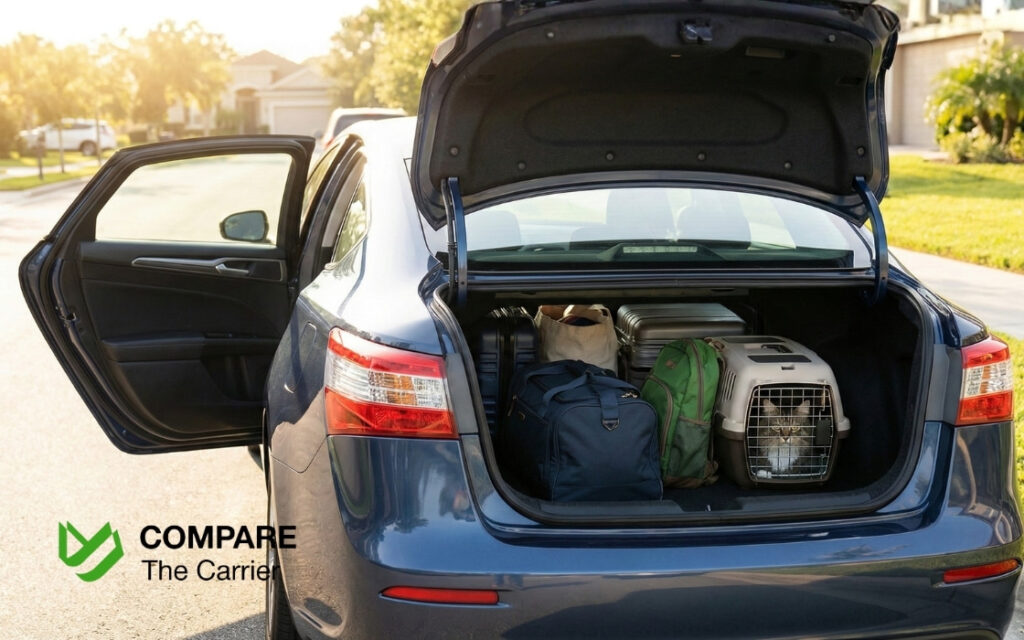
Big 80-foot car carriers have a hard time navigating narrow suburban streets or apartment complexes with low-hanging trees. Often, you have to meet the truck in a large parking lot or at a rest stop miles away from your home. A driveaway service is truly door-to-door. If your car fits in your driveway, the service starts and ends exactly there.
One interesting quirk of the driveaway industry is the “personal driver” aspect. In some cases, customers don’t just want their car moved; they want to be in it.
While not a standard “driveaway” service (which usually implies the owner isn’t present), some concierge companies offer professional drivers to handle the long-distance leg of a trip while the owner sits in the passenger seat. This is common for elderly drivers who still want to travel but no longer feel comfortable handling 10-hour days on the interstate. It’s a specialized version of the service that highlights just how flexible this industry can be compared to the rigid world of freight shipping.
Since your car will be driven for hundreds or thousands of miles, you can’t just hand over the keys and hope for the best. You need to treat it like you’re about to go on a personal road trip.
Auto transport generally falls into two categories: driveaway services and trailer transport (open or enclosed). While driveaway offers a direct, personalized experience with the ability to ship personal items, trailer transport is the industry standard for minimizing vehicle wear and maximizing safety by keeping the car off the road during the journey.
When you start looking into moving a car, you’ll quickly realize it’s not just a choice of who moves it, but how it gets moved. The “how” changes everything from the price tag to the condition of your tires when the car arrives.
To make an informed decision, you have to look at driveaway services side-by-side with the heavy hitters of the industry: Open Carrier and Enclosed Carrier transport.
| Feature | Driveaway Service | Open Carrier Transport | Enclosed Carrier Transport |
| Mileage | Increases (actual driving) | Zero (odometer stays still) | Zero (odometer stays still) |
| Speed | Very Fast (direct route) | Moderate (multiple stops) | Moderate (specialized routes) |
| Protection | Road hazards, weather | Weather & road debris | Full 360° protection |
| Personal Items | Usually allowed (flexible) | Strictly prohibited (DOT) | Strictly prohibited (DOT) |
| Door-to-Door | True door-to-door | Limited by truck size | Limited by truck size |
| Cost | Mid-to-High (individual) | Most affordable | Premium (highest cost) |
Not sure which option fits your move? Our guide to car shipping services breaks down every transport method with pricing and provider comparisons.
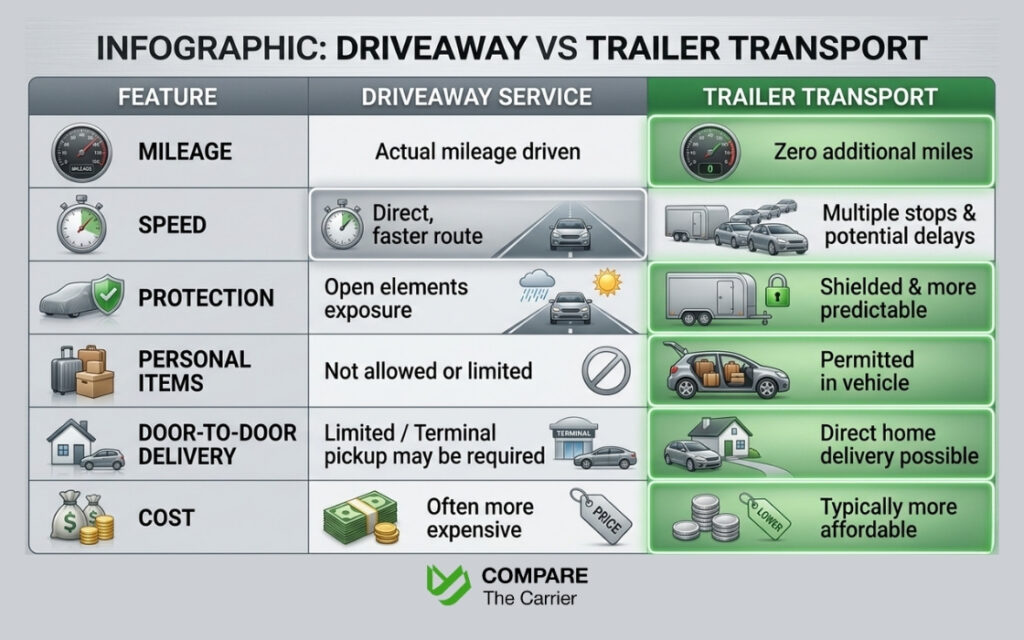
Let’s be honest: the biggest hurdle for most people considering a driveaway service is the odometer. If you’re moving a car from Chicago to Los Angeles, that’s roughly 2,000 miles.
In a trailer-based shipment, your car is a passenger. It sits on a deck, the engine is off, and the tires aren’t touching the asphalt. For a brand-new car or a high-end luxury vehicle, this is usually a deal-breaker for driveaway. However, for a reliable daily driver or an older vehicle, those 2,000 miles might not matter as much as the convenience of having your car delivered three days sooner.
Think of it this way: are those miles “lost” value, or is the speed and the ability to pack the trunk with your kitchen supplies worth the trade-off? For many relocations, the answer is a resounding “yes.”
One of the most critical aspects of any vehicle transport is insurance. You need to know what happens if a pebble cracks the windshield or if a distracted driver taps your bumper at a red light.
Pro Tip:
Always ask for a copy of the insurance certificate. You should also check with your own personal auto insurance provider. Many policies will still cover your vehicle even if someone else is driving it with your permission, but “commercial use” (which this technically is) can sometimes create a gray area. A reputable driveaway company will bridge that gap.
If you aren’t familiar with the term, “Snowbirds” are retirees who migrate south for the winter (Florida, Arizona, Texas) and north for the summer. For this demographic, driveaway services are often the gold standard.
Why? Because moving twice a year is a logistical nightmare.
Imagine trying to pack two suitcases for a four-month stay, then realizing you also need your golf clubs, your favorite espresso machine, and most importantly your dog.
A car carrier won’t let you put any of that in the car. A driveaway driver, however, is often happy to have the trunk full. It transforms the car from a “vehicle to be shipped” into a “mobile storage unit.” When the car arrives at the winter home, everything the owner needs is already there. No shipping boxes, no extra luggage fees at the airport, and no stressed-out pets in a plane’s cargo hold.
When you use a trailer, you rarely meet the driver. You might see them for five minutes during the loading process. With driveaway, the “Human Factor” is front and center.
You are essentially handing your keys to a stranger. This is why vetting is the most important part of the service. A professional agency doesn’t just hire anyone with a license. They look for:
As much as I advocate for the convenience of driveaway, it isn’t the right choice for every scenario. Here is when you should definitely opt for a trailer (specifically Enclosed Transport):
If your car needs to be towed rather than driven, see our complete breakdown of state-to-state car towing options – including costs, timelines, and what to watch out for.
It is a common misconception that driveaway is always the “cheap” option. In reality, it is often a premium service. You aren’t just paying for transport; you are paying for a person’s time, their flight back home, fuel, and specialized insurance.
However, when you factor in the “hidden” costs of other methods such as renting a car while you wait three weeks for a trailer to arrive, or the cost of shipping boxes separately because you couldn’t put them in the trunk the price of a driveaway service often becomes very competitive.
If you get a quote for a driveaway service and it seems higher than an open-carrier truck, don’t be surprised. You aren’t just paying for “a guy to drive.” You are paying for a specialized logistics operation. Here is where your money goes:
Example: If you’re moving a fuel-efficient sedan from New York to Florida, your gas costs might be 150$. If you’re moving a heavy-duty dually pickup that gets 10 miles to the gallon, that same trip might cost you 500$ in fuel alone. Always factor your car’s MPG into the “total cost of ownership” for the trip.
| Distance | Estimated Cost | Delivery Time |
| Under 500 miles | $300–$700 | 1–2 days |
| 500–1,500 miles | $700–$1,500 | 2–4 days |
| Cross-country (2,000+ mi) | $1,500–$3,000+ | 4–6 days |
💡 Hidden savings: Factor in the cost of renting a car while waiting 2–3 weeks for a carrier, plus shipping boxes separately. When stacked against those “hidden” expenses, driveaway’s all-in price is often very competitive.
Ready to calculate your exact cost? Use the free vehicle shipping calculator – enter your route and get a real quote instantly.
The internet is full of “brokers” who will promise you the world but won’t be there when the car breaks down in the middle of Nebraska. When vetting a provider, look for these three green flags:
Don’t be afraid to ask: “How do you pick your drivers?” A top-tier company will tell you about their background checks, their requirement for a clean MVR (Motor Vehicle Record), and their internal rating system. If they just “find someone on a board,” walk away. You want a company that has a relationship with its drivers.
In the digital age, there is no reason you shouldn’t have GPS tracking or at least a daily check-in. If the company seems “ghostly” during the sales process, they will definitely be ghosts when your car is 500 miles away. Look for companies that provide a direct line to the driver or a dedicated dispatcher.
Ask for an ACORD certificate. Your personal insurance is your first line of defense, but the company should have a secondary policy that covers “hired and non-owned” vehicles. If they tell you “don’t worry about it, our drivers are safe,” that’s a massive red flag.
💡 Red flag: If a company says “don’t worry about it, our drivers are safe,” that is a serious warning sign. Insurance documentation is non-negotiable.
Still on the fence? Ask yourself these four questions. If you answer “Yes” to at least three, a driveaway service is likely your best bet.
If you have a high-value collector car or a non-running project vehicle, stick with the trailers. But for the modern family, the relocating professional, or the vacationing retiree, driveaway is the “life hack” of the transport world.
At the end of the day, vehicle transport is about peace of mind. While the industry has spent decades trying to turn car moving into a rigid, industrial process, driveaway services remind us that sometimes the best solution is the simplest one.
By choosing a driveaway service, you aren’t just moving a piece of metal; you’re hiring a professional to take care of your property as if it were their own. You get your car faster, you get your belongings moved for free, and you avoid the “terminal-to-terminal” headaches of traditional shipping.
It’s personalized, it’s efficient, and when done right, it’s the most stress-free way to bridge the gap between your old home and your new one – compare your options and get a quote here.
The price varies based on distance, fuel prices, and the driver’s return travel. Generally, you can expect to pay between $\$1.00$ and $\$2.00$ per mile for long-distance trips. While this is often higher than open-trailer shipping, the cost is offset by the speed of delivery and the ability to pack the car with personal items.
Yes, this is one of the primary benefits of driveaway services. Unlike car carriers regulated by strict DOT weight limits, driveaway drivers can typically accommodate personal items in the trunk and back seat. However, you should always disclose the approximate weight to the agency beforehand and ensure the driver still has a clear line of sight through the windows.
Professional driveaway companies carry commercial liability and collision insurance that covers your vehicle while it is in their possession. Before booking, you should verify the coverage limits and check if your own personal insurance policy acts as primary or secondary coverage in the event of a claim.
Driveaway is the fastest land-based transport method. Because the driver goes directly from your pickup to your destination without stopping to load other vehicles, a cross-country trip (e.g., New York to California) typically takes 4 to 6 days, depending on weather and safe driving hours.
If a mechanical failure occurs, the driver will contact you and the agency immediately. Most agencies help coordinate repairs at a nearby service center. You are typically responsible for the cost of repairs and maintenance, while the agency handles the logistics of getting the driver back on the road once the vehicle is fixed.
Yes – 400 to 600 miles per day is the standard professional range. Federal hours-of-service guidelines for commercial drivers, combined with fuel stops and rest breaks, make this the practical daily limit for safe, legal operation.
Some premium services allow it – the pet rides in your own car with the driver, stopping for walks and water along the way. This is a significant advantage over flying, where pets travel in cargo holds. Always confirm the pet policy with your specific agency before booking.






Don't have time to fill out the form?
Call a transport company directly to get a quote now!
Select the category you need
Partner with Compare The Carrier & Grow!
We're open to collaborations, partnerships, and mutual growth! Whether you're an individual or a business, we offer exciting opportunities to work together. Fill out the form below to explore how we can collaborate.
Something Went Wrong
We're sorry, but something went wrong. Please briefly describe the problem you experienced in the text area below. Providing your contact information will allow us to follow up if needed.

Thank you,
your form has been accepted.
Your form has been successfully submitted. We appreciate your effort — our team will review it shortly and take the next steps.


