

Best RV Shipping Companies in 2026: Costs, Reviews & Expert Tips
Shipping an RV across the country in 2026 costs an averag...
12 December 2024
Shipping an RV from Florida to California typically costs $2,000–$4,800 for open transport and takes about 10-15 days in transit, depending on the RV’s size, weight, condition, pickup location, and delivery location. The route covers roughly 2,500-2,800 miles, so the final price can vary significantly between a compact camper van and a large Class A motorhome.
Calculate Shipping Quotes
For a move this long, transporting the RV can be more practical than driving it yourself, especially when you factor in fuel, lodging, time on the road, and vehicle wear. This guide explains how RV shipping from Florida to California works, what different RV types typically cost, which transport methods are available, what affects the quote, and how to prepare your RV before pickup and inspect it after delivery.
If you’re ready to compare transport options for your RV, you can request a quote based on your specific route and RV type.
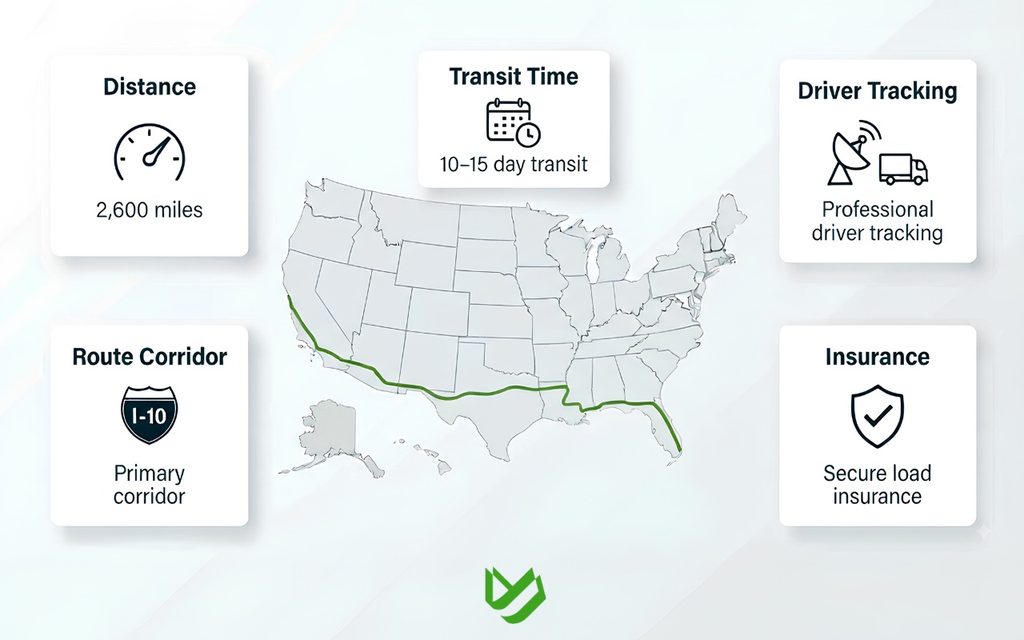
Table of Contents
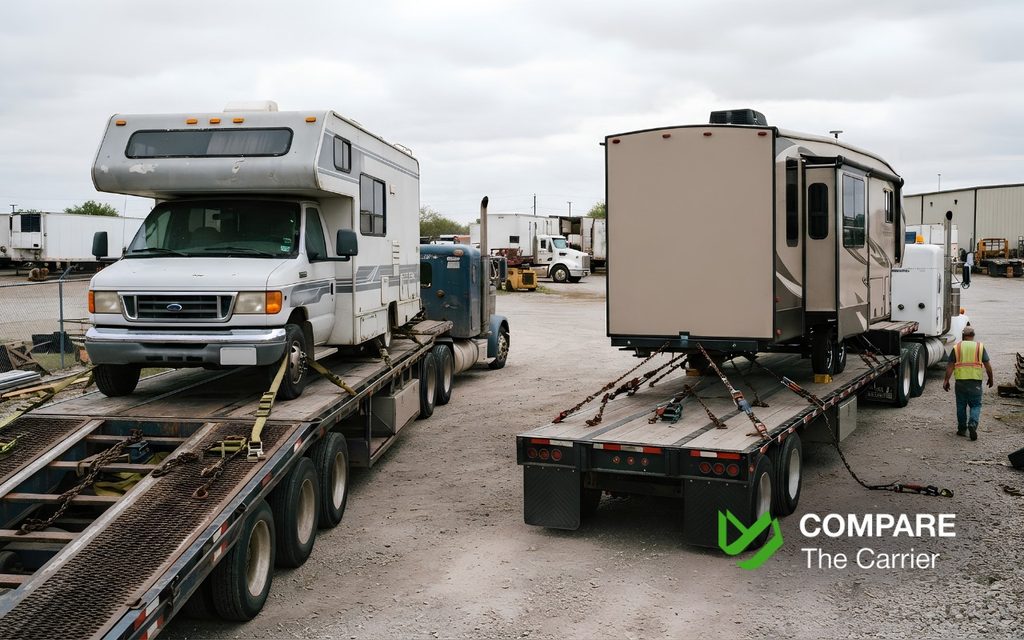
Shipping a motorhome or trailer isn’t dramatically different from shipping a car – the equipment is bigger, and securing it properly takes longer. A carrier arrives at your pickup address in Florida, usually within two to five business days of booking, and walks the unit before loading it. That walk-around gets written into a bill of lading, the document both driver and owner sign to confirm the RV’s condition before it leaves your driveway. From there it rides on either an open or enclosed trailer (or drives itself under a driveaway arrangement, for motorhomes that are road-ready), crosses the country along a handful of interstates, and arrives at your address, a storage yard, or an RV park near California if your street can’t fit a rig that size.
Some owners ask whether it’s smarter to just drive the thing themselves instead of paying for transport. It depends on the vehicle, your schedule, and how much you value your own time – that comparison gets its own full answer later in this guide.
Not every carrier handles every class of RV, so it’s worth confirming upfront that whoever you’re calling actually moves your specific type of unit. Here’s what typically ships on this lane:
| RV Type | Typical Length | Common Transport Method |
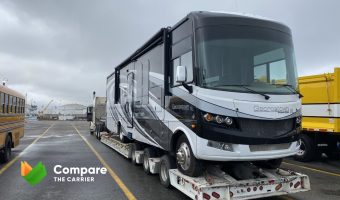
| Class A Motorhome | 30–45 ft | Driveaway or flatbed |
| Class C Motorhome | 20–33 ft | Driveaway or flatbed |
| Class B Camper Van | 17–22 ft | Driveaway (self-propelled) |
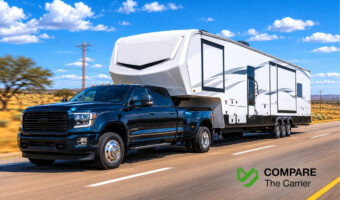
| Fifth Wheel | 25–40 ft | Flatbed / gooseneck trailer |
| Travel Trailer | 15–35 ft | Tow-away or flatbed |
| Toy Hauler | 25–42 ft | Flatbed, often needs an oversize permit |
Fifth wheels can’t move on their own, since the hitch sits in a truck bed rather than on a bumper, so you’ll need a tow vehicle waiting at the delivery point. If that’s what you’re shipping, ask specifically about fifth wheel shipping, or about general trailer shipping services if you’re moving a travel trailer or toy hauler instead.
Carriers running this lane stick to interstates built for heavy freight, not scenic backroads. A Jacksonville pickup often rides I-10 nearly the entire way. A Miami or Tampa pickup usually starts on I-75 or I-4 before joining I-10 somewhere around Lake City or Tallahassee. The main corridors look like this:
Start by asking for the carrier’s FMCSA number and looking it up yourself rather than taking their word for it – that single lookup tells you whether they’re actually licensed to haul freight across state lines. From there, check how long they’ve operated, whether their cargo insurance covers a rig of your size, and whether the quote you got is written down anywhere. A broker who won’t name the actual carrier driving your RV, or who pressures you for a large deposit before assigning a truck, is a warning sign worth taking seriously. Reading through a full RV shipping guide before you call anyone also helps – it gives you a baseline for what a normal quote and a normal timeline actually look like, so a lowball offer stands out immediately. Comparing a shortlist of RV transport companies side by side, rather than booking with the first name that answers the phone, tends to save both money and headaches.
“A legitimate carrier hands you their FMCSA number without hesitation. If a broker gets vague about who’s actually driving your rig, that’s the moment to walk away.” – Ryan Foster
It also helps to understand that RV hauling is a specialized branch of the broader state-to-state vehicle shipping industry. A company that mostly ships sedans may not have the flatbed or gooseneck equipment a 40-foot fifth wheel actually needs, even if they’re happy to quote you a price.
A few more questions tend to separate a solid carrier from a risky one. Ask how many RVs they move in a typical month – a company that ships a handful a year is going to have less practice securing a 45-foot coach than one that does it every week. Ask what happens if your pickup date slips by a day or two, since weather and traffic delays are common on a route this long and a rigid company can turn a minor scheduling hiccup into a real headache. And ask for references from RV owners specifically, not just car shippers, because the equipment, the loading process, and the risks involved are different enough that general auto transport reviews don’t tell the whole story.
For interstate RV transport, the carrier should have the required FMCSA financial responsibility in place before operating under its authority. For-hire property carriers with vehicles at or above 10,001 pounds GVWR generally must maintain at least $750,000 in public liability coverage. However, FMCSA does not set a general minimum cargo-insurance amount for ordinary property carriers; cargo coverage should therefore be verified directly with the carrier and its insurer.
| Coverage Type | What It Protects | Typical Minimum |
| Liability insurance | Damage the carrier’s truck causes to other vehicles or property | $750,000+ |
| Cargo insurance | Your RV itself while it’s on the trailer or under tow | $100,000 – 250,000+ |
| Bill of lading | Written record of condition at pickup and delivery | Documentation, not a dollar figure |
Cargo coverage matters more for RVs than for cars, simply because the values involved are higher and the units are harder to secure. A full auto transport insurance guide is worth reading before you sign anything, since coverage gaps – like what happens to personal belongings left inside during transit – trip people up more often than the liability numbers do.
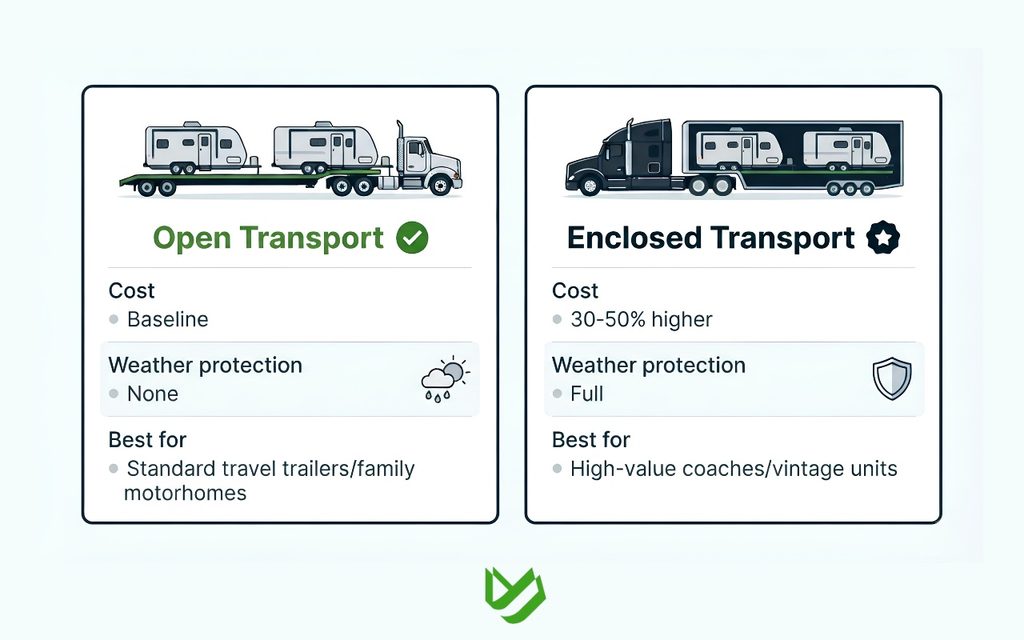
When shipping an RV over a long distance, choosing the right transport method is one of the most important decisions. The two main options are open and enclosed RV shipping, and each comes with different advantages depending on your budget, RV type, and level of protection you need. Understanding the differences between these methods will help you select a solution that fits your situation without paying for services you may not need.
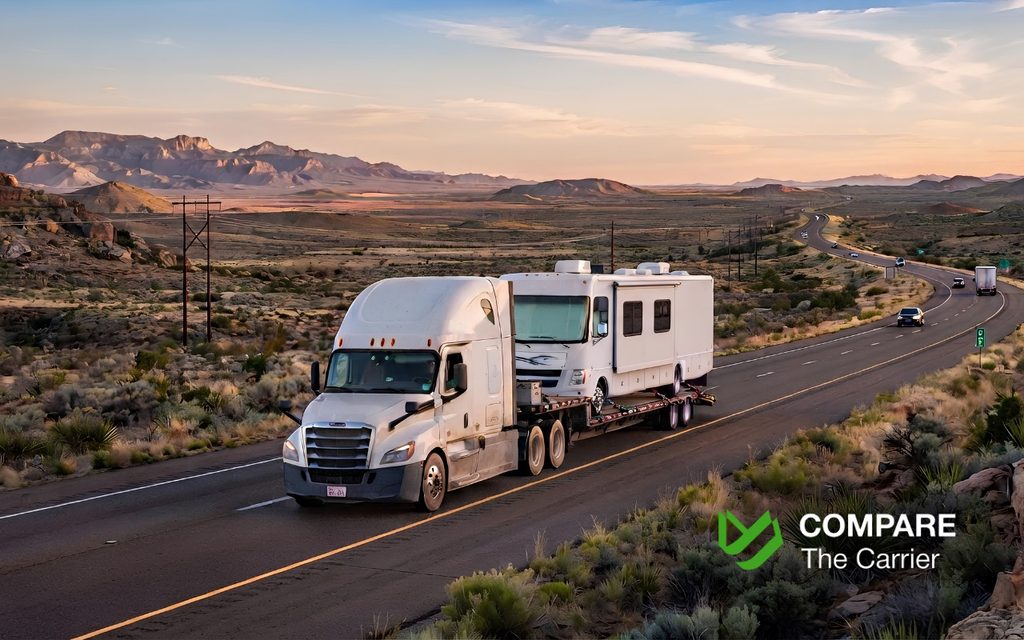
Open transport refers to your RV being transported on an open carrier, secured with chains and straps, or driven under its own power by a professional driver. It’s the preferred option for most RV shipments on this route and helps keep average shipping costs reasonable, especially on trips longer than 2,600 miles. The trade-off is exposure to weather and road spray, but a well-maintained RV should generally handle the exposure without significant damage.
Enclosed transport is when you place your unit in a completely covered trailer and protect it from debris, weather and nosy neighbors. It is typically about 30–50 percent more expensive than open shipping, mostly due to the fact that there is less enclosed equipment on the road and it is designed for oversized loads. Full enclosed auto transport is the best option for a 6-figure class A diesel pusher or for a restored vintage trailer or any RV that just cannot endure a single, costly scratch.
The decision usually comes down to value versus budget, not right versus wrong. A ten-year-old travel trailer bought for weekend camping doesn’t need the same protection as a coach that cost more than most houses.
| Factor | Open Transport | Enclosed Transport |
| Relative cost | Baseline | 30–50% higher |
| Weather protection | None – exposed to rain, dust, road debris | Full protection |
| Best for | Standard travel trailers, family motorhomes, most 5th wheels | High-value coaches, vintage units, luxury rigs |
| Availability | Widely available | Fewer trucks, may take longer to schedule |
The short answer: cost of shipping from Florida to California for an RV generally falls between $2,000 and $4,800 for open transport, with the exact number depending heavily on the size and weight of your unit. This route covers roughly 2,500 to 2,800 miles depending on your exact pickup and delivery cities, and it typically falls into the 10-to-15-day transit bracket that applies to any cross-country move of that length.
| Detail | What to Expect |
| Approximate distance | 2,500 – 2,800 miles, depending on exact cities |
| Average transit time | 10 – 15 days |
| Open transport cost | $2,000 – $4,800, depending on RV class and size |
| Enclosed transport cost | About 30–50% above the open-transport price |
| Primary corridor | I-10, with I-75/I-4 or I-95 feeding into it from Florida |
| Best booking window | 2–3 weeks ahead of your target pickup date |
Breaking it down by RV type gives a clearer picture, since a compact camper van and a 45-foot diesel pusher have almost nothing in common once you factor in weight, permits, and how much specialized equipment the move requires. The following figures are planning estimates, not fixed carrier rates. Actual quotes vary based on the RV’s dimensions, weight, operability, exact cities, season, and available equipment.
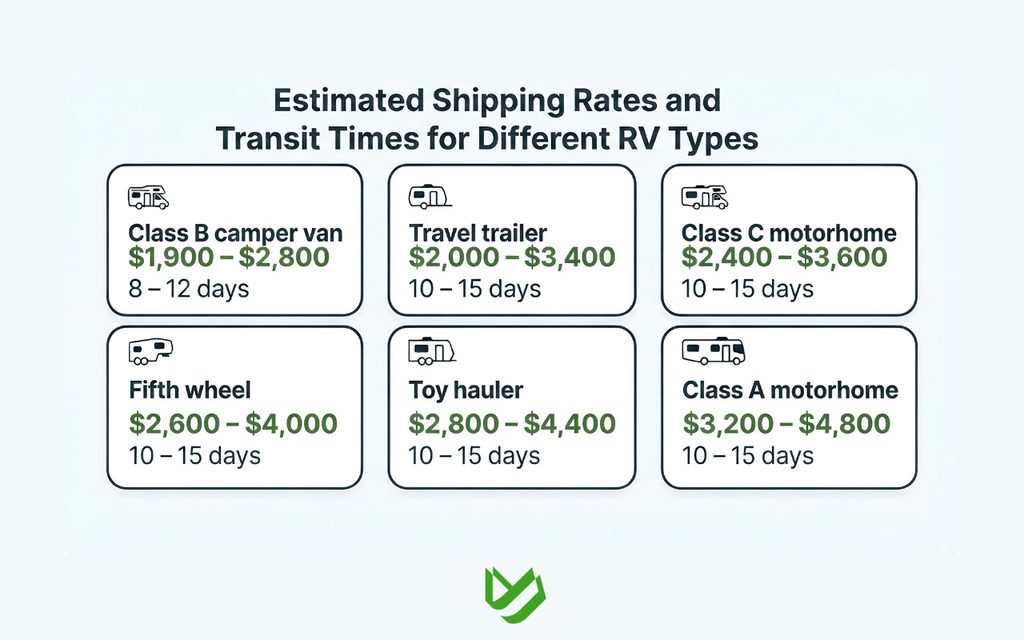
| RV Type | Estimated Cost (Open) | Transit Time |
| Class B camper van | $1,900 – $2,800 | 8 – 12 days |
| Travel trailer | $2,000 – $3,400 | 10 – 15 days |
| Class C motorhome | $2,400 – $3,600 | 10 – 15 days |
| Fifth wheel | $2,600 – $4,000 | 10 – 15 days |
| Toy hauler | $2,800 – $4,400 | 10 – 15 days |
| Class A motorhome | $3,200 – $4,800 | 10 – 15 days |
“Owners always ask for one number, but the honest answer is a range, because a 45-foot Class A and a pop-up camper simply don’t cost the same to move. Anyone who quotes you an exact figure before asking your RV’s length and weight is guessing.” – Ryan Foster
For a route this long, it’s worth reading through a dedicated cross-country travel trailer transportation guide as well, since a lot of the pricing logic that applies to a 2,500-plus-mile trailer move carries over directly to motorhomes and fifth wheels. Running your own numbers through an auto transport calculator before you call anyone also gives you a realistic baseline to compare quotes against.
A quote for the exact same route can swing by a thousand dollars or more between two RVs, and it usually comes down to a handful of variables working together rather than any single factor. Understanding these ahead of time makes it much easier to spot a RV delivery service cost that’s out of line – either suspiciously low or padded with fees that shouldn’t be there.
None of these factors work in isolation. A large, inoperable Class A booked during peak snowbird season with only two days’ notice will cost noticeably more than the same rig booked three weeks out in the shoulder season. Whenever a quote seems far outside the ranges above, it’s worth asking the carrier to walk through exactly which of these variables pushed the number up – a reputable company will be able to explain it in specific terms rather than shrugging and pointing to “market rates.”
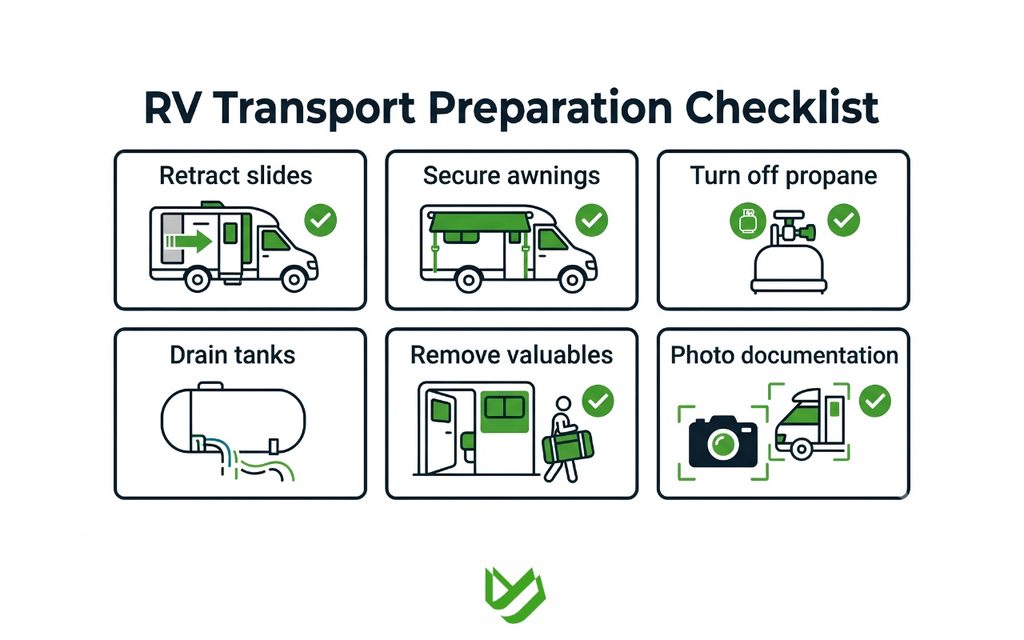
A little prep work before the carrier arrives speeds up loading and protects you if a dispute ever comes up about pre-existing damage. Walk through this list the day before pickup:
| Step | Why It Matters |
| Retract all slide-outs fully | Prevents damage during loading and while securing the unit |
| Secure or remove awnings and antennas | Loose exterior items can tear loose at highway speed |
| Turn off and secure propane tanks | Required for safe transport; most carriers won’t load with tanks live |
| Drain fresh, gray, and black water tanks | Reduces weight and prevents leaks or freezing damage in transit |
| Remove valuables and important documents | The cabin isn’t insured the way the exterior and mechanical systems are |
| Photograph the exterior from every angle | Your baseline evidence if you need to file a damage claim later |
| Leave about a quarter tank of fuel | Enough for loading and driveaway maneuvering, not so much it adds weight |
| Have your title or registration accessible | Some carriers request it at pickup, especially for dealer or auction units |
“The RVs that arrive in California with the fewest issues are almost always the ones where the owner spent twenty minutes walking around with a checklist the day before pickup. It’s not complicated, it just gets skipped.”– Ryan Foster
Don’t sign off on delivery before walking the unit yourself, even if the driver seems to be in a hurry. Compare what you see against the photos from pickup and against the notes on the bill of lading – any new scratches, dents, or leaks need to go on that paperwork before you sign, because once it’s signed clean, a claim gets much harder to make. Check that slide-outs still operate, that the propane system holds pressure, and that nothing shifted enough to damage interior fixtures. If you paid for door-to-door auto transport, confirm the drop-off location matches what you agreed to, especially if a narrow street forced a nearby alternate spot.
Shipping an RV from Florida to California is a bigger decision than shipping a sedan, mostly because the numbers are bigger on every side – the value of the unit, the cost of the move, and the length of time it spends on the road. A carrier that’s properly licensed, carries real cargo insurance, and has actually hauled rigs your size before will get you through the process with no surprises. Get your specific route priced out, compare a few quotes side by side, and don’t let anyone rush you into booking before you’ve checked their FMCSA number for yourself.
An unusually low quote can indicate limited insurance coverage, unsuitable equipment, hidden fees, or a quote that does not reflect the final transport cost. Before booking, ask what is included in the price, verify the carrier’s insurance, and confirm the equipment is appropriate for your RV.
Yes. Most RV shipments can be picked up at your Florida address and delivered to your California address, storage facility, or RV park. If the destination has tight turns, low clearance, or restricted access, the driver may arrange a nearby accessible meeting point instead.
Both open and enclosed transport can be appropriate when the carrier uses equipment suited to the RV and secures the unit properly. Enclosed transport provides additional protection from weather and road debris, while open transport is generally more widely available and less expensive.
Yes. RV transport companies may handle fifth wheels, travel trailers, toy haulers, and different classes of motorhomes. Confirm the carrier has the appropriate flatbed, gooseneck, tow-away, or other equipment for your RV’s size and weight before booking.
It depends on the RV, route, and your own travel costs. When comparing the two options, include fuel, lodging, meals, lost time, tow-vehicle wear, and potential maintenance costs rather than comparing transport pricing with fuel alone. This ship or drive an RV guide covers the main cost factors.
No. Enclosed transport is not required for every RV shipment. Open transport can be suitable when the carrier has the right equipment, follows proper loading and securement procedures, and carries appropriate insurance for the shipment.
Yes. Owners can usually handle basic preparation, including retracting slide-outs, securing loose exterior items, removing valuables, draining tanks, and photographing the RV’s condition before pickup. Follow the carrier’s specific preparation instructions as well.
Yes. Take clear photos of the RV’s exterior immediately before pickup and again at delivery. Photograph each side, the roof if accessible, and any existing scratches, dents, or other damage so you have a record to compare against the bill of lading.
Yes. Remove valuables, important documents, and irreplaceable items before transport. Personal belongings may not be covered by the carrier’s cargo policy, so ask the carrier and insurer about any applicable coverage before leaving items inside the RV.
It depends on the RV and the level of protection you want. Enclosed transport can make sense for high-value, vintage, restored, or particularly sensitive RVs, while open transport may be sufficient for many standard units.
Document the damage with photos and note it on the bill of lading before accepting delivery when possible. Then contact the carrier promptly and follow its claims process. Keep your pickup photos, delivery photos, bill of lading, and insurance information together in case the carrier or insurer requests supporting documentation.








Don't have time to fill out the form?
Call a transport company directly to get a quote now!
Select the category you need
Partner with Compare The Carrier & Grow!
We're open to collaborations, partnerships, and mutual growth! Whether you're an individual or a business, we offer exciting opportunities to work together. Fill out the form below to explore how we can collaborate.
Something Went Wrong
We're sorry, but something went wrong. Please briefly describe the problem you experienced in the text area below. Providing your contact information will allow us to follow up if needed.

Thank you,
your form has been accepted.
Your form has been successfully submitted. We appreciate your effort — our team will review it shortly and take the next steps.


