

Car Shipping with Personal Items: Essential 2026 Rules
Yes, you can ship personal items in your car – but only u...
28 May 2025
You finally found the exact trim, color, and package you want on a platform like Cars.com or AutoTrader. The only problem is that the car is sitting on a dealership lot three states away. When you ask the salesperson to arrange delivery, they casually add a “shipping fee” to your buyer’s order that makes your jaw drop.
Calculate Shipping Quotes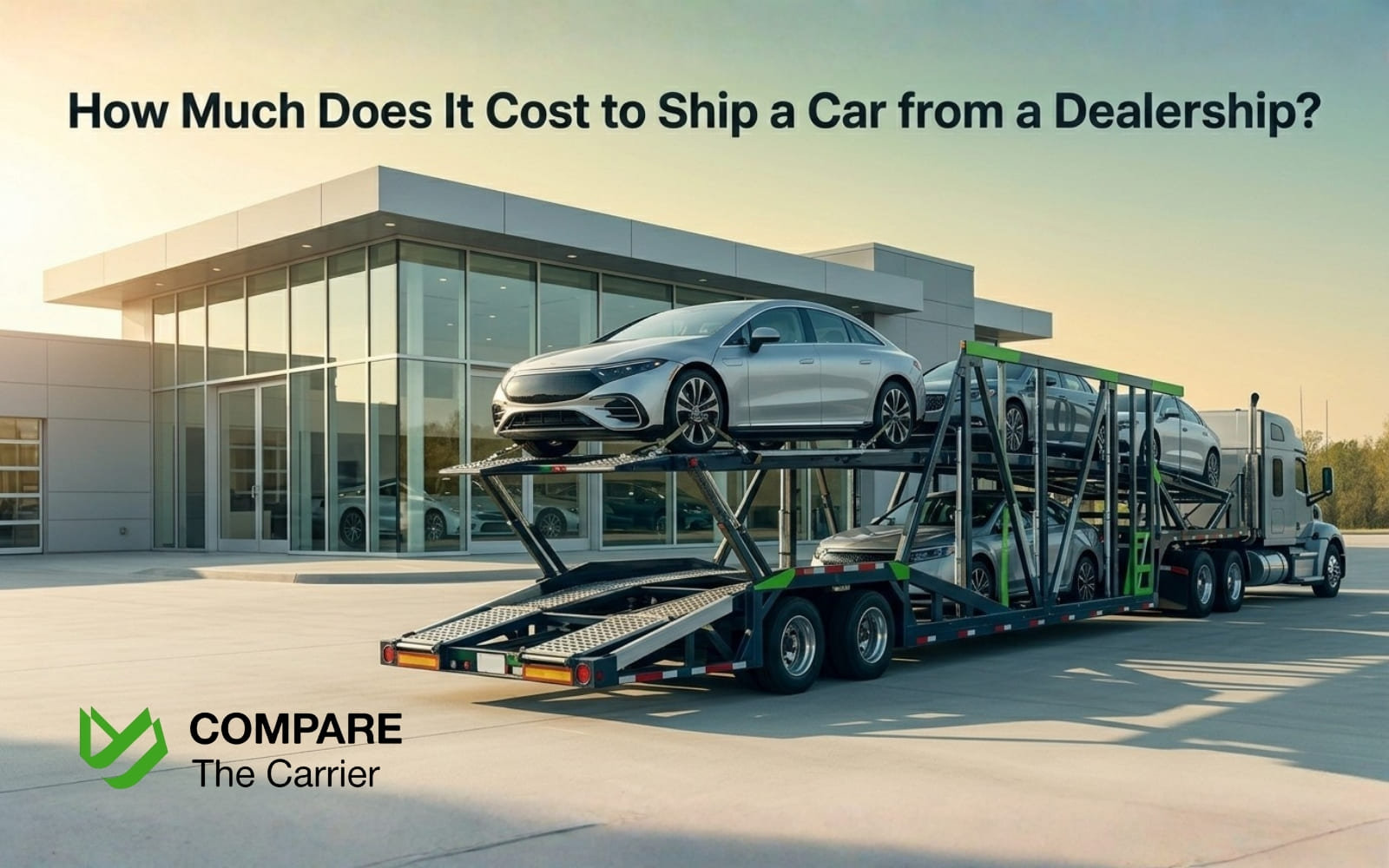
Recently, a buyer shared a quote where a dealer demanded $2,700 to ship a standard sedan from New York to Virginia – a 350-mile trip. On the open market, that transport route costs roughly $450. The dealer was attempting to pocket a massive profit center under the guise of logistics. Learn more about how to transport a car from a dealer before you sign anything.
Whether you are buying a car out of state or just trying to decipher a confusing window sticker, you need to know exactly what shipping actually costs – and when a dealership is using “freight charges” to quietly inflate their margin.
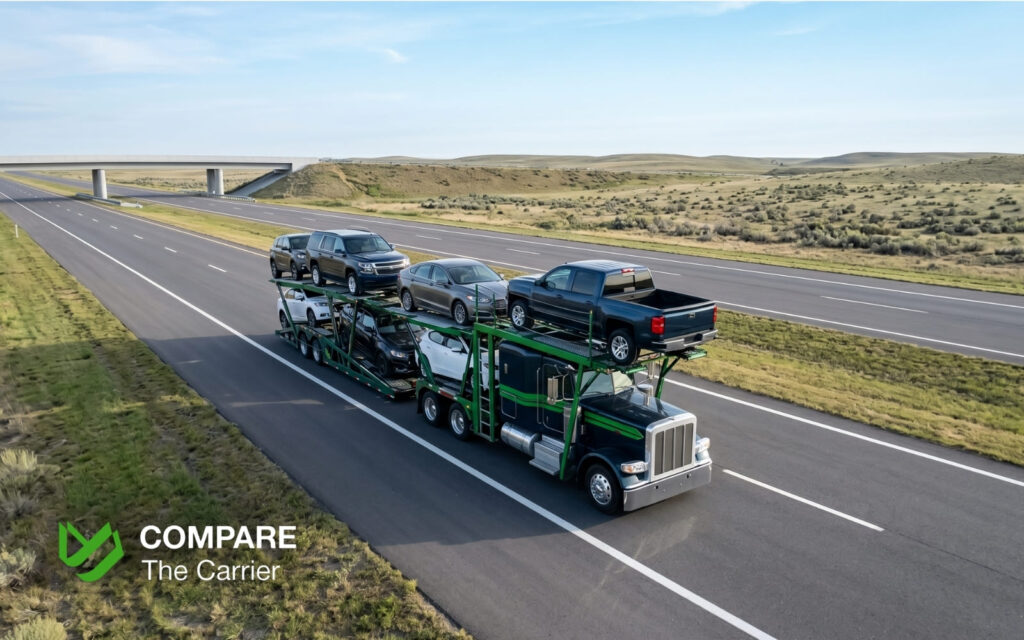
If a dealer is shipping a car directly to your driveway, the baseline cost is dictated by the auto transport spot market. As a general rule of thumb for 2026, standard open carrier shipping costs $1.00 to $1.50 per mile for routes under 500 miles, and drops to $0.60 to $0.90 per mile for cross-country routes.
However, dealerships rarely charge you their actual cost. They use third-party transport brokers, add a markup for their “administrative effort,” and pass the inflated invoice to you.
| Distance | Real Market Shipping Rate | What the Dealer May Charge You |
| Short (Under 500 miles) | $400 – $700 | $800 – $1,500 |
| Medium (500 – 1,000 miles) | $700 – $1,100 | $1,200 – $2,000 |
| Long (Over 1,000 miles) | $1,000 – $1,500 | $1,800 – $3,000+ |
If a dealership asks for $2,000 or more to ship a standard vehicle less than 500 miles, you are being overcharged. Stop negotiating only on the car price and start questioning the transport fee directly.
The biggest point of confusion for car buyers is the terminology. Dealerships throw around words like “freight,” “destination,” and “transport” interchangeably. In reality, there are three distinctly different types of fees, and mixing them up will cost you money.
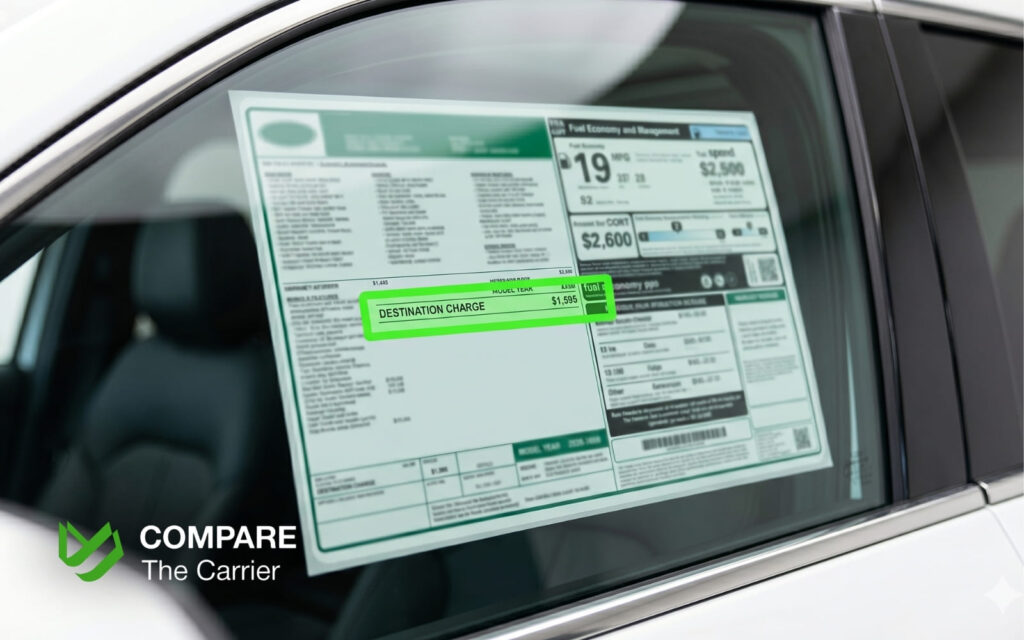
What it is: The cost to transport a brand-new vehicle from the manufacturer’s assembly plant (or port of entry) to the dealership’s physical lot.
The cost: $1,000 to $2,300, depending on the vehicle’s size and brand.
Can you avoid it? No. This is a non-negotiable charge set by the manufacturer. It is already included in the vehicle’s MSRP on the official window sticker and is the same at every dealer for the same model – whether you live next door to the plant or 2,000 miles away.
The catch: Some dealers list “Destination Charge” a second time as a separate line item on your final contract. Never pay this fee twice. If you see it appear both on the window sticker and again on your buyer’s order as a separate line, flag it immediately.
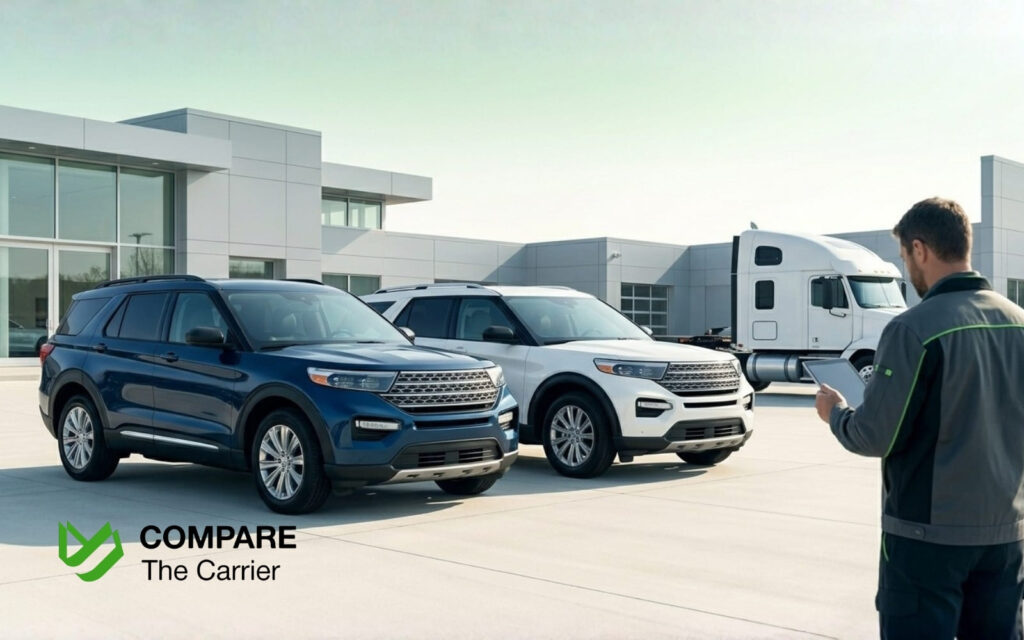
What it is: Your local dealer doesn’t have the blue SUV you want, but a dealership two states over does. Your dealer does a “dealer trade” and hires a truck to bring the car to their lot for you to purchase.
The cost: $300 to $800.
Can you negotiate it? Absolutely. The dealer is incurring a real cost to move the vehicle, but they are also making a full profit on the sale. You can – and should – ask them to absorb the transfer fee to earn your business. If they refuse, ask to see the actual invoice from the carrier to ensure they are not marking it up.
What it is: You buy a car directly from an out-of-state dealership online, and they arrange to have an auto transport company haul it to your driveway.
The cost: The true market rate plus a 30% to 50% dealer markup. Usually totals $1,200 to $2,700.
The catch: This is the most manipulative fee in the category. Dealerships do not own fleets of cross-country trucks. They log into the exact same dispatch boards that independent brokers use, hire a carrier for $600, and bill you $1,200. This is the fee you must aggressively verify against the open market before agreeing to anything. See how do dealerships deliver cars and what it actually costs them.
To know if a dealer is overcharging you on Customer Delivery Shipping, you need to know the true baseline costs of the auto transport industry. The table below reflects what independent, FMCSA-licensed carriers charge in 2026 for a standard sedan.
| Distance | Open Carrier (Market Rate) | Enclosed Carrier (Market Rate) | What the Dealer Usually Charges |
| 300 miles | $350 – $500 | $600 – $800 | $800 – $1,500 |
| 500 miles | $500 – $700 | $900 – $1,100 | $1,000 – $2,000 |
| 1,000 miles | $800 – $1,100 | $1,400 – $1,800 | $1,400 – $2,500 |
| 1,500 miles | $950 – $1,300 | $1,600 – $2,100 | $1,600 – $2,800 |
| 2,500 miles | $1,100 – $1,600 | $1,900 – $2,500 | $1,800 – $3,200 |
Why are dealer prices so high? Dealerships operate as middlemen. They typically contract a transport broker, who adds a $150–$250 fee on top of the carrier’s rate. Then the dealership’s finance office adds another $400–$800 markup before presenting the final number to you. By the time the invoice reaches the buyer’s order, the original carrier rate may be buried under two layers of margin. This is exactly why understanding the difference between a carrier and a broker matters before you negotiate.
Before a dealership adds their profit margin to your shipping invoice, the baseline cost is determined by the commercial auto transport market. Carriers calculate freight rates based on six key variables.
Distance is the primary cost driver. As total mileage increases, the overall price rises – but the cost per mile actually drops. Carriers maximize profit by keeping cars on the trailer for long highway stretches. A 300-mile trip might cost $1.50 per mile, while a 2,000-mile trip drops to around $0.60 per mile.
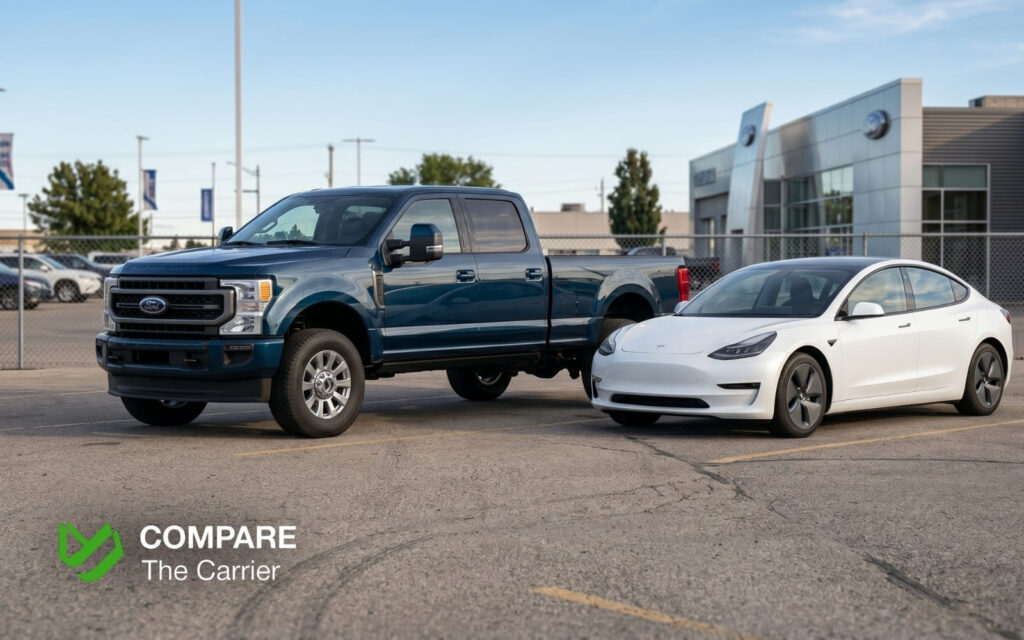
Carriers are legally bound by DOT gross vehicle weight limits (80,000 lbs). A heavy Ford F-150 or a full-size Chevy Tahoe takes up significantly more space and weight allowance on a trailer than a Honda Civic. As a result, shipping an SUV or full-size pickup consistently costs 15% to 20% more than a standard sedan.
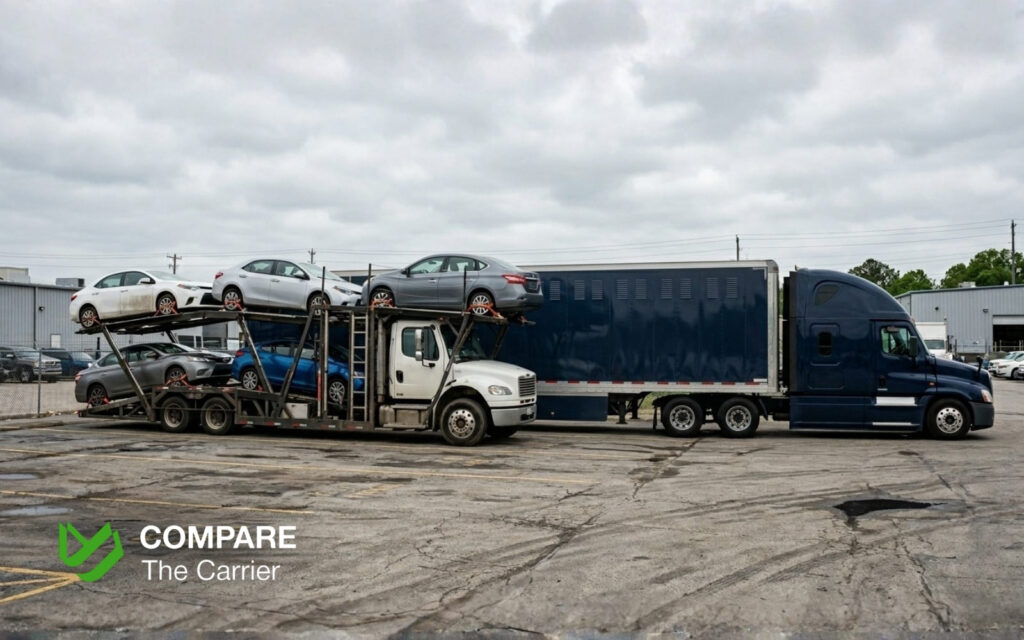
Open carrier transport uses the exposed, double-decker trailers you see on highways and is the industry standard. Enclosed carrier transport uses a fully sealed trailer for weather and debris protection, but commands a 30% to 50% price premium.
One important note: do not let a dealer convince you that a standard used car requires enclosed shipping. Dealerships receive the vast majority of their brand-new, zero-mile factory inventory via open carriers. Unless you are buying a classic, an exotic, or a vehicle valued well above $75,000, open transport is perfectly appropriate and safe.
The auto transport market is highly seasonal. Learn how the impact of seasonality on auto transport costs affects your quote. Peak demand runs from May through August when family relocations surge, pushing spot market rates up by 15% to 20%. Prices also spike during the final week of every month when lease expirations drive moving volume higher.
A dealership located next to a major interstate and a buyer in a metro area with wide streets means fast, easy loading and unloading. A rural delivery address 100 miles off the highway, or a residential neighborhood where an 80-foot carrier cannot safely turn around, means the carrier charges a premium for extra deadhead miles and labor. If flexibility is an option, consider terminal-to-terminal car shipping to reduce costs.
This is the single largest variable in your final price. If you arrange shipping yourself through an independent broker, you pay the market rate. If the dealer arranges it, they act as a secondary broker: they source a carrier for $800, mark it up 30% to 50% for their “logistics coordination,” and present you a $1,200 invoice.
When you buy an out-of-state car, the salesperson will inevitably ask: “Do you want us to handle the shipping?” Saying yes is convenient. Saying no keeps several hundred dollars in your pocket.
There are limited scenarios where letting the dealership handle logistics is reasonable.
As a closing incentive: If you are negotiating hard at month-end, a dealer may offer to ship the car at no charge – or at a steep discount – simply to close the deal before their monthly quota resets. In that case, the “free shipping” is a real concession worth accepting.
For financing purposes: If you don’t have immediate cash to pay an independent transport company, letting the dealer roll the shipping cost into your auto loan is an option. Be aware, however, that you will pay interest on that shipping fee for the entire loan term – typically 48 to 72 months. A $850 shipping fee financed at 7% over 60 months costs you closer to $1,000 in total.
If your goal is to avoid overpaying, bypass the dealer and act as your own logistics coordinator. Here is exactly how to do it:
You are buying a Toyota Camry from a dealership in Dallas, Texas, and shipping it to your home in Chicago, Illinois. The distance is 920 miles.
Twenty minutes of quote comparison is the easiest $500 you will save during the entire car-buying process. Use our car shipping cost calculator to get a baseline before you negotiate.
If you refuse to pay a dealership markup and don’t want to deal with brokers at all, there is a third option: buy a one-way plane ticket, inspect the car in person, and drive it home.
When this strategy makes sense: It works well for short-to-medium distances (under 600 miles) where a budget airline flies directly to the dealership’s city and you can drive the car home in a single day without a hotel stay.
When this is a poor choice: Do not attempt it for cross-country routes. Beyond the financial cost, there is a serious logistical risk: what if you fly 1,000 miles, test drive the car, and discover the transmission slips or the interior has water damage? This is exactly why pre-purchase inspections matter for used car buyers – get one done before you fly anywhere.
Example: New York to Miami, approximately 1,280 miles.
Compare that to the dealer’s shipping quote of $1,100. You save $650 by flying down and driving back. However, you are also adding 1,280 miles of wear and depreciation to a freshly purchased car and losing two full days to highway driving. If your time is valuable, paying an independent carrier $800 is often the better trade-off.
Finance managers are skilled at burying profit inside confusing line items. Here are five specific red flags that indicate the dealership is padding the shipping invoice.
Sign #1: The price is double the market rate. If a 400-mile transport route averages $500 on the open market and the dealer is asking $1,200, ask them directly: “What carrier are you using, and what is their exact rate?” Cross-reference with our list of top 25 best car shipping companies to benchmark the quote.
Sign #2: They refuse to provide the carrier’s invoice. If the dealer claims they are passing the transport cost straight through without markup, they should have no problem showing you the actual carrier invoice. A refusal means the invoice exposes their margin.
Sign #3: Full payment demanded before a carrier is assigned. Legitimate auto transport brokers collect a small deposit when the driver is dispatched and the balance upon delivery. If the dealer requires the full shipping cost wrapped into your down payment before a truck has even been sourced, they are locking in their markup before you can push back.
Sign #4: An “all-in fee” with no breakdown. A single line item reading “Dealer Prep & Delivery Fee: $2,500” is a deliberate tactic to merge actual shipping cost with pure dealer profit so the individual parts cannot be negotiated. Always demand a fully itemized breakdown.
Sign #5: No tracking information or direct carrier contact. Once you pay for shipping, you are entitled to the name, USDOT number, and direct phone number of the truck driver hauling your car. If the dealer refuses to provide this, they are likely using the cheapest carrier on the dispatch board to maximize their spread. Check our list of auto transport companies to avoid so you know which carriers raise red flags.
When you catch a dealer overcharging, use data rather than emotion. Pull up a quote on your phone and use this script verbatim:
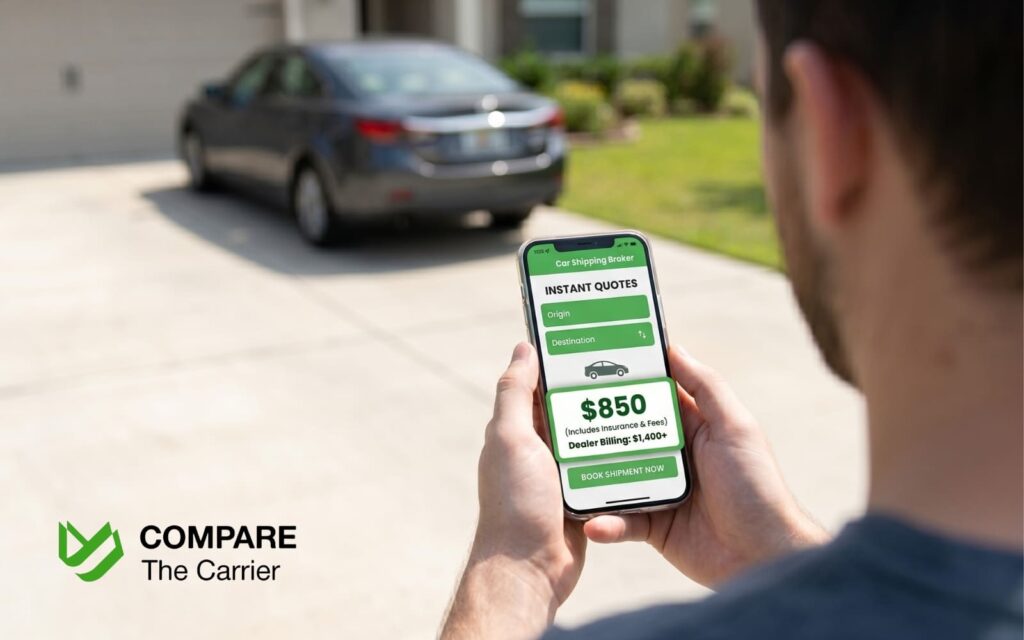
“I reviewed the $1,400 shipping fee on the buyer’s order. I just got a guaranteed quote from Montway Auto Transport for this exact route at $850. Will you match the $850 market rate, or should I arrange my own shipping company to pick the car up from your lot?”
They will either match the price or let you arrange it yourself. Either outcome saves you money.
When a vehicle leaves the dealership lot on an open carrier, the liability shifts entirely. Understanding who is responsible for your new purchase while it travels down the interstate protects you in the event of damage. Read our complete auto transport insurance guide before the vehicle is loaded.
In-transit insurance: Once the transport driver loads your car and pulls away from the lot, the dealership is no longer liable for physical damage. Legal responsibility transfers to the carrier’s cargo insurance policy. By federal law, active motor carriers must carry a minimum of $750,000 in liability insurance, and most cargo policies covering auto transport range from $100,000 to $250,000 per load. This covers damage from driver negligence or equipment failure. It typically does not cover acts of God (hail, flooding) or standard road debris, which are considered inherent risks of open transport.
The Bill of Lading (BOL): When the carrier arrives at your address, do not let the excitement of a new delivery rush you through the paperwork. Inspect the vehicle in daylight before signing anything. If you find a scratch or dent that was not recorded on the dealership’s outbound BOL, write it down on the delivery BOL before you sign. A clean signature on the delivery document will result in an automatic denial of any subsequent damage claim.
The odometer check: A vehicle transported on an open or enclosed carrier means the wheels never touch pavement during the journey. When the car arrives, check the odometer immediately. It should show the exact same reading it had when it left the dealership, plus perhaps 2 to 5 miles for loading and maneuvering at both ends. If a car shipped 1,000 miles arrives with 1,000 extra miles on the clock, it was not shipped – it was driven. Always use our vehicle condition documentation guide and keep your vehicle shipping document checklist handy at delivery.
Here is a summary for a standard 1,000-mile out-of-state purchase with two adults and a standard sedan.
| Strategy | Shipping Cost | Travel Expenses | Dealer Markup | Estimated Total |
| Option A: Dealer Arranges Shipping | ~$850 (base carrier rate) | $0 | $650+ | $1,500+ |
| Option B: You Arrange DIY Shipping | ~$850 | $0 | $0 | ~$850 |
| Option C: You Fly & Drive Home | $0 | ~$330 (flight + gas + food) | $0 | ~$330 |
The verdict: Option C (fly and drive) is the cheapest in raw cash terms, but only makes sense for routes under 800 miles with a direct, affordable flight and zero red flags about the car’s condition. Option B (DIY shipping via an independent broker) is the smartest balance of cost and convenience for longer distances. Get your baseline number with our car shipping quotes tool before you negotiate with any dealer.
Not asking for a breakdown. Assuming the Manufacturer’s Destination Fee and the Dealer Delivery Shipping Fee are the same thing. One is mandatory and already in the MSRP. The other is a negotiable profit center.
Not comparing with the open market. Accepting the dealer’s shipping quote without spending five minutes running a competing quote on a car shipping cost calculator.
Signing the BOL without inspection. Letting a transport driver rush you through delivery without physically checking the car for transit damage. Not verifying insurance. Failing to request a Certificate of Insurance from the carrier or broker before the vehicle is loaded onto the truck.
Believing “free shipping” is actually free. Dealerships do not absorb losses. If they offer free delivery, they simply declined to negotiate the vehicle’s purchase price by an equivalent amount. The cost is hidden, not eliminated. See how online car buying platforms handle this so you know what to expect before you start negotiating.
Buying a car from an out-of-state dealership is one of the smartest ways to find the exact vehicle you want at the right price – but only if you don’t hand back your savings at the finish line by accepting a dealer’s inflated shipping invoice.
Now you know the difference between a mandatory destination charge and a negotiable delivery fee, how much carriers actually charge versus what dealers bill, and exactly what to say when a finance manager slides a $1,800 transport fee across the desk for a 400-mile route.
Use the market data in this guide, run your own quotes, and never let logistics become a hidden profit center for the dealership.
Ready to arrange shipping on your own terms? Get instant quotes from FMCSA-licensed carriers who pick up directly from dealer lots – no middleman, no markup:
Calculate Your Car Shipping Cost
The actual market cost to ship a car on an open carrier ranges from $0.60 to $1.50 per mile depending on the total distance. Dealerships add a 30% to 50% markup on top of the carrier’s base rate, resulting in typical dealer shipping invoices of $1,200 to $2,500.
Yes. Because dealerships add significant margin on top of the actual transport cost, you can negotiate directly or threaten to arrange your own carrier. If they refuse to reduce the price, you are legally entitled to hire your own FMCSA-licensed transport company to pick the car up from their lot.
A destination charge is a non-negotiable manufacturer fee covering transport of a brand-new vehicle from the factory to the dealership lot. It is already included in the MSRP and is identical at every dealer for the same model. A shipping fee is a separate, dealer-imposed charge to transport the purchased vehicle from their lot to your home. The two are entirely different, and you should never pay both as separate line items on the same transaction.
Yes. You are never legally required to use a dealership’s transport service. Once the purchase paperwork is signed and the vehicle is yours, you can hire any FMCSA-licensed broker or carrier to pick it up from the dealer’s lot.
Once the vehicle is loaded onto a third-party carrier, liability transfers from the dealership to the motor carrier. The carrier’s cargo insurance covers damage caused by negligence or accidents during transit. Document every pre-existing condition on the Bill of Lading at pickup and note any new damage on the delivery BOL before signing.
Once a carrier picks up the vehicle, transit takes 1 to 3 days for routes under 500 miles and 5 to 10 days for cross-country routes. However, finding an available driver can take 2 to 7 additional days before the vehicle even leaves the lot, depending on route demand and time of year.






Don't have time to fill out the form?
Call a transport company directly to get a quote now!
Select the category you need
Partner with Compare The Carrier & Grow!
We're open to collaborations, partnerships, and mutual growth! Whether you're an individual or a business, we offer exciting opportunities to work together. Fill out the form below to explore how we can collaborate.
Something Went Wrong
We're sorry, but something went wrong. Please briefly describe the problem you experienced in the text area below. Providing your contact information will allow us to follow up if needed.

Thank you,
your form has been accepted.
Your form has been successfully submitted. We appreciate your effort — our team will review it shortly and take the next steps.


