

Car Shipping with Personal Items: Essential 2026 Rules
Yes, you can ship personal items in your car – but only u...
28 May 2025
Car shipping for deployed military members without PCS orders is usually a privately arranged move rather than a government-managed PCS shipment. If you’re deploying temporarily and your vehicle isn’t being transported under official PCS orders, you’ll generally need to decide whether to ship it, store it, leave it with family, or sell it. The right option depends mainly on the length of your deployment, your destination, your vehicle’s location, and whether someone needs access to the car while you’re away.
Calculate Shipping Quotes
Unlike a PCS move, a Non-PCS deployment typically doesn’t come with the same government-arranged vehicle transportation process. That means service members may need to compare private auto transport costs, coordinate pickup and delivery, and plan around deployment dates. This guide explains how Non-PCS car shipping works in 2026, what it can cost, and when shipping makes more sense than storage or leaving the vehicle behind.
Table of Contents
Vehicle shipping for military members covers a wide range of situations: PCS orders, TDY assignments, unaccompanied tours, and deployments that don’t involve a change of duty station at all. At its core, it’s the same nationwide vehicle transport that any civilian would book. A carrier picks your car up, hauls it on an open or enclosed trailer, and drops it off wherever you tell them to. What changes for service members is that military vehicle transport options are built around orders, timelines, and, in some cases, reimbursement rules.
For a Non-PCS deployment, though, there’s usually no government-funded shipment waiting for you. You’re arranging transport the same way a civilian would: comparing quotes, picking a carrier, and paying out of pocket unless your unit or branch has a separate arrangement in place. Ryan Foster, an auto transport specialist who’s spent over a decade vetting carriers, sums up the confusion this causes:
Expert Tip from Ryan Foster: “The number one mistake I see with Non-PCS orders is service members assuming the process mirrors a PCS move. It doesn’t. You’re the customer here, not a beneficiary of a government contract, and that changes who you should be comparing quotes from.”
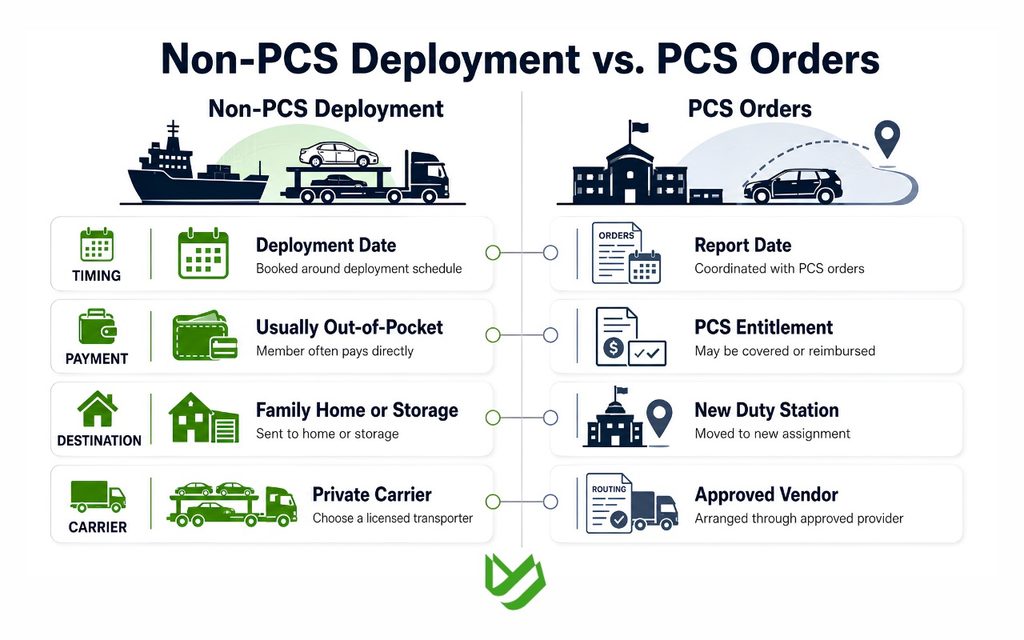
Before you request a quote, it helps to know exactly how a Non-PCS shipment differs from a PCS one. If you’re going through an actual PCS move instead, shipping your vehicle during PCS follows a different set of rules and reimbursement options entirely.
| Aspect | Non-PCS Deployment | PCS Orders |
| Booking timeline | Set by deployment date, usually flexible | Tied to the report date on orders |
| Reimbursement | Rare, and branch or unit dependent | Common under standard PCS entitlements |
| Typical destination | A family member’s home or a storage facility | The new duty station |
| Carrier selection | Fully open, your choice of any licensed carrier | Sometimes routed through a government-approved vendor |
In most cases, you do. The Department of Defense’s POV shipment benefit is tied specifically to PCS orders, not to deployments, TDY assignments, or unaccompanied tours. That means the cost of shipping usually falls on the service member preparing for a Non-PCS deployment, though some units cover partial costs for certain overseas or contingency deployments. It’s worth checking with your admin office before assuming either way, since policies vary by branch and by the type of orders you’ve received. If reimbursement isn’t on the table, that’s exactly when comparing transportation expenses across a few carriers actually saves money instead of just saving time.
Deciding whether to ship, store, sell, or hand your car off to a family member usually comes down to one question: how long will you actually be gone, and does anyone need the car while you’re away? A four-month deployment and a fourteen-month one call for very different answers.
There’s no single rule here, but the length of your orders should drive the decision more than anything else.
| Deployment Length | Common Approach | Why |
| Under 3 months | Store locally or leave the car with a family member | Shipping cost usually outweighs a short storage stretch |
| 3–6 months | Ship to a relative or a trusted driver | The car stays in regular use, avoiding battery and tire issues |
| 6–12 months | Ship, or arrange storage with regular maintenance visits | Storage costs start rivaling the cost of shipping |
| 12+ months | Ship to a permanent location, or consider selling | Long idle periods risk major mechanical problems |
Storage sounds cheaper on paper, and for a two- or three-month deployment it usually is. Once you’re past the six-month mark, though, storage fees start adding up in a way people don’t expect, and a car that sits untouched for a year tends to come back with a dead battery, flat-spotted tires, and a fuel system that needs attention before it’s safe to drive.
Shipping the car to a family member, a trusted friend, or even a secure storage facility closer to your home of record can mean the vehicle actually gets used and maintained instead of decaying in a garage somewhere.
Expert Tip from Ryan Foster: “I’ve talked to guys who stored a car for a ten-month deployment and came home to a vehicle that needed fifteen hundred dollars in repairs just to pass inspection. Shipping it to a relative who’d drive it once a week would’ve cost less than the storage did.”
There’s no single number that applies to every Non-PCS shipment. Cost depends on distance, vehicle type, transport method, and how fast you need it moved. What follows are typical national averages for comparable routes, not military-specific pricing, since most Non-PCS shipments are booked at standard consumer rates rather than through a government contract.
| Origin | Destination | Average Cost | Cost per Mile |
| San Francisco, CA | Seattle, WA | $1,163 | $1.44 |
| Denver, CO | Chicago, IL | $1,388 | $1.38 |
| Miami, FL | Washington, DC | $1,294 | $1.22 |
| Houston, TX | Los Angeles, CA | $1,475 | $0.95 |
| Philadelphia, PA | Dallas, TX | $1,413 | $0.98 |
| Boston, MA | Phoenix, AZ | $1,950 | $0.72 |
| Las Vegas, NV | Miami, FL | $1,878 | $0.73 |
These figures reflect national average open-transport rates and move around with fuel prices and seasonal demand, so treat them as a starting point rather than a quote. The most reliable way to know what your own shipment will cost is to estimate your transportation costs with a route-specific calculator before you commit to a carrier.
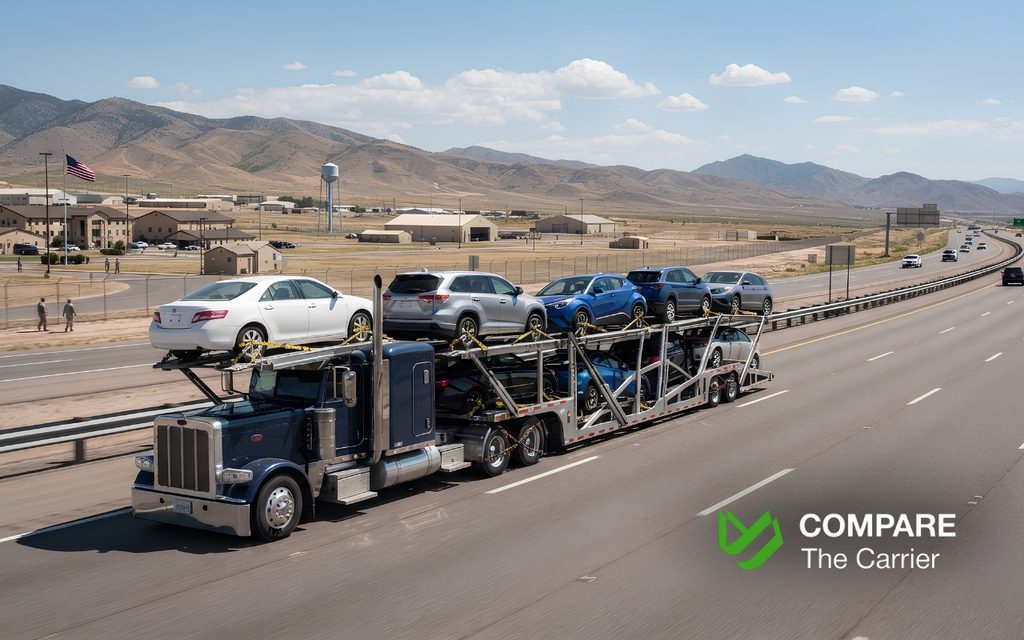
A handful of variables move the price up or down more than anything else:
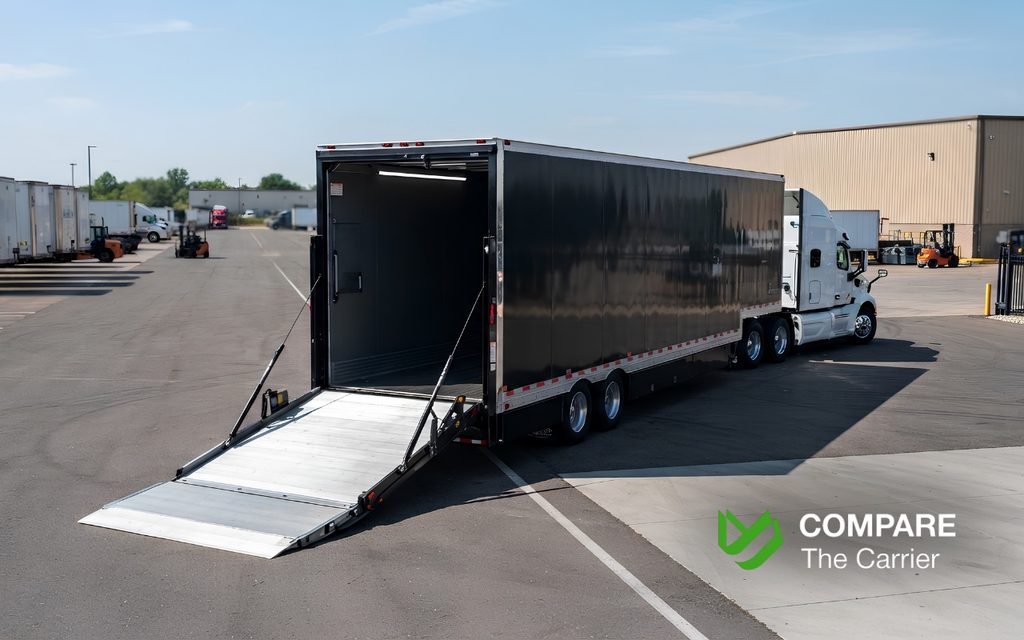
Enclosed transport typically costs more than open transport, but if added protection for your vehicle is important to you, it’s worth considering enclosed auto transport.
A quote that looks complete can still leave out charges that only show up once you’re locked into a booking. Ask each carrier directly about the following before you sign anything:
| Fee Type | When It Applies | Typical Impact |
| Enclosed transport | Luxury, classic, or high-value vehicles | 40–60% above open transport |
| Expedited pickup | Tight deployment timelines | Flat fee or per-mile surcharge |
| Inoperable vehicle | Car won’t start or drive under its own power | Extra charge for winch loading |
| Remote location | Pickup or delivery far from major routes | Added mileage or a “long carry” fee |
| Terminal storage | Vehicle waits at a terminal instead of door-to-door | Daily rate after a short grace period |
None of these fees are automatic. Some carriers waive expedited charges for military orders, and plenty of shippers never pay a remote-location fee simply because their pickup address happens to sit near an interstate. The point isn’t to expect every line item on that table, it’s to ask about each one before you sign, so nothing shows up as a surprise on delivery day.
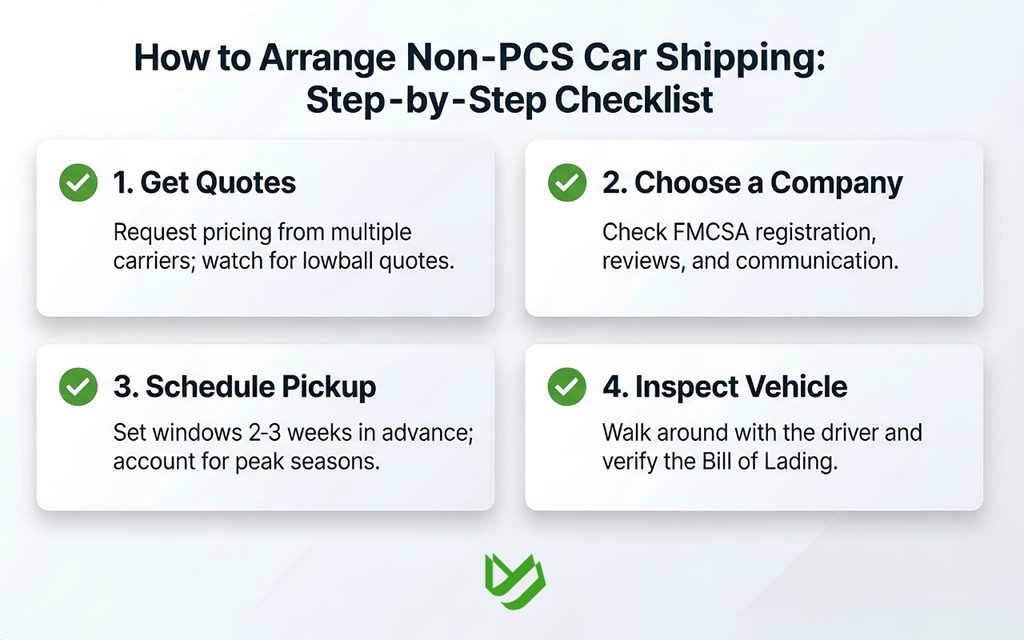
Booking a shipment for a Non-PCS deployment follows roughly the same process as any transport between different states, just on a tighter deadline than most civilian moves. Not every broker that offers car shipping services for military personnel treats Non-PCS orders the same way, so it’s worth asking directly how they handle deployment-specific bookings.
| Step | What You Do | What to Watch For |
| 1. Get quotes | Request pricing from several carriers or brokers | Unusually low quotes that may rise later |
| 2. Choose a company | Compare licensing, reviews, and communication | FMCSA registration, recent reviews |
| 3. Schedule | Set pickup and delivery windows | Peak-season delays, booking lead time |
| 4. Inspect | Walk the vehicle with the driver at both ends | Bill of Lading accuracy, timestamped photos |
Get quotes from at least three carriers or brokers before booking anything. A quote that comes in noticeably lower than the rest is worth a second look rather than an easy win. Foster has flagged this pattern for years:
Expert Tip from Ryan Foster: “Lowball quotes almost always turn into price creep once the broker can’t find a driver willing to take the job at that rate. By the time you’re a week from pickup, that two-hundred-dollar discount has evaporated.”
Request an itemization from each company so you can compare the total charge don’t only look at the top number that is printed. When the quote includes a breakdown of fuel surcharges, insurance coverage and pickup windows, it’s likely to be more accurate than a quote that provides just one flat fee.
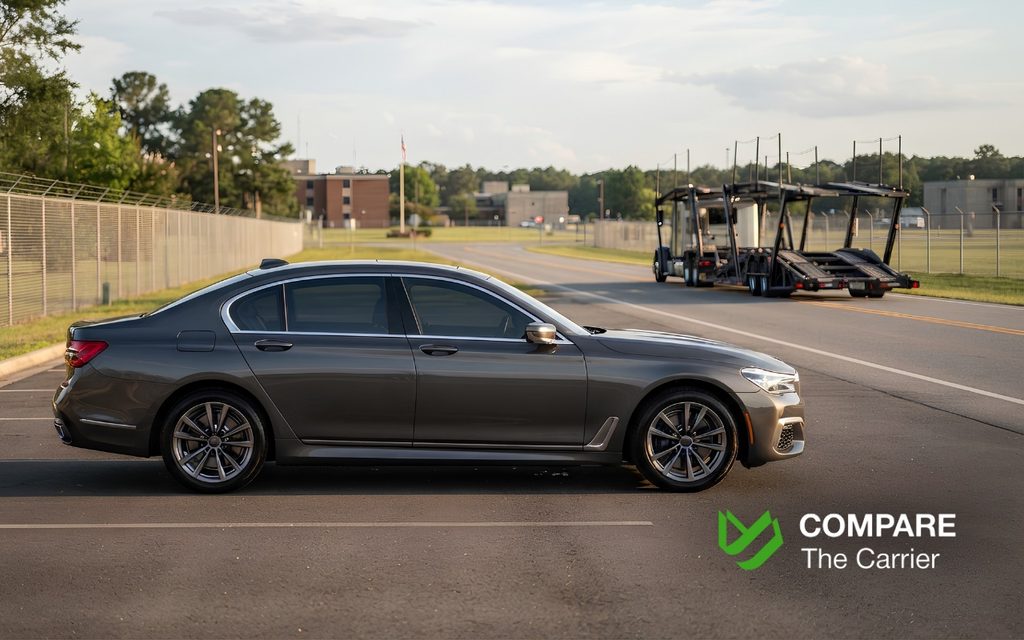
Price matters, but it shouldn’t be the only factor, especially when you’ll be unreachable for part of the shipment. What makes one the best car shipping company for military personnel over another usually comes down to communication and reliability, not just the quote. Check that the carrier is FMCSA-registered, ask how they handle updates during transit, and read recent reviews rather than the ones featured on the homepage. If your deployment leaves little room for delays, ask directly whether faster transport when time is limited is available and what it costs, since most companies offer some form of expedited service for an added fee.
Request your pickup at least 2–3 weeks before your target shipping date, or earlier if you’re moving during peak season (late spring through summer), when PCS demand is typically higher. If you won’t be available at pickup, decide in advance who will hand over the vehicle, as this may affect the required paperwork. It’s also worth asking for a wider pickup window rather than a specific day – a one- to three-day window gives the carrier more flexibility and may help keep the cost lower.
Whoever hands off or receives the car should walk the full exterior with the driver and note every mark on the Bill of Lading before signing anything. Photos help, but the signed inspection document is what actually protects you if a damage claim comes up later. This step matters more, not less, when you’re the one overseas and can’t inspect the car yourself, since a hastily signed form with no notes on it leaves your representative with nothing to point to if something looks different at delivery.
If you can, walk your representative through the process before pickup day, including where to check for existing damage (bumpers, wheel wells, and the roofline are the most commonly missed spots) and how to photograph the odometer reading. A short phone call the night before saves a lot of confusion the next morning.
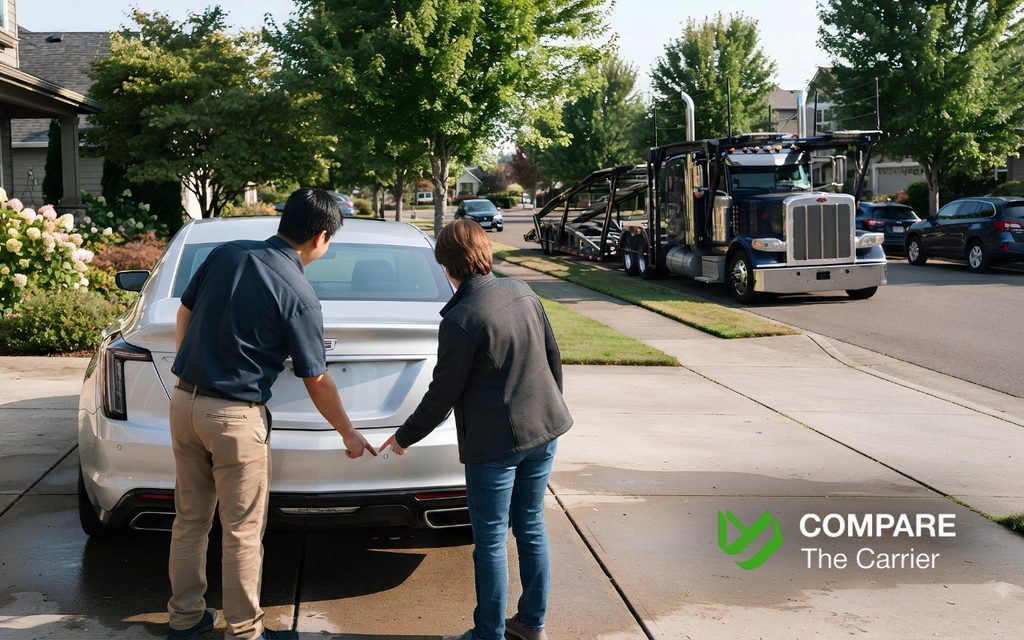
A little prep work before pickup day keeps things moving and avoids surprises at delivery.
Clear out the vehicle before it comes into the hands of the carrier, taking out personal, valuable, and important objects from the car interior and trunk. This means documents, electronics, cash, and anything else you do not want left in the vehicle during transport. Look for toll tags, garage door remotes, and other things that might be needed once the car is retrieved. If they can be carried, ask the carrier what they need and what they cannot carry beforehand.
Wash the car before pickup. A clean vehicle makes existing scratches and dents easier to spot and document. Note the mileage, check for fluid leaks, and make sure the battery is charged if the car has been sitting for a while. For a longer paper trail, documenting your vehicle before shipment with timestamped photos from every angle gives you more to work with if a dispute comes up later.
Expert Tip from Ryan Foster: “A five-minute walk-around before the truck shows up saves a lot of back-and-forth later,” Foster says. “Half the disputes I hear about come down to a scratch nobody wrote down at pickup.”
Having the right paperwork ready before pickup day keeps a Non-PCS shipment from stalling at the last minute. Since there’s no orders-based government process backing up a Non-PCS shipment, the burden of proof, ownership, authorization, and condition falls entirely on the documents you and the carrier put together yourselves.
| Document | Purpose |
| Deployment or military orders | Confirms your timeline; sometimes requested by the broker |
| Vehicle title or registration | Proves ownership of the vehicle |
| Government-issued ID | Required at both pickup and delivery |
| Power of attorney (if applicable) | Authorizes someone else to release or accept the car |
| Proof of insurance | Confirms what your own policy covers during transit |
| Bill of Lading | Signed condition report at pickup and again at delivery |
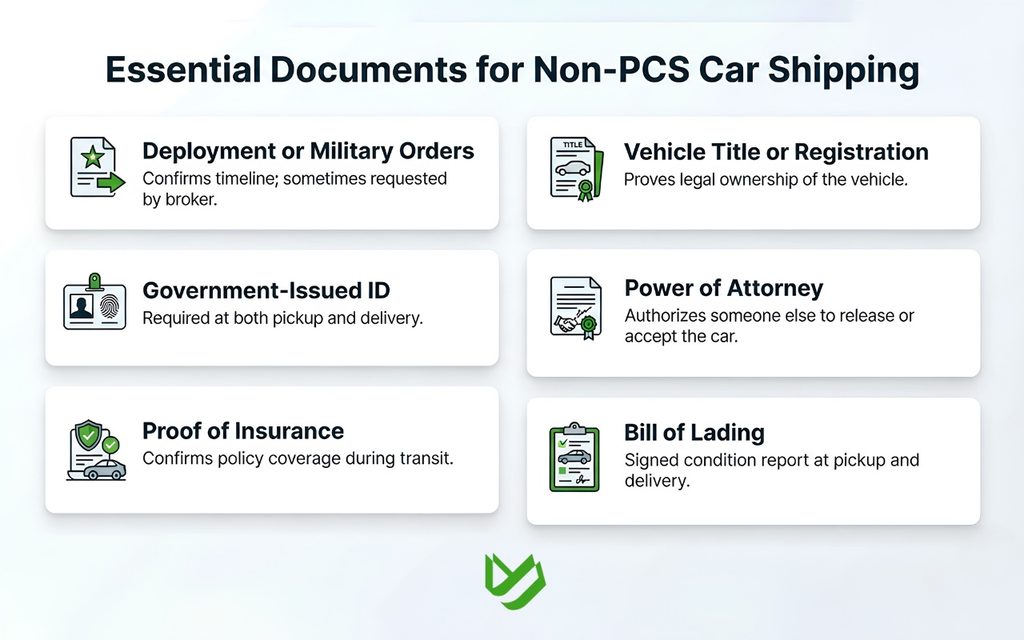
Keep digital copies of everything, since paper documents are easy to lose track of once you’ve deployed. If someone else is handling drop-off or pickup on your behalf, required shipping paperwork should include a power of attorney specific to that transaction, not a general one that may not cover vehicle transport. It’s also worth reviewing insurance considerations before you sign anything, since carrier cargo insurance and your own auto policy don’t always overlap the way people assume.
Transit time comes down almost entirely to distance, with weather and carrier availability as secondary factors.
| Mileage | Average Transit Time |
| 0–799 miles | 1–2 days |
| 800–1,499 miles | 2–4 days |
| 1,500–2,399 miles | 4–7 days |
| 2,400+ miles | 7–10 days |
These are typical transportation timelines for open transport. Enclosed shipments run on similar timelines but with fewer trucks on the road, which can add a day or two during busy months.
Getting the car to where it needs to go shouldn’t be more complicated than it already is when you don’t deploy the PCS. It’s important to recognize that you’re typically responsible for organizing and paying for the shipment, and to select the one that makes the most sense given when you will be away, where the car is going, and how quickly you need to get there. Shop around, verify the carrier’s qualifications, have proper paperwork ready, and ensure proper vehicle documentation before pickup. You can avoid last-minute fees, unnecessary storage costs, and unexpected charges while you’re deployed if you plan accordingly.
Non-PCS deployment means you’ll usually be arranging your vehicle transport yourself. Compare The Carrier can help you compare shipping options and get a free quote for your route. Start your quote online or call (321) 641-0625 if you need help planning your shipment around your deployment timeline.
Typically, the service member pays, since the POV shipment benefit is only available for PCS orders and not most deployments. Some units will contribute to some overseas assignments, so please check with your admin office before you think it is all on you.
Some car shipping companies may offer special rates or discounts for military members. If this is important to you, ask the carrier whether any military discounts are available and what requirements may apply.
Yes. Since there’s no government contract involved, you’re free to book with any licensed, insured carrier or broker. This is where ways to find a better shipping deal matter most, since you’re not locked into a pre-approved vendor list the way some PCS moves are.
Yes, if that person is at least 18 and you have made arrangements, preferably with signed documents, allowing the person to release or accept the vehicle on your behalf.
Occasionally, but it depends upon the carrier and the stage of the shipment. Contact us as early as possible; it will be much easier to accommodate a change that is requested before loading than one made mid-route.
Most brokers will rebook your pickup window at no charge if you give them enough notice. Locking in a firm date too far in advance without any flexibility can work against you if orders shift, so ask about the rescheduling policy before you book. It’s also worth confirming whether any deposit you’ve paid is refundable or transferable, since policies on that vary quite a bit between brokers.
If a small quantity (usually less than 100 pounds) is secure out of the way, it is probably safe. Extra fees and outright rejection may apply when loading larger volumes, and if anything happens while the load is in transit, no cargo insurance will cover the load.
Yes, if they have your permission and the vehicle’s registration. Many military personnel who are deploying make arrangements in advance for their spouse or parent to pick up or drop off the service member if the former is not available.
Generally, 2-3 weeks in advance is the target for most routes, but if you are flexible on price and pickup time, you could book a month out, especially in the summer months when travelers are coming for PCS season. Last-minute scheduling is likely to involve fewer carriers and be more expensive for the same route.
Please notify the carrier or broker if you are late for your pickup. They can reschedule a new pickup time; however, rescheduling may affect availability and may incur additional charges under the carrier’s policy. When you are deploying and unavailable, have an authorized family member, friend, or representative pick up the vehicle on your behalf and verify pickup procedures as far in advance as possible with the carrier.











Don't have time to fill out the form?
Call a transport company directly to get a quote now!
Select the category you need
Partner with Compare The Carrier & Grow!
We're open to collaborations, partnerships, and mutual growth! Whether you're an individual or a business, we offer exciting opportunities to work together. Fill out the form below to explore how we can collaborate.
Something Went Wrong
We're sorry, but something went wrong. Please briefly describe the problem you experienced in the text area below. Providing your contact information will allow us to follow up if needed.

Thank you,
your form has been accepted.
Your form has been successfully submitted. We appreciate your effort — our team will review it shortly and take the next steps.


