

State-to-State Vehicle Transport – What to Expect From Pickup to Delivery
You have handed over your keys to a stranger. Your car is...
6 July 2026
Every fall, hundreds of thousands of snowbirds begin the same migration – out of Texas and into Florida before the first cold front settles in. Most of them drive. But a growing number are discovering that shipping their RV instead of driving it is not just possible; for many situations, it is the smarter financial and physical choice.
Calculate Shipping Quotes
The snowbird auto transport trend has grown steadily year over year as more RV owners run the actual numbers and factor in fatigue, mileage, and their own time. This guide covers everything specific to the Texas-to-Florida RV transport corridor: real costs broken down by RV class, the exact booking windows that determine whether you pay a fair rate or a panic premium, the route itself, and a complete pre-transport checklist so your rig arrives in the same condition it left.
If you are evaluating carriers for this route, start with our vetted list of top RV shipping companies before requesting quotes.
The instinct is to drive. You own the RV, you know how it handles, and driving it yourself feels like the obvious choice. However, the math does not always support that instinct.

The true cost of driving your RV from Texas to Florida. The Texas-to-Florida corridor – Houston to Tampa, for example – covers roughly 1,100 to 1,300 miles depending on your origin and destination. A Class A motorhome averages 6 to 10 miles per gallon. At current diesel prices, that is roughly $300 to $550 in fuel alone for a single trip. Add two days of driving, overnight stops, meals on the road, and the wear on your engine, tires, and drivetrain, and the true cost of driving climbs significantly. Our should I ship or drive cross-country article runs the full cost comparison across different scenarios and vehicle classes.
The physical argument. Two consecutive days of driving a 35-foot motorhome on I-10 through Louisiana and Mississippi – construction zones, truck traffic, and all – is genuinely exhausting. For older snowbirds making this trip twice a year, see our dedicated guide to auto shipping in your golden years for a full breakdown of why professional transport makes sense at this stage.
The mileage preservation argument. High-mileage motorhomes depreciate faster and cost more to insure and maintain. Every mile you put on the engine is a mile closer to the next major service interval. Shipping the RV and flying to Florida puts zero miles on your rig.
When driving still makes sense. If you own a towable – a travel trailer or fifth wheel – and you have a capable tow vehicle, driving is often the cheaper option for a single trip. Professional RV shipping makes the most financial sense for Class B, C, and A motorhomes, or for snowbirds making the round trip twice a year and looking to preserve the vehicle long-term.
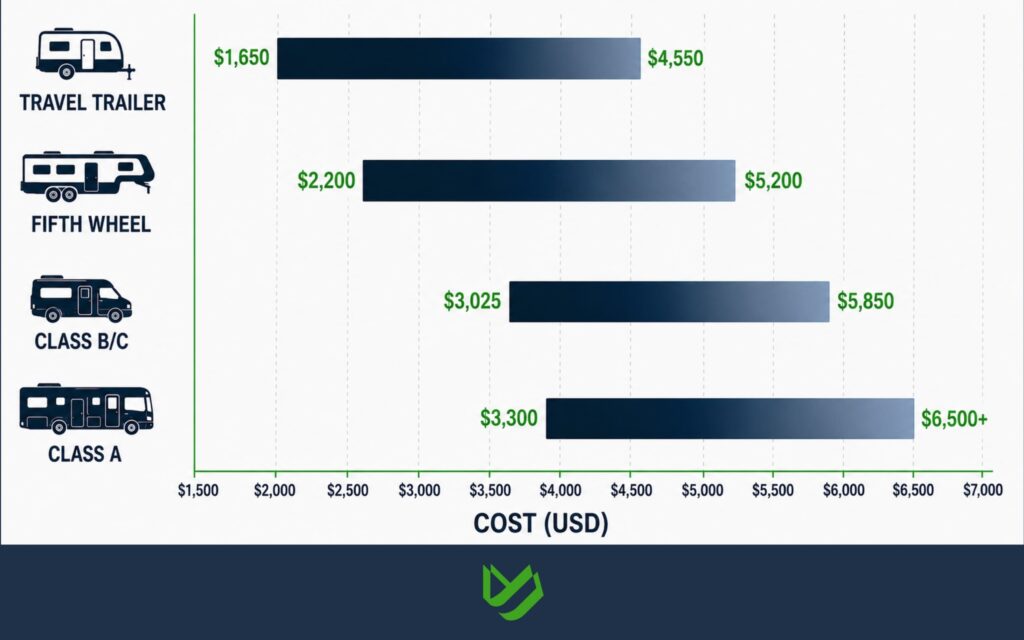
Shipping costs are quoted per mile or as a flat route rate. The Texas-to-Florida corridor is approximately 1,100 to 1,300 miles, depending on pickup and delivery zip codes. Use these ranges as your baseline when evaluating quotes.
Cost per mile by RV class:
| RV Type | Cost Per Mile | Estimated TX–FL Total |
| Travel Trailer | $1.50 – $3.50 | $1,650 – $4,550 |
| Fifth Wheel | $2.00 – $4.00 | $2,200 – $5,200 |
| Class B / C Motorhome | $2.75 – $4.50 | $3,025 – $5,850 |
| Class A Motorhome | $3.00 – $5.00+ | $3,300 – $6,500+ |
These are baseline ranges under normal seasonal conditions. During peak southbound season (October through December), expect quotes to run 15% to 30% above these figures. Understanding how demand cycles affect pricing across all vehicle types is covered in our breakdown of the impact of seasonality on auto transport costs.
What drives the price up beyond the base rate:
For a quick estimate on your specific zip codes, use our auto transport calculator.
The Texas-to-Florida transport corridor is one of the most demand-driven routes in the country. Prices are not fixed – they fluctuate with the migration calendar. Knowing the cycle is the single most effective way to manage your shipping cost.
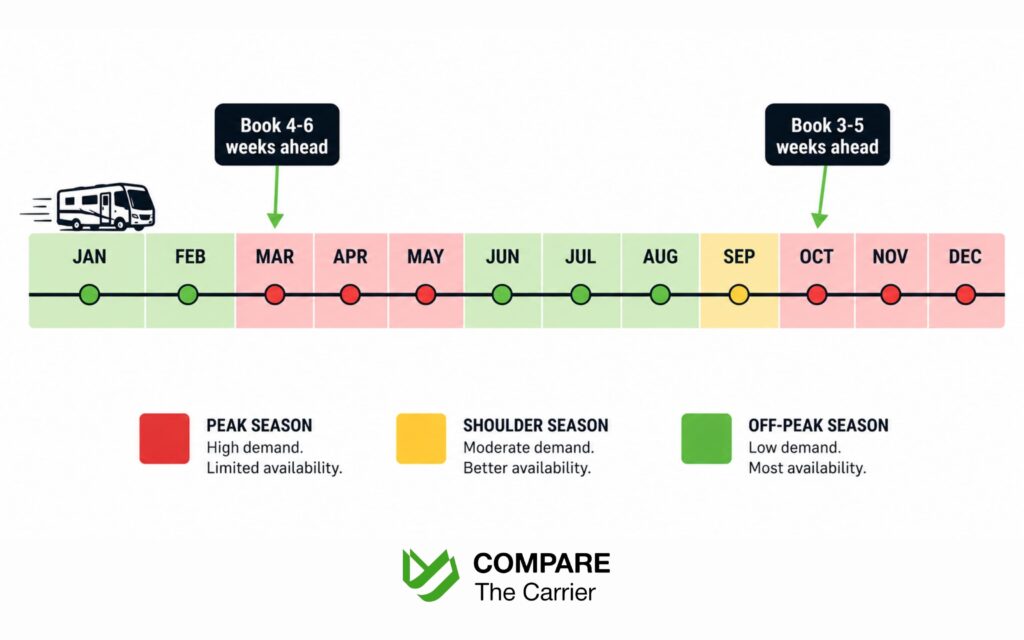
Southbound peak: October through December
This is the primary rush. Texas snowbirds who winter in Florida – particularly in the Tampa Bay area, the Gulf Coast, and South Florida – begin their migration in October. Volume peaks in November and stays elevated through mid-December. Two specific windows make pricing spike sharply:
Booking window for southbound: Place your order 3 to 5 weeks before your target pickup date. If your schedule allows 3 to 5 days of pickup flexibility, communicate this to your broker – that flexibility alone can reduce your quote by $150 to $300, as it allows the carrier to optimize their multi-stop route load. The relationship between booking lead time and final price follows the same patterns described in our auto transport myths: tracking, timing, and delivery guide.
Northbound peak: March through May
The return migration is equally predictable. Most Florida snowbirds begin heading home in late March after spring break crowds arrive. The volume peaks in April. Easter weekend creates a specific crunch similar to Thanksgiving on the southbound run – avoid needing pickup in the week surrounding Easter.
Booking window for northbound: Book 4 to 6 weeks out. The northbound corridor (Florida back to Texas) is moderately less competitive than the southbound because fewer carriers run Florida-origin loads back west. This can mean slightly longer wait times for pickup, even with advance booking.
The off-peak windows (January, February, June through September):
January and February are the quietest months on this corridor. Most snowbirds are already settled in Florida; demand for transport is low; carrier availability is high. If your schedule allows a mid-January departure from Texas (heading to Florida for a late-season stay), you will find the best rates and fastest pickup availability of the entire year. Summer months are similarly quiet, though extreme heat in Texas and Florida creates logistical complications for some haulers.
Understanding the physical route your RV takes helps you set realistic expectations for transit time and understand why delays happen.
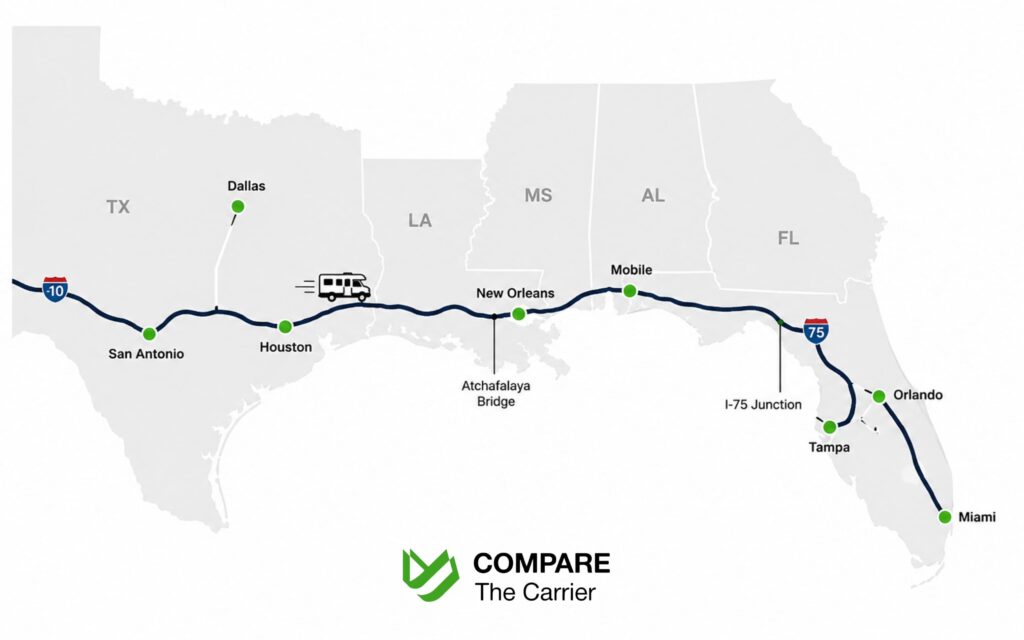
The primary corridor: I-10 East. The dominant route follows Interstate 10 east from Houston (San Antonio and Dallas connections funnel south first), through Beaumont, across southern Louisiana through Baton Rouge and New Orleans, then east through Mississippi and Alabama before entering the Florida Panhandle and branching south toward your destination. If you are shipping from the Dallas–Fort Worth area or San Antonio, our best Texas auto transport overview covers regional pickup logistics and which Texas origins add the most transit time.
Key route segments and their complications:
Approximate transit times by destination:
| Texas Origin | Florida Destination | Estimated Transit |
| Houston, TX | Tampa, FL | 2 – 4 days |
| Houston, TX | Orlando, FL | 2 – 5 days |
| Houston, TX | Miami, FL | 3 – 6 days |
| Dallas, TX | Tampa, FL | 3 – 5 days |
| San Antonio, TX | Fort Myers, FL | 3 – 5 days |
Transit times reflect multi-stop carrier routing and federal Hours of Service regulations – a commercial driver is legally limited to 11 hours behind the wheel per day. A driver cannot simply push through overnight to deliver faster.
If you have never shipped an RV before, the mechanics of the process are worth understanding. This is not the same as shipping a passenger car.

Transport methods by RV type:
logistics coordinator who matches your shipment with available carriers. The driver who physically moves your RV is employed by or contracted to the carrier. Before your rig moves, verify the carrier’s USDOT number and active cargo insurance status directly on the FMCSA SAFER system. Our guide on how to verify a carrier’s MC number walks through the exact steps.
The Bill of Lading: Before any movement, you and the driver sign a Bill of Lading – a legal condition report documenting every existing scratch, dent, and mechanical note on your RV. This document is your primary protection if damage occurs in transit. Photograph your RV independently before signing and keep your copy until delivery is complete and verified.
A properly prepared RV loads faster, travels more safely, and gives you stronger legal protection if a damage claim becomes necessary.

Exterior and structural prep:
Propane and power systems:
Interior prep:
Documentation. Photograph every exterior panel, all four corners, the roof if accessible, and the undercarriage. Record a slow walkaround video with verbal narration of any existing damage. Timestamp everything. These files are your protection if a dispute arises at delivery. Any questions about what to ask your carrier before pickup are covered in our questions to ask before shipping your vehicle checklist.
The FMCSA requires all licensed commercial haulers to carry active cargo insurance. For RV transport specifically, coverage minimums vary by carrier size and the vehicle’s declared value.
What is typically covered:
What is typically NOT covered:
Your personal RV insurance. Contact your RV insurer before shipping. Some comprehensive policies include in-transit coverage that acts as a secondary layer if the carrier’s cargo policy disputes a claim.For the full breakdown of what transport insurance does and does not cover, see our auto transport insurance guide. If a damage claim becomes necessary after delivery, our auto transport claims guide walks through every step of the filing process.
Declared value vs. cargo coverage: If your Class A motorhome is worth $200,000, verify that the carrier’s cargo policy limit is sufficient. Some smaller carriers carry a minimum coverage of $100,000. For high-value coaches, request a certificate of insurance showing the policy limit before signing anything.
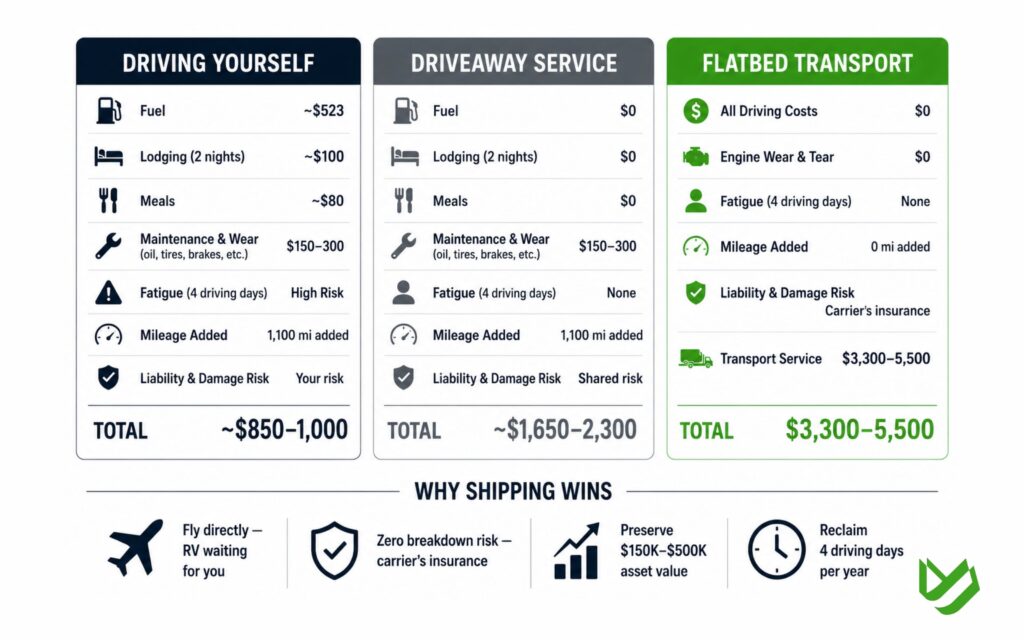
Rather than a theoretical debate, here is a side-by-side calculation for a realistic scenario: a Class A motorhome owner in Houston shipping to Tampa.
| Cost Factor | Driving Yourself | Driveaway Service | Flatbed Transport |
| Fuel & road costs | ~$523 | $0 | $0 |
| Lodging (2 nights) | ~$100 | $0 | $0 |
| Meals on the road | ~$80 | $0 | $0 |
| Engine wear / oil change | $150–$300 | $150–$300 | $0 |
| Driver fatigue | High | None | None |
| Miles added to engine | 1,100 mi | 1,100 mi | 0 mi |
| Road breakdown risk | Yours | Shared | Carrier’s insurance |
| Transport service cost | $0 | $1,500–$2,000 | $3,300–$5,500 |
| Estimated total | ~$850–$1,000 | ~$1,650–$2,300 | $3,300–$5,500 |
For a single one-way trip, driving wins on raw cost for most owners. However, for the round trip – Texas to Florida in October, Florida back to Texas in April – the gap narrows when you account for twice the fuel, twice the wear, and four full days of driving each year. The cost of moving to Florida guide puts these transport costs in the broader context of a full relocation budget.
Where shipping wins decisively:
Step 1: Know your RV’s exact dimensions. Length, height, width, and total weight (GVWR). Carriers quote based on these numbers. An incorrect measurement can cause the quote to change significantly at pickup, or result in the hauler arriving with the wrong equipment.
Step 2: Get at least three quotes. The Texas-to-Florida corridor is competitive. Do not accept the first quote. Use our RV shipping services page to compare vetted carriers. Prices for the same route can vary by $500 to $1,000 between carriers on the same day.
Step 3: Verify the carrier’s credentials. Before paying any deposit, look up the carrier’s USDOT number on the FMCSA SAFER website. Confirm their operating authority is active and their cargo insurance is current.
Step 4: Confirm your pickup flexibility. If you can offer a 3-to-5-day pickup window rather than a fixed single date, communicate this clearly. It lowers your quote and makes it easier for the carrier to assign a driver efficiently.
Step 5: Read the Bill of Lading carefully. At pickup, read every line before you sign. If the driver notes damage that does not exist, dispute it. If they note “condition unable to verify” due to dirt, get the RV wiped down and re-inspected before signing.
Step 6: Be present at delivery. You or a designated adult must be present to conduct the final walkthrough. Compare the rig to your pickup photos. Note any new damage in writing on the delivery BOL before signing. Contact the carrier within 24 hours if a claim is necessary.
The Texas-to-Florida corridor is one of the most predictable, well-serviced RV transport routes in the country. The carriers know it. The routes are established. The only variable you control is timing and preparation.
Book early – 3 to 5 weeks ahead for southbound, 4 to 6 weeks for the return. Offer pickup flexibility. Document your RV thoroughly before it leaves your driveway. Verify your carrier on FMCSA before you pay a deposit. And be present at delivery for the final inspection.
For vetted carriers who specialize in this route, start with our top RV shipping companies guide, or use our auto transport calculator for an instant route estimate.
Yes. Professional RV transport is a well-established industry. Drivable motorhomes are typically transported via driveaway service – a licensed driver moves the RV itself. Towable units (travel trailers, fifth wheels) are hauled by a commercial tow vehicle. All interstate carriers are required to be registered with the FMCSA and to carry active cargo insurance.
For the Texas-to-Florida corridor at roughly 1,100 miles, expect $1,650 to $4,550 for travel trailers, $2,200 to $5,200 for fifth wheels, and $3,300 to $6,500+ for Class A motorhomes. Rates rise 15–30% during peak snowbird season (October–December and March–May).
For a single one-way trip, driving is almost always cheaper in direct out-of-pocket cost. However, professional shipping eliminates driver fatigue, adds no miles to the drivetrain, and can be cost-justified for round-trip snowbird migrations, high-mileage rigs, or owners who prefer to fly directly.
The 3-3-3 rule is a self-imposed travel guideline (drive no more than 300 miles per day, arrive by 3 pm, stay at least 3 nights) used by RV owners to reduce fatigue on personal road trips. It does not apply to professional transport. Commercial drivers follow federal Hours of Service regulations – a maximum of 11 hours driving per 24-hour period – which is the actual regulatory framework governing transit time.
Close all propane tank valves, disconnect house batteries, retract all slide-outs and awnings, seal roof vents, drain holding tanks, remove all loose interior items, and check tire pressure. Photograph every exterior panel with timestamps before the driver arrives. These photos are your primary protection if a damage dispute arises at delivery.
For southbound travel (October–December), book 3 to 5 weeks in advance. Avoid the week of Thanksgiving and the two weeks before Christmas – those windows have the highest demand and lowest carrier availability of the year. For northbound return (March–May), book 4 to 6 weeks out. Flexibility in your pickup window by 3 to 5 days can reduce your quote by $150 to $300.
Standard RV insurance policies vary. Some comprehensive policies include in-transit coverage; many do not. Call your insurer before booking transport and confirm explicitly whether damage occurring while the RV is on a hauler – or being driven by a third-party driveaway driver – is covered under your current policy. The carrier’s cargo insurance is a separate layer of coverage.
Expedited transport – guaranteed pickup within 24 to 48 hours – is available for a premium of $200 to $400 above standard rates. Under normal conditions, a Houston-to-Tampa shipment takes 2 to 4 days in transit once the driver is assigned. The biggest variable is not driving time but carrier availability, particularly during peak season.












Don't have time to fill out the form?
Call a transport company directly to get a quote now!
Select the category you need
Partner with Compare The Carrier & Grow!
We're open to collaborations, partnerships, and mutual growth! Whether you're an individual or a business, we offer exciting opportunities to work together. Fill out the form below to explore how we can collaborate.
Something Went Wrong
We're sorry, but something went wrong. Please briefly describe the problem you experienced in the text area below. Providing your contact information will allow us to follow up if needed.

Thank you,
your form has been accepted.
Your form has been successfully submitted. We appreciate your effort — our team will review it shortly and take the next steps.


