

Car Shipping vs Driving: Is the 1,000-Mile Rule Worth It?
The 1,000-mile rule serves as a simple benchmark: if your...
19 May 2026
Yes, last-minute car shipping is possible – but it costs more and requires faster decisions. Most routes can be arranged within 24 to 72 hours through expedited transport services. Expect to pay $150–$500 above standard rates, depending on your route, timeline, and carrier availability. The shorter your deadline, the fewer options you have – which is why acting within the first few hours matters most.
Calculate Shipping Quotes
Maybe your job relocation came through faster than expected. Maybe the home sale closes early, and the moving truck arrives Saturday. Maybe you simply forgot until now, and the move is next week. Whatever the reason, you are not the first person to be in this position, and the situation is more manageable than it feels right now.
The key is knowing exactly what “last-minute” means to a carrier dispatcher, because your definition and theirs are often very different. What feels like a crisis to you might be a routine rush booking to them – or it might genuinely be impossible, depending on your route and timeline. This guide breaks down exactly where the line is, what it will cost you to cross it, and the fastest way to get your car moving today.
Compare The Carrier connects you with verified carriers on your specific route – including expedited options for tight timelines. Use the car shipping cost calculator to see real-time rates for rush booking before you make that first call.
When panic sets in, and you realize you have to move a vehicle immediately, your perception of time changes completely. A deadline that feels terrifying to you might actually be a standard, routine timeline for a logistics professional. Before you assume the worst and agree to pay an astronomical emergency premium, you need to understand how the auto transport industry categorizes urgency.
Not all “last-minute” requests are created equal. Dispatchers and brokers organize rush shipments into specific timeline tiers, and the price you pay depends entirely on which exact tier your deadline falls into.
| Timeline | Industry Term | Realistic? | Price Premium |
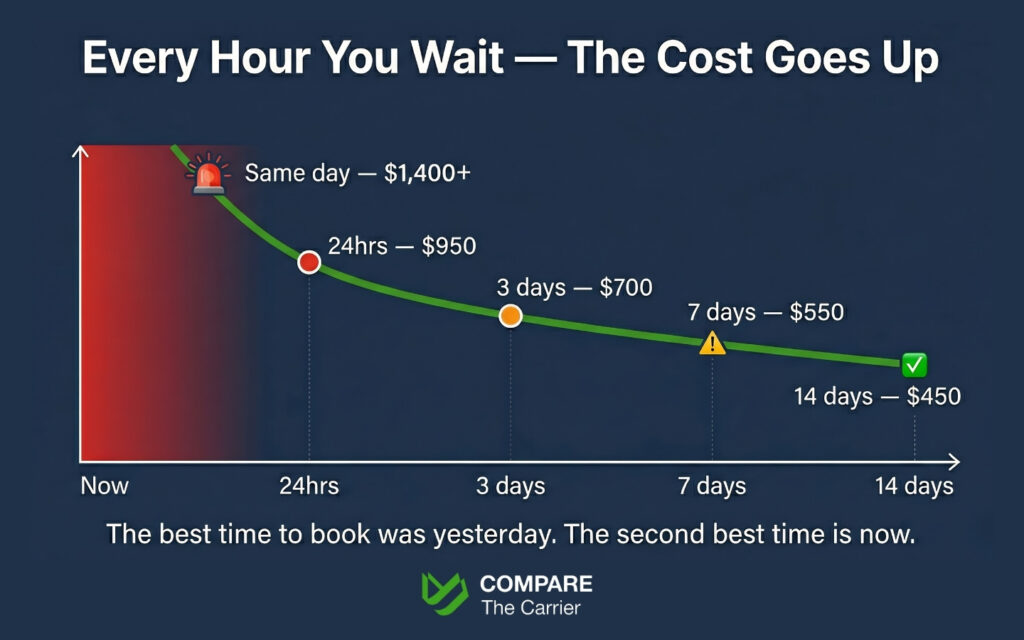
| Same day (under 24 hrs) | Emergency/Hotshot | Rarely, major cities only | +$400–$800 |
| 1–2 days | Expedited priority | Yes, on busy corridors | +$200–$500 |
| 3–5 days | Rush booking | Yes, most routes | +$100–$300 |
| 5–7 days | Short-notice | Yes, all routes | +$50–$150 |
| 7–14 days | Standard booking | Standard rate | No premium |
Most people who think they need “same-day” shipping actually have 48–72 hours if they make calls immediately. That window changes everything – it’s the difference between a $300 premium and a $700 one. When you give a broker three days instead of three hours, they have time to contact drivers currently in transit, negotiate a fair detour rate, and secure a spot on a standard multi-car hauler. If you demand a pickup by tonight, the broker has to bypass all standard fleet operations and hire a dedicated independent driver with a specialized flatbed, which instantly destroys your moving budget.
When you hear that a rush job costs hundreds of dollars more, it is easy to assume the transport company is simply taking advantage of your desperate situation. While predatory pricing does exist, the real reason is the economics of commercial trucking.
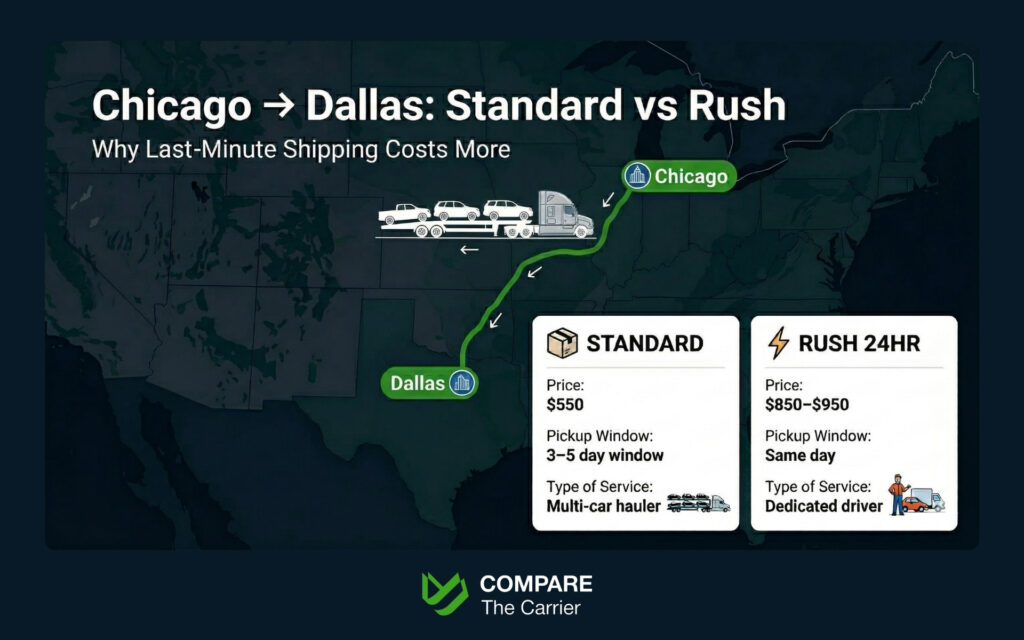
Companies make their profit by planning routes weeks in advance, ensuring every slot on their trailer is filled before they turn the ignition key. When you call today and demand a pickup tomorrow, the broker has to find a driver already passing through your area, with an open spot on their trailer, who is willing to deviate from their optimized route – all within hours. Every one of those conditions carries a financial penalty.
A standard open transport quote from Chicago to Dallas might be $550, with a 3–5-day pickup window. The same route with a 24-hour requirement? Expect $850–$950 – sometimes more during peak season. You are essentially paying the supply chain to drop everything and prioritize your vehicle over someone else’s.
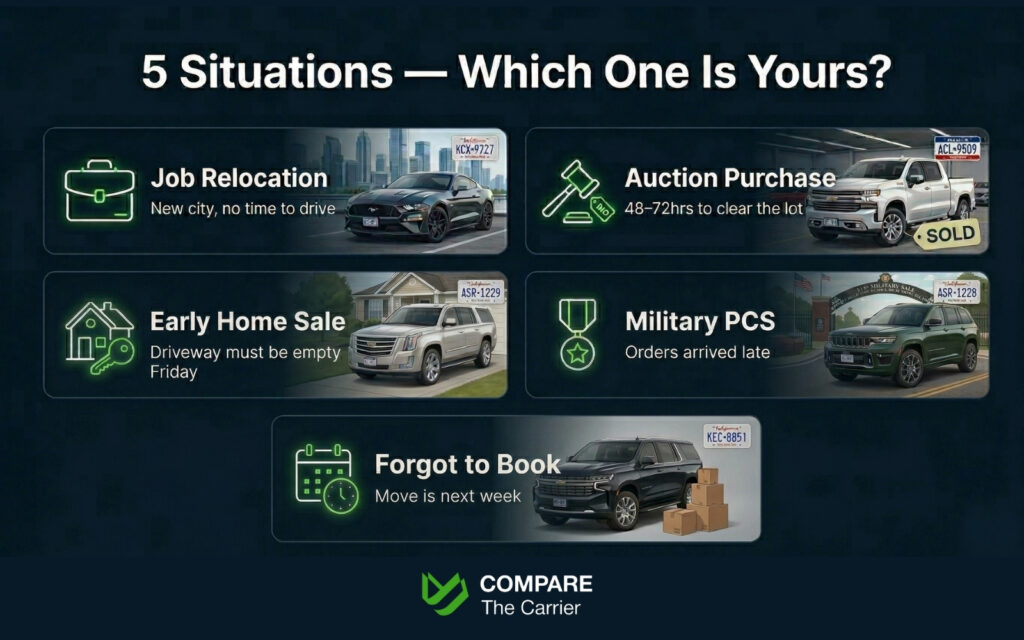
Urgent shipping needs rarely happen because someone was simply lazy; they happen because life throws massive curveballs. When you understand the specific mechanics of your personal situation, you can navigate the broker negotiations much more effectively.
Your employer just offered you an incredible promotion, but the catch is that you have to report to the new office three states away by next Monday. You are already scrambling to book a flight and find a temporary apartment, leaving you no time to drive your personal car across the country. This is arguably the most common rush scenario, and it is also one of the easiest to solve because major corporations often cover the bill. Before you pull out your own credit card, immediately ask your human resources department about a relocation allowance. Because you are traveling between active business hubs, you can generally expect a 3 to 5 day pickup window and a 5 to 10 day transit period. To figure out exactly when your car will arrive at the new office, read up on how long shipping takes on your route to set realistic expectations with your new boss.
You spent weeks hunting for the perfect used car, and you finally won the bid on a massive online auction site or finalized a deal through a remote dealership. The victory celebration ends abruptly when the seller informs you that the vehicle must be removed from their commercial lot within 48 to 72 hours, or you will face punishing daily storage fees. Dealerships and auction houses like Copart or IAAI do not have the space to hold sold inventory. This creates intense financial pressure. Always explicitly inform your broker about the strict storage deadline during your very first phone call. Certain transport networks specialize exclusively in rapid auction lot pickups and maintain faster dispatch protocols designed specifically to beat the clock and save you from those daily lot penalties.
Military life runs on a rigid schedule until the exact moment it doesn’t. Permanent Change of Station (PCS) orders can drop with terrifyingly short notice, forcing service members to uproot their entire family in a matter of days. When this happens, the government-run Vehicle Processing Centers (VPC) are usually booked solid for weeks, leaving you to handle the logistics privately. This is one of the most high-stress scenarios imaginable. If you are dealing with a government-funded PCS, call the VPC immediately and escalate your situation to see if they have emergency slots available. If you are forced to use the private sector, specifically seek out carriers that offer a military discount and have dedicated military car shipping options designed to accommodate base access and strict deployment timelines.
The real estate market is unpredictable. Sometimes a closing drags on for months, and sometimes the buyers push to close a week early and want the keys immediately. Suddenly, your moving truck is scheduled to arrive on Saturday, but your second family vehicle needs to be shipped out by Friday so you can hand over the empty driveway. This is a very tight window, but it is highly realistic on most popular highway corridors if you start making phone calls by Monday or Tuesday. The most practical piece of advice here is to offer flexible delivery terms. If you tell the broker, “deliver it anywhere within a 30-mile radius of my new address, whenever you arrive,” you drastically increase your chances of finding a driver who can accommodate the urgent Friday pickup. When you cross state lines under this kind of pressure, knowing exactly what to expect from state-to-state shipping keeps you grounded.
Between packing boxes, transferring utility bills, registering kids for new schools, and forwarding mail, the simple act of calling an auto transporter just slipped your mind. You wake up realizing your move is exactly seven days away, and your car has no ride. Take a deep breath, because this is the absolute easiest situation to fix. A seven-day lead time provides plenty of runway for a dispatcher to find a reliable carrier, especially when moving between two major metropolitan areas. The short-notice premium will likely be minimal, hovering around $50 to $150 above the standard baseline. The only rule here is that you cannot afford to wait one more day; you must compare rates and book immediately to prevent the situation from escalating into a true 48-hour emergency.
The numbers below provide a realistic view of the financial penalty for waiting. These are the current market premiums you can expect to pay based on the severity of your deadline.
| Route | Standard Rate | 3-Day Rush | 24-Hour Rush |
| New York → Florida | $450–$600 | $650–$800 | $900–$1,200 |
| California → New York | $800–$1,100 | $1,100–$1,400 | $1,500–$2,000 |
| Texas → Illinois | $400–$550 | $600–$750 | $800–$1,100 |
| Florida → California | $900–$1,200 | $1,200–$1,500 | $1,600–$2,100 |
| Chicago → Atlanta | $350–$500 | $500–$650 | $700–$950 |
These are baseline estimates using standard open car transport, which is always your fastest and most economical option. If you are shipping a luxury, classic, or heavily modified vehicle and absolutely require an enclosed, hard-sided trailer, you must add an additional 40% to 60% to these inflated rush figures. Furthermore, if you demand an enclosed trailer AND a same-day emergency pickup, you have to accept that the specific truck may simply not be available in your area, regardless of how much money you are willing to spend. To fully understand how standard rates transform into emergency rates, review the full cost breakdown by route to see the mechanics of carrier pricing.
When you throw down your credit card and agree to pay a $400 rush premium, you need to know exactly what you are buying. The term “expedited” is thrown around casually by sales representatives, but different companies have vastly different definitions of what the service actually provides.
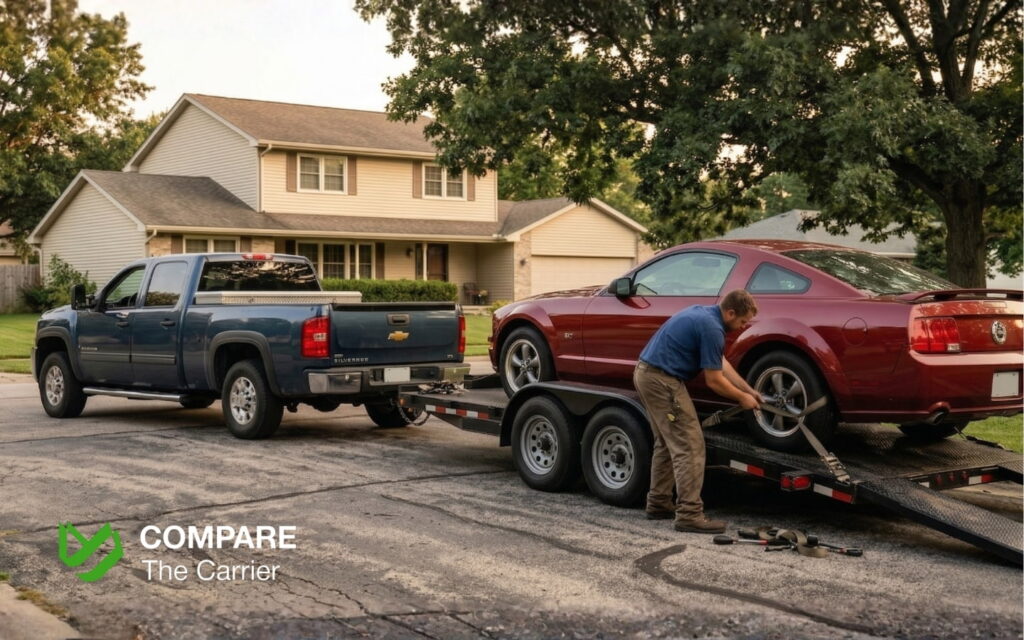
When you book legitimate expedited car shipping, you are generally paying for priority placement on the national dispatch board. This means the broker artificially inflates the payout they offer to the driver, making your specific vehicle the most lucrative and attractive load in your region. In extreme emergencies, expedited service means the broker hires a dedicated “hotshot” trailer – a smaller heavy-duty pickup truck pulling a specialized two-car flatbed directly to your house without making any other stops. Most importantly, true expedited service provides a guaranteed pickup date rather than a vague multi-day window.
However, you must clearly understand what expedited service does NOT mean. Paying a premium does not give the truck driver permission to break federal speed limits or bypass mandatory Department of Transportation sleep regulations. The physical transit time remains exactly the same. Expedited shipping guarantees a faster pickup, not a faster highway drive. Furthermore, while the loading day is locked in, the exact delivery date remains an estimate, subject to traffic, weigh-station delays, and severe weather. You are paying to have the car removed from your property immediately, not to make the truck travel faster than physics allows.
Panic is the enemy of a successful move. If your deadline is rapidly closing, you need to stop browsing endless forums and execute a precise, aggressive booking strategy. Follow these exact steps to secure a carrier without getting scammed.
1. Get your vehicle information ready before the first call
You need your vehicle’s specific make, model, year, the exact VIN, a confirmation of its operational status (does it steer and brake?), and the exact zip codes for both the pickup and delivery locations. Have this written on a piece of paper sitting right in front of you. Every single minute you waste digging through your glovebox searching for a registration card while on the phone with a dispatcher is a minute that another customer might use to steal the last open spot on a carrier’s trailer.
2. Call, don’t just fill out online forms
When you have two weeks to move, online forms are incredibly convenient. When you have two days to move, online forms are a dangerous trap. Most automated quote systems have a 2- to 4-hour processing delay before a human reviews your file. When every single hour dictates whether your car makes it onto a truck, you have to bypass the algorithms and speak directly to a human dispatcher. Dial the phone, bypass the standard sales pitch, and state your absolute final deadline within the first ten seconds of the conversation so they know exactly what they are dealing with. If you want to bypass the runaround, use a direct portal to get a shipping quote and follow up immediately with a live call.
3. Be honest about your timeline – don’t say “flexible” if you’re not
This is the single biggest mistake panicked customers make. In a desperate attempt to keep the quoted price low, people tell the broker that they are “somewhat flexible” on the pickup date. The broker hears this, categorizes your load as a standard priority, and searches for a cheap truck arriving in five days. When you call back 48 hours later, screaming that you have to leave town tomorrow, the broker has to scrap the entire plan. Be brutally honest about your drop-dead date from the very first breath, even if it means hearing a higher initial price tag.
4. Accept a wider delivery window
A highly restricted pickup deadline combined with a highly restricted delivery deadline creates a logistical nightmare that generates the absolute maximum possible price. You can aggressively offset the rush premium by offering the carrier extreme flexibility on the back end of the journey. If you tell the dispatcher, “I absolutely need it picked up by Thursday, but the driver can drop it off at the new house any time within a ten-day window after that,” you instantly open up your options to dozens of standard carriers who can fit the delivery into their regular schedule.
5. Have your payment ready
Emergency bookings operate on immediate commitment. Brokers know that panicked customers frequently call five different companies and accept whichever truck shows up first, leaving the other brokers with canceled contracts and angry drivers. Because of this high cancellation risk, rush jobs frequently require a larger upfront deposit or a full prepayment before the dispatcher will even contact a hotshot driver. Do not waste precious time arguing over standard payment terms; decide whether you are using a major credit card or certified funds before you dial the phone, and be ready to execute the transaction the moment they confirm a truck.
6. Compare at least 3 quotes – even under time pressure
Urgency does not excuse financial recklessness. Even if your flight leaves tomorrow afternoon, you still have ten minutes to make three separate phone calls. Taking a brief moment to run a rapid comparison protects you from predatory dispatchers who sense your desperation and artificially inflate their margin by an extra $400. You need to know how to read a shipping quote before you book so you can quickly filter out bait-and-switch scams that promise an impossible same-day pickup just to trap your deposit. Rush shipping requires acting fast, but it never requires acting blind.
Compare The Carrier connects you with verified carriers on your specific route – including expedited options for tight timelines. Use the car shipping cost calculator to see real-time rates for rush booking before you make that first call.
Integrity matters in logistics. Any company that promises you the moon regardless of the physical realities on the ground is lying to you. There are three specific scenarios where throwing thousands of dollars at a broker simply will not buy you a 24-hour miracle.

1. Rural origin or destination with no major highway within 50 miles
Commercial auto haulers live and die by the interstate system. They do not randomly wander through remote mountain passes or deep rural farmland in search of cars. If your origin or destination is an hour from the nearest major highway, carriers will absolutely not deviate that far from their profitable route for a single vehicle with 24-hour notice. If you live off the grid, your fastest realistic pickup window is 3 to 5 days, even when paying a massive expedited premium, because the broker has to find a highly specialized regional driver willing to make the trek.
2. Inoperable vehicle with same-day requirement
A vehicle with a dead battery, blown engine, or seized brakes cannot be driven onto a standard trailer. It requires a truck equipped with a heavy-duty commercial winch, and the driver must possess the specific expertise to safely drag dead weight up a steep steel ramp. The vast majority of standard open carriers simply do not carry this specialized equipment. Attempting to locate an available truck that has an empty slot, is driving through your zip code tomorrow, AND has a functioning winch is a logistical impossibility on most routes. Dead vehicles require time to move.
3. Peak season (June–August) on high-demand routes
During the massive summer relocation season, the entire auto transport industry operates at maximum capacity. From June through late August, carriers are completely booked with solid contracts weeks in advance. If you call in mid-July demanding a same-day pickup from New York to Florida, you will face an absolute wall. “Last-minute” during peak season is a relative term; even if you agree to pay double the standard rate, the sheer lack of available physical space on the trucks means your expedited premium might only buy you a pickup in 5 to 7 days rather than two weeks.
Last-minute car shipping is stressful, but it is rarely impossible. The difference between a smooth emergency move and a financial disaster comes down to one thing: how fast you act. Every hour you spend researching instead of booking is an hour that shrinks your carrier options and inflates your final bill.
You now know the timeline tiers, the real cost premiums, and the three situations where no amount of money will buy you a same-day miracle. You know to call instead of filling out forms, to be honest about your deadline, and to compare at least three quotes before committing.
The only step left is the most important one — finding a carrier that can actually move your vehicle on your timeline.
Compare verified carriers on your route right now – see real availability, get honest pricing, and lock in your pickup date before that window closes.
Yes. Most routes between major U.S. cities can accommodate last-minute car shipping with 24 to 72 hours’ notice through expedited services. Same-day pickup is possible in limited cases near major metropolitan areas. The shorter the timeline, the higher the price premium – typically $150 to $500 above standard open transport rates, depending on distance and carrier availability.
Last-minute car shipping typically costs $150 to $500 more than a standard booking for the same route. A 24-hour rush premium runs $300 to $800 above standard rates. A 3- to 5-day short-notice booking usually adds $100 to $300. Prices spike further during peak season (June through August) when carrier capacity is tight across all major corridors.
The fastest method is a dedicated hotshot trailer – a one or two-car transport that doesn’t wait to fill a full multi-car haul. This guarantees same-day or next-day pickup but costs significantly more, often $500 to $1,000 above open transport rates. For most last-minute situations, expedited priority booking on a standard open carrier is faster than hotshot and considerably cheaper.
Standard open transport should be booked 7 to 14 days in advance on popular routes and 2 to 3 weeks in advance for rural areas or peak season. If you book within 7 days, expect a premium for short notice. Anything under 48 hours requires expedited service. The earlier you book, the more carrier options you have and the closer your final price will be to the market rate.
Same-day car shipping is possible but rare and expensive. It typically requires a dedicated hotshot carrier and is only reliably available between major metropolitan areas. Expect to pay $800 to $1,500 or more above standard rates. Most brokers need 2 to 4 hours to locate and dispatch a driver, making true same-day pickup a best-effort service rather than a guarantee.
Yes – significantly more. Peak season (June through August) is the most expensive time for car shipping, and last-minute requests during this window face a double penalty: standard summer rates are already 15–25% higher than off-peak rates, and rush premiums stack on top of that. A route that costs $550 in February with a 3-day notice can easily hit $1,100–$1,300 for the same timeline in July. If your move falls in summer, book as early as humanly possible.
Yes, but it is significantly harder and more expensive. Inoperable vehicles require a carrier equipped with a winch or specialized loading ramp, which represents a small fraction of the total fleet. Finding one available on your specific route within 24 to 72 hours is difficult and sometimes impossible. Expect to pay an inoperable vehicle surcharge of $100–$200, in addition to the standard rush premium. For same-day inoperable shipping, availability cannot be guaranteed on most routes.












Don't have time to fill out the form?
Call a transport company directly to get a quote now!
Select the category you need
Partner with Compare The Carrier & Grow!
We're open to collaborations, partnerships, and mutual growth! Whether you're an individual or a business, we offer exciting opportunities to work together. Fill out the form below to explore how we can collaborate.
Something Went Wrong
We're sorry, but something went wrong. Please briefly describe the problem you experienced in the text area below. Providing your contact information will allow us to follow up if needed.

Thank you,
your form has been accepted.
Your form has been successfully submitted. We appreciate your effort — our team will review it shortly and take the next steps.


