

Carrier vs. Broker: What’s the Right Choice for Your Car Shipping?
Shipping a car across the country can be overwhelming — e...
31 March 2022
An auto transport quote is a legally binding document. It outlines the price, transport method, pickup window, and liability terms for moving your vehicle. Most hidden fees and bait-and-switch tactics lurk in the fine print, not the headline price. Knowing what each line item means and recognizing what a legitimate quote must include often determines if your move is smooth or ends in a costly dispute.
Calculate Shipping Quotes
The auto transport industry often thrives on your confusion. When you request a price, your inbox quickly fills with wildly different numbers. This creates a false sense of urgency and pushes you to make a rushed decision. It is tempting to scroll to the bottom line, pick the cheapest offer, and hope for the best. But that low first quote is rarely what you pay when the driver unloads your car.
That is exactly why you need to approach every estimate like a seasoned logistics expert. You have to look past the bold numbers and start questioning the missing details – like specific insurance limits, unwritten cancellation policies, and silent rural surcharges. We are going to tear apart a standard shipping quote line by line, expose the industry’s most common red flags, and show you exactly how to protect your vehicle and your wallet before you ever hand over a deposit.
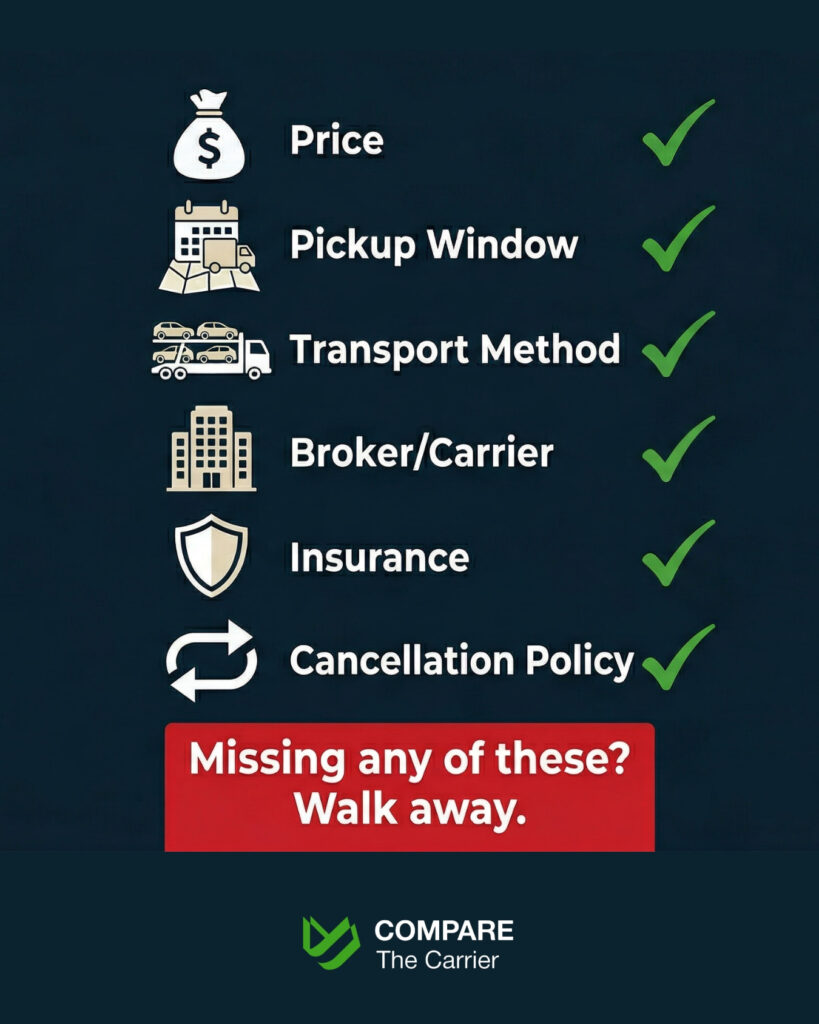
Before reviewing line items, understand the document’s purpose. When you request a price to move a vehicle, you are not getting a casual estimate as you might when hiring a teenager to mow your lawn. You are starting a contract involving federal regulations, interstate commerce, and heavy machinery hauling valuable property. The document is the blueprint for the entire move. If the blueprint is flawed, the move fails. Too many first-time shippers treat a transport offer like a store receipt, glancing at the dollar amount and ignoring critical terms. This is where predatory operators thrive. If they display a low price, you likely won’t spot missing details that let them double the price. A true, professional quote shields both you and the driver. It defines responsibility, timing, and cost. Whether you use standard car shipping specialized transit, every valid offer from a reputable company must transparently display these six components to be legitimate.
1. A fixed or binding price – not an “estimate”
A binding quote guarantees the price on your screen matches what you pay when you receive your keys. This protects you from sudden route adjustments or hidden surcharges. If the paperwork labels the total as just an “estimate,” the company can legally inflate your final bill once a driver is secured. Without a fixed price in writing, you give the broker a blank check for their own miscalculations.
2. Pickup window – not a pickup date
Legitimate transport operations provide a realistic pickup window of one to five days. Commercial trucking depends on unpredictable traffic, weather, and previous customer delays. If a company promises a specific guaranteed day without an expedited premium, they are likely not telling the truth to get your signature. A missing multi-day window means you could spend your shipping day waiting in an empty driveway and calling a dispatcher who never answers.
3. Transport method specified
Your document must state whether your vehicle is set for an open trailer or an enclosed hauler. These services have different prices and protection. If the quote only lists “standard transport” without detail, a broker can charge you for enclosed service but use an open rack. Requiring this detail in writing prevents service downgrades behind your back.
4. Carrier vs. broker identification
The paperwork must say if the quote comes from the carrier driving the truck or a broker selling your route. Knowing this determines who is responsible if your vehicle is damaged or disappears. If this is unclear, you could end up stuck between the broker and the driver when problems arise.
5. Insurance coverage details
A valid quote avoids vague phrases like “fully insured.” It must list exact cargo insurance limits and specify who pays the deductible. A trailer may carry a large policy, but if that total can’t replace every car, you need to know your individual protection limit. Not getting these insurance details leaves you open to major losses from damage or storms.
6. Cancellation and deposit policy
You must see a clearly defined section explaining exactly how much money is required upfront, under what specific conditions that deposit becomes non-refundable, and the exact steps required to legally cancel the contract. Shady operators intentionally leave this out, allowing them to keep your hard-earned deposit even if they completely fail to find a driver for your vehicle within the promised timeframe. A written cancellation policy ensures you retain financial leverage and an escape route if the company fails to uphold its end of the logistical bargain.
| Line Item | Included in Base Quote? | Notes |
| Pickup at origin address | Usually yes | Rural surcharge may apply |
| Delivery to destination address | Usually yes | Same rural caveat |
| Basic cargo insurance | Yes | Coverage limits vary widely |
| Fuel surcharge | Sometimes hidden | Ask explicitly |
| Terminal fees | No | Only if terminal-to-terminal |
| Priority/expedited pickup | No | Extra $200–$500 |
| Oversized vehicle surcharge | No | Lifted trucks, large SUVs |
| Inoperable vehicle fee | No | Extra $100–$200 |
The base quote is almost never the worst-case number. It’s the best-case scenario. Build a mental buffer of $100–$200 for the unexpected, and you’ll never be surprised at pickup.If you’re moving a vehicle across state lines and want to understand the full picture before requesting quotes – methods, costs, and what to expect from carriers – see our state-to-state car towing guide. Compare The Carrier shows verified quotes from licensed carriers on your exact route – so you can apply these criteria in real time before committing to anyone. Run your numbers through the car shipping cost calculator and see what a legitimate quote looks like before you start comparing offers. If you live down a winding dirt road surrounded by low-hanging trees, the massive eighty-foot commercial hauler cannot safely reach your house, forcing the driver to coordinate a secondary meeting spot or charge a hefty rural delivery fee for the inconvenience. Similarly, if you are shipping a heavily modified truck with an aftermarket lift kit and oversized tires, it takes up significantly more physical space on the trailer, meaning the driver loses the ability to load another paying customer’s vehicle in that slot. All of these unique variables stack on top of the initial quote, transforming a simple transaction into a customized logistics puzzle. For a comprehensive look at how these specific variables stack up and change your bottom line, review this full breakdown of what affects your shipping price so you can calculate your true exposure before signing anything.
The red flags below are compiled from real industry patterns and customer complaints. One flag alone doesn’t guarantee a scam – but two or more stacked together on the same document are almost never a coincidence.
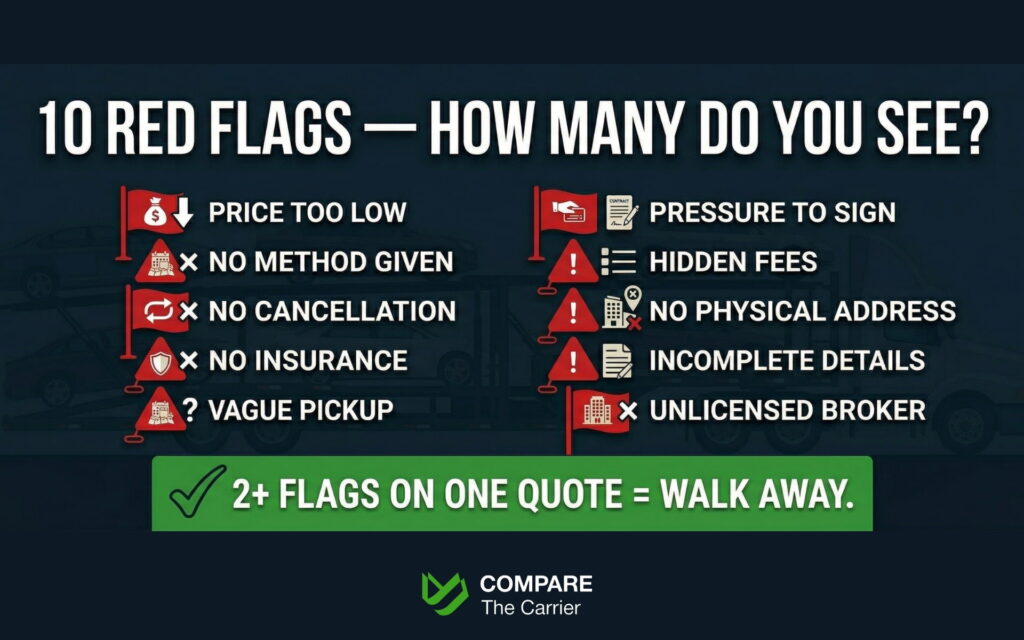
This is the classic bait-and-switch pricing model where a broker deliberately issues a quote drastically lower than the current market rate just to hijack your attention and secure your initial deposit. Once they have your money locked down, they will suddenly claim they cannot find a driver at that low price point, holding your car hostage until you agree to pay hundreds of dollars more to actually get it moving. Whenever you visit a car shipping quotes page, you should aggressively ignore the absolute lowest outlier and familiarize yourself with the companies known for this tactic to protect your budget from forced upgrades.
When a quote completely omits the physical type of trailer being used to move your vehicle, it creates a massive contractual loophole for the company to exploit at your expense. You might pay a premium rate under the verbal assumption that you are receiving protective enclosed transport, only to watch in horror as your classic car gets loaded onto a standard open transport rack exposed to the elements. Without the specific transport method locked down in writing, you have absolutely zero legal recourse to demand a refund for the downgraded service.
A legitimate brokerage firm uses your deposit to secure a verified spot on a specific truck, meaning they only take your money when they actually have a driver confirmed and dispatched for your route. Predatory companies demand a non-refundable upfront fee simply for the privilege of adding your name to a national dispatch board, offering absolutely no guarantee that a truck will ever arrive to pick up your vehicle. If a broker aggressively pushes for your credit card details before they can provide you with the name and phone number of the actual motor carrier, you should immediately walk away from the negotiation.
Seeing the phrase “fully insured” stamped across your quote might make you feel safe, but in the legal realm of commercial trucking, those two words are utterly meaningless without concrete numerical values attached. An eighty-foot trailer carrying eight vehicles might technically carry a federal minimum insurance policy, but if that total coverage limit is only $100,000, it cannot possibly cover the replacement cost of every single car if the truck rolls over on the highway. You must demand to see the explicit per-vehicle cargo limit, the exact deductible amount, and a written list of damage exclusions before you ever agree to hand over your keys.
For a complete picture of what cargo insurance actually protects and where the gaps are, read the auto transport insurance guide for 2026 before signing anything.
High-pressure sales tactics are designed to create artificial panic, forcing you to sign a legally binding contract before you have the time to carefully read the terms and conditions or compare the rate against other competitors. A dispatcher telling you that a remarkably low price expires in exactly two hours, or claiming they have a truck leaving tomorrow morning that requires immediate payment, is manipulating your fear of missing out. Legitimate auto transport quotes are generally valid for at least twenty-four to forty-eight hours, giving you the breathing room required to make an informed, rational financial decision without an artificial gun to your head.

Logistics in the commercial trucking industry are incredibly fluid, meaning an honest dispatcher can only ever guarantee a multi-day window for arrival, never a precise hour on a specific Tuesday. If your quote boldly lists a single, guaranteed exact date for your vehicle pickup without explicitly labeling it as a mere estimate or charging you a massive premium for expedited service, the company is making a promise they mathematically cannot keep. This missing window is a glaring signal that the broker is simply telling you exactly what you want to hear to get your signature, fully intending to deal with your angry phone calls when the truck inevitably fails to show up on time.
Many brokers intentionally hide their middleman status, designing their websites and quotes to make you believe they own a massive fleet of trucks directly handling your specific route. This deliberate deception becomes a nightmare when your car suffers damage during transit, as the broker will suddenly point to the fine print, absolve themselves of all liability, and force you to chase down a completely different trucking company for compensation. You can easily cut through this lie by running their provided MC number through the official FMCSA carrier lookup to instantly verify whether they possess the legal authority to operate vehicles or if they merely arrange the freight.
A quote that lacks a clearly defined cancellation policy is a one-way trap door designed to lock your deposit inside the company’s bank account, regardless of how poorly they perform their duties. If the broker completely fails to find a driver within their promised multi-day window, you need a written guarantee that you can walk away from the contract and receive a full refund without facing arbitrary administrative penalties. Forcing a company to put their refund conditions in writing keeps them honest and ensures you retain the financial freedom to hire a different service if your initial choice drops the ball.
A professional quote calculates your exact weight footprint and trailer slot requirements by explicitly listing your vehicle’s specific make, model, year, and operational status right at the top of the page. If you receive a highly generic document that simply labels your cargo as “one standard vehicle” or “one sedan,” the carrier can easily arrive at your driveway, claim your specific car is heavier than they anticipated, and demand an immediate cash surcharge to load it. Locking down your precise vehicle identification number (VIN) or exact model details within the quote removes the driver’s ability to play size-based pricing games on the day of pickup.
Before handing over the keys, follow this guide on how to document your vehicle’s condition with photos and written notes – it’s your strongest evidence if a dispute arises later.
In an industry that handles expensive assets across state lines, a company operating without a verifiable, brick-and-mortar corporate headquarters poses an unacceptable risk to consumers. A business that only lists a generic PO Box or a virtual office suite on their official quote can easily pack up, shut down their website, and disappear into the digital ether the moment a severe liability claim arises. Dealing exclusively with companies that maintain a real physical footprint ensures that you have a concrete location to direct legal correspondence, serve papers, or file a formal jurisdictional complaint if the transaction goes completely off the rails.
| Broker | Direct Carrier | |
| Who they are | Middleman who finds a carrier | Company that owns the truck |
| Quote accuracy | Estimate – final price set by carrier | More likely binding |
| Liability for damage | Limited – points to carrier | Direct responsibility |
| Price | Often lower upfront | Sometimes higher |
| Flexibility | More routes, more options | Limited to their fleet |
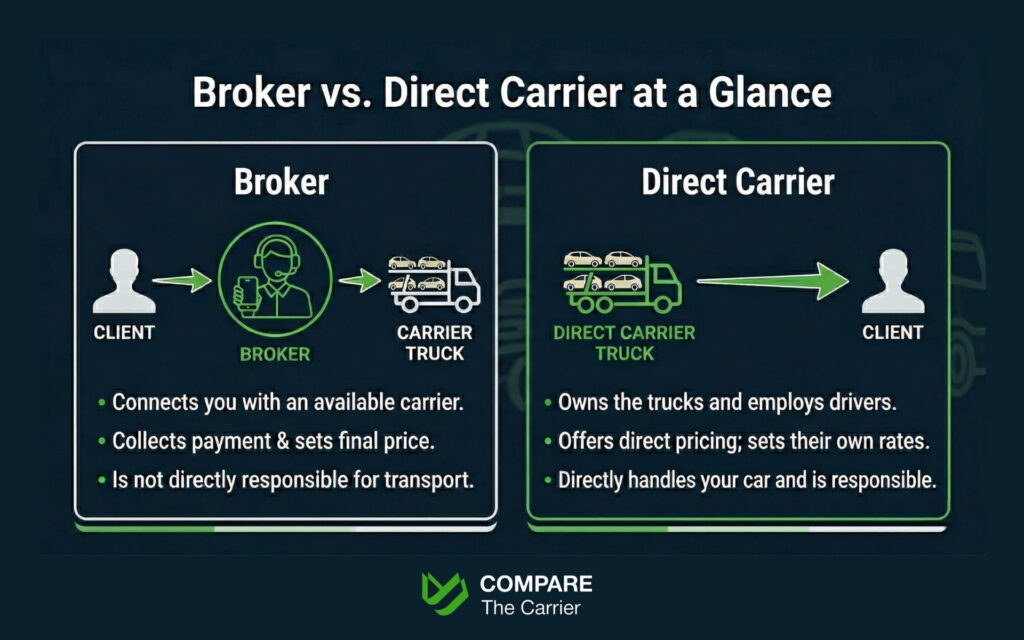
Understanding the core difference between these two entities is arguably the most critical piece of knowledge you can possess when reviewing your paperwork, but it is essential to realize that using a broker is not inherently a problem. In fact, the vast majority of residential car shipping in the United States is successfully facilitated by brokers simply because independent truck drivers are too busy staring at the highway to answer phone calls, manage complex marketing campaigns, or build consumer-facing websites. The problem only emerges when a broker actively attempts to conceal their middleman role, or when the initial estimate they provide you on the phone wildly diverges from the final, binding price demanded by the actual motor carrier who accepts the load. A transparent, high-quality broker acts as your personal logistics advocate, tapping into a massive national network to find you the best possible driver, while a shady broker simply throws a lowball number against the wall to secure your deposit and hopes a desperate driver eventually takes the bait. Your goal isn’t to avoid brokers altogether; it’s to demand absolute clarity about who is setting the price, who is taking your money, and who is ultimately responsible for the physical safety of your vehicle when it merges onto the interstate.
When you finally have three or four different offers sitting on your kitchen table, the numbers can quickly blur together into a confusing mess of competing promises. To figure out which offer actually provides the best value, you have to strip away the marketing jargon and systematically level the playing field. To get a shipping quote that you can truly trust, apply these three critical evaluation rules to every single document before you even think about reaching for your credit card.
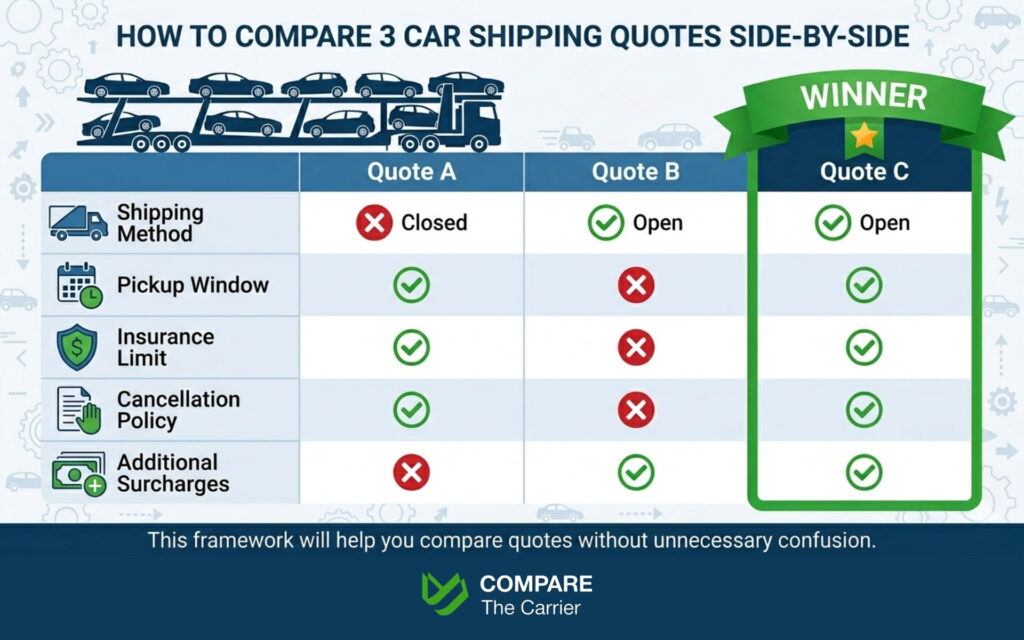
You absolutely cannot compare the bottom-line price of an open transport offer directly with the premium cost of an enclosed transport service, because you are comparing two entirely different logistical products offering vastly different levels of environmental protection. An open carrier will almost always drastically undercut an enclosed carrier on price, but that lower number comes with the accepted reality that your vehicle will be exposed to rain, road dust, and potential rock chips throughout the journey. Before you evaluate the dollar amounts, group your quotes by the specific type of trailer they promise to use, ensuring you are comparing apples to apples and not accidentally choosing a lower price that secretly compromises the safety of your high-value asset.
The bold number printed at the bottom of the quote is essentially the best-case scenario, assuming perfect conditions, but real-world trucking rarely goes perfectly. To find the true cost of each offer, you need to mentally add the standard industry surcharges that will likely apply to your specific situation, such as a fifty-dollar fee for living in a rural area, a potential fuel surcharge if gas prices are currently spiking, or the extra weight penalty for that massive lift kit you installed on your truck. By proactively padding each estimate with these realistic, worst-case surcharges, you protect yourself from sudden sticker shock at the loading ramp and reveal which company actually offers the most stable financial baseline.
A quote that saves you fifty dollars on the total transit cost might look incredibly appealing at first glance, but that temporary excitement vanishes if the associated pickup window requires you to wait an agonizing fourteen days for an available driver. Time is a deeply valuable currency during a stressful relocation, and a slightly more expensive offer from a company that guarantees a tight, two-to-three-day pickup window often provides vastly superior overall value by allowing you to stick to your original moving schedule. You must weigh the raw dollar amount against the logistical convenience being offered, recognizing that the absolute cheapest price usually requires sacrificing your personal timeline to accommodate the carrier’s convenience.
Compare The Carrier shows verified quotes from licensed carriers on your exact route – so you can apply these criteria in real time before committing to anyone. Run your numbers through the car shipping cost calculator and see what a legitimate quote looks like before you start comparing offers.
A valid quote must specify the total price (binding or estimated), transport method (open or enclosed trailer), pickup window range, insurance coverage with exact dollar limits, cancellation and deposit policy, and whether you are dealing with a broker or a direct carrier. Any quote missing these six elements gives the company room to raise the price or dodge liability once your vehicle is loaded.
That gap is almost always a bait price. Brokers issue deliberately low estimates to collect your deposit, then claim they cannot find a driver at that rate and demand more money before pickup. When comparing offers, ignore the lowest outlier and focus on the cluster of similar prices – that range reflects actual market rates.
Rural pickup or delivery surcharges ($50–$150), fuel surcharges (10–15% of the base rate), oversized vehicle fees for lifted trucks or large SUVs ($50–$200), inoperable vehicle fees ($100–$200), and priority offloading fees at the destination. Ask the broker explicitly whether each applies to your route and vehicle before signing.
A binding quote locks the price regardless of what happens during transit. A non-binding quote is an estimate the carrier can raise at pickup if they claim your vehicle is heavier, your address is difficult to reach, or the route changed. Always request a binding quote in writing – especially for high-value vehicles or tight budgets.
Search their MC or DOT number at fmcsa.dot.gov to confirm active operating authority and insurance status. Then cross-check reviews on Google and the Better Business Bureau. Any company that refuses to share its MC number or rushes you past the verification step should be avoided immediately.
Typically 24 to 72 hours, because carrier rates shift with fuel prices, seasonal demand, and available capacity. Some brokers hold a price for up to 7 days, but quotes older than 3 days usually need re-confirmation. A quote advertised as valid for 30 days or more without conditions is almost certainly a loose estimate, not a binding commitment.
With a non-binding quote, yes – the carrier can adjust the price at pickup. With a binding quote, the price is locked and cannot change after you sign. Never pay a deposit on a non-binding quote without understanding this distinction. If a company refuses to issue a binding quote at all, treat that refusal as a red flag.
A broker is a middleman who finds a carrier to move your vehicle; a direct carrier owns the truck and handles the move themselves. Brokers dominate the industry because most independent drivers do not manage their own bookings. Using a broker is not a problem – the problem is when a broker hides its middleman role or when the price it quotes differs significantly from what the actual carrier charges. Before signing, confirm whether you are dealing with a broker or carrier, and verify their MC. Knowing this upfront determines who is responsible if your vehicle is damaged.
Note any damage on the Bill of Lading before the driver leaves – once they pull away, disputing pre-existing versus transit damage becomes significantly harder. Photograph every scratch, dent, or scuff immediately at delivery. Then contact the carrier directly in writing and file a formal cargo claim within the timeframe specified in your contract, typically 30 to 60 days. If the carrier ignores the claim or denies responsibility, escalate to the broker (if one was used) and file a complaint with the FMCSA. Never sign a clean delivery receipt if you see damage.
Yes. Most carriers explicitly exclude personal belongings from their cargo insurance policy, meaning anything left inside the vehicle – luggage, electronics, documents – is transported at your own risk. Some carriers also refuse loads with heavy personal items because added weight affects trailer capacity and DOT regulations. Remove everything from the cabin and trunk before pickup. If you must leave something inside, declare it in writing and confirm whether the carrier’s policy covers it.










Don't have time to fill out the form?
Call a transport company directly to get a quote now!
Select the category you need
Partner with Compare The Carrier & Grow!
We're open to collaborations, partnerships, and mutual growth! Whether you're an individual or a business, we offer exciting opportunities to work together. Fill out the form below to explore how we can collaborate.
Something Went Wrong
We're sorry, but something went wrong. Please briefly describe the problem you experienced in the text area below. Providing your contact information will allow us to follow up if needed.

Thank you,
your form has been accepted.
Your form has been successfully submitted. We appreciate your effort — our team will review it shortly and take the next steps.


