

Ship Your Car Before the Moving Van: How to Time It Right (And Why It Matters)
If you're shipping your car during a move, it's usually b...
9 September 2026
Shipping a car from Texas to California runs roughly $600 to $1,600 for open transport, depending on the exact cities, the vehicle, and the season. The route covers about 1,200 to 1,900 miles, and most shipments arrive in 3 to 9 days once the carrier picks up the vehicle. Enclosed transport typically adds 40% to 70% on top of that.
Calculate Shipping Quotes
Texas and California are two of the busiest auto transport markets in the country, so car shipping from Texas to California tends to move faster and cheaper than routes with thinner carrier coverage. That doesn’t mean every quote is a good one, though – prices swing by a few hundred dollars depending on which city you’re shipping from and when you book. Below is a full breakdown of how the process works, what drives the price up or down, and how to line up a carrier without overpaying.
Before getting into the details, here’s the full picture in one place – the numbers below cover the range you’ll see across most standard sedan and SUV shipments on this route.
| Detail | What to Expect |
| Average cost (open transport) | $600 – $1,600, depending on cities and vehicle type |
| Average distance | 1,200 – 1,900 miles depending on the exact route |
| Average transit time | 3 – 9 days after pickup |
| Main interstates | I–10, I–20, I–40 |
| Busiest season | Late spring through summer, plus January relocations |
| California registration window | 20 days from arrival for new residents |
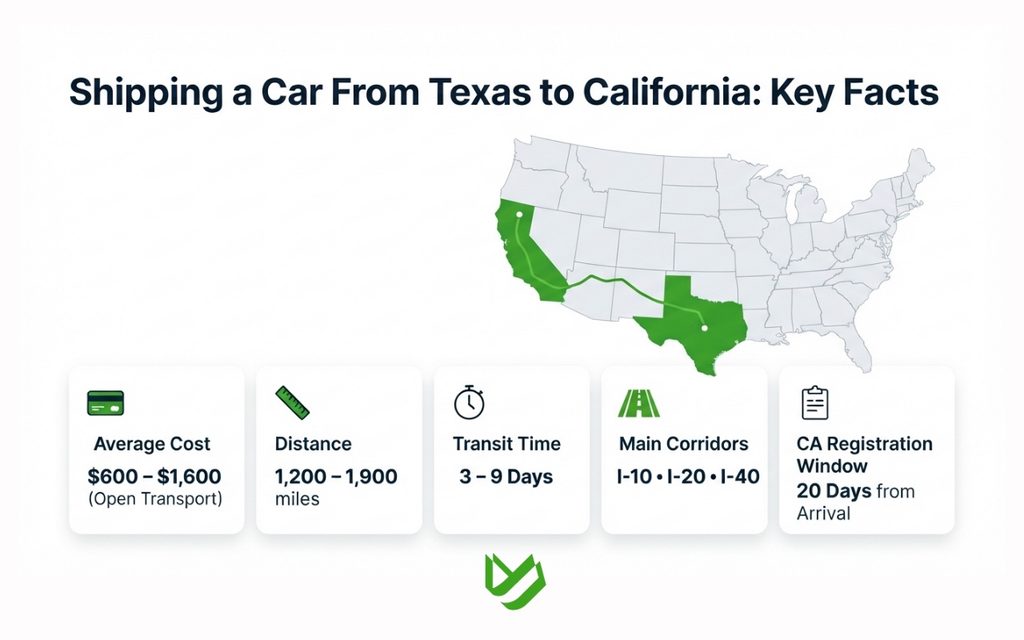
Table of Contents
The process looks the same whether you’re moving one sedan or shipping a fleet of company vehicles, though the details change based on distance, vehicle count, and how flexible your dates are.
Auto transport companies work as a broker or a carrier, matching your shipment with a truck already running a similar route. Brokers don’t own trucks themselves – they build a network of vetted carriers and hand your shipment to whichever one fits your dates and route best, which is usually faster than calling individual carriers on your own. You request a quote, give the year, make, and model of your vehicle, and pick your Texas pickup city and your California delivery city. Once you accept a rate, the company assigns a driver, and that driver contacts you directly to set a pickup window – usually a one– to three–day range rather than an exact time. From there, the vehicle rides on a multi–car trailer alongside four to nine other cars, since most drivers build a route that fills the truck before heading west.
Booking takes a few minutes once you have your details ready. Use an auto transport calculator to get an estimate, then compare a handful of offers side by side rather than accepting the first number you see. Read the fine print on cancellation policies and deposit requirements before you commit. A legitimate broker won’t pressure you to book same-day, and they’ll give you a written rate confirmation with the pickup window, price, and driver contact information once a truck is assigned.
The driver inspects your car before loading it, marking any existing scratches, dents, or chips on a Bill of Lading. Walk the vehicle with the driver and confirm you agree with what’s written down – this document is what you’ll compare against at delivery if a dispute comes up. Loading takes about fifteen to twenty minutes per vehicle. On the delivery end, expect a call or text twenty–four to forty–eight hours ahead with a narrower time window, then a second inspection once the truck arrives. Bring the same person who was present at pickup if possible, since they’ll know what to look for.
Most carriers now offer door-to-door service, meaning the driver comes as close to your home and your destination as the truck can safely maneuver – sometimes a nearby parking lot if your street is narrow or has low branches. Terminal-to-terminal shipping, where you drop off and pick up at a storage yard, is less common today and usually only saves a small amount. Unless you’re on a tight budget or shipping to a rural area with no direct access, door-to-door is worth the extra convenience.
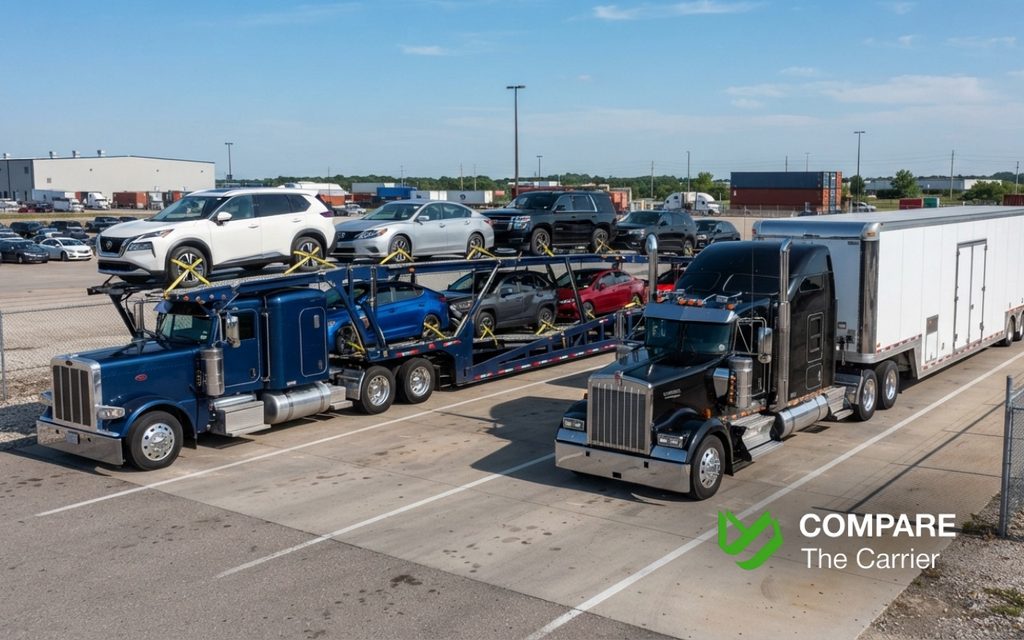
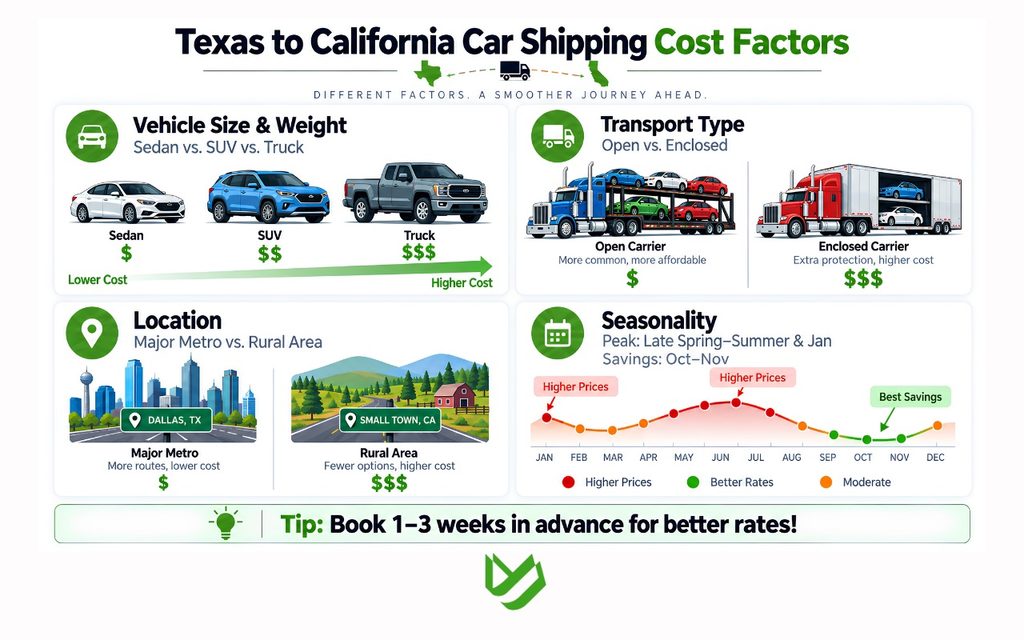
A handful of variables move the price more than others. Here’s what actually changes your quote:
Pricing depends on what you’re shipping as much as where it’s going. Below is a general range by vehicle category, followed by the extra fees that can change your final bill.
Pricing depends on what you’re shipping as much as where it’s going. Below is a general range by vehicle category, followed by the extra fees that can change your final bill. For a more specific estimate based on your vehicle and route, use our auto transport calculator before comparing quotes.
A standard sedan sits at the low end of the range, while a pickup truck, a full-size vans, or a lifted SUV pushes the quote higher. Larger equipment like commercial trucks or RVs and travel trailers usually needs a specialized carrier and a separate quote entirely, since they don’t fit on a standard nine-car trailer.
| Vehicle Type | Estimated Cost Range | Recommended Transport |
| Sedan / compact car | $600 – $1,050 | Open |
| Mid–size SUV | $700 – $1,150 | Open |
| Full–size SUV / pickup truck | $800 – $1,300 | Open |
| Minivan / cargo van | $750 – $1,250 | Open |
| Luxury or exotic car | $1,100 – $1,900+ | Enclosed |
| Non–running / inoperable vehicle | Add $100 – $200 for winch loading | Open, unless high–value |
The base quote doesn’t always tell the whole story. A few situational fees show up often enough that it’s worth knowing about them before you get a final number.
| Fee | When It Applies | Typical Amount |
| Winch/inoperable fee | Vehicle can’t be driven onto the trailer | $100 – $200 |
| Expedited pickup | You need a guaranteed date or faster window | $100 – $300 |
| Oversized/lifted vehicle | Height or width exceeds standard limits | $100 – $250 |
| Remote location surcharge | Pickup or delivery is off the main interstate | $50 – $150 |
| Storage fee | Vehicle isn’t picked up on delivery day | Varies by carrier |
Ask upfront whether any of these apply to your shipment. A quote that looks unusually low compared to others sometimes leaves these fees out and adds them later, so get the full breakdown in writing before you book.
Not every Texas-to-California pairing runs the same speed or price. Coverage is strongest between the major metros, since carriers run these lanes daily as part of broader state-to-state car shipping routes that connect the Southwest to the West Coast.
Southern California routes are the fastest and usually the cheapest, since I–10 runs almost the whole way and carrier volume on this stretch is high.
| Route | Distance | Estimated Cost | Transit Time |
| Dallas to Los Angeles | ~1,435 mi | $650 – $1,050 | 3 – 5 days |
| Houston to Los Angeles | ~1,550 mi | $700 – $1,150 | 4 – 6 days |
| San Antonio to Los Angeles | ~1,350 mi | $650 – $1,050 | 3 – 5 days |
| El Paso to San Diego | ~800 mi | $450 – $750 | 2 – 3 days |
| Houston to San Diego | ~1,670 mi | $750 – $1,200 | 4 – 6 days |
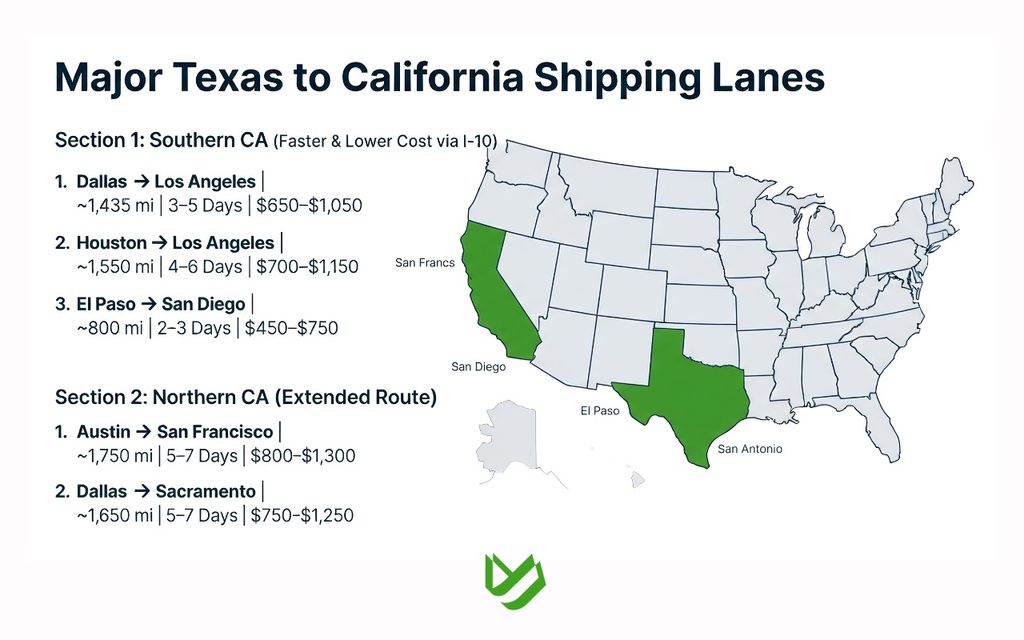
Northern California shipments run a bit longer and cost slightly more, since the route stretches further past Los Angeles and fewer carriers specialize in that last leg up the coast or through the Central Valley.
| Route | Distance | Estimated Cost | Transit Time |
| Dallas to Sacramento | ~1,650 mi | $750 – $1,250 | 5 – 7 days |
| Austin to San Francisco | ~1,750 mi | $800 – $1,300 | 5 – 7 days |
| Houston to San Francisco | ~1,900 mi | $850 – $1,400 | 6 – 8 days |
| Dallas to San Jose | ~1,700 mi | $800 – $1,300 | 5 – 7 days |
Where you pick up and drop off the vehicle can affect both the price and how quickly it gets moved. Major metro areas tend to have more carrier traffic and more flexible scheduling, while rural addresses may require a short drive to a more accessible meeting point. Here are the Texas and California cities that typically offer the most options for this route.
Houston, the Dallas-Fort Worth metroplex, Austin, and San Antonio handle the bulk of shipping a car from Texas to California volume, so pickup in any of these cities is usually fast – often within one to three days of booking. El Paso deserves a mention too, since its position near the New Mexico and Arizona borders puts it hundreds of miles closer to Southern California than the rest of the state, which shows up as a lower quote and a shorter transit window. See the full Texas transport hub for city-specific details.
On the delivery side, Los Angeles, San Diego, and the Bay Area (San Francisco, San Jose, Oakland) see the most traffic, along with Sacramento for Central Valley deliveries. Los Angeles alone accounts for a large share of Texas–origin deliveries, which keeps competition among carriers high and pricing relatively stable even during busier months. Check the California page for a breakdown by region.
A shipment between two major metro areas moves faster and usually costs less, because a driver can string together several deliveries in the same trip without much of a detour. If your delivery address sits well outside a metro area – a ranch outside Lubbock, a mountain town near Lake Tahoe – expect a slightly higher quote and a wider delivery window, since the driver may need to arrange a meeting point at a nearby truck stop, shopping center parking lot, or highway exit rather than pulling up to your driveway.
Auto transport is safe overall, and most shipments finish without a single issue. Still, it helps to know where things occasionally go wrong so you can pick a carrier that avoids these problems altogether.
None of these risks are common when you book through a licensed, FMCSA-registered carrier, but it’s worth knowing what to watch for rather than assuming every shipment goes off without a hitch.
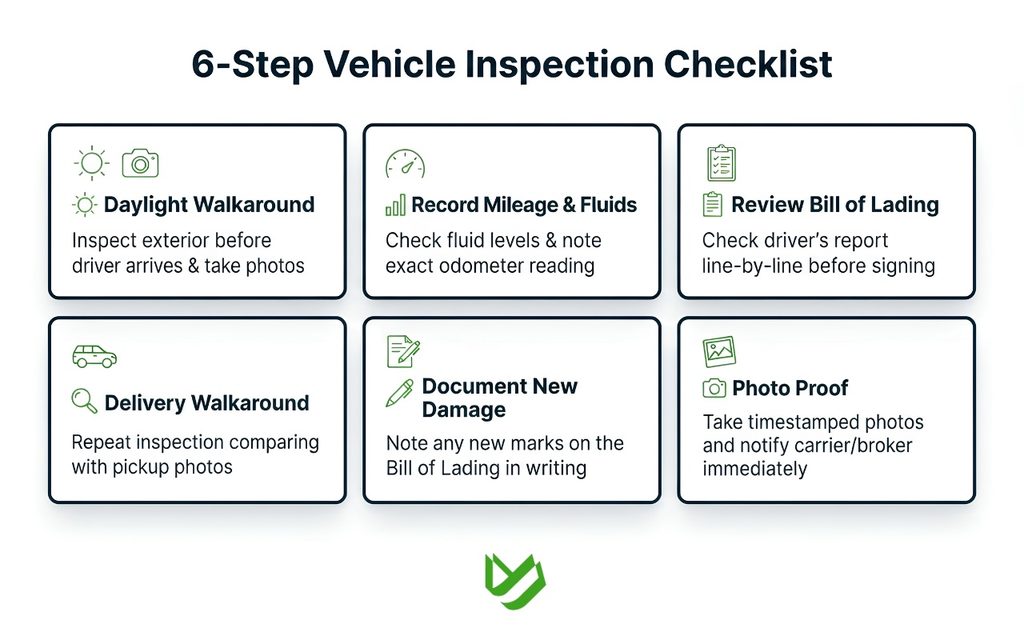
The inspection is the one step people rush through, and it’s the one that matters most if anything ever needs to be disputed. A few extra minutes with the driver at both ends of the trip is what separates a smooth claim from a frustrating one.
1. Walk the full exterior in daylight before the driver arrives, and take timestamped photos from all four corners plus close–ups of any existing damage.
2. Check fluid levels and note the mileage, since some brokers ask for this on the Bill of Lading.
3. Review the driver’s inspection report line by line before signing – don’t sign a blank or incomplete form.
4. At delivery, repeat the same walk–around before the driver leaves, comparing against your pickup photos in real time.
5. Note any new marks directly on the Bill of Lading in writing, and get the driver’s signature acknowledging it before they go.
6. Photograph anything unusual immediately and contact the carrier or broker the same day if you plan to file a claim.
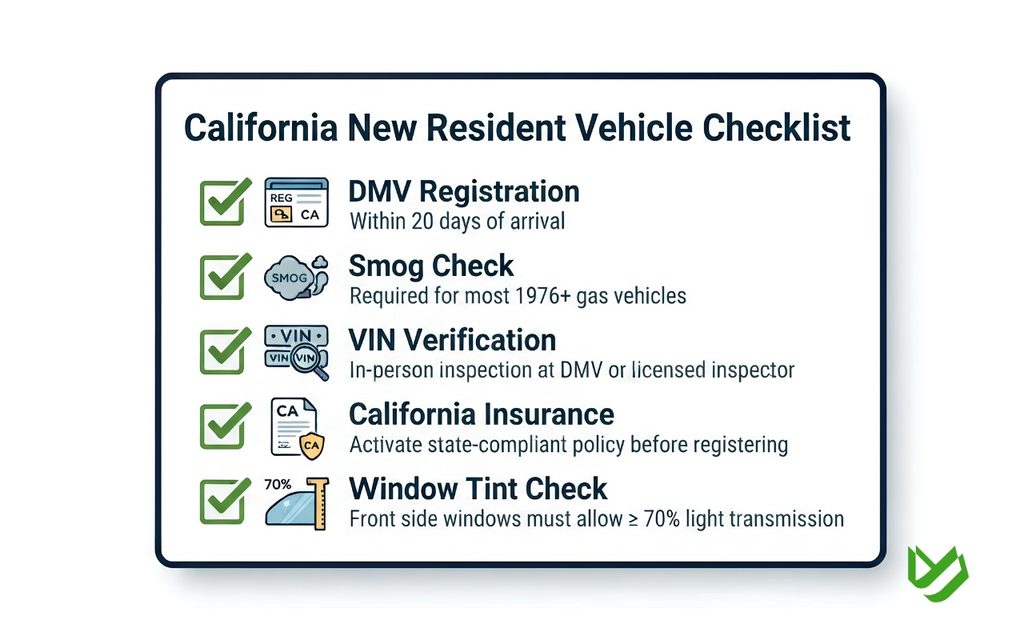
This route comes with more paperwork than a short in-state move, mostly because Texas and California don’t line up on registration timelines, emissions testing, or even how dark you’re allowed to tint your windows. None of it affects the shipping itself, but knowing what’s coming saves you a scramble once the car is off the truck.
Leaving Texas is the easy half of this move – there’s no special permit or inspection required just to have your car shipped out of state.
California is where most of the adjustment happens. The rules aren’t difficult, but several of them catch new residents off guard because they’re stricter than what Texas requires.
Every interstate carrier is required to hold active FMCSA authorization and a valid USDOT number, along with cargo insurance that covers your vehicle while it’s on the trailer. California also enforces its own emissions and equipment standards for commercial trucks entering the state, which means not every carrier licensed to run elsewhere is cleared to operate there – a reputable broker screens for this before assigning your shipment. You can look up any carrier’s safety record and licensing status directly through the FMCSA’s public database before you book, which takes a couple of minutes and confirms you’re not handing your car to an unregistered operator.
Paperwork for the shipment itself is minimal, but having everything ready at pickup keeps the driver from waiting around or, worse, rescheduling.
| Document | Why You Need It |
| Vehicle title or registration | Confirms ownership before the carrier accepts the vehicle |
| Photo ID | Required at both pickup and delivery for whoever signs the paperwork |
| Bill of Lading | Records the vehicle’s condition before and after transport |
| Insurance information | Useful if you need to file a claim beyond the carrier’s cargo coverage |
| Written rate confirmation | Locks in your price and pickup window in case of a dispute |
None of these require much effort, but stacked together they can pull a quote down by a couple hundred dollars without changing what you’re actually shipping.
Shipping a car from Texas to California doesn’t have to be complicated once you know what drives the price. Distance, vehicle size, transport type, and timing account for most of the swing between a $650 quote and a $1,600 one, and booking a couple of weeks out with a flexible pickup window is the single easiest way to land on the lower end. The same logic holds whether you’re running this route or a completely different one, like from California to Georgia. Get a rate for your specific route with our auto transport calculator, then compare carrier prices from FMCSA-verified carriers before you book.
Most shipments take 3 to 9 days once the carrier picks up the vehicle, depending on the exact distance. Shorter routes like El Paso to San Diego can arrive in as little as 2 to 3 days, while longer hauls to the Bay Area run closer to a week.
Yes. Open transport is the standard, more affordable option and works for the vast majority of vehicles. Enclosed transport costs roughly 40% to 70% more and mainly makes sense for classic, luxury, or exotic cars.
On paper, driving looks cheaper until you add fuel, food, lodging, and the extra mileage on your vehicle. For a 1,400-plus mile trip, most people find that shipping costs about the same or less once those expenses are counted, without the wear and tear or the time off work.
Pricing runs on demand more than direction, so how to ship a car from California to Texas follows roughly the same cost and timeline logic as the reverse trip. Heavier migration into Texas can mean slightly better rates eastbound during certain months, but the difference is usually small.
Yes, as long as you book with a licensed carrier. Every FMCSA-registered company carries cargo insurance that covers your vehicle while it’s on the trailer. Ask for a copy of the certificate before you book, and check your own auto policy for any gaps.
Late fall and early winter tend to be the cheapest stretch, after the summer relocation rush and before the January surge. If your dates are flexible, aim for October or November.
A 1,000-mile shipment typically runs $500 to $900 for open transport, though cost per mile is generally higher on shorter routes than on longer ones like this Texas-to-California corridor.
Yes, this is a common request. Many buyers purchase a vehicle from a Texas dealership or private seller and have it shipped directly to a California address, skipping the drive entirely. You’ll just need the title or a dealer-issued bill of sale ready for the carrier at pickup.
Damage is uncommon, especially with licensed carriers who inspect and photograph vehicles before loading. When it does happen, it’s usually minor cosmetic wear rather than mechanical damage, and it’s covered by the carrier’s cargo insurance when properly documented on the Bill of Lading.









Don't have time to fill out the form?
Call a transport company directly to get a quote now!
Select the category you need
Partner with Compare The Carrier & Grow!
We're open to collaborations, partnerships, and mutual growth! Whether you're an individual or a business, we offer exciting opportunities to work together. Fill out the form below to explore how we can collaborate.
Something Went Wrong
We're sorry, but something went wrong. Please briefly describe the problem you experienced in the text area below. Providing your contact information will allow us to follow up if needed.

Thank you,
your form has been accepted.
Your form has been successfully submitted. We appreciate your effort — our team will review it shortly and take the next steps.


