

Salvage Car Shipping: How to Transport Wrecked Vehicles Safely
Buying a salvage vehicle is usually a decision made with ...
8 January 2026
Copart storage fees start accruing the moment your free pickup window closes, usually three business days after the auction ends, including the day of the sale. Once that window expires, most yards charge somewhere between $20 and $100 per day, and in some urban locations, the rate climbs even higher the longer the vehicle sits. If you’ve already missed the deadline, the fees are already running, and every extra day makes the math worse.
Calculate Shipping Quotes
If you’re reading this with a Copart invoice open in another tab and a sinking feeling in your stomach, you’re not alone. This is one of the most common panic moments for auction buyers: you won a great deal, paid for it, and then realized the clock was already ticking before you even lined up transport. Below, we’ll break down exactly how the storage fee clock works, what the real per-day rates look like by yard type, what to do if you’re already past the deadline, and how to get a carrier moving before the fees pile any higher.
Storage fees are the daily charge Copart applies to any vehicle that stays on the lot past its free pickup window. They exist because Copart’s yards are working facilities, not long-term parking, and every car sitting unclaimed takes up space that’s needed for new inventory rolling in from insurance companies and dealers.
The fee is separate from your winning bid, the buyer’s premium, and the gate fee. It’s purely a penalty for time, and unlike a lot of other Copart charges, it doesn’t have a hard cap. It simply keeps adding up, day after day, until the car leaves the lot.
| Fee Type | What Triggers It | Typical Range |
| Late payment fee | Not paying the invoice within 3 business days | $50 flat |
| Storage fee | Not removing the vehicle within the free window | $20–$100+ per day |
| Relist fee | Not paying in full within 8 calendar days | 10% of final sale price, minimum $600 |
| Gate fee | Standard charge on most lots | $79 (clean title) / $95 (salvage title) |
Fee amounts reflect Copart’s published U.S. fee schedule and are subject to change by location and title type – always confirm current rates on your buyer dashboard before bidding.
Most Copart locations provide a limited free pickup period before storage fees begin, but the exact number of days depends on the specific yard and is always listed on your buyer invoice. A common structure is three business days, including the day of the sale, though this can vary – always verify with your own invoice rather than assuming a standard number applies. For the full official fee schedule, see Copart’s published fees page.
| Day | What’s Happening |
| Day 0 (sale day) | Auction ends, counts as day 1 of the free window |
| Day 1–2 | Payment due (2 business days), still inside free pickup window |
| Day 3 | Last free day at most yards |
| Day 4+ | Storage fees begin accruing |
Two details catch almost every first-time buyer off guard. First, weekends and holidays still count toward how long the car sits, even though they don’t count as “business days” for the payment deadline. That means a Friday win can quietly burn through two calendar days of your free window before Monday even starts. Second, the free window doesn’t start when you click “pay,” it starts when the payment actually clears. A wire transfer usually clears the same day or the next day. A cashier’s check can take two to three business days to process, which can eat your entire grace period before you’ve done anything wrong. If you’re not sure how many days you’ve already lost, it’s worth running your timeline through Compare The Carrier’s auto transport calculator to see what transport will cost before the fees climb any higher.
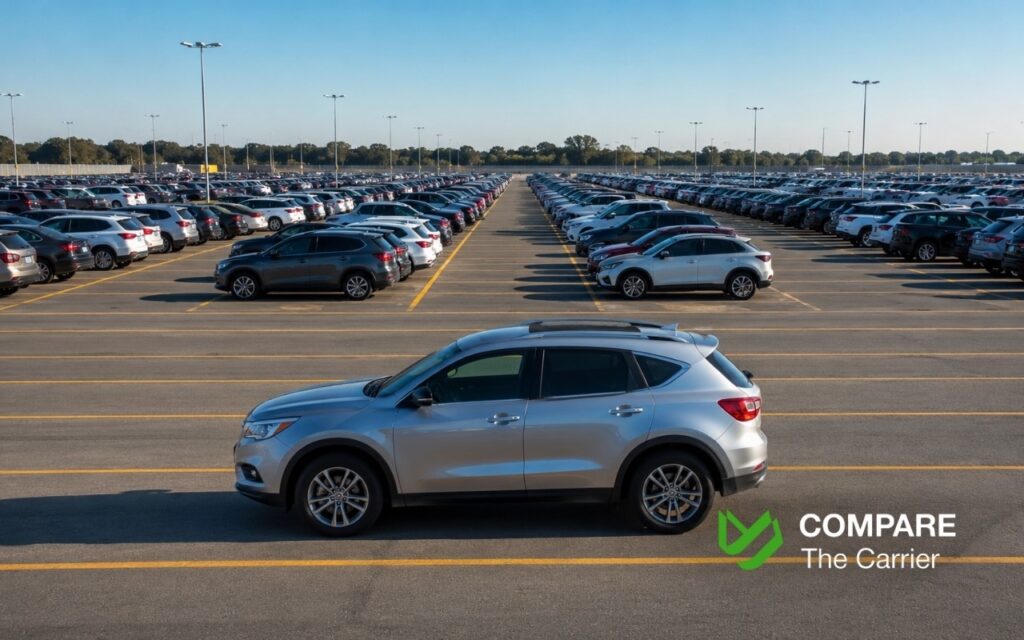
This is where the numbers genuinely vary, and it’s also where a lot of buyers get blindsided, because the rate isn’t published as a single national figure. Buyer reports and industry sources indicate a typical range of $20 to $40 per day at standard yards, with some urban or high-demand locations charging $50, $85, or more, especially the longer a vehicle sits. Copart does not publish a universal storage fee schedule – the rate is set per yard, so always confirm the exact number on your buyer dashboard or Copart’s Help Center before assuming a figure applies to your lot.
| Yard Type | Typical Daily Storage Rate | Notes |
| Rural / smaller yards | $5–$25/day | Lower overhead, smaller lots |
| Standard regional yards | $20–$40/day | Most common range |
| Urban yards (CA, NY, FL major metros) | $35–$85/day | Higher land and demand costs |
| Extended-delay cases | $85–$100+/day | Rate can climb the longer the car stays |
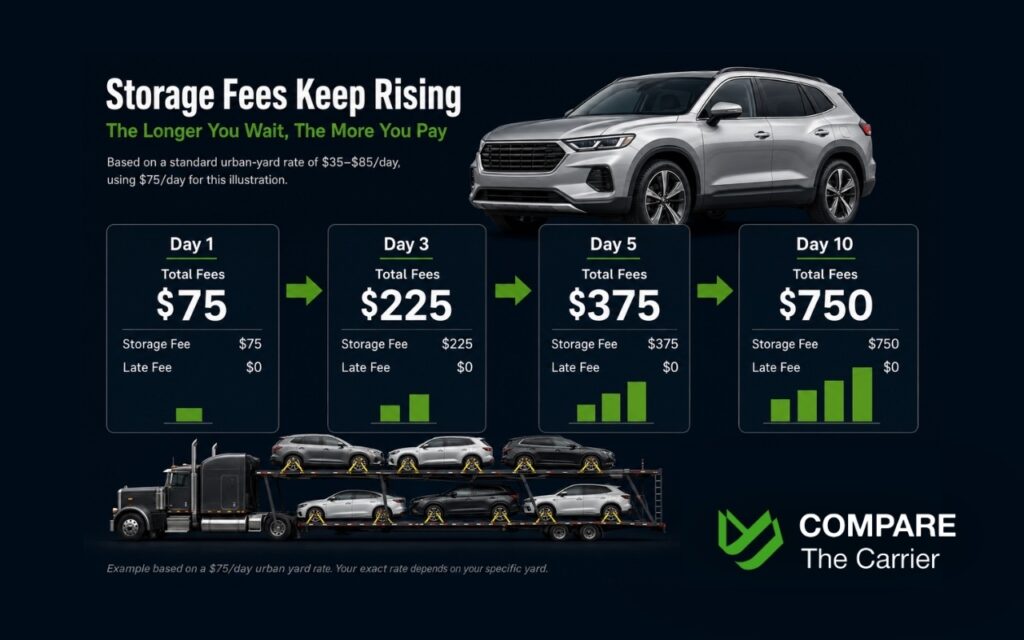
To put this in real terms: a five-day delay at a higher-rate urban yard can easily run $175 to $400 in accumulated storage, on top of everything else you already paid for the vehicle. That’s often enough to erase the entire discount that made the auction deal attractive in the first place. If you’re still new to bidding and want to avoid this kind of surprise on future purchases, our tips for first-time auction buyers cover how to budget for total cost, not just the winning bid.

Why the Rate Isn’t Listed the Same Way Everywhere
Copart doesn’t publish one universal storage rate because each yard operates somewhat independently based on local lot capacity, regional demand, and how much space is available for incoming inventory. The rate that applies to your vehicle is set at the specific yard where the car is sitting, not by a national price sheet. The only way to know your exact number is to check your buyer dashboard or call the yard directly, since “around $30 a day” can mean very different things depending on which state you’re in.
If your lot happens to be sitting in one of the higher-rate states, it’s worth planning your transport ahead of time – compare carrier options and pricing for California auto transport, New York auto transport, or Florida auto transport.
Understanding the mechanics here is the difference between catching this early and discovering a $300 surprise bill.
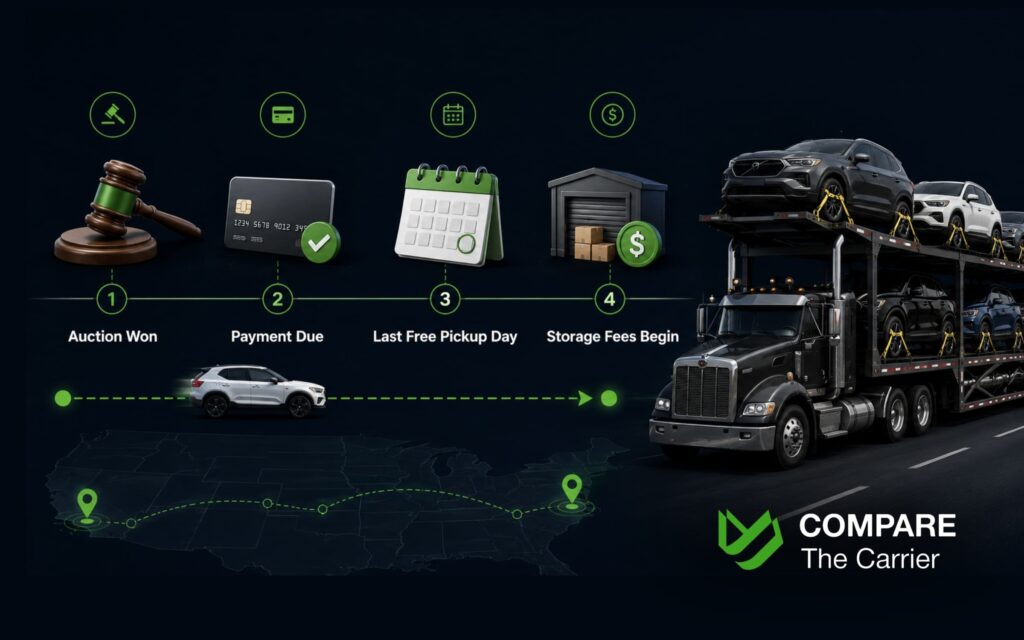
The clock starts at sale, not at payment. The day of the auction counts as day one of your free window, regardless of when you actually submit payment within the allowed two business days.
Weekends count against you, even though they’re not business days for payment. This is the single biggest trap. If you win on a Friday, pay by Monday (your two business days), and the free pickup window also expires around that same time, you may already be into storage fees by Tuesday without having done anything technically late.
The free window ends; storage doesn’t pause for processing time. Even if your transport company is actively trying to schedule a pickup, the yard doesn’t extend your free days because a truck hasn’t arrived yet. Storage fees are based on the calendar, not on whether you’re trying.
Payment method affects everything downstream. Wire transfers and electronic payments through Copart’s app tend to clear fastest, which matters because your Gate Pass (the document a transporter needs to legally remove the car) isn’t generated until the balance shows as paid in full. For a full breakdown of what your carrier needs beyond just the Gate Pass, see our vehicle shipping document checklist.
If storage fees keep accruing and the vehicle is never removed, Copart doesn’t let this go on indefinitely. After a period of continued non-removal, the vehicle becomes subject to lien or abandonment procedures under state law, meaning Copart can take legal steps to dispose of or resell it to recover its costs.
This is rarely where things actually end up for buyers who are simply slow to arrange transport. It’s far more common, and far more avoidable, for someone to rack up a week or two of storage fees out of disorganization rather than genuinely walking away from the car. But it’s worth knowing the worst-case scenario exists, because it’s the reason Copart’s system is built to penalize delay so aggressively from day one. The simplest way to never reach this point is to know your transport cost before you bid – run the numbers through Compare The Carrier’s auto transport calculator.
If you’re reading this because the deadline has already passed, here’s the order of operations that actually moves the needle.
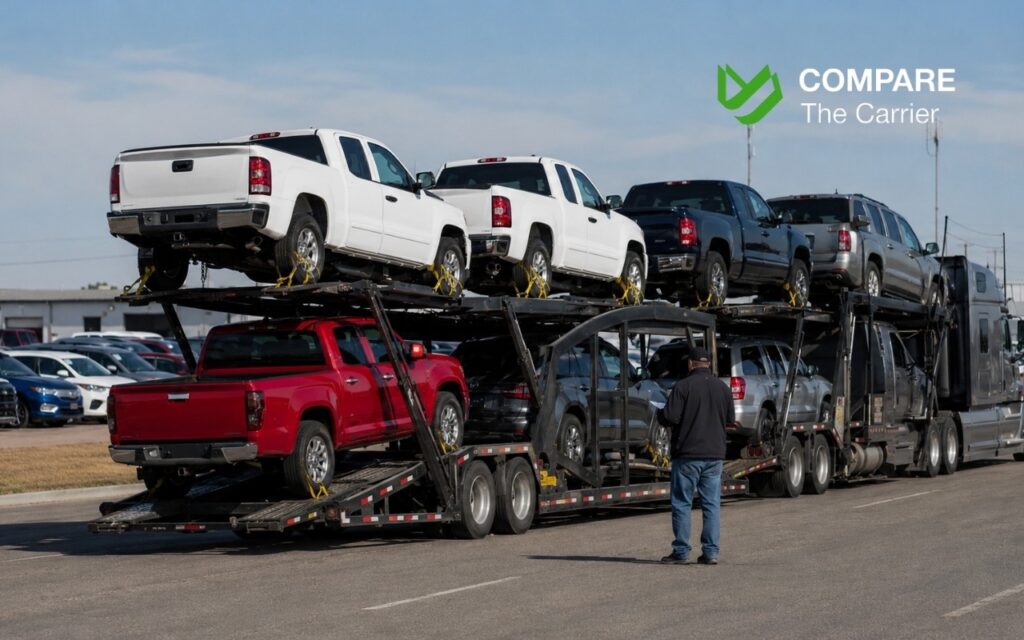
First, confirm your balance is fully paid, including any accrued storage. A transporter cannot generate or use a Gate Pass while there’s an outstanding balance on the lot. If there’s any unpaid amount, even a small leftover storage charge, the yard will turn your driver away when they show up, which costs you another day.
Second, pull your Gate Pass (Release Ticket) immediately after payment clears. This is generated automatically once the account shows a zero balance, and it’s the document that authorizes a transporter to physically remove the vehicle. No Gate Pass means no pickup, no matter how good your carrier is.
Third, book transport today, not “this week.” Every additional day you wait to even contact a carrier is another day of storage stacking up. Compare The Carrier connects you with FMCSA-licensed carriers who specialize in salvage and auction pickups and can typically dispatch within 24 to 48 hours once your Gate Pass is ready.
Fourth, give your carrier your Buyer Number and Lot Number right away. These two pieces of information are what a transporter uses to schedule the pickup through Copart’s dispatch system. Without them, no carrier can move forward, no matter how urgent your situation is.
Fifth, ask about expedited dispatch if you’re already several days deep. Standard carriers sometimes wait to fill a full trailer with multiple vehicles before heading to a yard, which can take several extra days. An expedited or smaller-scale pickup typically costs more upfront but often pays for itself if it shaves several days of storage fees off the total.
| If You’re At This Point | Do This Next |
| Auction just ended, haven’t paid yet | Pay within 2 business days via wire or app to avoid the $50 late fee |
| Paid, free window still open | Book a carrier immediately, don’t wait for “the right deal” |
| Free window expired, fees accruing | Pay the full balance including storage, then book transport same day |
| Storage fees already over $100–$200 | Confirm Gate Pass is ready, request expedited carrier dispatch |
If you’re unsure how the broader Copart pickup and shipping process works beyond just the storage clock, our complete guide on how to ship a car from Copart walks through everything from Buyer and Lot Numbers to winch fees for non-running vehicles.
The best version of this entire process is the one where storage fees never start in the first place. Here’s how experienced buyers structure their timeline to make that happen.

Line up transport before you bid, not after you win. This sounds backward, but it’s the single biggest difference between buyers who never pay storage fees and buyers who panic every single time. Before placing a serious bid, have a sense of which auto transport companies regularly run routes near that specific yard, and roughly what a quote would look like.
Pay the same day you win, using a fast-clearing method. Wire transfer or Copart’s in-app electronic payment options clear the fastest. Avoid mailing a cashier’s check or paying by physical check at the facility unless you have no other option, since both introduce processing delays you can’t control.
Generate your Gate Pass the moment your balance clears. Don’t wait until a carrier asks for it. Having it ready in advance shaves a step off the process and means your transporter can move the instant they’re dispatched.
Book a carrier the same day you pay, not the same day you plan to pick up. Reputable transport companies need lead time to route a driver to the yard. Booking the day before you “need” the car removed is too late; booking the day you pay gives the carrier room to actually hit the free window.
Choose a carrier who already runs that yard regularly. Transport companies that frequently service a specific Copart location tend to move faster than those that dispatch a driver from far away just for your one vehicle. This is also why getting a quote through a platform that compares multiple FMCSA-licensed carriers can be faster than calling a single company and hoping they have a truck nearby.
Build in a buffer for non-running vehicles. If your vehicle is listed as a non-runner or has frame or suspension damage, it requires winch or forklift loading, which takes longer to coordinate and sometimes means waiting for a flatbed instead of a standard multi-car hauler. Factor that extra coordination time into your plan from the start.
Get a Free Quote for Auction Pickup
If you’re bidding across both major salvage auction platforms, it helps to know that IAAI (Insurance Auto Auctions) follows a broadly similar structure, free pickup window, then daily storage, but the specific deadlines, daily rates, and release paperwork differ enough that you shouldn’t assume one platform’s rules apply to the other.
| Feature | Copart | IAAI |
| Free pickup window | Typically 3 business days | Varies, often similar window |
| Release document | Gate Pass | Buyer Letter / Vehicle Release Form |
| Daily storage range | $20–$100+ depending on yard | Comparable range, yard-dependent |
| Payment deadline | 2 business days | Similar, platform-specific |
The practical takeaway is the same either way: read the specific deadline and fee schedule listed on your invoice rather than relying on what worked at a different yard or a different platform last time.
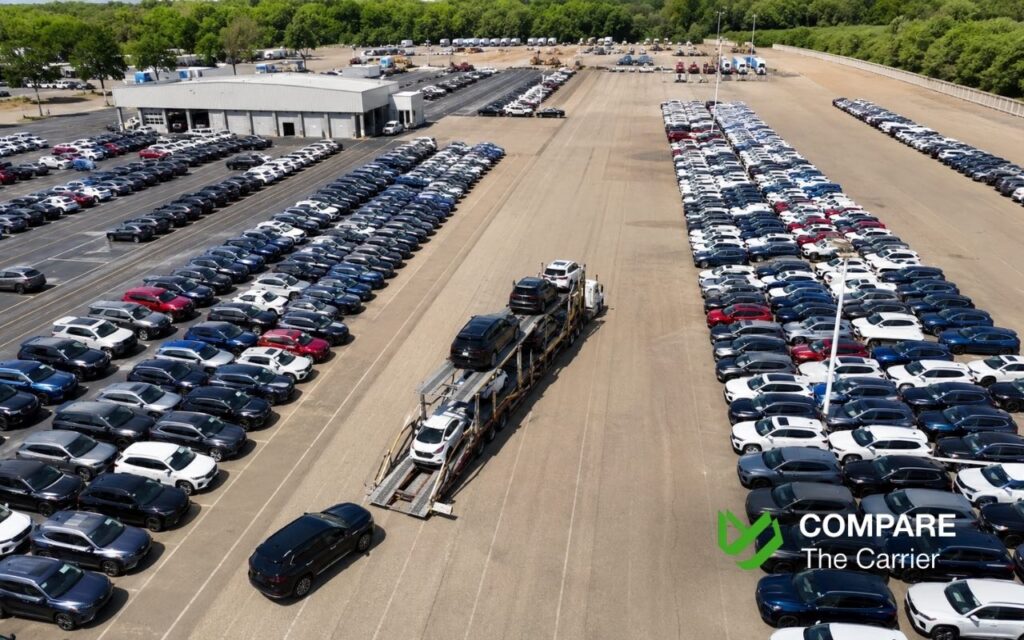
A few questions come up constantly once buyers realize the storage clock is real and already running.
“Can I negotiate or waive the storage fee?” In most cases, no. Storage fees are a standard part of Copart’s consignment and buyer terms, and individual yards generally don’t have discretion to waive them for a buyer who simply ran out of time. The exceptions tend to involve documented Copart system errors, not buyer scheduling issues.
“Does the storage fee include weekends?” Yes. Once your free window has expired, storage accrues every calendar day, including weekends and holidays, even though the yard itself may be closed and not actively processing pickups on those days.
“Will my carrier wait to fill a full trailer, even if it costs me storage fees?” Sometimes, yes, and this is one of the more frustrating parts of the process. Larger carriers running multi-car haulers often wait several days to maximize the load before dispatching to a specific yard. If your timeline is tight, ask upfront whether the carrier can prioritize a faster, smaller pickup instead – or get a quote from a carrier that already specializes in expedited auction pickups.
“What if the car isn’t released even though I paid?” This usually means either the payment hasn’t fully cleared yet, there’s an outstanding sub-balance like an unpaid gate fee, or required documentation like a power of attorney hasn’t been uploaded. Double-check your buyer account for any flagged items before assuming it’s a Copart error.
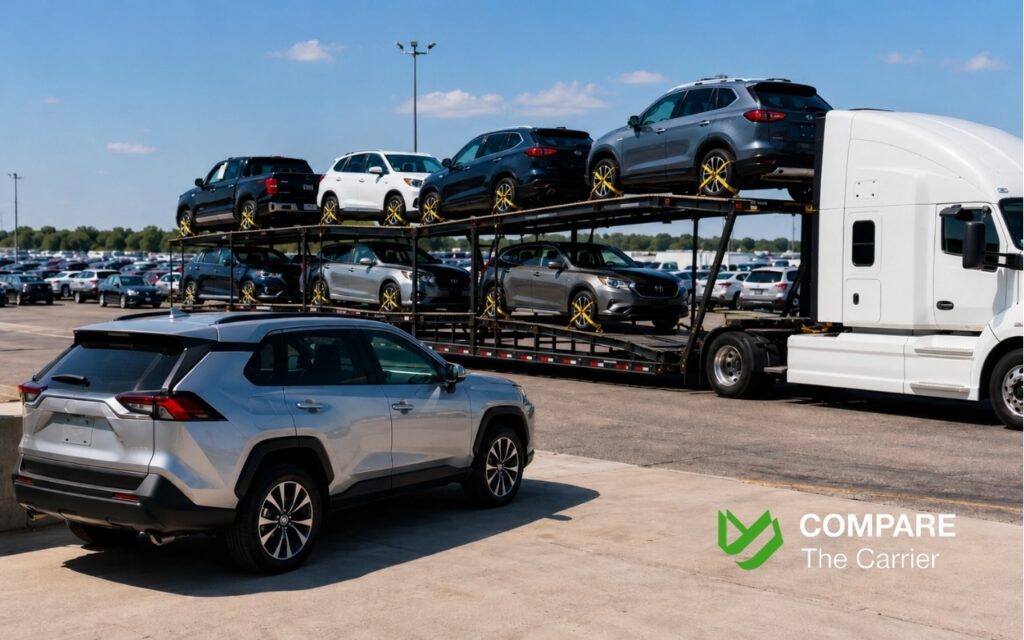
Copart storage fees are one of the most preventable costs in the entire auction-buying process, and also one of the most common ways buyers quietly lose the savings they thought they’d locked in with a winning bid. The fix isn’t complicated: know your exact free-pickup deadline before you bid, pay using a fast-clearing method the same day you win, and have a transport plan ready to move the instant your Gate Pass is generated.
If you’re already past the deadline and the fees are stacking up, the priority now is speed, not finding the cheapest possible quote. Compare The Carrier connects you with FMCSA-licensed carriers experienced in salvage and auction pickups who can move quickly once your account is clear. For the full picture of what shipping a Copart vehicle involves beyond just the storage clock, including winch fees, documentation, and realistic transit times, see our complete guide to shipping a car from Copart.
Already past your free pickup window, and the fees are climbing? Get a fast shipping quote from Compare The Carrier and get an FMCSA-licensed carrier moving toward your yard today.
Rates typically range from $20 to $40 per day at standard yards, with some urban or high-demand locations charging $50 to $100 or more, especially the longer the vehicle remains uncollected. The exact rate is set per yard, so always check your specific buyer invoice.
Most Copart locations give three business days, including the day of the sale, before storage fees begin. A small number of yards offer a slightly longer window, so confirm the exact terms on your invoice rather than assuming a standard number applies.
Yes. Once your free window has expired, storage fees accumulate every calendar day, including weekends and holidays, regardless of whether the yard is open or processing pickups that day.
You can’t avoid fees that have already accrued, but you can stop them from growing further by paying your full balance immediately, generating your Gate Pass, and booking a carrier the same day rather than waiting for a “better” quote.
A Gate Pass, also called a Release Ticket, is the document Copart generates once your balance is paid in full. Transporters cannot legally enter the yard or load your vehicle without it, so getting it ready quickly is essential to avoiding extra storage days.
If a vehicle remains unpaid or uncollected for an extended period, Copart can relist it and charge a relist fee, typically 10% of the bid or a few hundred dollars minimum. If storage and non-removal continue further, the vehicle may become subject to lien or abandonment procedures under state law.
It depends on the route and how urgently you need the car removed. Copart can connect you with affiliated shippers, but independent FMCSA-licensed carriers booked through a comparison platform often offer more flexibility on dispatch timing, which matters most when you’re racing the storage clock.
Storage rates are set at the individual yard level based on local capacity and demand, not a single national price list. Two buyers at different Copart locations can see meaningfully different daily rates even for similar vehicles.












Don't have time to fill out the form?
Call a transport company directly to get a quote now!
Select the category you need
Partner with Compare The Carrier & Grow!
We're open to collaborations, partnerships, and mutual growth! Whether you're an individual or a business, we offer exciting opportunities to work together. Fill out the form below to explore how we can collaborate.
Something Went Wrong
We're sorry, but something went wrong. Please briefly describe the problem you experienced in the text area below. Providing your contact information will allow us to follow up if needed.

Thank you,
your form has been accepted.
Your form has been successfully submitted. We appreciate your effort — our team will review it shortly and take the next steps.


