

Ship a Car by Train in 2026: Amtrak Guide & Costs
In 2026, only one company in the US ships cars by train: ...
18 August 2022
For the 2026 tax year, car shipping costs are primarily deductible for active-duty military members moving due to a permanent change of station (PCS) and small business owners who use the vehicle for business operations. While the 2017 Tax Cuts and Jobs Act suspended personal moving deductions for most civilians through 2025, business-related transport remains a powerful write-off under Section 179 or as a necessary business expense, provided you meet specific IRS distance and time requirements.
Calculate Shipping Quotes
Moving a vehicle across state lines is rarely cheap. Between the carrier fees, insurance, and fuel surcharges, you’re looking at a significant investment. It’s only natural to wonder if Uncle Sam might help foot the bill.
The reality of tax deductions in 2026 is a bit like a “good news, bad news” sandwich. The bad news? If you’re just moving for a change of scenery or a new job as a W-2 employee, those shipping receipts probably won’t help your tax return. The good news? If you wear a uniform or run your own shop, there are very clear paths to getting that money back.
If you are an active-duty member of the Armed Forces, the rules are much friendlier. When you receive orders for a permanent change of station (PCS), the IRS views the cost of moving your household including your car as a deductible expense.
This applies if your move is a result of a military order and a permanent change of station. You can typically deduct the “unreimbursed” portion of your shipping costs. If the military pays for one car but you have to ship a second one out of pocket, that second car’s journey is usually your ticket to a deduction. You’ll use IRS Form 3903 to make this claim.

For the entrepreneurs and freelancers out there, shipping a car isn’t just a “moving” expense; it’s a “business asset” expense. If you are relocating your business or purchasing a vehicle from out of state to be used for your work, the rules shift in your favor.
The IRS allows you to deduct the cost of transporting equipment. In the eyes of the tax code, a business vehicle is a piece of equipment. If you ship a van, truck, or even a sedan that is used more than 50% for business, the cost of getting that vehicle to its “place of service” can often be capitalized or deducted.
If you are moving your entire base of operations, the IRS requires you to pass two specific hurdles to write off the transport of your fleet:
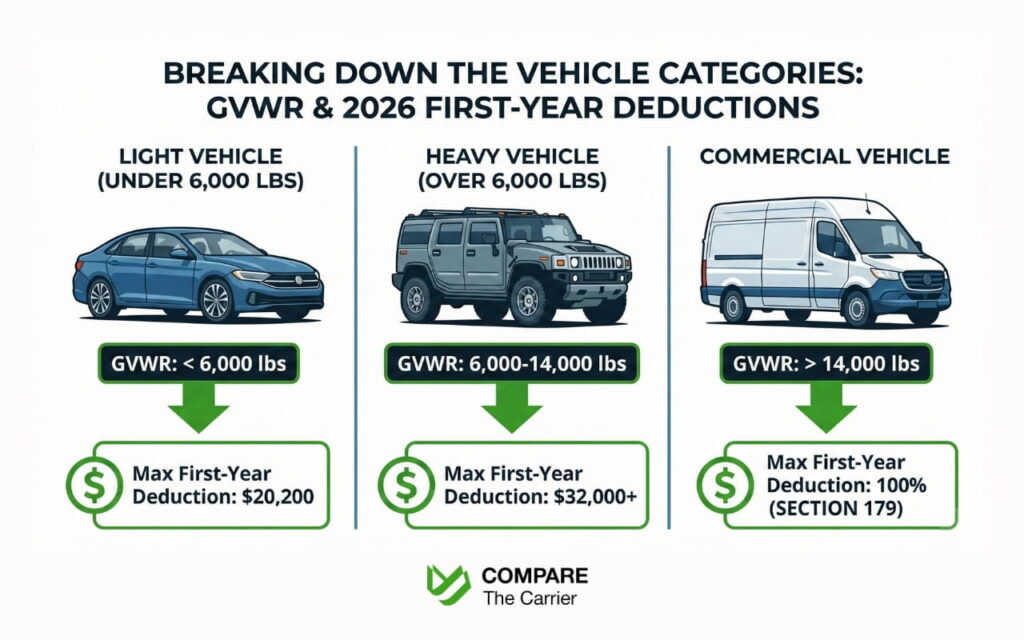
When claiming a vehicle for business use, the weight of the car technically the Gross Vehicle Weight Rating (GVWR) determines how much you can squeeze out of the tax code.
| Vehicle Category | GVWR Requirement | 2026 Deduction Potential |
| Light Vehicles | Under 6,000 lbs | Capped (approx. $20,200 including bonus depreciation) |
| Heavy Vehicles | 6,000 to 14,000 lbs | Higher limits (often up to $32,000 or 100% bonus) |
| Other (Commercial) | Over 14,000 lbs | Often 100% deductible in the first year |
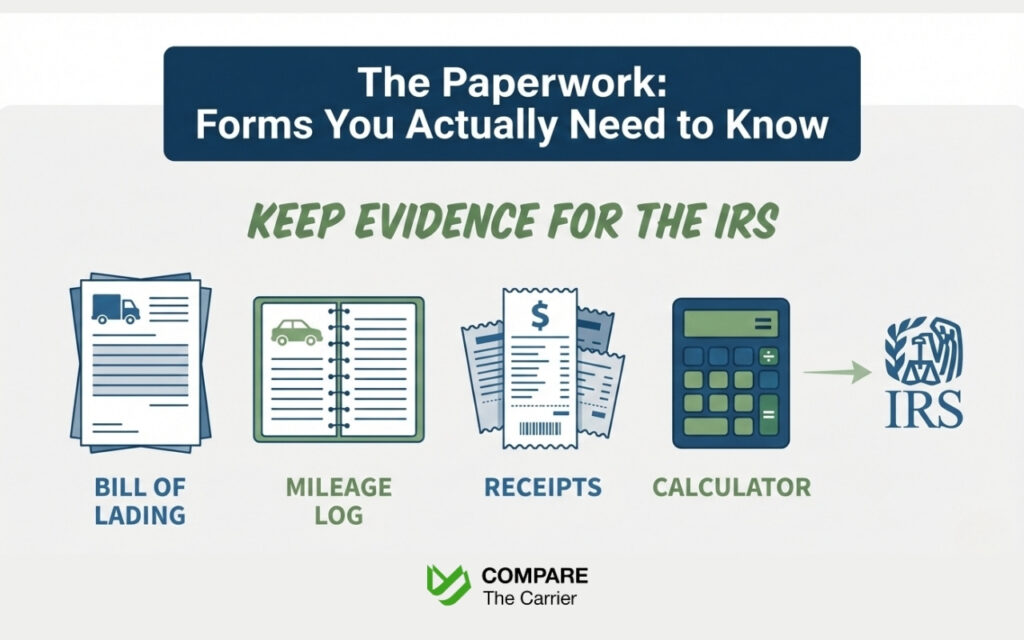
Look, nobody likes a shoebox full of receipts, but when it comes to car shipping, the IRS is a stickler for documentation. If you’re claiming a deduction, you need more than just a credit card statement. You need the Bill of Lading.
The Bill of Lading is the document your driver gives you when they pick up and drop off the car. It proves the origin, the destination, and the date. If you’re trying to prove you met the “Distance Test,” this document is your best friend. It bridges the gap between “I spent money” and “I moved for business.”
If you decide to skip the professional carrier and drive the car yourself, you can’t deduct the “value” of your time, but you can deduct actual expenses. This includes:
Alternatively, you can use the standard mileage rate for moving (which is typically lower than the business mileage rate). For 2026, keeping a log of your odometer readings at the start and end of the trip is non-negotiable if you want the deduction to stick.
For business owners in 2026, the weight of your vehicle is the single most important factor in determining your tax deduction. Under Section 179, “heavy” vehicles those with a Gross Vehicle Weight Rating (GVWR) between 6,001 and 14,000 pounds qualify for significantly higher immediate write-offs than standard passenger cars. This allows you to deduct up to $32,000 of the cost in the first year for SUVs, while true commercial vehicles and certain trucks can often be fully expensed up to the $2,560,000 annual limit.
If you’ve ever wondered why so many small business owners drive massive SUVs or heavy-duty pickups, it isn’t always about the towing capacity it’s about the tax code. In the world of the IRS, not all “cars” are created equal.
When you ship a vehicle for business use, you aren’t just paying for the transport; you are moving a business asset. If that asset happens to be “heavy,” the 2026 tax year is incredibly generous. Section 179 is essentially a “buy it and write it off now” rule, designed to help you reinvest in your business immediately rather than waiting five years to recoup the cost through standard depreciation.
The IRS uses the Gross Vehicle Weight Rating (GVWR) not the weight of the car on a scale (curb weight), but the maximum weight the manufacturer says it can safely carry (passengers, fuel, and cargo included).
If you follow tax news, you might remember that the 100% Bonus Depreciation from the 2017 Tax Cuts and Jobs Act was supposed to be dead by now. It was phasing down 20% every year and should have been a measly 20% in 2026.
However, thanks to the One Big Beautiful Bill signed in mid-2025, the 100% Bonus Depreciation has been reinstated for property placed in service after January 19, 2025. This is a game-changer for 2026.
What does this mean for your car shipping? If you buy a heavy truck for $80,000 and ship it to your job site:
It’s a “double-whammy” that can effectively make a brand-new work vehicle “free” from a taxable income perspective in its first year.
Here is the “human” catch: the IRS knows people like to use their work trucks for weekend camping trips and grocery runs. To claim any of the advanced deductions like Section 179 or Bonus Depreciation, you must use the vehicle for business more than 50% of the time.
If you use it 40% for business, you are stuck with standard, slow-motion depreciation. If you use it 70% for business, you get the advanced credits, but you can only deduct 70% of the costs. This includes the shipping. If it cost $1,500 to ship your SUV from Dallas to Seattle, and you use that SUV 70% for your real estate business, you can claim $1,050 of that shipping fee as a deduction.
Pro Tip:
Use a mileage tracking app. In an audit, “I think I used it for work most of the time” won’t fly. You need a log that shows the date, the miles, and the business purpose of every trip.
If your business vehicle is a light sedan let’s say a Tesla Model 3 or a Honda Accord the IRS places it in the “Luxury Passenger Automobile” category. Don’t let the word “Luxury” fool you; even a basic budget sedan falls into this bucket if it’s under the weight limit.
For 2026, the first-year depreciation limit for these vehicles is roughly $20,200 (if you claim bonus depreciation). While that’s still a decent chunk of change, it’s a far cry from the full-price write-off you get with a heavy truck.
Wait, what about shipping?
If you are shipping a “light” vehicle, that shipping cost is added to the “basis” of the car. It doesn’t disappear, but it gets capped along with the purchase price. If your total “basis” (price + shipping + taxes) is $45,000, you still only get to deduct that first-year cap. The rest of the shipping cost will be slowly trickled back to you through depreciation over the next five to six years.
Filing for a tax deduction isn’t just about having a receipt; it’s about placing that receipt on the correct line of the correct form. For 2026, your two primary tools are IRS Form 3903 (for moving-related transport) and Form 4562 (for business asset depreciation). Missing a single checkbox on these forms can trigger an automated “request for evidence” from the IRS, delaying your refund for months.
Documentation is the bridge between “spending money” and “saving on taxes.” Even if you have a rock-solid claim, the IRS won’t take your word for it without a paper trail.
If you are an active-duty military member or a qualifying member of the intelligence community (a new inclusion for 2026!), this is your home base.
For the self-employed or business owners using Section 179 or Bonus Depreciation, Form 4562 is where the magic happens.
One of the most common questions I get is: “Can I just deduct the gas if I drive it myself?” The answer is yes, but the math is different.
If you hire a professional shipping company, you have a single, clear invoice. It’s “clean” and easy to justify. However, if you (or a friend) drive the car, you have two choices for your 2026 return:
Not sure which transport method fits your situation? Our state-to-state car shipping guide breaks down open carrier, enclosed, and driveaway options with 2026 pricing.

The 2026 tax year is unique because of the One Big Beautiful Bill passed in mid-2025. This legislation made the 100% Bonus Depreciation permanent.
In previous years, we were looking at a “phase-down” where you could only deduct 20% or 40% of a car’s cost in the first year. In 2026, that floor will be ripped out. If you buy a heavy-duty vehicle for work and ship it across the country, you can effectively zero out the entire cost on your 2026 return, provided your business is profitable.
Car shipping is a major expense, but in 2026, it doesn’t have to be a total loss. Whether you are relocating for a PCS order or expanding your small business fleet, the tax code is designed to reward those who keep their receipts and understand their vehicle’s weight class.
The “sweet spot” for 2026 is clearly the heavy SUV or truck (6,000+ lbs. GVWR) used for business. By taking full advantage of the generous Section 179 deduction limits, shipping fees become a small, fully deductible part of a much larger tax-saving strategy. Just remember: track your miles, save your Bill of Lading, and when in doubt, consult a tax professional to ensure you correctly apply the “50% business use” requirement.
Ready to make your next vehicle shipment count toward your taxes? Compare vetted shipping companies, lock in your price, and walk away with the clean invoice your accountant will thank you for. Get your Shipping Quotes today.
Only active-duty military members and certain members of the U.S. intelligence community moving due to a permanent change of station (PCS) can claim moving expenses on Form 3903. For general civilians, the federal moving deduction remains suspended unless the move is strictly related to business asset relocation for a company or self-employed entity.
To claim vehicle shipping as a business relocation expense, your new workplace must be at least 50 miles farther from your old home than your previous workplace was. For example, if your old commute was 15 miles, your new office must be at least 65 miles from your old home to qualify for the deduction.
Yes, but you can only deduct the percentage of the shipping cost that matches your business use. To qualify for advanced deductions like Section 179 or Bonus Depreciation, you must use the vehicle for business more than 50% of the time. If you use it 70% for work, you deduct 70% of the shipping fee.
Vehicle weight determines the first-year depreciation limit. “Light” vehicles (under 6,000 lbs) are capped at roughly $20,200 in total deductions for 2026. “Heavy” vehicles (6,000–14,000 lbs) enjoy a higher Section 179 cap of $32,000 and may qualify for 100% Bonus Depreciation, allowing you to deduct the full shipping cost and purchase price immediately.
The most critical document is the Bill of Lading provided by your carrier, which proves the dates and locations of the transport. You should also maintain a mileage log if the car is for business use, and keep all invoices showing the specific breakdown of shipping fees, fuel surcharges, and insurance costs.
Unfortunately, no. Since the Tax Cuts and Jobs Act suspension of civilian moving deductions remains in effect through at least 2025, W-2 employees relocating for a new employer – including remote work – cannot deduct car shipping costs on their federal return. The only civilian path to a deduction is if you are self-employed and the vehicle is a documented business asset being moved to a new place of business operations.
Yes. The reinstated 100% Bonus Depreciation covers both new and used vehicles, provided the vehicle is new to you (meaning you haven’t previously owned or used it). The vehicle must also be placed in service after January 19, 2025, used more than 50% for business, and properly documented on Form 4562. This means a used heavy-duty truck purchased and shipped to your business location in 2026 can still be fully expensed in the first year.
If your carrier damages the vehicle, any insurance reimbursement you receive reduces your deductible basis. For example, if you paid $1,500 to ship a business truck and received a $600 insurance payout for damage, only $900 of the shipping cost remains deductible. Keep all claim correspondence and settlement documents, as the IRS may ask you to reconcile the original expense against any reimbursements received.











Don't have time to fill out the form?
Call a transport company directly to get a quote now!
Select the category you need
Partner with Compare The Carrier & Grow!
We're open to collaborations, partnerships, and mutual growth! Whether you're an individual or a business, we offer exciting opportunities to work together. Fill out the form below to explore how we can collaborate.
Something Went Wrong
We're sorry, but something went wrong. Please briefly describe the problem you experienced in the text area below. Providing your contact information will allow us to follow up if needed.

Thank you,
your form has been accepted.
Your form has been successfully submitted. We appreciate your effort — our team will review it shortly and take the next steps.


