

World’s Best Car Collections in 2026: Top 10 Must-See Garages
Okay, be honest with me for a moment, the entire luxury c...
12 February 2026
Let’s be honest for a second. The process of moving a car is not simply about getting it from point A to point B. It is a challenge of physics, a dice throw with your transmission, and a justifiable experiment of your sanity.
Calculate Shipping Quotes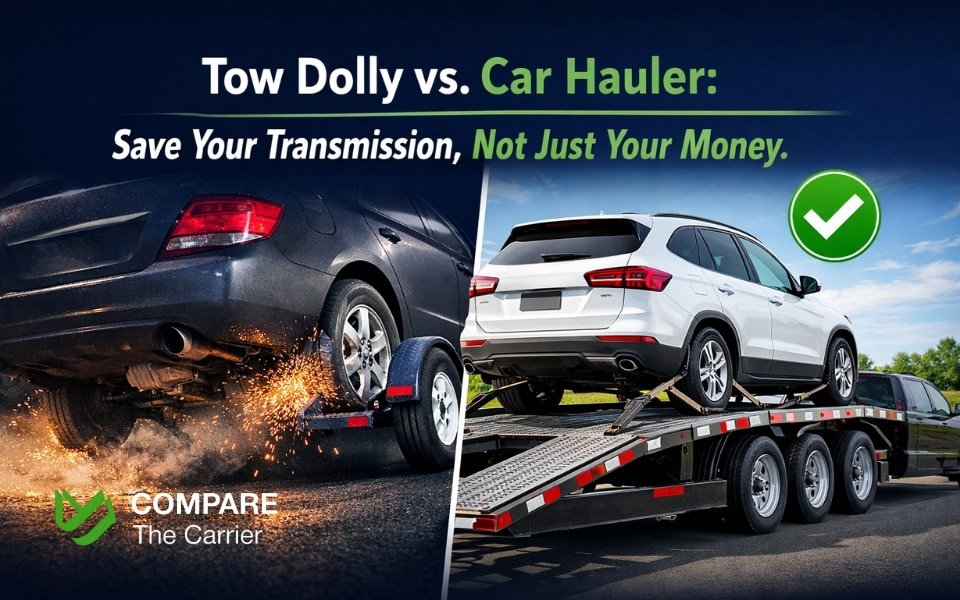
Is it better to tow with a dolly or a trailer? Towing with a full trailer (car hauler) is superior to a tow dolly because it keeps all four wheels off the ground. This setup eliminates tire and transmission wear, prevents odometer mileage accumulation, improves highway stability, and protects the vehicle’s undercarriage from road debris, reducing the risk of dangerous “trailer sway” common with lightweight dollies.
You have most likely spent hours gazing at floating checklists, selecting the apartment lease, utilities, and mail forwarding. However, you find yourself staring at your automobile, your true pride and joy, and you are asking yourself: Do I take the low-cost option or the correct option?
You are inclined to go to the rental tow dolly because it costs you a good steak dinner. Stop. Just stop. Breathe. We have to discuss what is really happening to your car when you drag it over three state lines. The current automotive environment of 2026 is not what it was thirty years ago. We have complex, low-clearance AWD systems and sensors that become uncontrollable when the car is tilted at the wrong angle for too long. (and, by the way, repairing a fried sensor array is even more expensive than it would be to do this once).
Here we are putting the lowly tow dolly up against the car hauler. We are not simply looking at the prices but the mechanical soul of your car. In fact, your decision today will determine whether your car is on the road or in the junkyard.
Before we get into the “why,” let’s look at the “what.” In the world of logistics, there are two primary ways a DIY’er or a pro moves a single unit.
A tow dolly is a small, two-wheeled trailer that lifts only the front wheels of your car off the ground, leaving the rear wheels on the road, spinning as you drive. It’s the “lightweight” option in the rental world cheap and easy to get but it’s not for every vehicle. I’ve seen it go wrong more times than I can count: someone thinks they’re being smart, only to end up halfway through Ohio with a rear differential that feels like it’s completely seized.
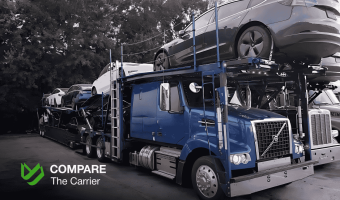
When we talk about a car hauler or auto transport, we are talking about a four-wheel (or more) trailer where the entire vehicle is lifted off the ground. No wheels spinning. No contact with the road. No transmission wear. It is the gold standard for long-haul safety and vehicle preservation. Monarch Transport Group doesn’t just see this as a service; we see it as an insurance policy for your car’s longevity.
To decide which is better, we have to break them down across the metrics that actually matter when you’re 500 miles away from home on a rainy Tuesday.
Using a tow dolly is like asking your car to run a half-marathon while its front half is asleep. The front wheels are strapped down, but the rear wheels, differential, and part of the suspension are still fully connected to the road, doing all the work.
The problem is, cars aren’t built to be dragged like this. In contrast, an enclosed car transporter or a standard open car hauler keeps the car completely stationary. And stationary is good no extra mechanical friction. What does that mean for you? Simply put, you’re not putting 1,000 extra miles of wear on your bearings and suspension while the car is technically “just being towed.”
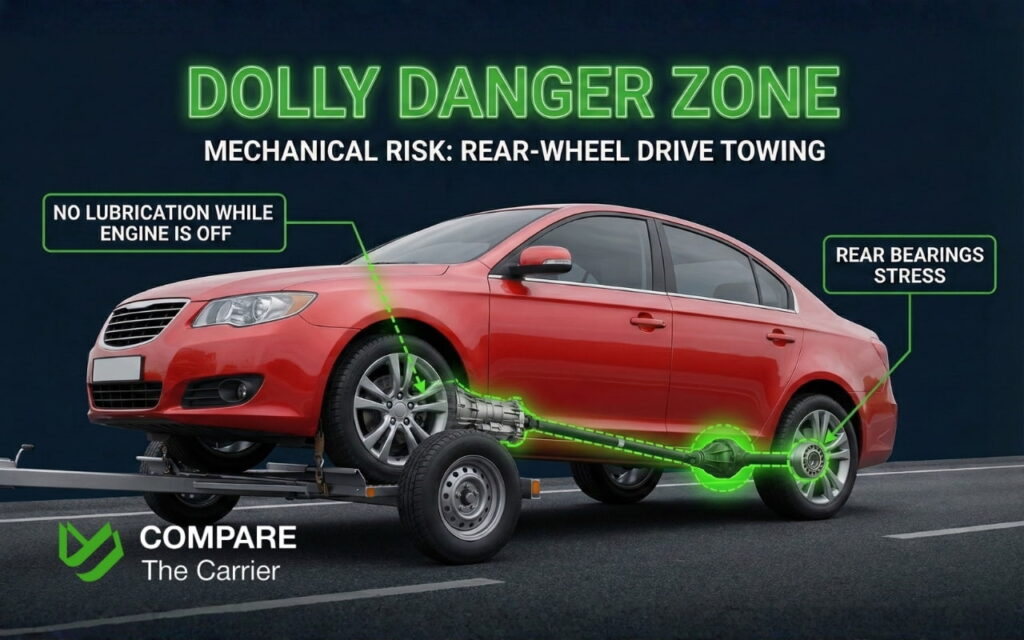
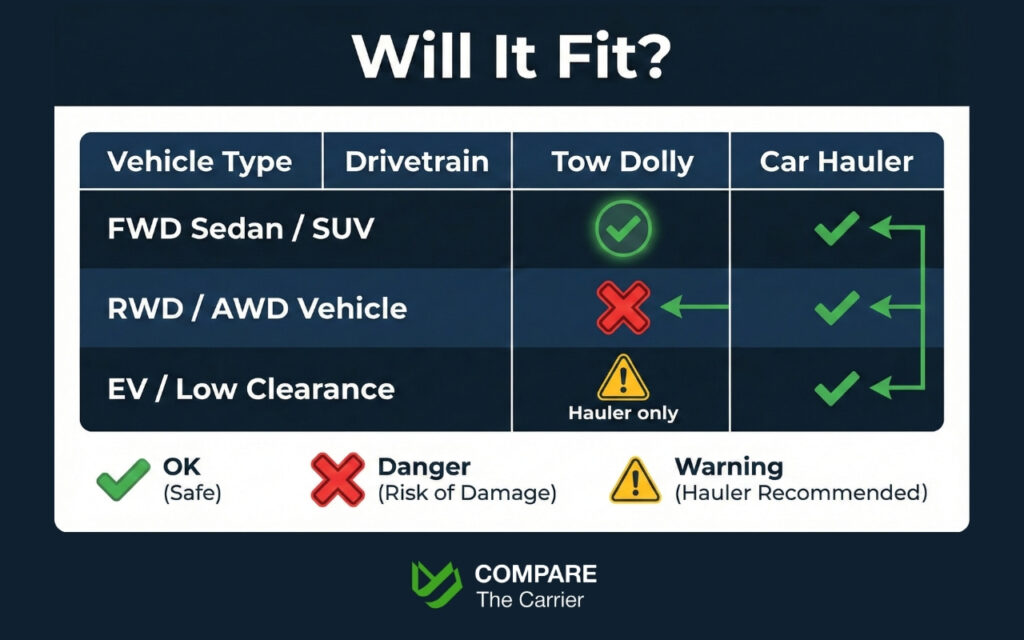
This is where people make expensive mistakes. Most modern cars are Front-Wheel Drive (FWD), which makes them “okay” for a dolly. But if you have an All-Wheel Drive (AWD) SUV or a Rear-Wheel Drive (RWD) sports car, a tow dolly is a death sentence for your transmission.
The catch is, you’d have to start pulling driveshafts to make it safe, and let’s be real, you aren’t doing that in a U-Haul parking lot. A car hauler, however, is the universal solvent. It fits everything from a Mini to a massive dually truck. Actually, from a buyer’s point of view, the peace of mind knowing the wheels aren’t spinning is worth every penny.
Hooking up a tow dolly is hard work. You’re kneeling on the ground, tightening ratchets, and hoping those safety chains don’t snap. Get the tension wrong, and your car will start dancing behind you.
With professional vehicle transport, a pro does all of that for you. They load the car, chain it down, and make sure it’s secure. Your only job? Sign the Bill of Lading. Let’s be real after spending days packing and moving boxes, do you really want to wrestle with 50-pound steel ramps in the rain? Yeah, didn’t think so.
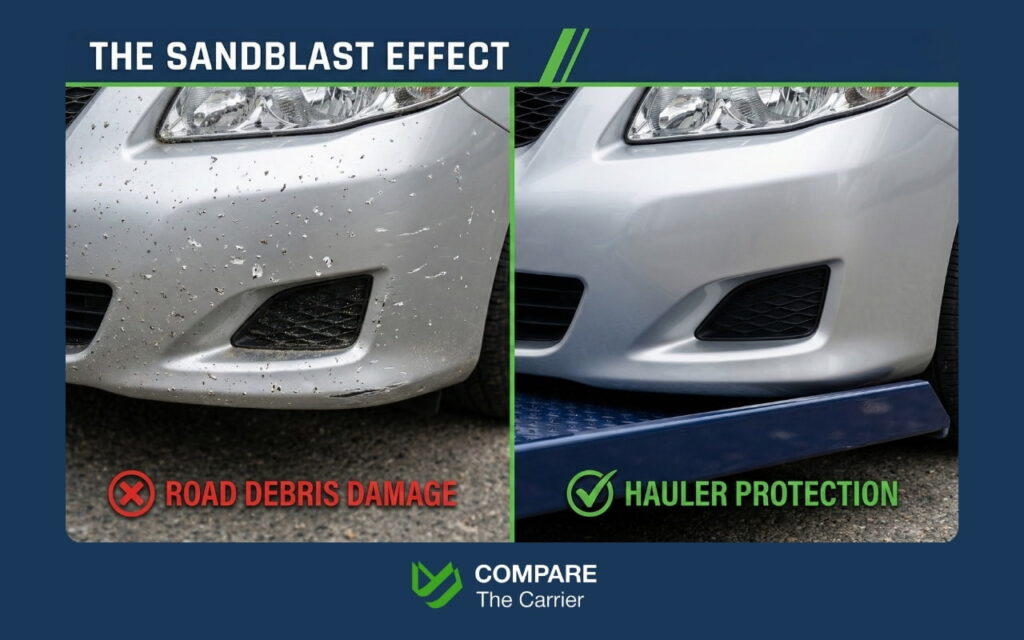
Drag a car 1,000 miles on its rear wheels and you’ve just added 1,000 miles of wear to the tires and bearings. But wait, there’s more. Think about the “sandblast effect.” Rocks kicked up by your towing vehicle will pepper the front of your towed car. If you’re moving a high-value asset, you need luxury car shipping companies that use trailers with stone guards or fully enclosed walls.
I hate when people realize too late that their front bumper looks like it was hit by a shotgun blast because they followed a gravel truck for fifty miles on a dolly.
Sure, renting a tow dolly might only set you back $100. But have you thought about the fuel? Hauling a 4,000-pound car behind your truck tanks your MPG sometimes down to single digits. Chances are, you’ll spend more at the pump than you saved on the rental.
When you get a free quote from a professional car transporter, that “expensive” option often ends up being cheaper. Factor in gas, hotel stops, and the inevitable backache from DIY towing, and the math is pretty clear: going pro usually saves both money and headaches.
“Trailer sway” is the ghost that haunts every DIY towers’ dreams. At 65 MPH, a slight wind gust can turn a tow dolly into a pendulum. Once it starts fishtailing, you’re in God’s hands.
A car hauler, especially a tandem-axle trailer, is significantly more stable. It’s built to track straight, even in crosswinds. Why does this matter? Because your family is in the towing vehicle. Safety isn’t a place to cut corners.
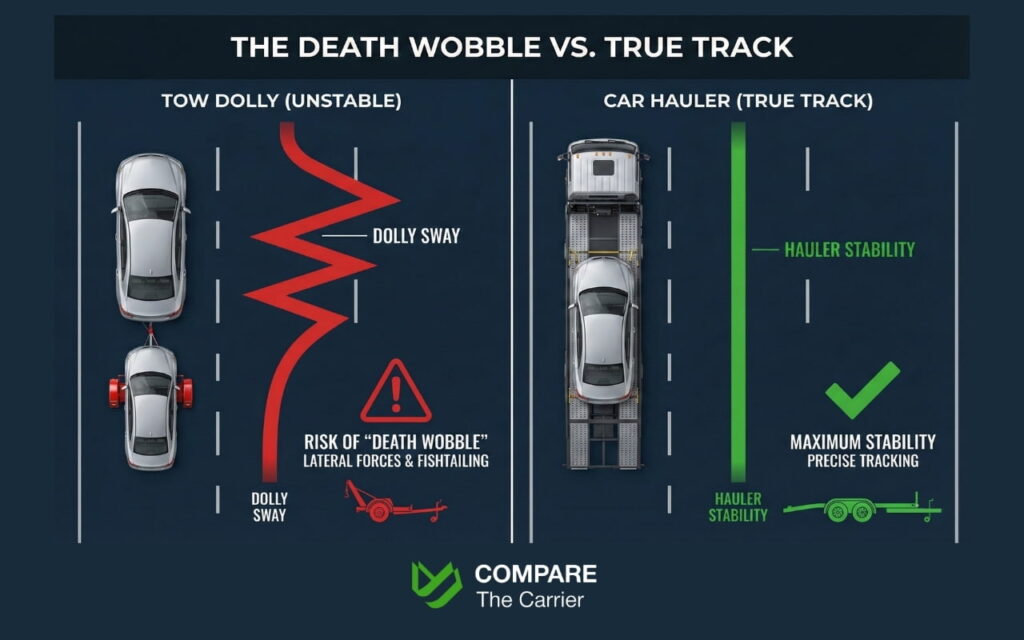
Can you back up with a tow dolly? Technically, yes. In reality? Almost nobody can do it without jackknifing. If you pull into a tight gas station with a dolly, you’d better hope there’s a way out the front. You aren’t backing out.
State-to-state car shipping drivers are masters of the “impossible turn.” They have the equipment to handle tight urban spaces. Actually, watching a pro navigate a 53-foot carrier into a cul-de-sac is a work of art.
Rental companies warn you to keep your speed under 55 MPH when towing a dolly. Now, picture driving from New York to Florida at that pace; it’s a nightmare.
Professional car haulers can safely maintain regular highway speeds. If you’re on a schedule, a tow dolly isn’t the answer; you go with the pros.
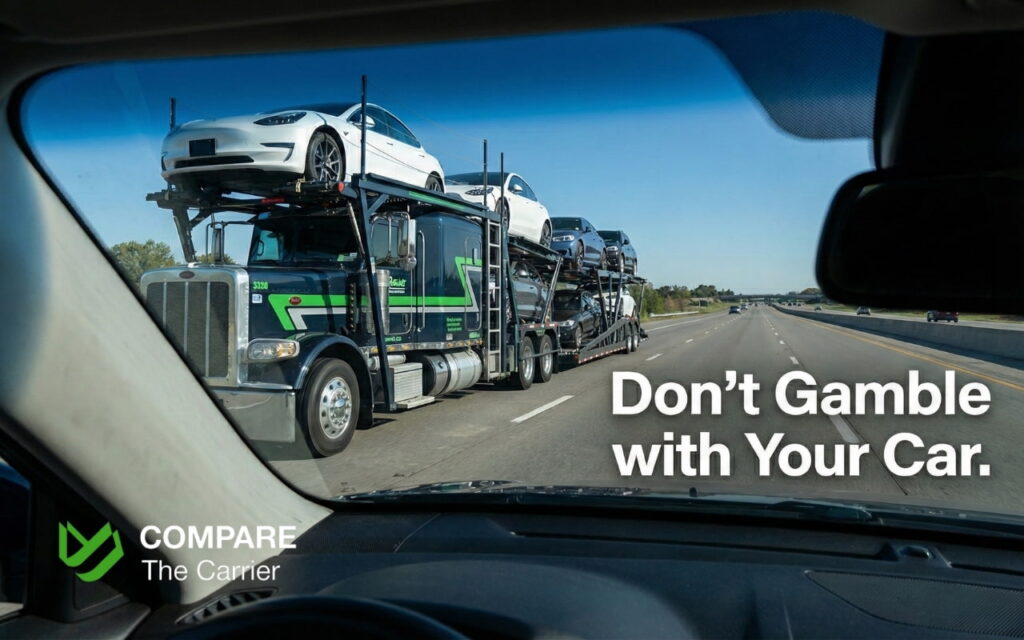
Let’s be honest you want the cheaper option. Everyone does. But the highway doesn’t negotiate. It hums, it shakes, and it punishes bad decisions without skipping a beat.
I’ve seen this movie too many times. Same story, different person: they rent a dolly, strap the car down, call it their “baby.” Half a day in, the weather turns rain, wind and that little death shudder starts tapping the steering wheel. Rear tires screaming, alignment never checked, straps too loose. Now it’s midnight on I-95. Flashers on the shoulder. Tow truck on the way. Surprise bill: at least $500.
I hate that moment. It’s no longer about cars it’s wasted time and unnecessary stress. You think you’re transporting something safely. You’re not. This becomes a costly problem you’re dragging across states. If you respect your car at all, you don’t tow it on a dolly like this. You lift it, put it on a proper deck, and move it the way it deserves. Because it matters.
Is the tow dolly always bad? No. It has a very specific, very narrow niche.
But for anything else? You’re playing a dangerous game. Especially if you’re dealing with auction car shipping, where you don’t even know if the car’s rear tires hold air or if the bearings are seized.
When you choose state-to-state car shipping, you’re buying peace of mind. Here’s what you’re actually paying for:
Zero Mileage
Your odometer stays frozen. In 2026, resale value is everything. Every mile you save is money in your pocket later.
Structural Integrity
A car hauler supports the vehicle at its strongest points. A tow dolly puts weird lateral stress on the rear suspension that it wasn’t designed to withstand. From a mechanical standpoint, it’s just wrong.
Insurance Coverage
Most car shipping companies carry massive insurance policies. If a rock chips your windshield on a pro trailer, they pay for it. If you’re DIY towing and a rock hits your car, that’s on you. (And your personal insurance might laugh at you if you try to file a claim for a car being towed on a dolly).
Specialty Needs
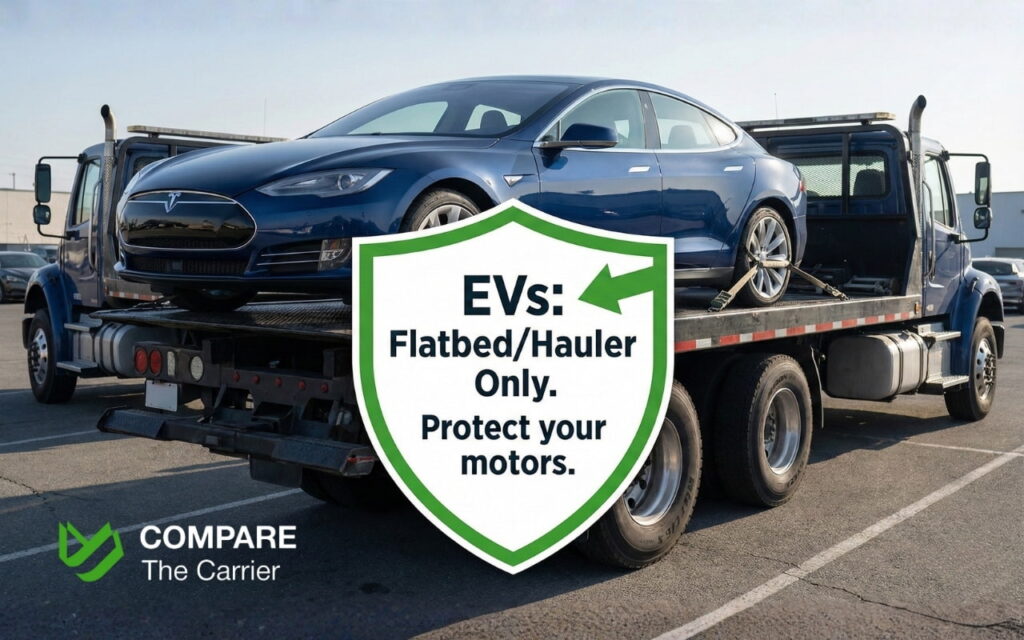
Got an EV? You can’t tow a Tesla on a dolly without frying the motors. Period. You need a flatbed or a car hauler. Actually, the sensors in modern EVs will often engage the brakes automatically if they detect movement without the car being “on,” which can lead to a literal fire on the highway.
Stop pretending. Seriously. You aren’t a long-haul trucker. You don’t have the seat time. You certainly lack the muscle memory of reflex to do 8,000 pounds of moving UNTEN weight behind your SUV.
Physics is a cold mistress. Brutal, actually. Having a center of gravity that is disoriented by two inches alone is enough to cause the trailer to speak to you. First, it’s a whisper. A little shimmy at 50 MPH. But at 65? It’s screaming. It is only by luck you have not been in a pickup when a trailer attempted to overturn your steering wheel. Seriously. It is a level of stress that is clinically obsessive and is unnecessary. I have witnessed that people would come with a white knuckle and an adultile hand. It’s not a vibe.
Being sane throughout the move is an art. Truly. And that art is not staring through the rearview mirror after every five minutes to ensure that your vehicle has not been stolen. Logistics… I am not even going to start. It’s a circus. In fact, it is a carnival of poor choices when you are not in the right clothing.
So, why do people do this? Simple. They come to a sign that says: low price and they become blind. The second axle breaks and they lose track of the car being turned into a six figure paperweight. Don’t be that guy. And it is not to be the one with the broken rhythm on the road, white-knuckling the wheel and wondering why the car is fisktailing.
If you’ve realized that a tow dolly is a bad idea, your next step is finding a pro. But not all companies are created equal. You need to avoid the “brokers from hell” who promise a price they can’t keep.
The greatest car moves of 2026 aren’t just about moving steel; they are about preserving time. Your car is a time machine it’s how you get to work, how you take your kids to school, how you escape on the weekend. Why would you treat it like an afterthought?
It is a huge burden to move a house. It demands a team. It demands curators of your life’s work. Why, anyway, when you have the most beautiful car in the world, should you not be able to have it arrive in perfect condition?
Let’s be honest: if you’re going more than 100 miles, the car hauler wins every single time. The tow dolly is a relic of a time when cars were simpler and gas was cheap. Today, it’s a liability.
The choice is simple: do you want to be a mechanic on the side of the road, or a driver when you arrive? The “broken rhythm” of DIY towing is a stress you don’t need during a move.
Do you want to open your own collection at your new home, or would you like to take your present “pride and joy” to another house without a scratch? Whether you’re doing a ship car from Florida to Michigan run or just crossing the state line, the first step to ensuring your vehicle receives the royal treatment it deserves is to request a free car shipping quote.
Don’t let your car become a six-figure paperweight. Lift it up, ship it right, and enjoy the drive when you get there. Monarch Transport Group is here to make sure that happens.
A tow dolly is a cost-effective choice for front-wheel-drive (FWD) vehicles on local trips under 100 miles. However, professional auto transport is essential for all-wheel-drive (AWD), long-distance, or high-value vehicles to prevent drivetrain damage. Professional carriers eliminate road wear and potential transmission failure, providing a safer, insurance-backed alternative for cross-country moves where DIY towing risks significant mechanical repair costs.
Enclosed car shipping is the premium standard, providing a climate-controlled environment that shields vehicles from weather, road grime, and debris. For standard daily drivers, an open car hauler offers the best balance of safety and price, typically costing 40% to 60% less than enclosed options. Professional transport via multi-car carriers remains the most efficient method for maintaining vehicle integrity during long-distance transit.
The primary disadvantages of a tow dolly include limited vehicle compatibility and high risk of transmission damage for RWD or AWD models. Dollies lack maneuverability, as reversing is physically impossible without damaging the equipment. Additionally, the lightweight two-wheel design is prone to “trailer sway” at speeds exceeding 55 mph, posing a significant safety risk during highway travel or in adverse weather conditions.
Professional carrier drivers typically complete the loading process in 15 to 30 minutes using specialized hydraulic ramps and soft-tie securement systems. In contrast, DIY loading onto a tow dolly or personal trailer can exceed 60 minutes. This extra time is required for manual alignment, tensioning wheel straps, and performing multiple safety checks to ensure the vehicle remains stable during transit.
Towing an automatic vehicle with a dolly can cause catastrophic transmission failure if the drive wheels remain on the ground. Most automatic transmissions rely on an engine-driven pump for lubrication; towing with the engine off prevents fluid circulation, leading to rapid overheating. Unless the driveshaft is disconnected or the vehicle is FWD with front wheels elevated, professional flatbed transport is the only safe method.
The maximum safe speed for towing with a dolly is 55 mph, regardless of higher posted highway limits. Exceeding 55 mph increases the likelihood of “trailer sway” and overheating the dolly’s tires, which are often not rated for sustained high speeds. For those requiring normal highway travel speeds (65–70 mph).







Don't have time to fill out the form?
Call a transport company directly to get a quote now!
Select the category you need
Partner with Compare The Carrier & Grow!
We're open to collaborations, partnerships, and mutual growth! Whether you're an individual or a business, we offer exciting opportunities to work together. Fill out the form below to explore how we can collaborate.
Something Went Wrong
We're sorry, but something went wrong. Please briefly describe the problem you experienced in the text area below. Providing your contact information will allow us to follow up if needed.

Thank you,
your form has been accepted.
Your form has been successfully submitted. We appreciate your effort — our team will review it shortly and take the next steps.


