Auto Transport Lead Cost in 2026: How to Lower Your CPL Without Killing Conversions
In 2026, the average cost per lead (CPL) for auto transpo...
15 November 2024
Your moving leads and transport profits vanishing into thin air? These 2026 lead tracking strategies aren’t just tips; they’re your new playbook.
Contact Us Now
Forget what you think you know about chasing down transport or moving leads. If your approach to lead management hasn’t had a serious tune-up lately, you’re likely leaving a pile of cash on the table for your competitors.
It’s time to get serious with a comprehensive Digital Marketing Strategy for Logistics Companies backed by top-tier tracking tactics for 2026. Recent industry analyses highlight that businesses effectively using CRM systems for lead management can see conversion rate increases by as much as 300%.
That’s not just a small bump; it’s a game-changer in the competitive transport and moving sector. This isn’t about fancy jargon; it’s about smart, actionable steps to make sure every potential customer gets the attention they need to turn into a paying client, boosting your conversion rate optimization and making your business engine hum.

Today effective lead tracking strategies are fundamental to your financial survival and growth. Ignoring them means losing transport and moving leads, which translates directly to lost revenue. Solid lead management is your best defense against this, turning potential losses into profits.
Simply put, lead tracking for your business is the systematic way you capture, monitor, and manage every potential customer. It means knowing exactly how leads find you (like “Apex Logistics” or the Miller family), understanding every interaction, and seeing their current stage in your sales pipeline.
This isn’t just list-keeping; it’s the core of smart lead management and drives conversion rate optimization.
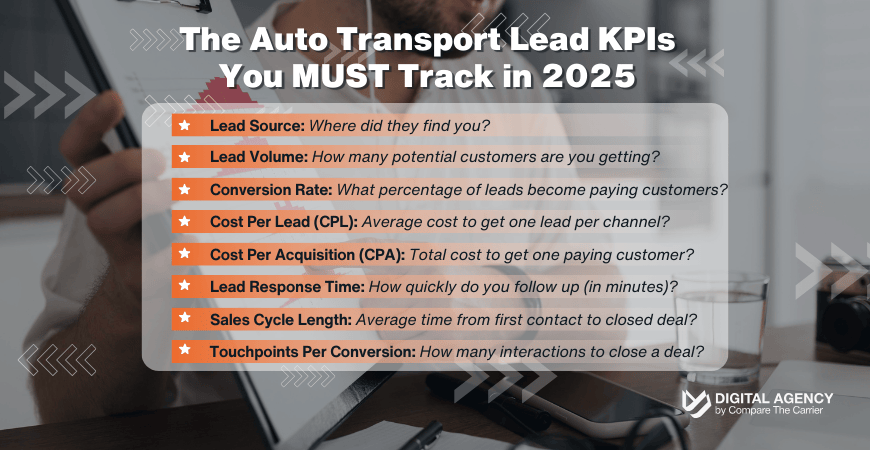
If you’re not measuring, you’re guessing. Tracking these Key Performance Indicators (KPIs), consistently emphasized by top auto transport CRM, is crucial for understanding the real impact of your lead tracking strategies.
Monitoring these numbers provides the business intelligence to make sharper, more profitable decisions, focusing onshipping KPIs that drive revenue growth. In 2026, your lead tracking strategies deliver this intelligence, shifting your operations from reactive to proactive.
To truly master your lead tracking strategies and stop transport leads and moving leads from vanishing, you need a rock-solid infrastructure. This isn’t about collecting fancy software; it’s about strategically deploying core tools that form the backbone of effective lead management and drive conversion rate optimization.
These are the must-haves for any transport or moving company serious about growth in 2026.
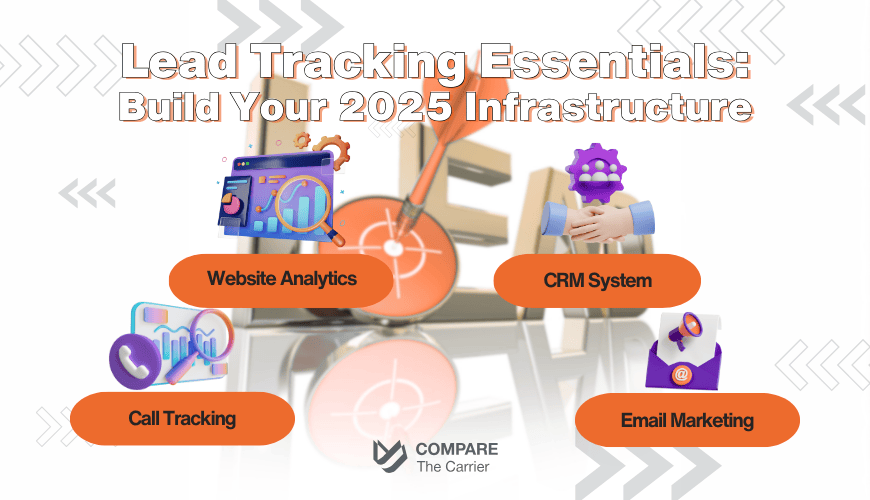
Laying this foundational infrastructure is the critical first step. With these systems working for you, you’re equipped to capture, understand, and effectively manage every lead that comes your way.
You’ve laid the groundwork with essential tracking systems. Now, let’s shift into high gear. These advanced lead tracking strategies are about precision, deep analysis, and squeezing maximum value from every transport lead and moving lead. This is how you elevate your lead management and truly drive conversion rate optimization in the competitive 2026 landscape.
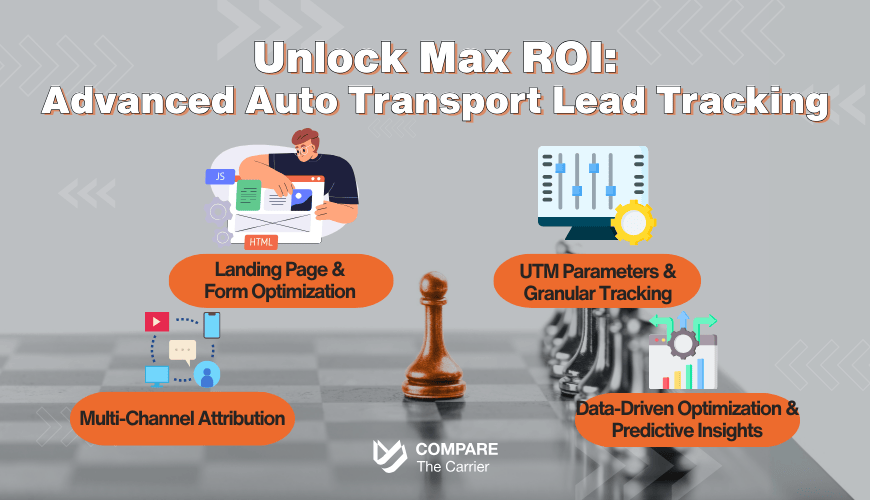
Don’t just direct ad clicks to your generic homepage. For every distinct campaign, craft a dedicated landing page a tactic central to successful Inbound Marketing for Logistics. Dedicated landing pages consistently outperform generic pages because they offer a focused message. Keep forms short; every unnecessary field is a potential point of friction.
Dedicated landing pages consistently outperform generic pages because they offer a focused message aligned with the ad or link the prospect clicked. Industry best practices, often highlighted by platforms like HubSpot and Unbounce, show that targeted landing pages can significantly increase conversion rates – sometimes by 50% or more compared to sending traffic to a homepage.
Regarding forms, the consensus from user experience research (see reports from Nielsen Norman Group or form analytics services) is that shorter forms generally lead to higher completion rates. Every unnecessary field is a potential point of friction. For initial transport leads or moving leads capture, aim for the bare minimum needed to qualify and make contact.
Key Actions: Create unique, compelling landing pages. A/B test headlines, calls-to-action (CTAs), and form length. Ensure lightning-fast mobile load times.
Implement Urchin Tracking Module (UTM) parameters across all your digital marketing links. This allows you to dissect campaign performance with surgical precision. This detailed data allows for highly informed budget allocation, ensuring you’re investing in specific, proven tactics like refined SEO Strategy Execution rather than just throwing money at a channel.
While standard analytics might tell you a lead came from “Google,” UTMs, as championed by digital marketing authorities like the Digital Marketing Institute or Google’s own Analytics resources, can tell you it came from a specific ad group, keyword, or even a particular email newsletter link. This granularity is crucial for understanding which precise elements of your campaigns are generating valuable moving or transport leads.
This detailed data allows for highly informed budget allocation. You’re not just throwing money at a channel; you’re investing in specific, proven tactics, dramatically improving marketing ROI, especially when combined with advanced PPC tactics for logistics advertising. This is a hallmark of advanced lead tracking strategies.
Key Actions: Develop a consistent UTM tagging system. Regularly analyze campaign performance in your analytics platform based on these tags.
Move beyond the often-misleading “last-click” attribution. A prospect might see an ad via SMM & Social Networks, search on Google, and finally convert on a lead form. Understanding this synergistic effect leads to better budget allocation, which is exactly why proper Sales & Marketing Integration is so powerful.
A prospect might see a Facebook ad, later search on Google, click an organic link, receive a retargeting ad, and then finally convert on a transport lead form. Last-click only credits the final action. However, research and analysis from firms like Gartner or discussions in publications like MarketingProfs emphasize that understanding the entire customer journey is vital. Different models (Linear, Time Decay, Position-Based – often available in advanced CRMs or analytics suites like Google Analytics 4) help assign value more accurately across the path to acquiring moving leads.
This holistic view helps you understand the synergistic effect of your marketing channels, leading to better budget allocation across your entire lead management ecosystem and improved long-term conversion rate optimization.
Key Actions: Explore the attribution models available in your analytics or CRM. Start with a simple model beyond last-click and gradually refine your understanding.
Treat your lead tracking data as a live feed for continuous improvement. Modern CRMs are increasingly incorporating Logistics AI Integration to identify patterns in your sales data. This can help predict which leads are most likely to close. Schedule regular data reviews and conduct ongoing Growth Opportunities Research to keep your pipeline fully optimized.
The principle of continuous improvement (Kaizen) is as applicable to sales and marketing as it is to manufacturing. Industry leaders and sales consultancies consistently stress that top-performing organizations regularly review their pipeline data to refine processes.
Modern CRMs and sales intelligence platforms (often discussed in publications like FreightWaves or Transport Topics for industry-specific applications, or by general sales tech reviewers) are increasingly incorporating AI to identify patterns in your transport sales or moving sales data. This can help predict which moving leads are most likely to close or which transport leads might need a different approach, allowing for more targeted and efficient lead management.
Key Actions: Schedule regular (e.g., monthly) deep-dive data reviews. Identify stages in your funnel where leads stall. Test changes to your follow-up processes, messaging, or targeting based on these insights. Explore AI-powered features in your CRM.
By embracing these advanced lead tracking strategies, backed by industry best practices and a commitment to data analysis, you’re not just managing leads; you’re actively engineering a more profitable future for your transport or moving business.
Even with robust lead tracking strategies initiated, many transport and moving companies encounter preventable setbacks. These common errors can undermine your lead management, stall conversion rate optimization, and lead to lost transport and moving leads.
Recognizing these pitfalls is key to sidestepping them and maintaining a healthy sales pipeline.
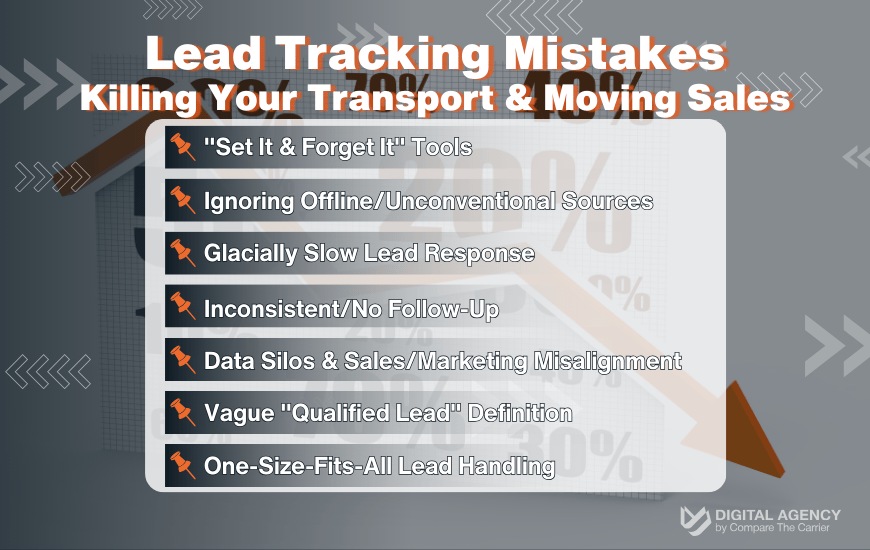
Common Pitfall | The Damaging Impact on Your Leads | The Smart Fix for Success |
1. “Set It & Forget It” Tools | CRM/analytics software becomes an underused digital paperweight, missing automation & crucial insights for your lead tracking strategies. | Ensure full team training. Customize tools to your specific sales process for moving & transport leads. Regularly audit tool usage & effectiveness. |
2. Ignoring Offline/Unconventional Sources | Focusing only on digital channels gives an incomplete lead origin picture, potentially misallocating marketing spend. | Implement call tracking. Standardize manual CRM entry for all non-digital transport & moving leads. Consistently ask, “How did you hear about us?” |
3. Glacially Slow Lead Response | Letting new transport or moving leads wait kills conversion rate optimization. Leads go cold fast; competitors win. | Aim for follow-up in 5-15 minutes. Use CRM automation for instant acknowledgments & lead assignment. Implement efficient lead routing. |
4. Inconsistent/No Follow-Up | Minimal contact attempts or no structured follow-up means lost revenue, as most sales require multiple touchpoints for moving or transport leads. | Develop a multi-touch follow-up cadence (calls, emails). Automate parts of this sequence. Ensure your lead management system logs all attempts. |
5. Data Silos & Sales/Marketing Misalignment | Marketing generates transport leads unaware of outcomes; sales gets poor quality leads. Data isn’t shared, fragmenting lead tracking strategies. | Integrate CRM, marketing, & analytics tools. Hold regular sales/marketing meetings to discuss lead quality & campaign performance. Align teams with shared goals. |
6. Vague “Qualified Lead” Definition | Sales & marketing having different ideas of a good moving or transport lead leads to inefficient time use & poor conversion rate optimization. | Collaboratively define MQL & SQL criteria. Implement lead scoring to prioritize follow-up based on demographics & engagement. |
7. One-Size-Fits-All Lead Handling | Using a generic approach for every transport & moving lead, regardless of source or needs, means messaging falls flat & lowers conversions. | Segment leads (by service, source, etc.). Tailor messaging & offers. Use data from your lead tracking strategies to personalize interactions. |
Avoiding these common blunders is about continuous refinement of your lead tracking strategies and lead management processes to build a more profitable sales engine.
Seeing how effective lead tracking strategies transform businesses is powerful. It’s not just about theories; it’s about real transport and moving companies achieving significant breakthroughs in their lead management, conversion rate optimization, and overall profitability. These successes, fueled by a commitment to tracking and optimizing every transport and moving lead, pave the way for sustainable growth.
And the good news?
These kinds of results are within your reach.
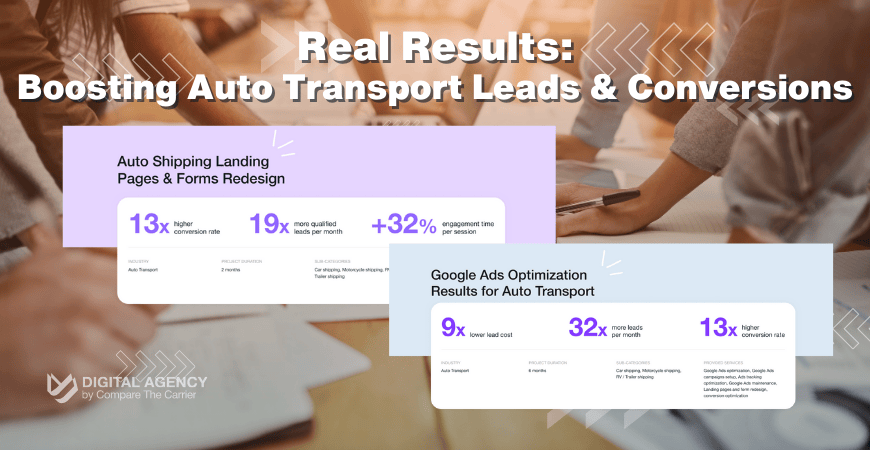
One auto transport company transformed its lead generation by overhauling its online presence.
Their initial challenge was a low 2% conversion rate from Google Ads, a quote form missing key fields, and slow loading times. Compare The Carrier addressed this by redesigning landing pages with clear messaging and user-friendly layouts, revamping the quote form for better data capture and user experience, and ensuring seamless CRM integration.
This strategic approach yielded a 13x higher conversion rate (jumping from 2% to 26%), 19x more qualified leads per month, and a 32% increase in visitor engagement time within just two months.
Another auto transport client struggling with high Google Ads costs saw a dramatic turnaround.
They initially faced an average cost per lead of $63.26 and a conversion rate below 2%, generating only 100 leads in four months. Through a phased optimization process, Compare The Carrier overhauled their Google Ads campaigns, implemented rigorous tracking, created new ads, and developed service-specific landing pages with improved load speeds.
After six months, the results were striking, with the final month showing a 9x lower lead cost at $7.11, 32x more leads (over 800 in that month), and a 13x higher average conversion rate of 26.17%.
These aren’t isolated incidents. They are clear examples of how a dedicated approach to tracking, analyzing, and refining your processes for handling transport and moving leads can yield extraordinary outcomes.
Achieving these kinds of results requires more than just understanding the concepts; it demands expert implementation, industry-specific knowledge, and often, a guiding hand to navigate the complexities of modern lead tracking strategies and lead management systems. This is precisely where Compare The Carrier steps in.
We don’t just provide high-quality transport and moving leads; we empower you with the strategies and systems to convert them effectively and profitably. With over four years of dedicated experience in the transport and logistics sector, we understand the unique challenges you face and offer tailored solutions to:
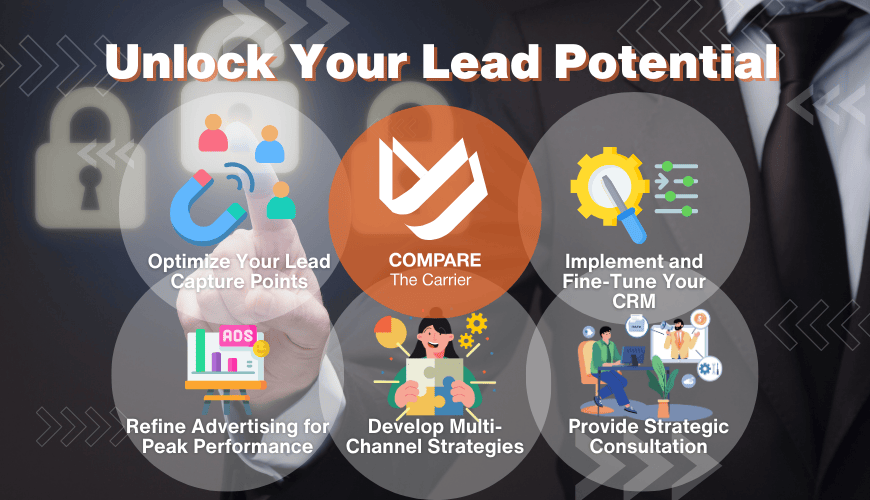
By partnering with Compare The Carrier, you gain more than a service provider; you gain a strategic ally dedicated to simplifying your operations, enhancing your lead management capabilities, and significantly boosting your bottom line. We help you turn data into dollars.
Ready to transform your lead tracking and see real results?
This combined section aims to inspire with real results and then clearly position Compare The Carrier as the solution to help achieve similar success.
The message for transport and moving companies in 2026 is clear: overlooking yourtransportor moving leads is a direct hit to your profits. Implementing robust lead tracking strategies isn’t just an operational upgrade; it’s the cornerstone of a thriving business.
By building the right systems, leveraging advanced techniques, sidestepping common errors, and committing to data-driven lead management, you shift from hoping for sales to engineering them.
The path to superior conversion rate optimization and a healthier bottom line is paved with consistent effort and intelligent tracking. Embrace these strategies, and watch your business transform. Compare The Carrier is ready to be your partner in this journey, helping you turn every lead into a victory.
In 2026, the most effective lead tracking method combines a centralized cloud CRM with AI-driven attribution modeling. This setup automatically captures leads from all sources like search, paid ads, and social media and attributes them to specific marketing touchpoints. It eliminates manual entry errors and provides real-time visibility into the exact cost per acquisition for moving and freight leads.
Basic lead tracking software for small transport companies typically starts around $25 to $50 per user monthly. Comprehensive logistics CRMs with AI predictive scoring, automated follow-ups, and advanced API integrations average between $100 and $200 per user monthly in 2026. Custom enterprise-level solutions for large fleets often require minimum annual contracts exceeding $10,000.
The average lead conversion rate in the transport and moving industry ranges from 3% to 8%, depending heavily on the lead source. Exclusive organic search leads often convert at higher rates, sometimes exceeding 12%, while shared or purchased third-party leads typically convert at 1% to 3%. Consistent follow-up within the first five minutes dramatically increases these baselines.
Logistics companies must monitor high-level lead volume and response times daily to ensure operational efficiency. Deeper analysis of conversion rates, Cost Per Lead (CPL), and campaign ROI should occur monthly. In 2026, automated analytics dashboards allow sales directors to track real-time pipeline velocity, immediately identifying bottlenecks in the freight brokerage or moving sales cycles.
AI significantly enhances lead tracking by introducing predictive lead scoring and automated data entry. In 2026, AI algorithms analyze historical sales data to assign a probability score to new transport leads, helping sales reps prioritize high-value prospects. Additionally, AI tools automatically log call summaries and email interactions directly into the CRM, eliminating manual administrative work.
The primary Key Performance Indicators (KPIs) include Cost Per Lead (CPL), Customer Acquisition Cost (CAC), and Lead-to-Close Conversion Rate. Transport companies must also track Average Response Time, as speed-to-lead directly dictates closing success. Finally, monitoring the Sales Cycle Length helps forecast revenue accurately by showing exactly how many days it takes a prospect to book a shipment.









Select the category you need
Partner with Compare The Carrier & Grow!
We're open to collaborations, partnerships, and mutual growth! Whether you're an individual or a business, we offer exciting opportunities to work together. Fill out the form below to explore how we can collaborate.
Something Went Wrong
We're sorry, but something went wrong. Please briefly describe the problem you experienced in the text area below. Providing your contact information will allow us to follow up if needed.

Thank you,
your form has been accepted.
Your form has been successfully submitted. We appreciate your effort — our team will review it shortly and take the next steps.