Washington to Louisiana Car Shipping – Get Free Quotes
- Free Quotes – No Sign-Up Needed
- Compare Rates, Save Up to 30%
- Compare 100+ Vetted Providers
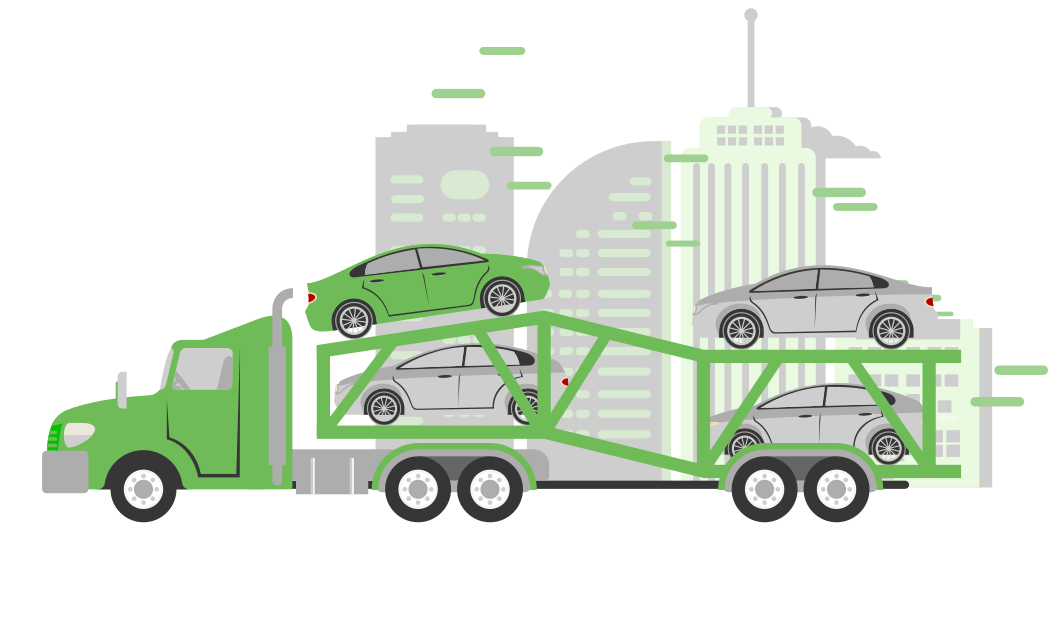
Choosing the Right Car Shipping Company for Washington to Louisiana Auto Transport
Summer snowbird reversals and fall relocation surges hit the Washington-to-Louisiana corridor hard – that is when seasonal demand spike compresses availability and pushes rates up fast. Compare The Carrier's vetted network of 100+ pre-screened transport companies keeps customers matched to companies with active runs on this lane before the crunch hits.



Prior Route Experience
Running 2,027 miles from Washington State down through Oregon, California or Idaho, and into the Gulf South means a driver navigates I-5, I-84, and I-10 across mountain passes, high-desert stretches, and Gulf Coast humidity corridors. A company unfamiliar with this lane may not account for Cascade Range weather closures in winter or the weight-station density along I-10 through Texas – both of which can add a full day to transit. An experienced company with active runs on this corridor plans dispatch around those checkpoints, routes around known congestion near Los Angeles or Houston, and adjusts pickup timing when mountain pass conditions are flagged. That operational knowledge keeps the shipment moving instead of sitting at a truck stop waiting for a reroute call. Compare The Carrier matches customers only with companies from its network who have documented experience on this specific Washington-to-Louisiana run.
Customer Reviews and Ratings
Picture a driver assigned to the Washington-to-Louisiana run who blows a tire outside Redding, California at mile 600 – one company calls the customer within the hour with an updated ETA and a rerouted dispatch plan; the other goes silent for two days. That gap is what reviews actually reveal – not star counts. For interstate hauls of this length, look specifically for mentions of communication during delays, how the company handled weather holds on I-5 or I-10, and whether the Bill of Lading inspection was completed properly at both ends. Generic five-star ratings with no route detail tell you nothing. Look for verified reviews that name the corridor, describe the driver's professionalism at pickup, and confirm the vehicle arrived in the documented condition. Compare The Carrier pre-screens every company in its network for exactly this track record before they are listed – so customers are not doing that research blind.
Pricing Transparency and Fairness
Low-ball quotes work like this: a transport company posts a load at below-market rate on the dispatch board, and every experienced driver scrolls past it because better-paying runs on I-5 or I-10 are sitting right next to it. The Washington-to-Louisiana corridor is a long-haul run with real fuel exposure – 2,027 miles through multiple states means fuel surcharges, weigh station stops, and deadhead miles factor into every legitimate quote. During peak relocation seasons – spring military PCS cycles and fall college moves – demand on this lane tightens and rates climb. A quote that looks like $700 in January may be a $1,100-$1,400 reality by April when the board fills up. Open-transport rates on this corridor typically run $1,050-$1,350 for a standard sedan. To protect yourself: get the fuel surcharge spelled out in writing before dispatch is assigned, confirm the rate is locked, and do not hand over a deposit on a quote that has no written confirmation. Use our calculator above for a real-time quote.
Say Goodbye to Car Shipping Stress with Compare The Carrier
Compare The Carrier matches customers with companies from our vetted network of 100+ transport partners, all pre-screened for reliability on the Washington-to-Louisiana lane. Gulf Coast humidity, Cascade pass weather, and seasonal relocation surges make pre-screening on this specific corridor especially important – not optional.

Say No to Hidden Fees

Save Time and Effort

Access Verified & Trusted Carriers

Wide Range of Options
How It Works
Your Simple 3-Step Vehicle Shipping Process

Get Your Free Washington to Louisiana Quotes in Seconds
Enter your Washington pickup zip, your Louisiana delivery zip, and your vehicle details – the calculator returns real-time rates in seconds, factoring in current fuel costs and the full 2,027-mile route. No estimates pulled from last quarter. No generic national averages. You see what this specific corridor costs right now, so you can make a real decision with real numbers.

We Send Your Request to the Washington to Louisiana Top-Rated Carriers
Your request goes to pre-screened, FMCSA-licensed transport companies in our network of 100+ vetted partners who have active runs on the Washington-to-Louisiana corridor – not a mass blast to unknown operators – that is active matching. Companies selected are already running loads along I-5, I-84, and I-10, which means faster pickup and rates built on real lane knowledge, not guesswork.

Compare Offers, Choose Your Carrier & Save!
Stack the quotes side by side and weigh price against transit time for the full 2,027-mile Washington-to-Louisiana haul. A rate that looks attractive today can shift if fuel prices spike or seasonal demand tightens the board next week – locking in early protects the current rate. Review each company's pickup window and delivery estimate before deciding. Use our calculator above for a real-time quote.
Average Washington to Louisiana Shipping Rates & Delivery Time
Shipping Distance
Transit time
| Origin | Destination | Average cost | Cost per mile |
|---|---|---|---|
| Seattle, WA | Monroe, LA | $909 | $0.37 |
| Spokane, WA | Bossier City, LA | $862 | $0.40 |
| Tacoma, WA | Kenner, LA | $980 | $0.37 |
| Vancouver, WA | Lake Charles, LA | $918 | $0.37 |
| Bellevue, WA | Lafayette, LA | $949 | $0.37 |
| Kent, WA | Shreveport, LA | $879 | $0.37 |
| Everett, WA | Baton Rouge, LA | $961 | $0.37 |
| Renton, WA | New Orleans, LA | $982 | $0.37 |
Origin
Seattle, WA
Destination
Monroe, LA
Average cost
$909
Cost per mile
$0.37
Origin
Spokane, WA
Destination
Bossier City, LA
Average cost
$862
Cost per mile
$0.40
Origin
Tacoma, WA
Destination
Kenner, LA
Average cost
$980
Cost per mile
$0.37
Origin
Vancouver, WA
Destination
Lake Charles, LA
Average cost
$918
Cost per mile
$0.37
Origin
Bellevue, WA
Destination
Lafayette, LA
Average cost
$949
Cost per mile
$0.37
Origin
Kent, WA
Destination
Shreveport, LA
Average cost
$879
Cost per mile
$0.37
Origin
Everett, WA
Destination
Baton Rouge, LA
Average cost
$961
Cost per mile
$0.37
Origin
Renton, WA
Destination
New Orleans, LA
Average cost
$982
Cost per mile
$0.37
*Shipping costs are estimated and based on national shipping averages, which are subject to change. For the most accurate quote, please use our calculator.
| Mileage | Average transit time | |||
|---|---|---|---|---|
| 0 - 799 Miles | 1 - 4 Days | |||
| 800 - 1499 Miles | 4 - 7 Days | |||
| 1500 - 2399 Miles | 6 - 10 Days | |||
| 2400 Miles and Up | 10 - 15 Days |
Mileage
0 - 799 Miles
Average transit time
1 - 4 Days
Mileage
800 - 1499 Miles
Average transit time
4 - 7 Days
Mileage
1500 - 2399 Miles
Average transit time
6 - 10 Days
Mileage
2400 Miles and Up
Average transit time
10 - 15 Days
*Transit times are estimated and based on national shipping averages, which are subject to change.


Ready To Ship Your Vehicle to or from Washington to Louisiana?
Looking for reliable Washington to Louisiana car shipping? We’ve got you covered with trusted carriers and competitive quotes.
Ship a Car to Louisiana with Compare The Carrier
Average Cost: $1,050-$1,350 for open transport. Estimated Delivery Time: typically 3-14 days depending on pickup location. Best Shipping Method: open transport for standard vehicles; enclosed for high-value or classic vehicles on this long-haul corridor.
The Washington-to-Louisiana run covers 2,027 miles and crosses multiple distinct geographic zones. From Seattle or Tacoma, most loads move south on I-5 through Portland and into Northern California, then pick up I-10 east through Los Angeles, Phoenix, and Houston before dropping into Louisiana via Baton Rouge or New Orleans. The Cascade Range creates real weather exposure in winter – mountain pass closures on US-2 or I-90 east of Seattle can delay dispatch by 24-48 hours. Book with a company that monitors pass conditions and adjusts pickup timing proactively rather than reacting after the delay hits.
The mid-route stretch through the Mojave Desert and West Texas adds fuel exposure that shows up in surcharges. Legitimate companies price this in upfront – if a quote skips the surcharge line entirely, ask why before signing anything. Houston metro congestion on I-10 near Katy is a known delay point; experienced companies on this lane factor in buffer time rather than promising a hard delivery date through that corridor.
Seasonal demand is a real variable on this lane. Spring military PCS cycles out of Joint Base Lewis-McChord near Tacoma and fall college moves to Louisiana universities push rates up and tighten availability. Booking 2-3 weeks ahead during those windows locks in the current rate and secures a pickup slot before the dispatch board fills. Compare The Carrier matches customers with companies from its vetted network who have active, documented runs on this full corridor.
Advantages of Shipping with Compare The Carrier for Washington to Louisiana Auto Transport
Why pay to ship when you could just drive it yourself? Run the numbers first. Washington to Louisiana is 2,027 miles – at current fuel prices that is roughly $300-$400 in gas alone for an average sedan, plus 2-3 nights in motels at $100-$150 each, meals on the road, and the wear and tear of adding two thousand miles to your odometer in a single push. By the time you land in Louisiana, you have spent close to what shipping costs – and you arrive exhausted instead of ready to move in.
For job relocations with a hard start date, that math gets sharper. A company transferring an employee to Baton Rouge or New Orleans cannot afford two days of drive time eating into the first week of work. Military PCS orders out of Joint Base Lewis-McChord give families a fixed report date with no flexibility – shipping the vehicle while flying with family is the standard solution, not a luxury. College students moving to LSU or Tulane with a car full of gear face the same equation: flying is faster, shipping is cheaper than driving solo and flying back.
Before any vehicle leaves Washington, the Bill of Lading inspection is the customer's most important protection tool. The driver and customer walk the vehicle together, document every existing scratch, dent, and chip on the inspection form, and both sign it. That signed document is the baseline record. If any damage is claimed at delivery in Louisiana, the BOL is the evidence that determines whether it happened in transit or existed before pickup. Never skip this step – it costs nothing and protects everything.
Car Shipping Services
Simplify your Washington to Louisiana car transport with Compare The Carrier. We connect customers with vetted companies from our network of 100+ pre-screened transport partners who have active runs on this specific route.
Open and Enclosed Car Shipping
For most Washington-to-Louisiana shipments, open transport is the right call. It is the industry standard, widely available across this 2,027-mile corridor, and cost-effective for daily drivers, commuter sedans, and standard SUVs. Most vehicles in this category ship in the $1,050-$1,350 range on open transport – the same method used to move the majority of vehicles across the country every day.
Enclosed shipping adds $300-$500 above open rates and provides full hard-sided protection from road debris, weather exposure, and the elements across the Mojave and Gulf Coast stretches of this route. It is worth it for high-value vehicles, classics, exotics, or modified builds where a single chip or paint scuff represents a real financial loss. If the vehicle's condition at delivery matters more than the cost difference, enclosed is the correct choice.

Door-to-Door and Terminal-to-Terminal Car Delivery
Door-to-door service picks up directly from the customer's Washington address and delivers to the Louisiana destination – no drop-off lots, no extra coordination. If an 80-foot transport truck cannot access a tight residential street in Seattle or a narrow neighborhood road in New Orleans, the driver contacts the customer and agrees on a nearby open meeting point such as a shopping center parking lot. That is standard practice on this corridor and does not affect the quoted price. The Bill of Lading inspection documents the vehicle's condition at the agreed pickup location before the truck moves.
Terminal-to-terminal saves $100-$200 compared to door-to-door but requires the customer to drop the vehicle at a designated lot in Washington and collect it from a terminal in Louisiana. Transit time may also extend slightly depending on terminal processing schedules. This option suits customers with flexible timelines, those relocating without a fixed delivery date, or cost-conscious shippers who live near an active terminal and can work around the drop-off and pickup logistics.
Expedited Car Shipping
On standard dispatch, a Washington-to-Louisiana load competes with every other run posted on the board that day. If the rate is tight or the route dips into a lower-volume stretch through the Gulf South, a driver will take the better-paying load first – and your vehicle sits unassigned, sometimes for days. Expedited service eliminates that wait with first-on, first-off priority loading, bypassing the typical 1-5 day pickup window entirely.
Expedited runs $200-$400 more than standard on this corridor. The reason is straightforward: a higher posted rate makes your load the most attractive option on the dispatch board, so companies in the network prioritize it over competing runs along I-5 and I-10. When a job start date in Baton Rouge, a military report date, or a move-in deadline makes the pickup window non-negotiable, that premium is the cost of certainty. Use our calculator above for a real-time quote.
Ready to Get Your Free Car Shipping Quotes?
Stop searching for reliable auto transport! Compare top car shipping companies and save on your vehicle transport costs. Get your free, no-obligation car hauling quotes now!
Shipping Across The Entire USA
Select needed state below for more information and carrier availability in that area
Alabama Shipping Services
Carrier Availability
4/5
Average Pickup Time
3-5 days
FAQ
How should I prepare my car for shipping from Washington State to Louisiana?
Remove personal items above 100 lbs, leave the fuel tank at 1/4 full, and photograph all pre-existing damage before pickup. Disable any aftermarket alarm, confirm the vehicle starts and drives, and provide a spare key. These steps prevent delays at the Bill of Lading inspection in Washington and protect you if any condition dispute arises at delivery in Louisiana.
What is a Bill of Lading and why does it matter when shipping a car from Washington State to Louisiana?
The Bill of Lading is the inspection form signed by both the driver and customer at pickup and again at delivery. It records your vehicle's condition before it leaves Washington and after it arrives in Louisiana. If damage is claimed at delivery, the BOL is your primary evidence. Never release your vehicle at pickup without completing and signing this document – it is your only verifiable baseline.
Why do car shipping quotes sometimes change between booking and pickup on the Washington State to Louisiana route?
Quotes shift when fuel prices spike mid-dispatch, when seasonal demand tightens the board during spring PCS cycles or fall moves, or when a low initial rate fails to attract a driver on this 2,027-mile corridor. Lock your rate by getting written confirmation with fuel surcharges included before dispatch is assigned. Compare The Carrier's vetted network minimizes repricing risk by matching customers with companies that price this lane accurately upfront.
How does expedited car shipping work from Washington State to Louisiana and is it worth the extra cost?
Expedited posts your load at a premium rate on the dispatch board, triggering first-on, first-off priority pickup and bypassing the standard 1-5 day window. On a 2,027-mile run through I-5 and I-10, that can mean the difference between a same-week pickup and waiting through a demand surge. It runs $200-$400 more than standard – worth it when a job start date, military report date, or move-in deadline makes the pickup window non-negotiable.
Can you track your car during shipping from Washington State to Louisiana, and how do you stay updated throughout transit?
Most transport companies provide a direct driver contact number at dispatch. Some use GPS tracking through their dispatch system. Ask for the driver's number at booking and request check-in updates at major state crossings – Oregon, California, Arizona or New Mexico, Texas, and into Louisiana. Compare The Carrier matches customers only with companies that maintain active communication throughout the full transit, not just at pickup and delivery.
What should you do if your car arrives damaged after shipping from Washington State to Louisiana?
Photograph all damage immediately at delivery before signing the Bill of Lading. Note every new mark on the BOL and do not release the driver until it is recorded in writing. Then file a claim with the transport company's cargo insurance using the signed BOL as your evidence. Do not accept delivery without a thorough walk-around inspection – once you sign a clean BOL, the claim window closes.
How do car shipping rates and logistics differ when crossing multiple states from Washington State to Louisiana?
The Washington-to-Louisiana route crosses five or more states, adding weigh station stops, varying weight restrictions, and road conditions ranging from Cascade mountain passes to Gulf Coast humidity. Low-volume stretches through parts of the Southwest can create dispatch board competition and limited backhaul options that affect pricing. Compare The Carrier matches customers with companies that have active, documented runs on this full corridor – not operators pricing a route they have never run.
23 May 2024
12 min video

Think you can’t afford your dream car? Think again. We’re spilling the beans on how to buy cars at auction, even if it’s your first time at the auction block.
14 August 2024
15 min read

Does looking for your next car leave you feeling like you’re in the dark? Carfax’s vehicle history reports can help…but can Carfax deliver car straight to your door?
05 April 2024
15 min read

Buying a car at the Manheim auction is a great solution for anyone who wants to buy a good car at an affordable price, while spending a minimum of nerves and time. Having bought a sedan or wagon, expensive or cheap, with a large engine capacity or a small engine capacity, the question arises: “Who to entrust the delivery of the car?” After all, many cars, despite the fact that they are in better condition than cars that are purchased at other auctions, still cannot be driven by the new owner on their own and require repair.
06 January 2023
15 min read