Washington to Colorado Car Shipping – Get Free Quotes
- Free Quotes – No Sign-Up Needed
- Compare Rates, Save Up to 30%
- Compare 100+ Vetted Providers
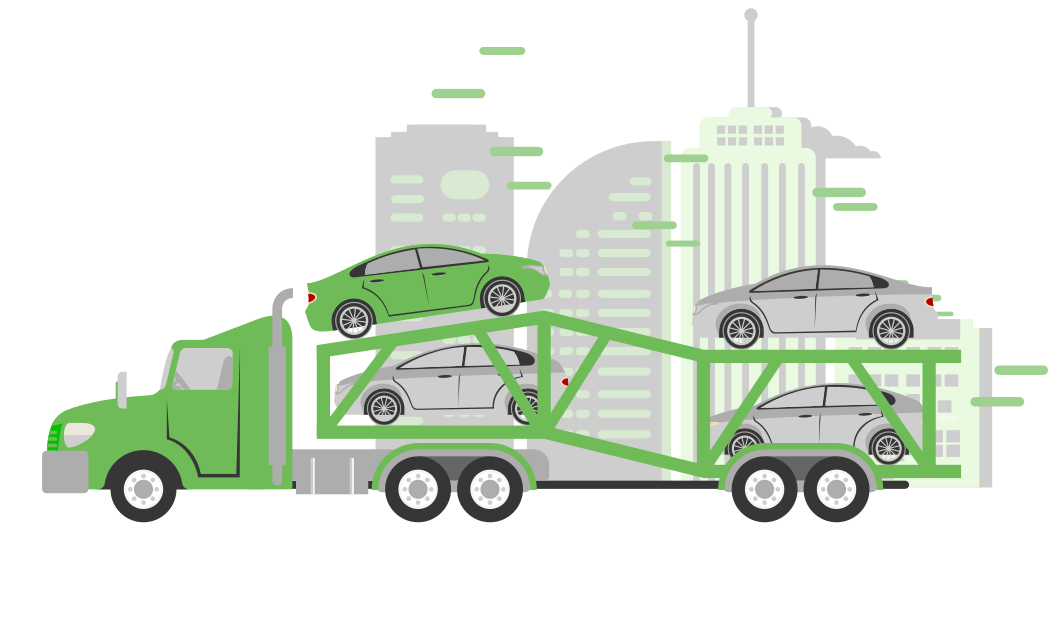
Choosing the Right Car Shipping Company for Washington to Colorado Auto Transport
Summer relocations and snowbird reversals hit the Washington-to-Colorado corridor hard every year, creating a seasonal demand spike that tightens availability and pushes rates up fast. Compare The Carrier's vetted network of 100+ pre-screened transport companies keeps options open even when the lane is congested with competing loads.



Prior Route Experience
Running I-82 east out of the Yakima Valley, then merging onto I-84 through the Columbia River Gorge before cutting south on I-15 or US-95 toward Colorado, this corridor shifts dramatically by season. Winter mountain passes – including stretches near the Blue Mountains and the Rockies approach on I-70 – can add hours or full-day delays when ice and chain controls go active. A company without active runs on this lane will misquote transit time and underestimate fuel burn through the high-elevation segments. An experienced company with scheduled runs here monitors CDOT and WSDOT road condition alerts in real time, adjusts dispatch routing before a pass closes, and communicates updates proactively. Compare The Carrier matches customers only with companies from its network who have documented experience on this specific Washington-to-Colorado corridor.
Customer Reviews and Ratings
Picture a driver assigned to your Washington-to-Colorado run who goes silent somewhere between Boise and Salt Lake City – no update, no ETA, no response to calls. That scenario separates companies fast. A reliable company calls ahead, reroutes around a closure on I-84, and contacts the customer before the delay becomes a problem. A weak operator goes quiet and leaves the customer guessing. When reading reviews for this interstate haul, look past star counts: search specifically for mentions of communication during delays, how missed pickup windows were handled, and whether the final delivery matched the quoted timeframe. One-sentence five-star reviews tell you nothing – detailed accounts of a problem and how it was resolved tell you everything. Compare The Carrier pre-screens every company in its network for exactly this track record before they are listed.
Pricing Transparency and Fairness
Low-ball quotes work like this: a transport company posts your load below the going market rate, and every experienced driver on the dispatch board skips it in favor of better-paying runs on the same corridor. Your vehicle sits unassigned – sometimes for days. The Washington-to-Colorado lane runs approximately 1,021 miles and sees strong competition for truck space during spring and summer relocation peaks, which means market rates are real and non-negotiable when demand is high. Realistic open-transport pricing on this corridor runs $950-$1,250 depending on season, vehicle size, and pickup location within Washington. A quote well below that range is not a deal – it is a load that will not move. To protect yourself, get the rate confirmed in writing with fuel surcharges itemized before dispatch is assigned, and verify the company's FMCSA operating authority before handing over a deposit. Use our calculator above for a real-time quote.
Say Goodbye to Car Shipping Stress with Compare The Carrier
Compare The Carrier matches customers with companies from our vetted network of 100+ transport partners, all pre-screened for reliability on the Washington-to-Colorado run. Summer relocation demand on this corridor spikes fast, tightening availability and pushing rates up – pre-screening means you get quotes from companies already running this lane, not operators scrambling to fill a new route.

Say No to Hidden Fees

Save Time and Effort

Access Verified & Trusted Carriers

Wide Range of Options
How It Works
Your Simple 3-Step Vehicle Shipping Process

Get Your Free Washington to Colorado Quotes in Seconds
Enter your Washington and Colorado zip codes plus vehicle details and the calculator returns real-time rates in seconds – factoring in current fuel costs, route distance across the 1,021-mile corridor, and seasonal demand on this lane. No waiting on callbacks. No estimates built on last month's fuel prices. The number you see reflects what the market is actually paying right now on this specific run.

We Send Your Request to the Washington to Colorado Top-Rated Carriers
Compare The Carrier selects from its network of 100+ vetted, FMCSA-licensed transport companies who have active, scheduled runs on the Washington-to-Colorado corridor – not a mass blast to unknown operators – that is active matching. Companies in our network know this lane: I-84 through the Columbia River Gorge, the I-15 southern cut, and the I-70 mountain approach into Colorado. Your request goes only to companies already moving loads on this route.

Compare Offers, Choose Your Carrier & Save!
Weigh each quote against the transit time estimate for the 1,021-mile Washington-to-Colorado haul – a rate that looks competitive today can shift if fuel prices spike or summer relocation demand tightens availability next week. Locking in your rate early protects you from that adjustment. Review pickup window, delivery estimate, and company credentials before deciding. Use our calculator above for a real-time quote.
Average Washington to Colorado Shipping Rates & Delivery Time
Shipping Distance
Transit time
| Origin | Destination | Average cost | Cost per mile |
|---|---|---|---|
| Seattle, WA | Westminster, CO | $707 | $0.49 |
| Spokane, WA | Arvada, CO | $613 | $0.49 |
| Tacoma, WA | Thornton, CO | $705 | $0.49 |
| Vancouver, WA | Lakewood, CO | $693 | $0.49 |
| Bellevue, WA | Fort Collins, CO | $688 | $0.49 |
| Kent, WA | Aurora, CO | $707 | $0.49 |
| Everett, WA | Colorado Springs, CO | $737 | $0.49 |
| Renton, WA | Denver, CO | $710 | $0.49 |
Origin
Seattle, WA
Destination
Westminster, CO
Average cost
$707
Cost per mile
$0.49
Origin
Spokane, WA
Destination
Arvada, CO
Average cost
$613
Cost per mile
$0.49
Origin
Tacoma, WA
Destination
Thornton, CO
Average cost
$705
Cost per mile
$0.49
Origin
Vancouver, WA
Destination
Lakewood, CO
Average cost
$693
Cost per mile
$0.49
Origin
Bellevue, WA
Destination
Fort Collins, CO
Average cost
$688
Cost per mile
$0.49
Origin
Kent, WA
Destination
Aurora, CO
Average cost
$707
Cost per mile
$0.49
Origin
Everett, WA
Destination
Colorado Springs, CO
Average cost
$737
Cost per mile
$0.49
Origin
Renton, WA
Destination
Denver, CO
Average cost
$710
Cost per mile
$0.49
*Shipping costs are estimated and based on national shipping averages, which are subject to change. For the most accurate quote, please use our calculator.
| Mileage | Average transit time | |||
|---|---|---|---|---|
| 0 - 799 Miles | 1 - 4 Days | |||
| 800 - 1499 Miles | 4 - 7 Days | |||
| 1500 - 2399 Miles | 6 - 10 Days | |||
| 2400 Miles and Up | 10 - 15 Days |
Mileage
0 - 799 Miles
Average transit time
1 - 4 Days
Mileage
800 - 1499 Miles
Average transit time
4 - 7 Days
Mileage
1500 - 2399 Miles
Average transit time
6 - 10 Days
Mileage
2400 Miles and Up
Average transit time
10 - 15 Days
*Transit times are estimated and based on national shipping averages, which are subject to change.


Ready To Ship Your Vehicle to or from Washington to Colorado?
Looking for reliable Washington to Colorado car shipping? We’ve got you covered with trusted carriers and competitive quotes.
Ship a Car to Colorado with Compare The Carrier
Average Cost: $950-$1,250 for open transport. Estimated Delivery Time: typically 3-14 days depending on pickup location. Best Shipping Method: open transport for standard vehicles; enclosed for high-value, classic, or modified vehicles on this corridor.
The Washington-to-Colorado route spans approximately 1,021 miles and runs through several distinct geographic zones that directly affect scheduling and cost. From the Seattle or Tacoma metro area, loads typically move east on I-90 over Snoqualmie Pass before connecting south toward the Columbia River Gorge on I-82 and I-84. That mountain pass segment is a known delay point – chain controls and winter closures can hold a truck for hours. Booking with a company that monitors WSDOT pass conditions in real time is not optional on this lane; it is the difference between a smooth run and a multi-day hold.
South of the Oregon border, the route transitions toward I-84 east, then picks up I-15 or US-95 heading into the Intermountain corridor before the final push into Colorado on I-70. The I-70 mountain corridor through the Rockies is one of the most weather-sensitive freight segments in the western US – closures near Eisenhower Tunnel and Vail Pass are common in winter and spring. A company without active runs on this specific corridor will not have the contingency routing experience to keep your shipment on schedule when conditions shift.
Seasonal demand is a real pricing factor here. Spring and summer relocation volume out of the Pacific Northwest drives up competition for truck space on this lane. Booking 2-3 weeks ahead during peak periods locks in the current rate and secures a pickup window before availability tightens. Compare The Carrier matches customers with pre-screened companies from our network who have documented, active runs on this full Washington-to-Colorado corridor.
Advantages of Shipping with Compare The Carrier for Washington to Colorado Auto Transport
Why pay to ship when you could drive it yourself? Run the numbers first. The Washington-to-Colorado route covers approximately 1,021 highway miles. At current fuel prices, a vehicle averaging 28 mpg burns roughly 36 gallons one-way – call it $130-$160 in fuel alone. Add one or two motel stops at $100-$150 each, meals, and the wear on brakes, tires, and drivetrain from a sustained mountain-pass run through the Cascades and Rockies, and the out-of-pocket cost closes the gap with shipping faster than most people expect.
For a job relocation with a hard start date, driving is rarely realistic. Flying back to Washington to retrieve a vehicle adds airfare and another full day of travel. Military PCS orders to a Colorado installation – Fort Carson, Buckley Space Force Base, Peterson – come with tight report dates that make a two-day solo drive a liability, not a convenience. Shipping the vehicle and flying direct keeps the timeline intact and eliminates the physical toll of back-to-back cross-country drives. College moves follow the same logic: a parent flying home from Denver after dropping off a student costs far less than two people driving two cars across the Rockies.
At pickup, the driver and customer complete a Bill of Lading inspection together – every pre-existing scratch, dent, and paint chip is documented on the form before the vehicle is loaded. Both parties sign it. At delivery, the same inspection happens. If any new damage appears, the signed BOL is the customer's primary evidence for a cargo insurance claim. Skipping or rushing this step removes that protection entirely – take the time to walk the vehicle and confirm every item is recorded accurately before signing.
Car Shipping Services
Simplify your Washington to Colorado car transport with Compare The Carrier. We connect customers with vetted companies from our network of 100+ pre-screened transport partners who have active runs on this specific route.
Open and Enclosed Car Shipping
Open transport is the industry standard for the Washington-to-Colorado corridor – cost-effective, widely available, and the right call for daily drivers, commuter sedans, and standard SUVs. Most vehicles in this category ship in the $950-$1,250 range on this route. If the vehicle runs, drives, and does not require special handling, open transport is the practical choice for the vast majority of customers on this lane.
Enclosed shipping provides full hard-sided protection from road debris, weather exposure, and the kind of mountain-pass conditions this corridor sees regularly on I-70 and Snoqualmie Pass. It runs $300-$500 more than open transport and is worth every dollar for high-value, classic, exotic, or modified vehicles where paint condition, body integrity, and mechanical protection are non-negotiable. If the vehicle's value or condition makes road exposure a real risk, enclosed is the right call.

Door-to-Door and Terminal-to-Terminal Car Delivery
Door-to-door service picks up directly from the customer's Washington address and delivers to the Colorado destination – no intermediate stops, no lot drop-offs. If an 80-foot transport truck cannot access a tight residential street in Seattle, Tacoma, or a Denver suburb, the driver coordinates a nearby open meeting point such as a shopping center or wide parking lot. That adjustment is standard practice and does not affect the quoted price. The Bill of Lading inspection documents the vehicle's condition at pickup, regardless of where the agreed meeting point is located.
Terminal-to-terminal shipping saves $100-$200 compared to door-to-door but requires the customer to drop off the vehicle at a designated lot in Washington and collect it at a terminal location in Colorado. Transit time may also be slightly longer due to terminal scheduling. This option works best for customers with flexible timelines, no strict delivery deadline, and the ability to arrange their own transportation to and from the terminal lots on both ends.

Expedited Car Shipping
On standard dispatch, your load competes with every other shipment posted on the board for the same corridor. If the rate is tight or the route runs through a low-volume segment between Washington and Colorado, a driver will take a better-paying load first – and your pickup window slips by days. Expedited service eliminates that wait with first-on, first-off priority loading, bypassing the typical 1-5 day standard pickup window entirely.
Expedited runs $200-$400 more than standard shipping on this corridor. The reason is straightforward: a higher posted rate makes your load the most attractive option on the dispatch board, so companies in the network prioritize it over competing runs on the same Washington-to-Colorado lane. When a move-in date, job start, military report date, or college arrival deadline makes the pickup window non-negotiable, the premium is justified. Use our calculator above for a real-time quote.
Ready to Get Your Free Car Shipping Quotes?
Stop searching for reliable auto transport! Compare top car shipping companies and save on your vehicle transport costs. Get your free, no-obligation car hauling quotes now!
Shipping Across The Entire USA
Select needed state below for more information and carrier availability in that area
Alabama Shipping Services
Carrier Availability
4/5
Average Pickup Time
3-5 days
FAQ
What is the difference between open and enclosed transport when shipping a car from Washington to Colorado?
Open transport is the industry standard for most Washington-to-Colorado shipments – cost-effective, widely available, and runs $950-$1,250 for most sedans and SUVs on this route. Enclosed adds $300-$500 and is the right call for high-value, classic, or modified vehicles where road debris exposure or mountain-pass weather conditions on I-70 or Snoqualmie Pass present a real risk to paint and body condition. Use our calculator above for a real-time quote.
How does seasonal demand affect car shipping prices on the Washington to Colorado route?
Spring and summer relocation volume out of the Pacific Northwest drives up competition for truck space on this lane, pushing rates higher and tightening pickup availability fast. The reverse snowbird migration in spring adds further pressure. During peak periods, rates can climb $150-$300 above off-season pricing. Book 2-3 weeks ahead during spring and summer to lock in the current rate before availability tightens on this corridor.
Can you ship a non-running or inoperable car from Washington to Colorado?
Yes – but it requires a transport company equipped with a winch and hydraulic lift gate to load the vehicle safely. The vehicle must be disclosed as non-operational at the time of booking, not at pickup. Expect a surcharge of $150-$300 above standard open-transport rates. Confirm the company has handled inoperable vehicles on the Washington-to-Colorado corridor specifically before committing to a booking.
What is the difference between door-to-door and terminal-to-terminal shipping from Washington to Colorado?
Door-to-door picks up and delivers directly to your addresses in both states – the standard choice for most customers on this 1,021-mile run. If an 80-foot truck cannot access a tight street, the driver arranges a nearby open lot at no extra charge. Terminal-to-terminal saves $100-$200 but requires drop-off and pickup at designated lots on each end. Best for flexible schedules where cost matters more than convenience.
How do you verify a transport company is legitimate before booking a shipment from Washington to Colorado?
Check the company's FMCSA operating authority at safer.fmcsa.dot.gov using their MC or DOT number. Confirm active cargo insurance by requesting a certificate of insurance directly – do not accept verbal confirmation. Review verified Google ratings and FMCSA complaint history for this specific corridor. Compare The Carrier pre-screens every company in its network for active authority, insurance, and reliability track record before listing them.
Can you cancel a car shipping order after booking from Washington to Colorado?
Most transport companies allow cancellation before a driver is assigned with no penalty. Once a driver is dispatched on the Washington-to-Colorado run, cancellation fees typically range from $100-$200. Always read the cancellation terms in full before paying a deposit and get the policy confirmed in writing from your matched company. Do not assume a verbal cancellation policy is enforceable.
How much deposit is required to book car shipping from Washington to Colorado and when is the balance due?
Most transport companies collect a deposit of $100-$200 at booking, with the remaining balance paid in cash or certified funds directly to the driver at delivery. Never pay the full amount upfront – that is a recognized red flag for transport scams on long-haul routes like this one. Compare The Carrier's network includes only companies with transparent, standard deposit practices confirmed during the pre-screening process.
23 May 2024
12 min video

Think you can’t afford your dream car? Think again. We’re spilling the beans on how to buy cars at auction, even if it’s your first time at the auction block.
14 August 2024
15 min read

Does looking for your next car leave you feeling like you’re in the dark? Carfax’s vehicle history reports can help…but can Carfax deliver car straight to your door?
05 April 2024
15 min read

Buying a car at the Manheim auction is a great solution for anyone who wants to buy a good car at an affordable price, while spending a minimum of nerves and time. Having bought a sedan or wagon, expensive or cheap, with a large engine capacity or a small engine capacity, the question arises: “Who to entrust the delivery of the car?” After all, many cars, despite the fact that they are in better condition than cars that are purchased at other auctions, still cannot be driven by the new owner on their own and require repair.
06 January 2023
15 min read