

Tow Dolly vs. Car Hauler: Which Transport Method Is Better?
Let's be honest for a second. The process of moving a car...
16 February 2026
Using a GPS tracker when shipping a car allows you to monitor your vehicle’s real-time location during auto transport. While most carriers provide only manual status updates, a personal device offers 24/7 visibility via a mobile app, significantly improving auto transport safety and peace of mind during long-distance moves or cross-country relocation.
Calculate Shipping Quotes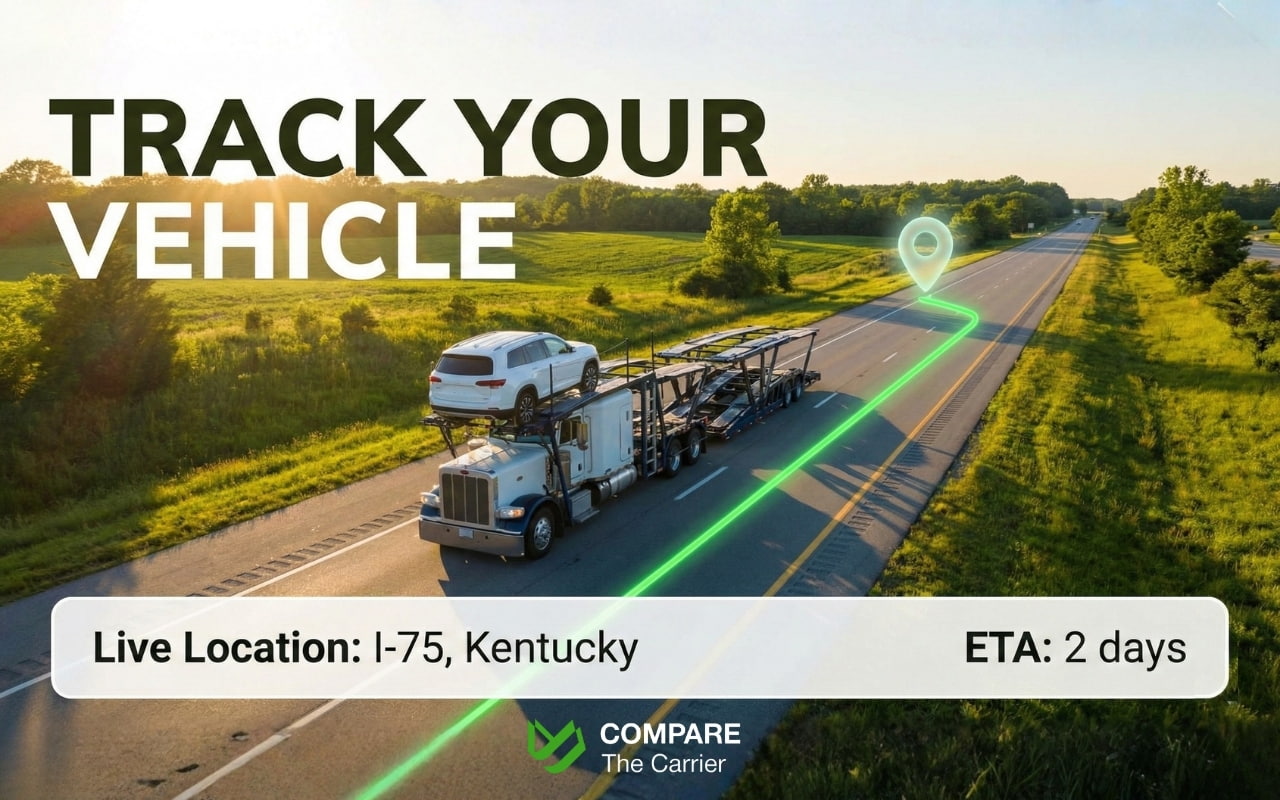
I’ve been there. You arrange transportation, receive a pickup window, sign the papers, and then you wait. Most carriers only provide broad pickup and delivery windows, leaving you in the dark for days. If you’re lucky, the driver might call you when they’re an hour away. That information gap is where personal tracking makes sense, it replaces infrequent phone calls with direct control. To avoid unnecessary stress, you can also get your free checklist to ensure everything is ready before delivery day.
Most auto transport companies do not offer true GPS tracking. What they call “tracking” in their marketing materials is usually manual status updates, not live location access.
To understand why, you have to look at how the industry works. The difference between brokers and carriers confuses a lot of people, but it’s the main reason why live data is so hard to get. If you want to skip the confusion, it’s better to start using Compare the Carrier to find vetted professionals.
First, you have brokers. Brokers don’t own the trucks. They connect you with a carrier and handle the paperwork. When you ask them for an update, they usually have to contact the driver or the carrier’s dispatch and then pass that update to you. It’s a manual, multi-step process.
Now, carriers are the ones who actually move your vehicle. Some larger carriers use internal fleet management systems to monitor their trucks, but that data rarely gets shared with customers in real time. Before booking, you can use an auto transport calculator to see how tracking features might affect your total cost.
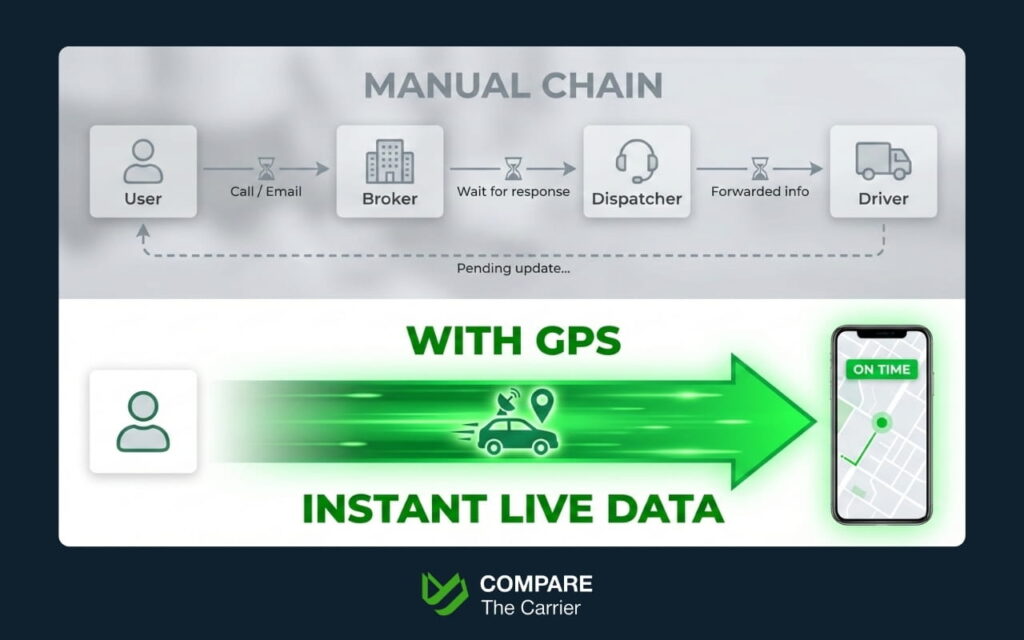
Tracking usually just means driver check-ins 99% of the time. You might receive notifications from dispatch similar to:
That’s not the same as opening an app and watching the truck move on a map. If you expect 24/7 visibility where you can track your car during shipping through a map link, that’s uncommon unless the company specifically advertises customer-facing GPS access. Even then, access is often restricted. Comprehending this distinction is vital for auto transport safety and managing your expectations.
Using a device like a BrickHouse Security GPS tracker gives you direct, real-time access to your vehicle’s location. People choose this option when they want control, proof, and added security beyond basic carrier updates.
I’ve seen this most often with long-distance car shipping. When your vehicle is traveling 800, 1,500, or even 2,000 miles, waiting for a phone call update doesn’t feel like enough. You want to see the progress without guessing.
Real-time location: you just open an application and see the exact location. Forget the dispatch call. No waiting on a driver to respond. Just clarity. It’s also used for trip confirmation. If the truck is supposed to be going west, but you see it move the other way, you can inquire then, instead of after a lag.
Sudden delays happen due to weather, traffic, breakdowns. When you can see the stop yourself, it reduces stress because you understand what’s happening. Furthermore, during layovers, especially overnight stops at lots or rest areas, theft prevention becomes a real concern. A hidden tracker gives you an extra layer of awareness; if the vehicle moves without notice, you’ll know immediately.
Yes, it is legal to put a GPS tracker in your own vehicle. You have the fundamental right to monitor property that you own. However, there are some professional courtesies and safety rules to follow.
If you plan to use a tracker, I still recommend informing the transport company. You don’t need their permission, but transparency avoids confusion. If a driver notices a blinking device or a wire they didn’t see before, they might think it’s a mechanical issue or a security risk to their truck.
The Golden Rule: The tracker must not interfere with driver operations. Don’t attach anything near pedals, steering components, or wiring that controls the vehicle’s essential functions. A small magnetic tracker placed discreetly inside the car or connected safely to the OBD2 port works perfectly without breaking any rules.
If you’re considering this step, you generally have two main options. Each works differently, and the right one depends on distance and how you prefer to monitor your shipment.
An OBD2 GPS tracker plugs directly into the diagnostic port under your dashboard. Every car built after 1996 has this port, usually near the driver’s seat.
A magnetic battery-powered tracker is a self-contained unit that hides inside the vehicle. You can place it under a seat, in the trunk, or attach it to a metal surface.
Yes, it works as long as there is cellular coverage. These devices receive coordinates from satellites via the Global Positioning System (GPS) but use LTE or 4G networks to send that data to your phone.
The good part is that updates resume automatically once the device reconnects to a mobile network. You don’t need to reset anything; the tracker simply picks up where it left off.
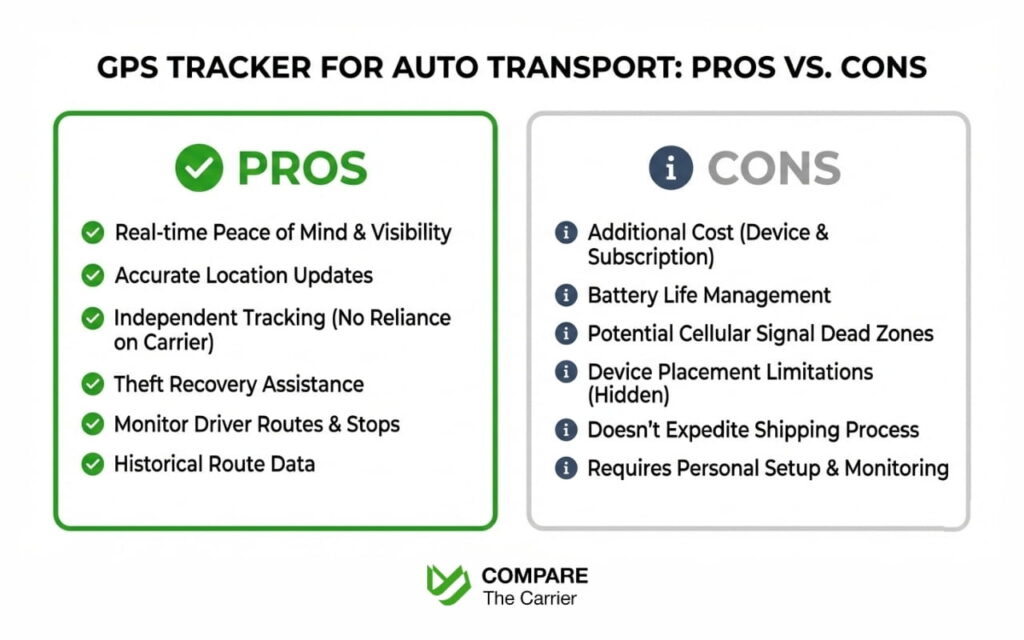
Before you buy a device, it helps to compare the benefits against the practical trade-offs.
It’s sensible when distance, value, or timing are enough to raise the stakes. Tracking is overkill for a simple move across town, but for a 2,000-mile trip, it’s a vital safety tool for auto transport.
You might skip the tracker if:
A GPS tracker, when shipping a car, is an effective tool for anyone prioritizing visibility and peace of mind. For long-distance moves and high-value vehicles, it provides an independent layer of security. Before you start, use our auto transport calculator to get an accurate estimate for your shipment.
Most auto transport companies do not offer real-time GPS access. Instead, they provide manual status updates via dispatch or driver check-ins. Brokers must contact carriers to relay information, which often results in delays. If you require 24/7 visibility on a live map, using a personal GPS tracking device is the only reliable method to monitor your vehicle’s exact location independently throughout the journey.
It is legal and common practice to place a GPS tracker in a vehicle you own. While you do not need the carrier’s permission, informing the driver is a recommended professional courtesy to avoid confusion during inspections. Ensure the device is securely attached and does not interfere with the vehicle’s pedals or steering. This measure adds an essential layer of security during long-distance transport.
The ideal location depends on the device type. OBD2 trackers plug directly into the diagnostic port under the dashboard for constant power. For magnetic or battery-powered units, place them under a seat, inside the glovebox, or within the trunk to balance discretion with signal strength. Avoid the engine bay, as extreme heat and heavy metal shielding can damage the device or block GPS signals.
Most high-sensitivity GPS trackers function inside enclosed trailers, though metal walls may weaken cellular signals. Expect intermittent updates or minor accuracy drops compared to open-air transport. The device typically reconnects and updates its position as the truck moves through areas with strong cellular coverage. For maximum reliability in shielded environments, use a tracker with a high-gain antenna designed to penetrate metal structures.
To track a vehicle in transit to a dealership, use the Vehicle Identification Number (VIN). Most manufacturers provide owner portals where customers can monitor production and shipping progress in real time. If a third-party logistics provider handles the car, obtain the Bill of Lading (BOL) number. This document allows you to check status updates directly through the carrier’s tracking system or their dispatch office.
The primary drawbacks of GPS-based tracking are ongoing monthly subscription fees for data plans and the requirement to keep an eye on the battery status for mobile devices. Signal reliability is also reliant on cellular coverage alone. In some rural areas, in tunnels, or in the center of large concrete buildings, trackers can sometimes go into temporary “blind spots,” which will result in the location updates being temporarily interrupted until the tracker reconnects to an LTE or 4G signal.








Don't have time to fill out the form?
Call a transport company directly to get a quote now!
Select the category you need
Partner with Compare The Carrier & Grow!
We're open to collaborations, partnerships, and mutual growth! Whether you're an individual or a business, we offer exciting opportunities to work together. Fill out the form below to explore how we can collaborate.
Something Went Wrong
We're sorry, but something went wrong. Please briefly describe the problem you experienced in the text area below. Providing your contact information will allow us to follow up if needed.

Thank you,
your form has been accepted.
Your form has been successfully submitted. We appreciate your effort — our team will review it shortly and take the next steps.


