

Top 10 States With the Cheapest Used Cars in 2026
In an era when used-car prices can fluctuate by over $5,0...
27 January 2026
While the world watches the lights go out on a Sunday afternoon, a much larger, more complex race has already been running for weeks. It’s the invisible marathon of moving ten teams, twenty cars, and nearly 1,500 tons of equipment across five continents. In practice, the logistics of Formula 1 is widely considered the most sophisticated supply chain operation on the planet. If a team misses a flight or a shipping container gets stuck in customs, it’s not just a delay it’s a catastrophic failure that can cost millions in sponsorship and championship points.
Calculate Shipping Quotes
How does Formula 1 transport its cars and equipment around the world?
Formula 1 utilizes a tri-modal logistics system involving specialized road transporters for European rounds, chartered Boeing 747-8F cargo aircraft for international flyaway races, and a five-set sea freight rotation for heavy assets. Each team ships two race cars, a spare chassis, and 1,500 tons of components in custom modular flight cases. This synchronized operation ensures all technical equipment arrives on schedule across 24 global venues.
From a practitioner’s point of view, F1 logistics is a masterclass in risk management and synchronization. Imagine moving a mid-sized factory every two weeks, ensuring that every single nut, bolt, and high-performance sensor arrives in a desert or a crowded city center exactly when needed. It’s worth noting that not every transportation company handles this level of pressure. While your average state-to-state car towing service handles valuable assets with care, F1 logistics works with a precision that borders on the obsessive.
In this deep dive, we’ll explore the “three-pillar” strategy that keeps the sport moving, the staggering costs involved, and how the teams manage to beat the clock every single time. Whether you’re a fan of the engineering or someone curious about how world-class transport works, this is the story of the race behind the race.
Formula 1 is not dependent on any one way of travelling. Instead, they employ an expertly balanced tri-modal approach. Cost-effectiveness, speed, and necessity of the item are evaluated for each method.
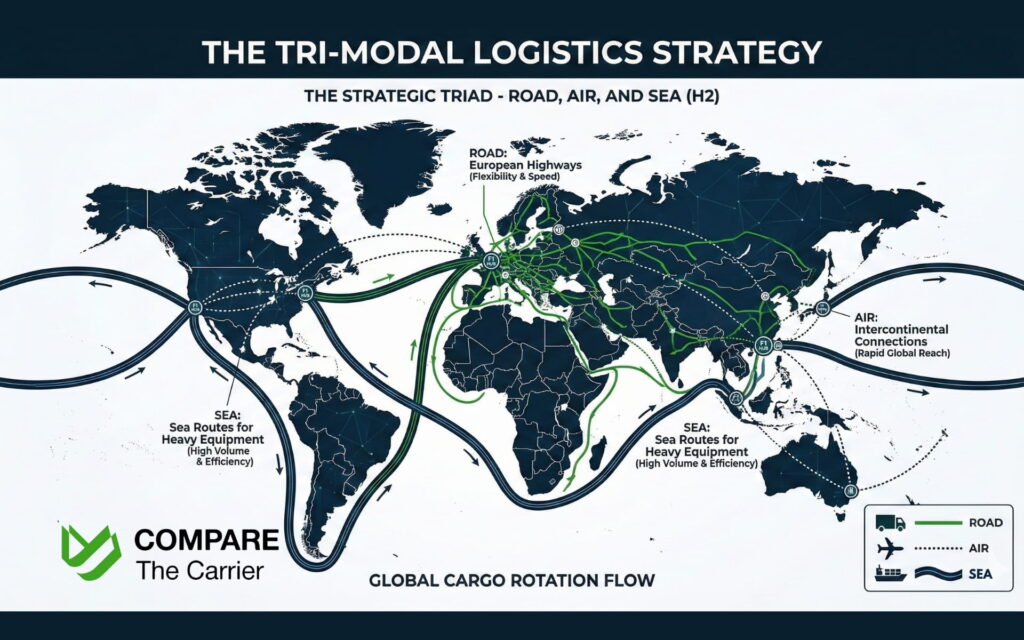
During the European leg of the season, legendary tracks like Spa-Francorchamps, Silverstone, and Monaco, road transport is king. This is when the “F1 Circus” truly looks like a circus, but convoys of specialized trucks stretch for miles.
When the F1 calendar moves to “flyaway” races in countries like Australia, Japan, or the Americas the logistics strategy goes to the sky. This is the most expensive and stressful aspect of the season.
Formula 1 Management (FOM) charters a fleet of Boeing 747-8F and 777F cargo planes. These planes are effectively “giant puzzles” where each centimeter of space is calculated. Cars are stripped bare to the chassis level, stacked into custom aluminum flight cases. From a buyer’s point of view, air freight is the ‘Premium’ option. A single team usually carries around 50 tons of air freight per race. Cars, pit wall computers, any last-minute upgrades fresh from the factory: Those are all included.
If you’ve ever considered overseas auto transport, you know what a struggle international shipping can be simply multiply that figure by twenty cars and slap on a demanding 48 hours to deal with an inflexible deadline.
If air freight is about speed, sea freight is about staying alive at the budget limit. Teams don’t ship their most expensive components by sea, but they send the “heavy” stuff. It is the “rotation” system. Teams have five or six identical sets of sea freight kits rather than one set of garage gear. These kits include:
One set is being used at the track in Miami, another is on a ship heading to Singapore, and a third is being refurbished at the factory, either in the UK or Italy. This would require a level of thinking that would have most logistics managers spinning their heads.
The race doesn’t end when the driver takes the checkered flag. For the logistics crew, the race begins the moment the car enters the Parc Fermé. The goal? To have everything packed and on a plane or truck within six to eight hours.

First, the car is stripped. The fragile carbon-fiber bodywork is removed and inspected for damage. The front and rear wings are placed in specialized vertical racks within foam-lined flight cases.
The engine and gearbox are detached from the chassis. These are high-value, high-risk items. They are shipped in vibration-isolated crates that monitor temperature and G-forces. It’s worth noting that not every team handles this exactly the same way, but the industry standard is to treat these components with more care than a museum artifact.
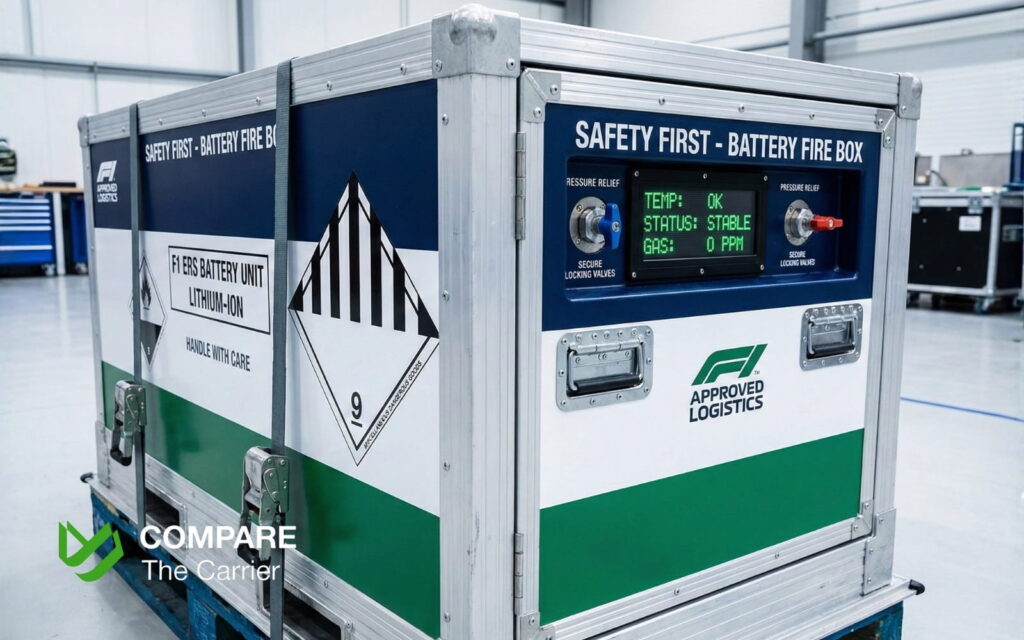
As the world shifts toward shipping electric vehicles, F1 has already been dealing with the complexities of high-output hybrid batteries for years. These lithium-ion units are classified as Class 9 Hazardous Materials. They require specialized pressure-stable containers and constant monitoring. If a battery is damaged in a crash, it is isolated in a “fire box” for transport to ensure it doesn’t pose a risk to the cargo plane or ship.
In the old days, a team with the most money could simply blow the budget off competitors’ logistics budgets flying some pieces on private jets at the last minute. These days, every dollar used towards transportation is also another dollar spent away from a superpowered car.
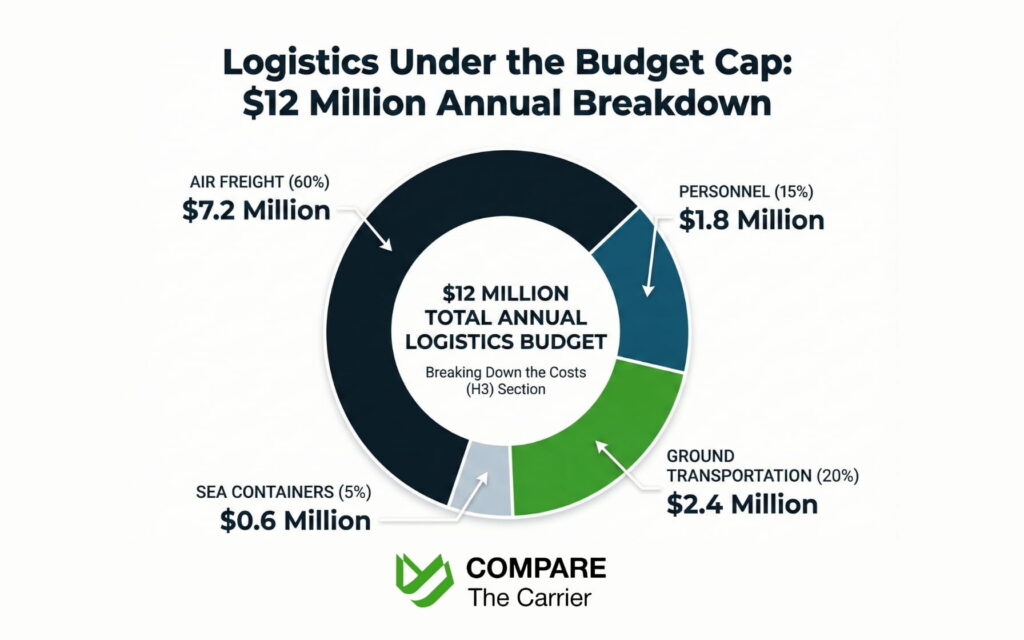
Logistics cost about 10% of a top team’s annual budget. Here is a rough breakdown of where that $10 to $12 million is going:
Even if you are a luxury car owner, these prices are staggering. But even if a private buyer is seeking just a top 25 car shipping company to ship your car to, you can see how specialized handling increases the cost. In F1, there’s no space you’re simply paying for; you’re paying for the guaranteed date of arrival.
One of F1’s major headaches in logistics isn’t the actual moving it’s the paperwork. It’s a legal nightmare crossing borders with millions and millions of dollars in proprietary technology. To manage this, teams apply an ATA Carnet, called a “Passport for Goods.”
This document enables them to bring these autos and equipment into the country without paying import tariffs. But perfect inventory is crucial. And if the team enters with 5,000 components and leaves with 4,999 (possibly because its part got smashed in a car accident), they must show proof to customs officials, lest they get millions of dollars in fines. Countries such as Brazil, Mexico, and China have been notoriously difficult to navigate. Teams often dispatch, weeks before the race, “advance parties” of logistics experts to these ports to avoid “red tape” and prevent the race from being stopped.
While the drivers get the glory, the logistics crew works the longest hours. For a typical flyaway race, the “build crew” arrives at the track on Monday or Tuesday before the race. They work 12-hour shifts to turn an empty concrete garage into a high-tech laboratory.
After the race on Sunday, these same people work through the night to pack everything back up. By the time the driver is back at their hotel, the car is already in a crate, and the team is heading to the airport for the next destination. It is a grueling lifestyle that requires immense physical and mental stamina.
Formula 1 has pledged to be Net Zero Carbon by 2030. Since logistics is the largest contributor to the sport’s carbon footprint, this is where the most innovation is happening.
Most will never have to send a $15 million chassis to Singapore, but F1’s values can apply quite naturally to our lives. Your needs do not look different whether shipping across the country or purchasing a car at auction; the basics of safe transportation stay the same.
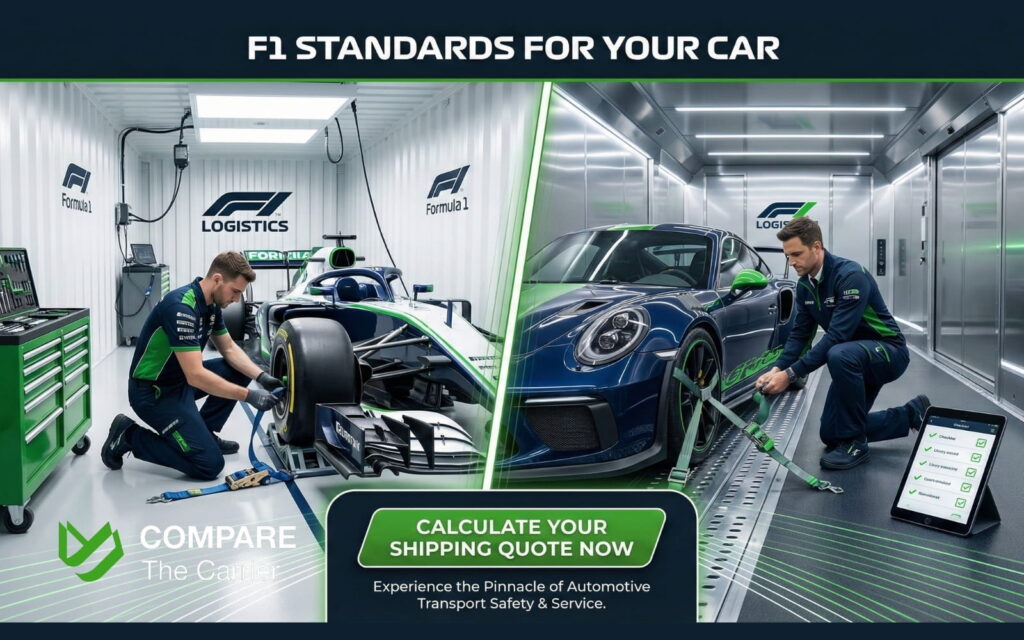
Formula 1 has been called a circus – but that’s just the tip of the iceberg, as it is a beautifully tuned machine where everything from the driver to the truck driver needs to function together perfectly and ideally. The mechanics of the sport speak volumes – an example of human creative, resourceful craftsmanship and relentless quest for efficiency.
And as the game heads toward a more sustainable, regionally focused future, how the “Invisible Race” will play out will be no less spectacular. The next time you’ve watched a car dive into the opening corner, stop and think of the thousands of miles it has traveled, of the hundreds of people who have touched it, and of the intricate web of air, sea, and road transport that made this instant one to remember.
Would you want to receive the same kind of care in your own car? We can help you with finding your partner, whether it is a cross-country move or an international shipment. Now take advantage of our auto transport cost calculator to instantly get an accurate estimate and take your start on the logistics journey today.
F1 operates with a tri-modal logistics approach: specialist road transporters for the European rounds, chartered Boeing 747-8F cargo planes for international flyaway races, and a five-set sea freight rotation for heavy equipment. All the technical equipment is packaged in standard modular flight cases, which allow teams to maximize cargo volume and enable rapid assembly at multiple venues around the world.
F1 teams ship two complete race cars plus one spare chassis to each Grand Prix. In addition to the main cars, they also bring a full load of modular parts such as wings, gearboxes, and suspension kits that can be used to build a third car at the race venue. This reserve is maintained to ensure the vehicle is technically ready if a primary vehicle is destroyed in a high-impact crash.
Drivers and team principals travel on private jets or by first-class commercial flight to mitigate the physical strain of a 24-race global calendar. This logistics approach allows for precise control over sleep schedules and circadian timing. Jet lag is a crucial element of performance, and the drivers must have the reaction times and physical stamina necessary for top-level racing to be able to race.
DHL, Formula 1’s official logistics partner, manages the movement of more than 2,000 tons of equipment per race. They mainly use chartered Boeing 747-8F and 777F freighters to transport cars and FOM broadcasting equipment globally. This dedicated air bridge guarantees that all high-technical value assets and television infrastructure reach the circuit on a synchronized worldwide timeline.
F1 power units are sent in bespoke containers which are climate-controlled and vibration-isolated to avoid internal damage. These are tracked in real-time via GPS and have data loggers that record temperature and G-force. Engines are usually the last things loaded onto aircraft and the first to be offloaded, ensuring the shortest time in transit and the highest level of security for these valuable components.
Private collectors can access F1-level logistics through premium, door-to-door enclosed vehicle transport. These services utilize specialized trailers featuring climate control, soft-tie systems, and hydraulic lift gates to protect exotic cars from road debris and weather. This method emulates the professional standards used by racing teams, providing a secure, temperature-regulated environment for high-value assets during long-distance transit.










Don't have time to fill out the form?
Call a transport company directly to get a quote now!
Select the category you need
Partner with Compare The Carrier & Grow!
We're open to collaborations, partnerships, and mutual growth! Whether you're an individual or a business, we offer exciting opportunities to work together. Fill out the form below to explore how we can collaborate.
Something Went Wrong
We're sorry, but something went wrong. Please briefly describe the problem you experienced in the text area below. Providing your contact information will allow us to follow up if needed.

Thank you,
your form has been accepted.
Your form has been successfully submitted. We appreciate your effort — our team will review it shortly and take the next steps.


