SEO Strategies to Rank #1 in Auto Transport

Tired of watching your competitors hijack the best car shipping leads? It’s time to stop trailing behind and start dominating the search results.

Contact Us Now
SEO Strategies to Rank #1 in Auto Transport

In 2026, the digital landscape for auto transport has shifted. It’s no longer just about “ranking for keywords”, it’s about capturing the high-intent traffic that Google and AI-driven search engines prioritize. Recent data shows that the top three search results now command nearly 75% of all clicks, leaving the rest of the industry to fight over the crumbs. For auto transport firms, being invisible on page one isn’t just a missed opportunity; it’s a direct hit to your bottom line.

At Compare The Carrier Digital Agency, we don’t believe in generic marketing. We specialize in Digital Marketing Strategy for Logistics Companies, focusing on the technical nuances that actually move the needle in the car shipping niche. We understand that your business relies on high-quality, high-converting leads, not just vanity metrics.

This guide is a deep dive into proven, field-tested SEO Strategy & Execution specifically for the auto transport industry. From technical foundations to AI-ready content, we’ll show you how to outmaneuver the competition, secure the #1 spot, and turn search visibility into scalable business growth.

Decoding Auto Transport SEO
Common SEO Challenges for Auto Transport Companies
Fueling Your Online Engine: Effective SEO Strategies for Auto Transport
Tracking SEO Success and Making Adjustments
Conclusion
FAQ

Decoding Auto Transport SEO

In the digital age, your website is often the first impression a potential customer has of your auto transport business. Think of it as your virtual storefront.

Would you let your physical storefront be hidden down a dark alley with no signage?

Of course not!

The same principle applies online. SEO strategies act as your online signage, guiding customers directly to your services.

Without a strong online presence, your company risks getting lost in the sea of competitors. To avoid this, it’s essential to implement effective online marketing strategies for logistics, such as optimizing your website, creating valuable content, and building a strong backlink profile.

Effective auto transport SEO ensures your website appears prominently in search results when potential customers look for services like yours.
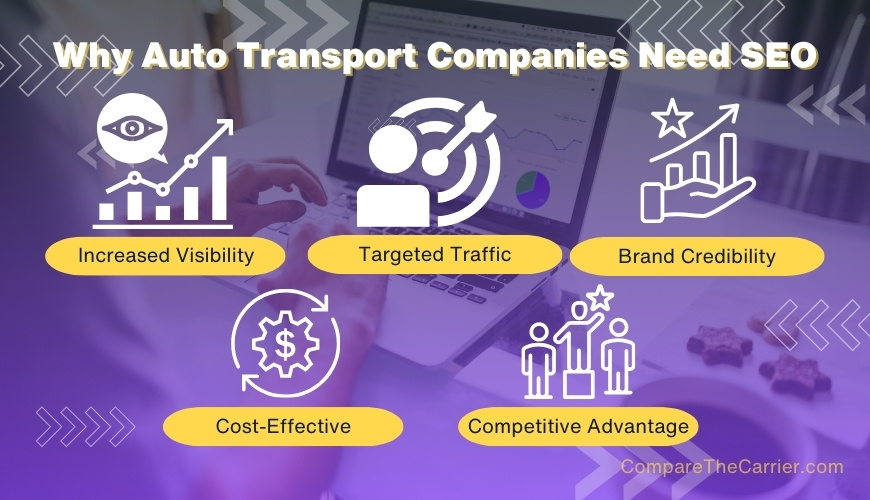
why auto transport SEO is crucial for companies

Here’s why SEO is crucial for auto transport companies:

Increased Visibility: Higher search engine rankings mean more eyes on your business. When someone searches for “car shipping from California to Florida,” you want your company to be among the top results.
Targeted Traffic: SEO helps you attract qualified leads – people who are actively looking for the services you offer. This is far more effective than traditional advertising, which often casts a wide net and reaches many people who aren’t interested in your services. For those seeking alternatives to traditional methods, exploring how to generate free vehicle shipping leads can be a game-changer.
Brand Credibility: Appearing on the first page of search results instantly boosts your credibility. Customers tend to trust businesses that rank highly, associating them with quality and reliability.
Cost-Effectiveness: Compared to paid advertising, SEO offers a more sustainable and cost-effective way to attract customers. While it requires an initial investment of time and resources, the long-term benefits far outweigh the costs.
Competitive Edge: In a crowded marketplace, SEO can give you a significant edge over your competitors. By outranking them in search results, you capture more leads and secure a larger market share. However, it’s essential to be selective about your partnerships. Learn about the worst auto transport leads providers to avoid making costly mistakes.

Common SEO Challenges in the Auto Transport Industry

Navigating search algorithms in 2026 requires overcoming specific industry hurdles:

Hyper-Local Competition: Shipping routes (e.g., NY to FL) are highly contested. Success requires a granular approach to local SEO.
User Experience (UX): Search engines now prioritize “page experience” as a core ranking factor. A clunky site will kill your rankings. Improving your Logistics Branding & Design is often the first step to reducing bounce rates.
Mobile-First Indexing: Most shipping leads are generated via mobile devices. If your site isn’t optimized for thumb-navigation and speed, you’ve already lost.

By understanding these challenges and implementing effective SEO strategies, you can overcome these hurdles and achieve sustainable online growth for your auto transport business.

Fueling Your Online Engine: Effective SEO Strategies for Auto Transport

Think of SEO as the fuel that powers your auto transport company’s online presence. Just as a well-maintained engine needs the right fuel to perform optimally, your website needs effective SEO strategies to reach its full potential and drive business growth.
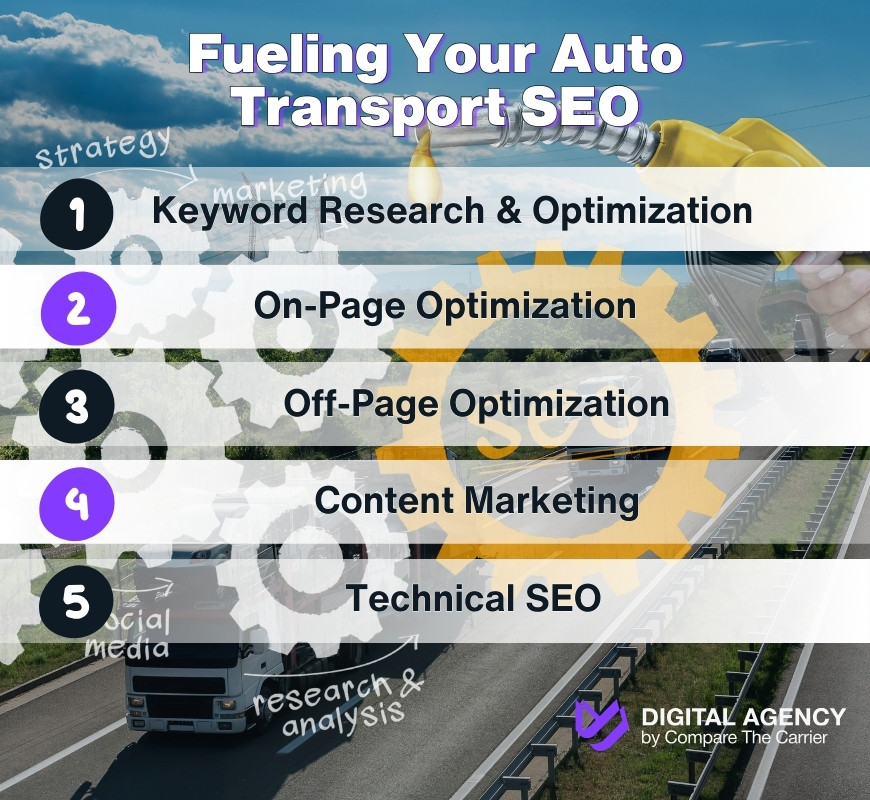
Effective SEO Strategies for Auto Transport

1. Keyword Research and Optimization

Keywords are the foundation of any successful SEO strategy. They’re the words and phrases potential customers use when searching for auto transport services online. Effective keyword research and optimization involve:

Identifying High-Value Keywords: Utilize keyword research tools like Google Keyword Planner, SEMrush, or Ahrefs to identify relevant keywords with high search volume and low competition. For example, “car shipping,” “auto transport,” “vehicle relocation,” and “motorcycle transport” are broad keywords in the auto transport industry. For a deeper dive into keyword strategies specifically for logistics companies, check out our guide on supercharging your brokerage marketing.
Targeting Long-Tail Keywords: Focus on long-tail keywords, which are longer and more specific phrases that target niche audiences. These keywords often have lower search volume but higher conversion rates. Examples include “classic car shipping from Los Angeles to Miami,” “military vehicle transport services,” and “oversize vehicle shipping.” Our agency can help identify and effectively target valuable long-tail keywords that help you rank higher.
Analyzing Competitor Keywords: See what keywords your competitors are ranking for and identify opportunities to outrank them. Tools like SpyFu can help you uncover your competitors’ keyword strategies.

2. On-Page Optimization Techniques

On-page optimization refers to optimizing the content and structure of your website to improve its visibility in search results.

Key elements include: 

Optimizing Title Tags and Meta Descriptions: Craft compelling title tags (concisely summarizing the page’s content) and meta descriptions (briefly describing the page) that accurately reflect your page content and entice users to click. These elements appear in search results and play a crucial role in attracting clicks.
Effective Use of Header Tags: Structure your content with header tags (H1, H2, etc.) to improve readability and highlight important information. Header tags not only make your content more user-friendly but also help search engines understand the hierarchy and relevance of your information.
Image Optimization: Use descriptive file names and alt text for images to improve accessibility and help search engines understand their content. Optimized images can also contribute to faster page loading speeds, a crucial factor for SEO.

We can help you optimize your website content, structure, and technical elements for improved search engine visibility.

3. Off-Page Optimization Strategies

Off-page optimization focuses on building your website’s authority and reputation through external signals. This involves:

Building High-Quality Backlinks: Earn backlinks from reputable websites in the automotive and logistics industries. Backlinks act as votes of confidence from other websites, signaling to search engines that your content is valuable and trustworthy. Guest blogging, participating in industry forums, and creating shareable content can help you attract valuable backlinks and establish your company as a thought leader. For more expert tips and strategies on building industry authority, read our article on securing those crucial first clients for your logistics business.
Leveraging Google My Business: Claim and optimize your Google My Business profile to improve your local SEO and appear in Google Maps searches. Ensure your profile is complete and accurate, including your business name, address, phone number, website, hours of operation, and customer reviews.
Social Media Engagement: Establish a presence on relevant social media platforms and share engaging content to connect with potential customers and build brand awareness. Social media signals can indirectly influence your SEO by driving traffic to your website and increasing brand visibility.

To further enhance your online presence, consider how to promote your business in the transport industry using a multi-faceted approach. 

4. Content Marketing for Auto Transport

Content marketing plays a vital role in attracting and engaging your target audience. Create valuable and informative content that addresses their needs and questions. This could include: 

Blog posts about car shipping tips: Offer practical advice on preparing vehicles for transport, choosing the right auto transport method, and understanding insurance options.
Articles about different transport methods: Explain the differences between open, enclosed, and expedited transport, highlighting the benefits and drawbacks of each.
Videos showcasing your services: Provide visual demonstrations of your loading and unloading procedures, customer testimonials, and behind-the-scenes glimpses of your operations.
Infographics on auto transport statistics: Present interesting data on car shipping trends, popular routes, and seasonal demand. For example, you could highlight that in 2023, the snowbird season saw a 30% increase in auto transport requests from the Northeast to Florida.

To get a head start on your content strategy, download our free logistics marketing plan.

5. Technical SEO for Auto Transport Websites

Technical SEO ensures your website is technically sound and easily accessible to both users and search engines. Key aspects include:

Mobile Optimization: With the majority of internet users accessing websites on mobile devices, a mobile-responsive website is crucial. Google prioritizes mobile-first indexing, meaning your site’s mobile version primarily influences its search rankings. Ensure your website is mobile-friendly and optimized for search engines with our WordPress web design solutions for shipping businesses.
Website Security: Use HTTPS to secure your website and protect user data. HTTPS is a ranking signal, and it builds trust with your visitors.
Schema Markup: Implement schema markup to help search engines understand the content on your website and display it more effectively in search results. Schema markup uses structured data to provide context to your content, improving its visibility and click-through rates.

After implementing these effective SEO strategies, you might feel like you’re explaining futuristic concepts to someone still stuck in the past.

explaining futuristic concepts to someone still stuck in the past

Check out how AI is actually transforming the logistics world, and fuel your online engine and drive your auto transport business towards greater success.

Tracking SEO Success and Making Adjustments

Implementing SEO strategies is like setting your auto transport business on a cross-country journey.

You’ve mapped out the route (your keyword strategy), fueled up the vehicle (your website), and hit the road (launched your optimized content). But how do you know if you’re on the right track and making progress toward your destination (top search rankings)?

That’s where tracking and analysis come in. Understanding key shipping KPIs can significantly impact your revenue growth.

Measuring Your SEO Performance

Just like a GPS helps you navigate your road trip, SEO tracking tools provide valuable data to monitor your progress and make necessary adjustments. Here are key metrics to track:
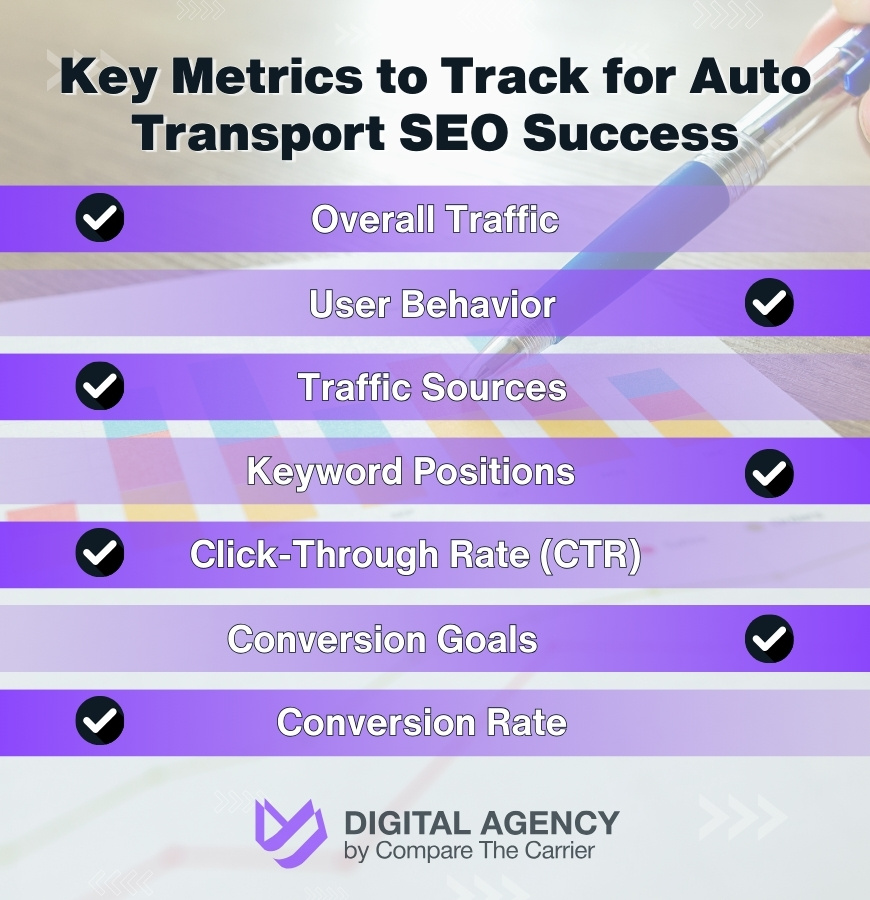
SEO tracking

Website Traffic:

Monitor overall traffic: Use tools like Google Analytics to track the number of visitors coming to your site, where they’re coming from (search engines, social media, referrals), and which pages they’re viewing.
Analyze user behavior: Pay attention to metrics like bounce rate (the percentage of visitors who leave your site after viewing only one page) and average session duration (the average time visitors spend on your site) to understand how users are interacting with your content.
Identify traffic sources: Determine which channels are driving the most traffic to your website, whether it’s organic search, paid advertising, social media, or referrals.

Keyword Rankings:

Track keyword positions: Monitor your website’s ranking positions for your target keywords in search results. Tools like Google Search Console can help you see which keywords are driving traffic to your site and identify opportunities to improve your rankings.
Analyze keyword performance: Track the click-through rate (CTR) for your keywords to see how often people are clicking on your website in search results.

Conversions:

Define your conversion goals: Determine what actions you want visitors to take on your website, whether it’s filling out a contact form, requesting a quote, or making a booking.
Track conversion rates: Monitor how many website visitors are converting into leads or customers. This will help you measure the effectiveness of your SEO efforts and identify areas for improvement to maximize ROI on your logistics leads.

Making Data-Driven Adjustments

Tracking your SEO performance is only half the battle. The real power lies in using that data to make informed decisions and optimize your strategy. Here’s how:

Analyze your data: Regularly review your website traffic, keyword rankings, and conversion data to identify trends and areas for improvement. Our agency uses a data-driven approach to track your SEO performance and make informed adjustments to your strategy.
Identify what’s working: Pinpoint the SEO strategies that are driving the most traffic and conversions.
Address areas for improvement: If your website is ranking poorly for certain keywords, or if your bounce rate is high, investigate the reasons and make necessary adjustments.
Experiment with new tactics: Don’t be afraid to try new SEO techniques and track their impact on your performance.
Stay updated with SEO best practices: The world of SEO is constantly evolving. Stay informed about the latest algorithm updates and best practices to ensure your strategy remains effective.

Remember, SEO is not a one-time fix; it’s an ongoing process of continuous improvement. By consistently tracking your performance, analyzing your data, and making data-driven adjustments, you can ensure your auto transport business stays ahead of the curve and achieves long-term online success.

Conclusion

auto transport SEO strategies

So, what’s the next stop for your auto transport company? Imagine zooming past the competition and capturing the top spot on Google’s results page it’s not just a dream. With the right mix of SEO strategies you’ve just uncovered, from meticulously chosen keywords to compelling, user-focused content, your path to digital dominance is clearer than ever.

Embrace the journey; it’s time to shift gears and accelerate your online presence. Let every blog post, backlink, and SEO tweak drive you closer to where you deserve to be right in front of your future customers. And if you ever feel like you’re navigating tricky territory, remember that Compare The Carrier Digital Agency is ready with a roadmap and the support to help you thrive. Together, let’s put your company in the fast lane and race towards that #1 ranking with confidence!

FAQ

How can I verify if my auto transport website is mobile-friendly?

In 2026, mobile-friendliness is assessed via Google’s Search Console under the “Core Web Vitals” report. A truly mobile-optimized site features responsive design, fast-loading images, and touch-ready buttons. Testing across various screen resolutions is essential, as Google uses mobile-first indexing, meaning the mobile version of your site determines your primary search ranking.

What is the process for listing an auto transport business on Google Maps?

To appear in Google Maps, you must claim and verify a Google Business Profile. Accurate NAP (Name, Address, Phone) data is critical. Businesses must select relevant categories like “Auto Transport Service,” upload high-resolution photos of their fleet, and actively manage customer reviews. Local map rankings are heavily influenced by proximity, review score, and profile completeness.

How frequently should logistics content be updated for optimal SEO?

Content freshness is a significant ranking signal in 2026. High-performing pages should be reviewed every 3 to 6 months to ensure data, regulations, and keywords remain current. Regularly publishing new blog posts at least twice monthly prevents “content decay.” This consistency signals to search engines that the website is an active, authoritative source of industry information.

How does a content marketing strategy improve shipping lead generation?

Content marketing builds top-of-funnel awareness by answering specific customer questions. By publishing guides on “Enclosed vs. Open Transport” or “Shipping Insurance Needs,” a company captures users early in their decision-making journey. This establishes trust and authority, making the user significantly more likely to request a quote when they reach the final stage of the sales funnel.

What is the typical timeline for seeing results from an SEO campaign?

SEO is a long-term investment. While technical fixes can show minor improvements within weeks, significant movement in competitive auto transport keywords typically takes 4 to 9 months. This duration allows search engines to crawl new content, index backlinks, and establish the website’s authority. Consistent optimization leads to sustainable, compounding growth in organic traffic and lead volume.

How is the ROI of auto transport SEO accurately measured?

ROI is calculated by comparing the lifetime value of customers acquired through organic search against the total SEO spend. Key metrics include organic conversion rate, total lead volume, and average cost per lead. Utilizing advanced analytics tools allows businesses to attribute specific quote requests to organic landing pages, providing a clear picture of how SEO impacts the bottom line.

Review us on Trustpilot
3.7 3 votes
Article Rating
Subscribe
Notify of
guest
0 Comments
Oldest
Newest Most Voted
Inline Feedbacks
View all comments

Pass It Along!

If you found this article useful, share it with your friends