Texas to Utah Car Shipping – Get Free Quotes
- Free Quotes – No Sign-Up Needed
- Compare Rates, Save Up to 30%
- Compare 100+ Vetted Providers

Choosing the Right Car Shipping Company for Texas to Utah Auto Transport
The Texas to Utah corridor spans 923 miles with real dispatch board gaps – fewer transport companies run this inland route compared to coastal lanes, and that company scarcity means unassigned loads can sit for days. Compare The Carrier's vetted network of 100+ pre-screened transport companies fills that gap by matching customers with partners who have active, confirmed runs on this specific corridor.



Prior Route Experience
Running the Texas to Utah corridor means dealing with I-10 to I-20 through West Texas, then transitioning onto I-15 north through the desert Southwest – a stretch where summer heat regularly exceeds 110°F and can affect vehicle fluids and tire pressure on open-transport loads. A company without active runs on this lane may not account for mandatory rest stops near El Paso or the elevation shift climbing into Utah's Wasatch Front, where winter ice and canyon grades on I-15 near Provo demand route-specific judgment. Companies unfamiliar with this corridor tend to underestimate transit time and miss delivery windows when weather or weigh station backups hit near the Utah-Nevada border. An experienced company with documented runs on this route knows where to stage, which rest areas accommodate 80-foot trucks, and how to reroute through US-6 if I-15 backs up near Salt Lake City. Compare The Carrier matches customers only with companies from its network who have proven, active experience on this specific Texas to Utah lane.
Customer Reviews and Ratings
Picture this: a transport truck breaks down outside Lubbock on the Texas to Utah run, and the customer's vehicle is sitting on the trailer with no update for 36 hours. One company calls within the hour, coordinates a contingency dispatch from its network, and keeps the delivery window intact – the other goes silent until the customer calls repeatedly. That gap is what reviews actually reveal – not star counts. For interstate hauls on this corridor, look specifically for reviews that mention communication during delays, whether the driver provided updates at state crossings, and how the company handled rescheduling when weather or mechanical issues hit. Generic five-star ratings with no route detail are not useful. Look for verified reviews naming this lane, the pickup city, or conditions specific to the Southwest desert stretch. Compare The Carrier pre-screens every company in its network for this track record – communication standards, dispatch responsiveness, and documented performance on long-haul inland routes – before they are ever listed as a match.
Pricing Transparency and Fairness
Low-ball quotes work like this: a transport company posts a load at below-market rates, and every experienced driver on the dispatch board skips it in favor of better-paying runs on the same board. Your vehicle sits unassigned – sometimes for days. The Texas to Utah corridor is a moderate-volume inland lane, not a high-frequency coastal route, which means fewer companies are running it at any given time. That limited supply gives drivers leverage to pass on underpriced loads entirely. Realistic open-transport rates on this corridor run $900-$1,200 for a standard sedan, depending on season, fuel surcharges, and exact pickup location within Texas. To protect yourself from a price adjustment at pickup, get the full quote in writing before dispatch is assigned, confirm that fuel surcharges are included, and verify the rate covers door-to-door service to your Utah destination. Never accept a verbal rate adjustment at the truck without a written amendment. Use our calculator above for a real-time quote.
Say Goodbye to Car Shipping Stress with Compare The Carrier
Compare The Carrier matches customers with companies from our vetted network of 100+ transport partners, all pre-screened for reliability on the Texas to Utah route. Summer heat across the West Texas and desert Southwest stretch of I-10 and I-15 creates real logistical pressure – pre-screening companies for this corridor means your shipment goes to a partner who already knows the route, not one learning it on your load.

Say No to Hidden Fees

Save Time and Effort

Access Verified & Trusted Carriers

Wide Range of Options
How It Works
Your Simple 3-Step Vehicle Shipping Process

Get Your Free Texas to Utah Quotes in Seconds
Enter your Texas origin zip, Utah destination zip, and vehicle details – the calculator returns real-time rates in seconds, factoring in current fuel costs and route-specific variables for the 923-mile Texas to Utah corridor. No estimates pulled from outdated averages. The numbers reflect what companies in our network are actively quoting on this lane right now, giving you an accurate market baseline before you commit to anything.

We Send Your Request to the Texas to Utah Top-Rated Carriers
Your request goes directly to pre-screened, FMCSA-licensed transport companies in our network of 100+ vetted partners who have active runs on the Texas to Utah corridor – not a mass blast to unknown operators – that is active matching. These are companies with documented dispatch history on I-10, I-20, and I-15 through the Southwest, not operators picking up a new lane for the first time. Every company in the match set has already cleared our reliability and compliance screening before your request reaches them.

Compare Offers, Choose Your Carrier & Save!
Review each quote against the stated transit time for the 923-mile Texas to Utah run. A rate that looks attractive but comes with a vague pickup window can cost more in delays than the savings are worth. Fuel price swings and seasonal demand on this inland corridor can shift rates week to week – locking in your quote early protects the current rate before the board tightens. Use our calculator above for a real-time quote.
Average Texas to Utah Shipping Rates & Delivery Time
Shipping Distance
Transit time
| Origin | Destination | Average cost | Cost per mile |
|---|---|---|---|
| San Antonio, TX | St. George, UT | $881 | $0.37 |
| Dallas, TX | Ogden, UT | $711 | $0.49 |
| Austin, TX | Sandy, UT | $734 | $0.49 |
| Fort Worth, TX | Orem, UT | $678 | $0.49 |
| El Paso, TX | West Jordan, UT | $570 | $0.52 |
| Arlington, TX | Provo, UT | $683 | $0.49 |
| Corpus Christi, TX | Salt Lake City, UT | $701 | $0.40 |
Origin
San Antonio, TX
Destination
St. George, UT
Average cost
$881
Cost per mile
$0.37
Origin
Dallas, TX
Destination
Ogden, UT
Average cost
$711
Cost per mile
$0.49
Origin
Austin, TX
Destination
Sandy, UT
Average cost
$734
Cost per mile
$0.49
Origin
Fort Worth, TX
Destination
Orem, UT
Average cost
$678
Cost per mile
$0.49
Origin
El Paso, TX
Destination
West Jordan, UT
Average cost
$570
Cost per mile
$0.52
Origin
Arlington, TX
Destination
Provo, UT
Average cost
$683
Cost per mile
$0.49
Origin
Corpus Christi, TX
Destination
Salt Lake City, UT
Average cost
$701
Cost per mile
$0.40
*Shipping costs are estimated and based on national shipping averages, which are subject to change. For the most accurate quote, please use our calculator.
| Mileage | Average transit time | |||
|---|---|---|---|---|
| 0 - 799 Miles | 1 - 4 Days | |||
| 800 - 1499 Miles | 4 - 7 Days | |||
| 1500 - 2399 Miles | 6 - 10 Days | |||
| 2400 Miles and Up | 10 - 15 Days |
Mileage
0 - 799 Miles
Average transit time
1 - 4 Days
Mileage
800 - 1499 Miles
Average transit time
4 - 7 Days
Mileage
1500 - 2399 Miles
Average transit time
6 - 10 Days
Mileage
2400 Miles and Up
Average transit time
10 - 15 Days
*Transit times are estimated and based on national shipping averages, which are subject to change.


Ready To Ship Your Vehicle to or from Texas to Utah?
Looking for reliable Texas to Utah car shipping? We’ve got you covered with trusted carriers and competitive quotes.
Ship a Car to Utah with Compare The Carrier
Average Cost: $900-$1,200 for open transport. Estimated Delivery Time: typically 3-14 days depending on pickup location. Best Shipping Method: open transport for standard vehicles; enclosed for high-value, classic, or modified vehicles on this desert Southwest corridor.
The primary routing on the Texas to Utah lane runs I-20 west out of Dallas-Fort Worth or I-10 west from San Antonio and Houston, connecting to I-25 north through New Mexico and then I-15 into Salt Lake City and Provo. Companies staging out of major Texas metros – Dallas, Houston, San Antonio – generally have better dispatch board access than those originating from smaller West Texas cities like Midland or Amarillo, where load volume is thinner and pickup windows can stretch. If your origin is in a lower-density Texas market, factor in an extra 2-3 days for a driver to reach your location before the Utah leg even begins.
The desert stretch through New Mexico and southern Utah is the corridor's biggest weather and mechanical variable. Summer temperatures between El Paso and St. George regularly exceed 110°F, which affects tire pressure and fluid levels on open-transport loads. Winter brings the opposite problem: I-15 through the Wasatch Front near Provo and Salt Lake City can close or slow significantly due to ice and snow between November and March. Companies with active runs on this lane know to stage ahead of those windows and carry chains for the Utah mountain approach. Book with a company that has documented experience on this specific route, not one that treats it as a one-off haul.
Backhaul dynamics also affect pricing on this corridor. Texas generates strong outbound volume, but Utah return loads are thinner, which means companies price the Texas-to-Utah direction competitively to fill trucks heading northwest. That works in the customer's favor on rate – but it also means fewer companies are actively running the lane at any given time. Compare The Carrier's network matches customers with partners who have confirmed, scheduled runs on this corridor, reducing the risk of a load sitting unassigned while a driver waits for a better-paying run to fill the board.
Advantages of Shipping with Compare The Carrier for Texas to Utah Auto Transport
Why pay to ship when you could drive the 923 miles from Texas to Utah yourself? Run the numbers first. Fuel alone at current prices runs $120-$160 for a standard sedan on this route. Add one or two motel stops at $80-$120 per night, meals on the road, and the accelerated wear on brakes, tires, and suspension crossing the West Texas desert and Utah canyon grades – the out-of-pocket cost climbs past $400 before you factor in your time. Shipping a standard vehicle on open transport for $900-$1,200 starts looking like a straightforward trade-off, not a luxury.
For job relocations and military PCS moves, the math tilts further toward shipping. A new employer's start date does not flex because you needed three days to drive across the Southwest. A military report date is non-negotiable. Flying to your destination and having your vehicle delivered within the transit window keeps both timelines intact. College moves and snowbird seasonal migrations follow the same logic – one person flying is cheaper and faster than two people driving, and the vehicle arrives in the same condition it left in rather than absorbing 900-plus highway miles in summer heat.
The Bill of Lading inspection at pickup is the practical protection tool that makes shipping a documented transaction rather than a handshake deal. The driver and customer walk the vehicle together, record every pre-existing scratch, dent, and chip, and both sign the form before the truck moves. At delivery in Utah, the same inspection happens. If new damage appears, the signed BOL is the customer's primary evidence for a cargo insurance claim. Without it, there is no baseline to compare against – and no recourse.
Car Shipping Services
Simplify your Texas to Utah car transport with Compare The Carrier. We connect customers with vetted companies from our network of 100+ pre-screened transport partners who have active, confirmed runs on this specific route.
Open and Enclosed Car Shipping
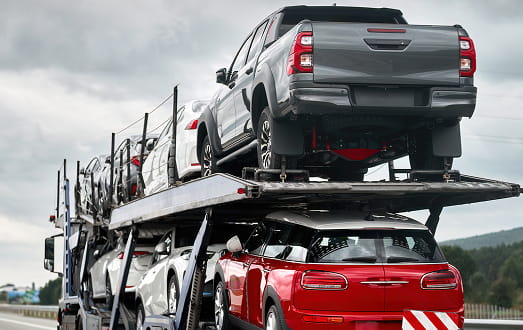
Open transport is the industry standard for the Texas to Utah route – cost-effective, widely available, and the right call for daily drivers, commuter sedans, and standard SUVs. Most vehicles in this category ship in the $900-$1,200 range on this corridor. The load rides on an open multi-vehicle trailer, which is how the majority of vehicles move across the country without issue.
Enclosed shipping provides full hard-sided protection from road debris, blowing sand, and the temperature swings common on the desert Southwest stretch of this route. It typically runs $300-$500 more than open transport and is worth every dollar for high-value, classic, exotic, or modified vehicles where paint condition, body panels, and custom finishes cannot absorb road exposure. If the vehicle's appearance affects its value or you would file a claim over a rock chip, enclosed is the right call.

Door-to-Door and Terminal-to-Terminal Car Delivery
Door-to-door service picks up directly from your Texas address and delivers to your Utah destination – the standard choice for most customers on this corridor. If an 80-foot transport truck cannot access a tight residential street in either state, the driver coordinates a nearby open meeting point such as a shopping center or wide parking lot. This is standard practice and does not affect the quoted price. The Bill of Lading inspection documents the vehicle's condition at pickup before the truck moves.
Terminal-to-terminal saves $100-$200 compared to door-to-door but requires the customer to drop off the vehicle at a designated lot in Texas and collect it at a terminal location in Utah. This option works best for customers with a flexible timeline who are not on a tight delivery deadline – or for shippers who want to reduce cost and can work around the terminal's operating hours and location. It is not the right fit if your Utah delivery address is time-sensitive.

Expedited Car Shipping
On standard dispatch, a load on the Texas to Utah corridor competes with every other run posted to the board at the same time. If the rate is tight or the route dips into a deadhead zone between West Texas and the Utah state line, a driver will pass on it in favor of a better-paying load. That is how a standard pickup window stretches from 1-5 days into a week or more. Expedited service eliminates that wait by posting the load at a premium rate with first-on, first-off priority loading – your vehicle moves before competing runs on the same board.
Expedited shipping runs $200-$400 more than standard on this corridor. The reason is mechanical: a higher posted rate makes your load the most attractive option on the dispatch board, so companies in the network prioritize it over other Texas to Utah runs competing for the same driver. When a job start date, military report date, or move-in deadline makes the pickup window non-negotiable, that premium is a direct cost of keeping your schedule intact. Use our calculator above for a real-time quote.
Ready to Get Your Free Car Shipping Quotes?
Stop searching for reliable auto transport! Compare top car shipping companies and save on your vehicle transport costs. Get your free, no-obligation car hauling quotes now!
Shipping Across The Entire USA
Select needed state below for more information and carrier availability in that area
Alabama Shipping Services
Carrier Availability
4/5
Average Pickup Time
3-5 days
FAQ
What is the total cost of shipping a car from Texas to Utah?
Open-transport rates on the Texas to Utah corridor typically run $900-$1,200 for a standard sedan. Final cost shifts based on fuel surcharges, seasonal demand on this inland Southwest lane, exact pickup location within Texas, and vehicle size. Enclosed transport adds $300-$500 above open rates. Use our calculator above for a real-time quote.
How long does car shipping take from Texas to Utah?
Transit on the 923-mile Texas to Utah route typically takes 3-14 days depending on pickup location and season. DOT driving hour limits cap most drivers near 500 miles per day, so the drive time alone runs 2-3 days. Pickup windows in lower-volume West Texas markets like Midland or El Paso can add 2-3 days before the Utah leg begins.
What insurance coverage applies when shipping a car from Texas to Utah?
The transport company's cargo insurance covers your vehicle during transit on the Texas to Utah run. Before booking, request the company's certificate of insurance directly, verify the coverage limit against your vehicle's value, and check whether your personal auto policy provides any supplemental coverage for transport. Compare The Carrier's network only includes companies with active, verified cargo coverage.
Can I ship personal belongings inside my car from Texas to Utah?
A strict 100 lb limit applies to items left in the trunk under DOT weight scale rules. Exceeding that limit can trigger a delay at a weigh station on I-10 or I-15 or void the transport company's liability coverage for the vehicle itself. Keep the interior clear of loose items and stay within the weight threshold to avoid complications at pickup or in transit.
Is it better to use a quote-matching platform or book directly with a single transport company for the Texas to Utah route, given the limited number of companies running this inland corridor?
Compare The Carrier's network of 100+ pre-screened transport companies gives customers access to multiple active runs on the Texas to Utah corridor at once. Booking a single company directly means relying on that one company having a scheduled run to Utah – if they do not, your load waits. The platform result: faster pickup, competitive rates, and companies already vetted for reliability on this specific inland lane.
How does pickup and delivery actually work when shipping a car from Texas to Utah, especially in areas like West Texas with rural roads and wide-open terrain far from major interstates?
An 80-foot transport truck cannot always access tight residential streets or remote rural addresses in either state. The standard solution: driver and customer agree in advance on a nearby open lot – a shopping center, truck stop, or wide parking area works well in West Texas and Utah metro areas alike. This is routine, costs nothing extra, and the Bill of Lading inspection happens on the spot at the agreed location.
What is the most reliable way to ship a car from Texas to Utah, given the desert heat and limited transport company availability on this inland Southwest corridor?
Compare The Carrier is an active quote-matching platform that connects customers with vetted, FMCSA-licensed transport companies from a network of 100+ pre-screened partners with documented runs on the Texas to Utah lane. Unlike booking a single company directly or using a standard broker, every match comes from companies already screened for reliability on this specific corridor. Get a free quote using the calculator above.
23 May 2024
12 min video

Think you can’t afford your dream car? Think again. We’re spilling the beans on how to buy cars at auction, even if it’s your first time at the auction block.
14 August 2024
15 min read

Does looking for your next car leave you feeling like you’re in the dark? Carfax’s vehicle history reports can help…but can Carfax deliver car straight to your door?
05 April 2024
15 min read

Buying a car at the Manheim auction is a great solution for anyone who wants to buy a good car at an affordable price, while spending a minimum of nerves and time. Having bought a sedan or wagon, expensive or cheap, with a large engine capacity or a small engine capacity, the question arises: “Who to entrust the delivery of the car?” After all, many cars, despite the fact that they are in better condition than cars that are purchased at other auctions, still cannot be driven by the new owner on their own and require repair.
06 January 2023
15 min read