

Where Is It Cheapest to Buy a Car? States That Save Buyers the Most
Buying a car is one of the most significant financial dec...
10 March 2026
To ship a car to college safely and affordably in 2026, students should book an open-carrier transport at least 4–6 weeks before the semester starts, verify the carrier’s FMCSA license, and arrange a meeting point near campus boundaries to avoid narrow dorm-zone streets. Costs typically range from $600 for regional moves to $1,400+ for cross-country trips, with many providers offering 5–10% student discounts. Preparing the vehicle involves cleaning it for inspection, removing all valuables, and maintaining a quarter-tank of fuel for safety.
Calculate Shipping Quotes
Whether you’re heading to a university across the state or shipping a car cross-country for college, professional auto transport removes one of the biggest logistical headaches of move-in season. Instead of adding 1,500+ miles of wear to your vehicle – or arriving on campus exhausted from a multi-day drive – you can fly ahead, settle into your dorm, and have your car waiting for you at a pre-arranged meeting point near campus. For most students, the cost of shipping is comparable to gas, hotels, and food for a long drive, with none of the risk.
This guide covers everything you need to know: how much car shipping to college actually costs in 2026, how to vet a carrier so you don’t get scammed, and exactly how to time your booking around the semester calendar. If you already know your route and want a number right now, you can get a free quote in under 60 seconds – otherwise, read on to make sure you’re choosing the right service for your situation.
Heading off to college is a rite of passage, but the 1,500-mile drive from your front door to your dorm room isn’t always “a cinematic road trip” as it’s made out to be. More students – and their parents – are turning to professional auto transport in 2026 with fluctuating fuel prices and the sheer density of highway traffic.
Let’s be real: You have better things to do with your time than stare at a highway for three days, like finishing that orientation paperwork and saying goodbye to friends from your hometown. Shipping your car isn’t just a “luxury” move anymore; it also makes sense when you want to save your car from unnecessary mileage and spare yourself the exhaustion of a cross-country haul before classes get underway.
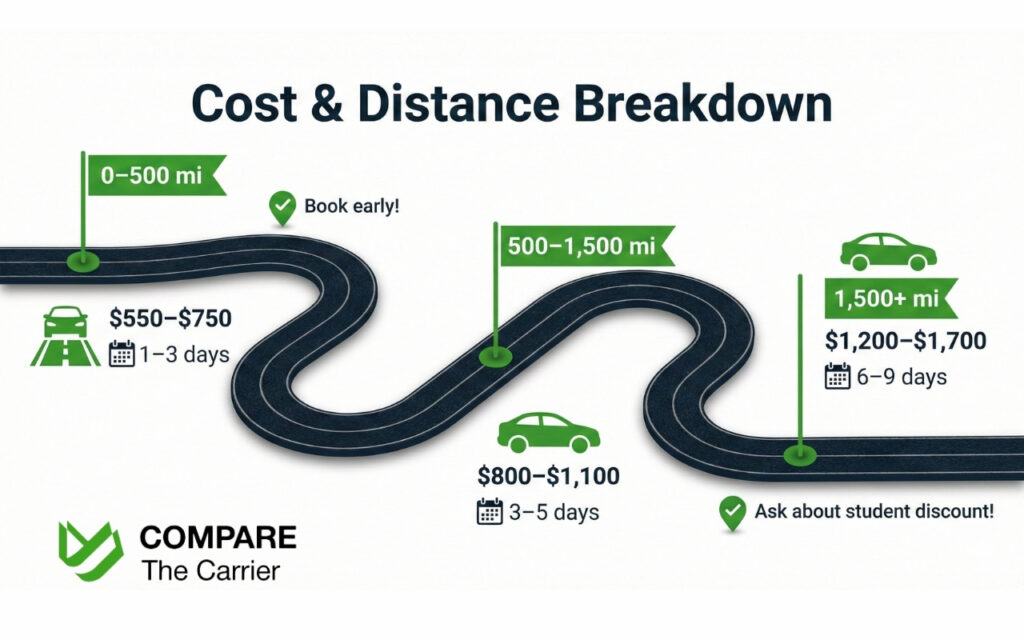
When you’re already looking at tuition bills and meal plans, the cost of shipping a car needs to make sense. It’s not just one flat fee; it’s a calculation based on how much space your car takes up and how far it’s going.
In 2026, the industry has shifted toward more transparent, real-time pricing, but the core factors remain the same:
| Distance | Estimated Cost (Open Carrier) | Estimated Timeline |
| Short (0–500 miles) | $550 – $750 | 1–3 Days |
| Medium (500–1,500 miles) | $800 – $1,100 | 3–5 Days |
| Long (1,500+ miles) | $1,200 – $1,700 | 6–9 Days |
Pro Tip: Always ask about the “Student Discount.” Many brokers won’t advertise it on their landing page, but if you mention your .edu email address or show a student ID during the quote process, they’ll often shave $50 off the top.
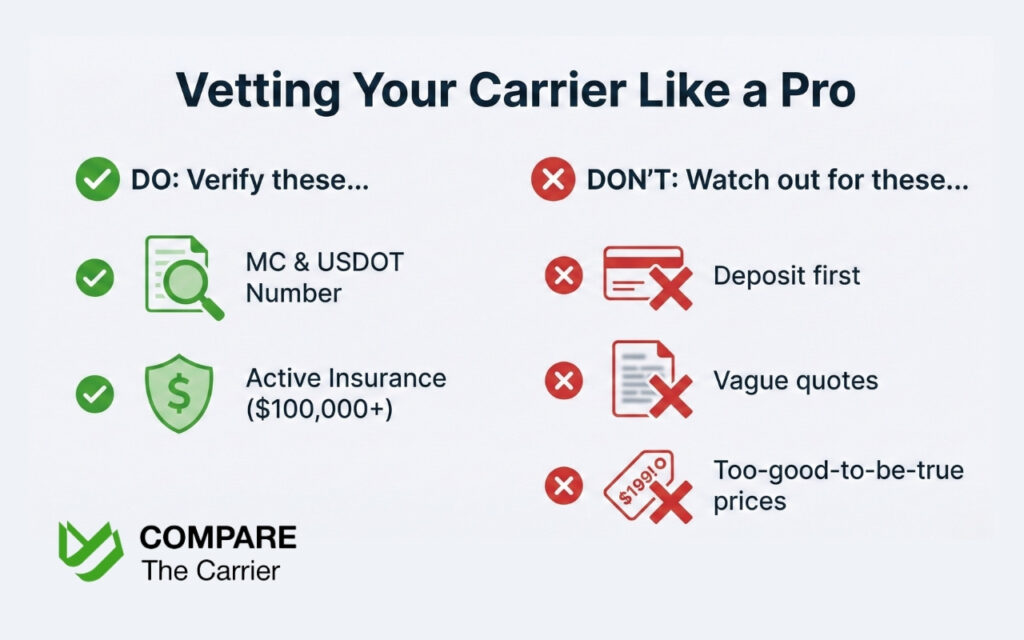
You aren’t just shipping a piece of metal; you’re shipping your freedom on campus. The internet is full of “brokers” who promise the world but disappear when a claim arises. In 2026, vetting a company takes five minutes if you know where to look.
Don’t get dazzled by a shiny website. Every legitimate transporter must have:
If a company does any of the following, run the other way:
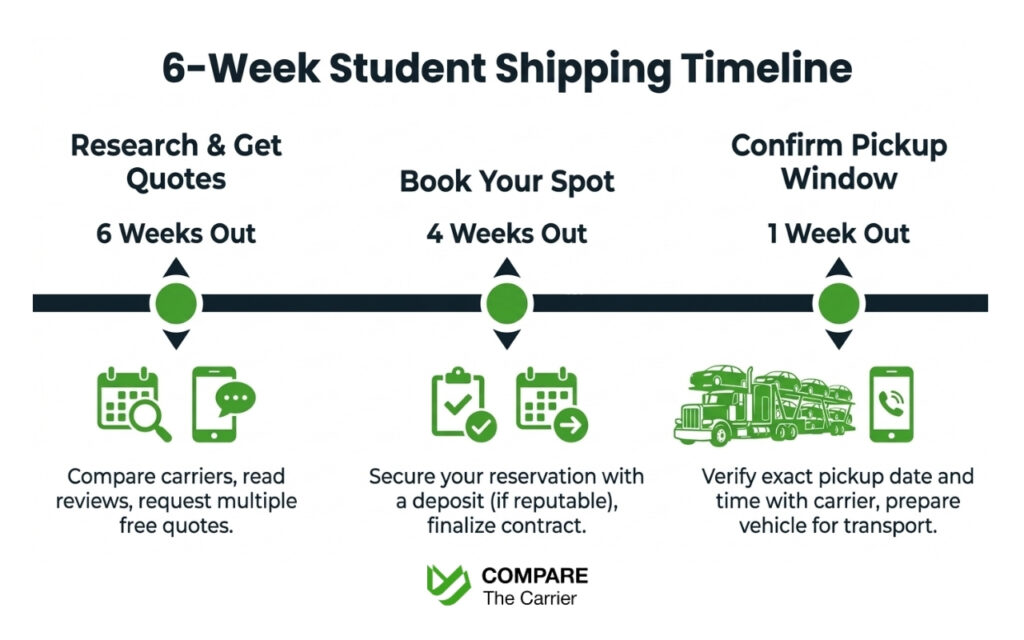
Timing a car shipment is like landing a plane; you want to synchronize your arrival with the car’s arrival. If the car gets there too early, you’re paying storage fees. If it gets there late, you’re walking three miles to the grocery store.
In 2026, the “Sweet Spot” for booking is 6 weeks out.
Universities are notorious for narrow one-way streets, low-hanging trees, and “No Parking” zones. A 75-foot car hauler cannot get to the front door of your dorm.
Not all trailers are created equal. Depending on what you’re driving, you have two main choices.
This is what you see on the highway: a large double-decker trailer carrying 8–10 cars.
Your car is tucked inside a hard-sided trailer, completely protected from the world.
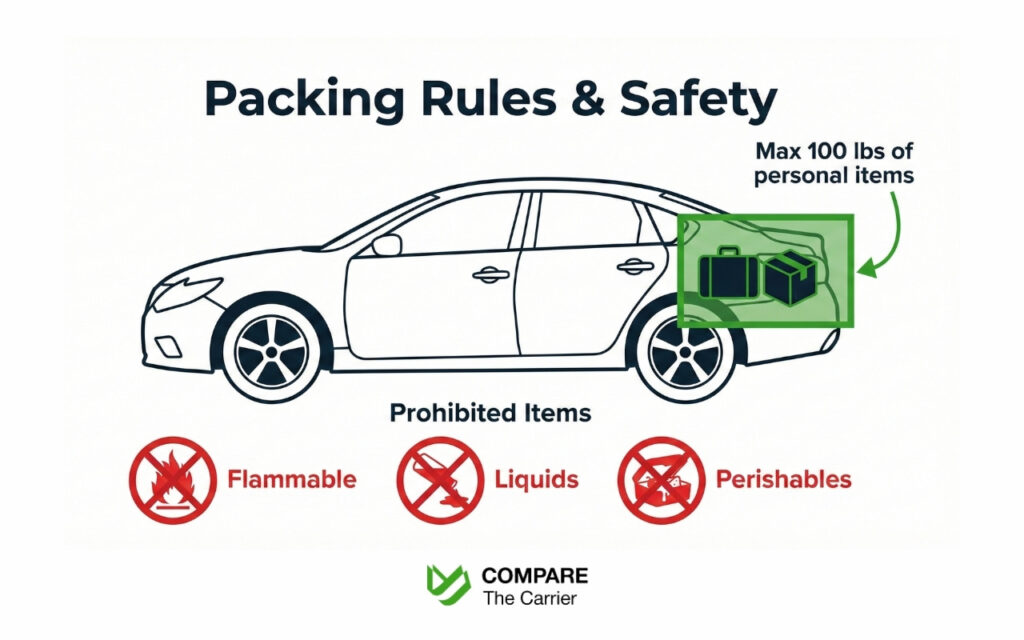
Car owners wanting to use their car for student transport will need to scrub their car to provide an honest condition report, remove any prohibited item (if allowed) and not exceed the personal luggage weight limit of 100 pounds, and maintain the fuel gauge at one-quarter full. The critical thing at the time of pickup is the joint inspection with the driver to document all existing damage on the Bill of Lading (BOL) – your legal document for any claims to insurance.
One of the biggest questions students ask is: “Can I fill my car with my dorm gear to save on shipping costs?” In 2026, the answer is a cautious “maybe,” but you have to play by the carrier’s rules to avoid hefty fines or having your car rejected at the curb.
Most auto transport companies allow students to pack up to 100 pounds of personal belongings in the trunk or below the window line. This is a courtesy, not a right.
While it’s tempting to use your car as a secondary moving van, remember that auto transport insurance does not cover your personal items. If your laptop is in the trunk and it’s stolen or damaged by a bump in the road, the carrier is not liable. Use this space only for soft goods like bedding, winter coats, or towels that aren’t high-value.
Before the carrier arrives, your car needs to be “inspection-ready.” This isn’t just about being polite; it’s about protecting your investment. If your car is covered in mud, the driver can’t see the scratches underneath, and they will simply mark the car as “dirty/damaged” on the paperwork.
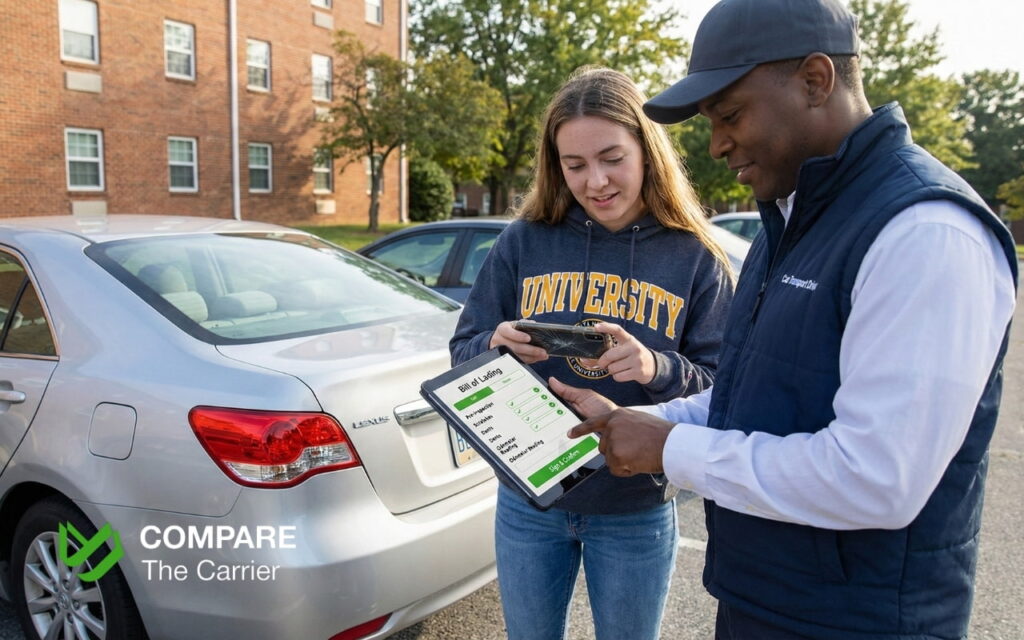
The most important document in the entire shipping process is the Bill of Lading (BOL). In 2026, most drivers use digital apps (like Navi Track or similar) to complete this, but the logic remains the same.
When the driver pulls up, they will walk around the car with you. They will point out every chip, ding, and scratch.
Navigating a university campus with a massive car hauler is like trying to fit a square peg in a round hole. You need to be the “boots on the ground” for your driver.
Before you book, check with your school’s Residential Life or Campus Police.
Drivers are juggling multiple stops and strict DOT driving hours.
For students to receive a car at college, they must complete a final walk-around with the driver and compare the vehicle to the original Bill of Lading. All discrepancies must be noted on the delivery receipt. In the event of damage, a claim should be submitted to the carrier’s insurance provider with photographic evidence within 24–48 hours so as to be fully reimbursed for repairs.
The moment of truth arrives when the car hauler pulls into the pre-arranged meeting spot near your university. In 2026, the delivery process is often the most hectic part, especially if it coincides with “Move-in Weekend,” when thousands of other students clog local roads.
When you see your car, the excitement is real. You want your keys, you want to head to the grocery store, and you want to be done. Stop. * The Walk-Around: Just as you did during pickup, walk around the car. If it’s dark, use your phone’s flashlight. Look at the roof and the lower bumpers for places where debris from the road might have hit.
If you didn’t pay in full upfront, you’ll likely owe a “balance on delivery” (BOD).
Statistically, over 95% of car shipments happen without a hitch. But if you’re in that unlucky 5%, you need a clear head.
Note: The carrier’s insurance usually has a deductible. A good broker will often help mediate this, so you aren’t stuck paying the first $500 of a repair.
Not all shipping companies “get” the student lifestyle. When choosing a provider for 2026, look for these specific “student-friendly” indicators.
Think of car shipping not as an expense, but as an investment in your first semester.
Shipping a car to college in 2026 is not just a logistics headache but a chance to get one small worry out of the way before the start of school. In the end, by researching your carrier, preparing your car appropriately, and being smart about the inspection, you turn what could be a nightmare into a smooth transition.
For all you freshmen moving into your first dorm or seniors heading off on an internship, just follow the “6-week rule,” keep your paperwork in order, and enjoy the freedom of your own car on campus.
In 2026, shipping a car for a student costs an average of $600 to $1,500. Short-distance moves (under 500 miles) are typically on the lower end, while cross-country shipments for larger vehicles like SUVs are more expensive. Factors like the “semester surge” in August and January can raise rates, so booking early is essential to save money.
Most carriers allow up to 100 pounds of personal items in the trunk or below the window line, but this is not a universal rule. Insurance does not cover these items, so avoid packing electronics or valuables. Always confirm the weight limit with your specific carrier to avoid “overweight” fees at DOT scales during transit.
The timeline depends on the distance: 1–3 days for regional moves, 3–5 days for mid-range (1,000 miles), and 6–9 Daysfor cross-country trips. These estimates include the time the driver will need to make other stops along the route. In 2026, most students use the carrier’s real-time GPS tracking to monitor their car’s progress.
Usually, no. Because large 75-foot car haulers cannot navigate narrow campus streets or low-clearance dorm areas, you will likely meet the driver at a nearby large parking lot (like a stadium or shopping center). It is important to coordinate this location with the driver 24 hours in advance to ensure a safe and legal unloading process.
Yes, legitimate carriers are required to have cargo insurance, typically covering between $100,000 and $250,000 in damage. This covers major issues like accidents or structural damage during transit. However, it does not cover “acts of God” (like hail) or mechanical failures. Always verify the carrier’s insurance certificate before handing over your keys.










Don't have time to fill out the form?
Call a transport company directly to get a quote now!
Select the category you need
Partner with Compare The Carrier & Grow!
We're open to collaborations, partnerships, and mutual growth! Whether you're an individual or a business, we offer exciting opportunities to work together. Fill out the form below to explore how we can collaborate.
Something Went Wrong
We're sorry, but something went wrong. Please briefly describe the problem you experienced in the text area below. Providing your contact information will allow us to follow up if needed.

Thank you,
your form has been accepted.
Your form has been successfully submitted. We appreciate your effort — our team will review it shortly and take the next steps.


