

State-to-State Car Towing & Shipping: Complete 2026 Guide
State-to-state car towing costs $300–$1,400 depending on ...
27 July 2025
POV shipping during Permanent Change of Station (PCS) in 2026 means balancing entitlements with strict timelines. For a stress-free process, verify your orders for OCONUS or CONUS eligibility, reserve a Vehicle Processing Center (VPC) slot at least 60 days ahead, and ensure your vehicle meets agricultural and safety standards. Early documentation and thorough cleaning, whether using government or private carriers, are key.
Calculate Shipping Quotes
PCS season has always been synonymous with stress, but 2026 brings a unique set of challenges and digital shifts. With the military’s continued transition toward integrated move management portals, the “old way” of just showing up with a folder of papers is gone. Today, the process is data-driven. If your paperwork doesn’t match the system’s digital record, your car stays on the curb.
Shipping a Privately Owned Vehicle (POV) is often the most logistically sensitive part of a move. Unlike a crate of household goods, your car is your primary mode of independence the moment you hit the ground at your new duty station. In 2026, global shipping lanes remain busy, and port congestion will be a factor that cannot be ignored. This guide isn’t just about following rules; it’s about hacking the system to ensure your vehicle arrives when you do, without the typical “military move” headache.
Before you wash a single window or print a single form, you need to know what the government is actually willing to cover. Entitlements aren’t universal; they are dictated by your orders and your destination.
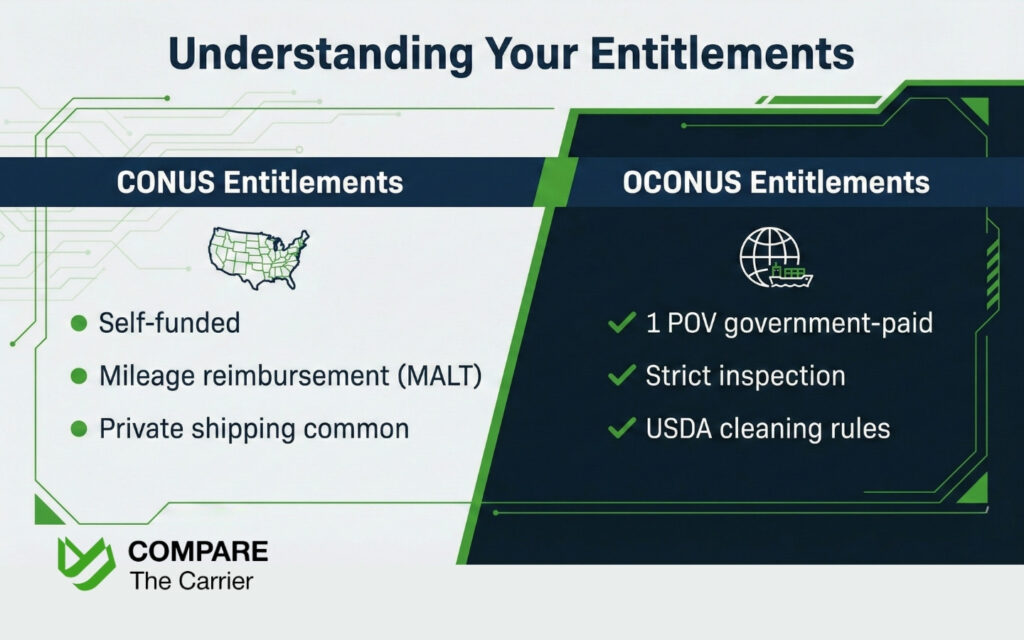
For the uninitiated, the rules for shipping a car within the continental United States (CONUS) are vastly different from shipping overseas (OCONUS).
The government pays for one vehicle. Dual-car households must decide: sell the second car, leave it with family, or pay for shipping themselves. In 2026, more families will use Personally Procured Shipping (PPS) for their second vehicle. The government’s liability covers only the officially shipped vehicle.
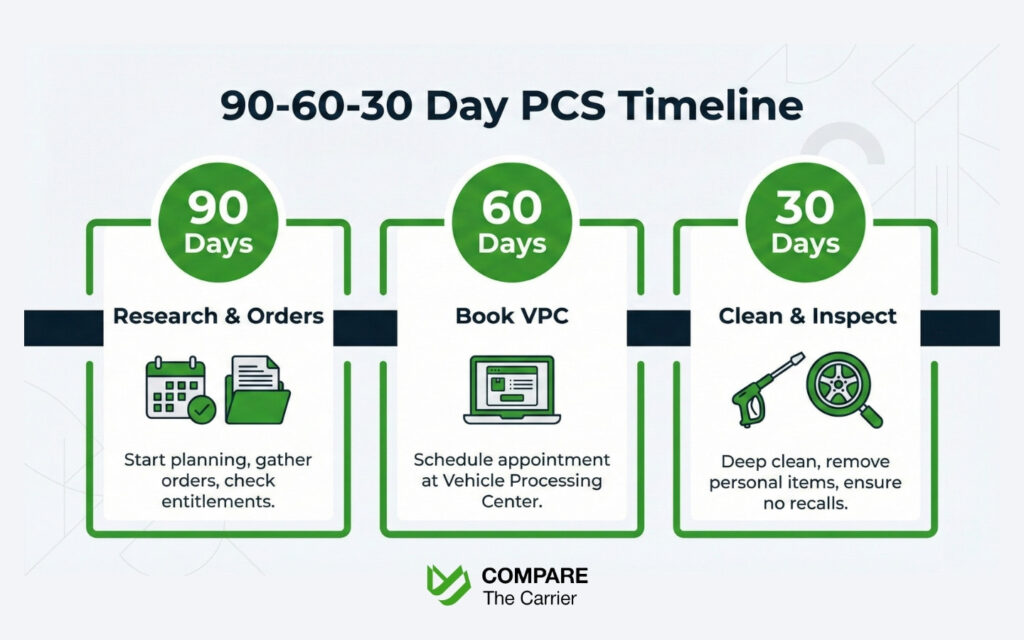
A stress-free move doesn’t happen in the final week. It’s built over three months of small, calculated steps.
Start research as soon as you see “Projected” on your assignments. Don’t wait for hard copy orders.
The Global POV Contract handles thousands of vehicles. Slots at major VPCs (like Baltimore, Los Angeles, or Dallas) fill up fast during the summer surge.
Now address routine issues that often cause VPC failures.
| Timeframe | Key Actions | Consequence if Skipped |
| 90 Days Out | Check recalls, get lender authorization letter | VPC rejection, weeks of delays |
| 60 Days Out | Book VPC slot, upload orders to portal | No appointment during summer surge |
| 30 Days Out | Fix leaks, deep clean, battery check | Turned away at gate on drop-off day |
| 7 Days Out | Confirm digital pre-screener form | Cannot check in at VPC kiosk |
In the world of PCSing, paperwork is your shield. If you don’t have it in a physical folder (and a digital backup), it doesn’t exist. By 2026, while most systems are digital, the port inspectors still rely on physical verification.
I always recommend service members keep a cloud-based folder (Google Drive or iCloud) specifically for the POV. Scan every document. If the VPC clerk says they can’t find your Lien Holder letter, you can pull it up on your phone and email it to their desk right away. This “redundancy” is the difference between a 30-minute drop-off and a 4-hour nightmare.
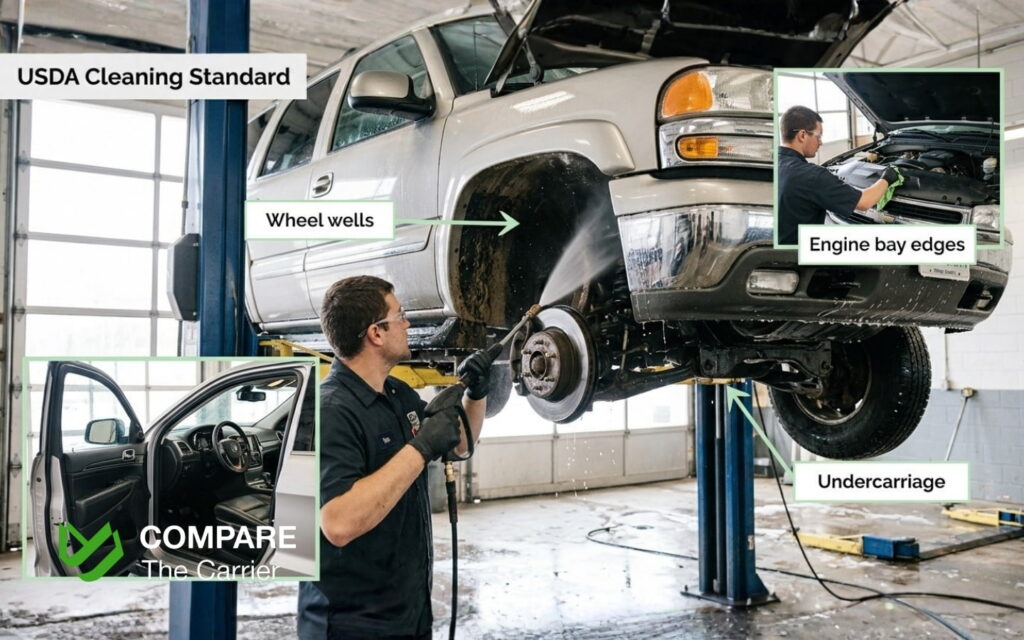
VPC inspectors follow international shipping laws and USDA rules to prevent invasive species spread, which is not difficult.
The exterior must be spotless, but the underside is where people fail.
In 2026, shipping safety protocols are tighter than ever.
To successfully execute a POV drop-off at a Vehicle Processing Center (VPC), service members must complete a joint physical inspection, document all pre-existing damage on the Inspection and Shipping Form (IAL), and verify their contact information for the 2026 automated tracking system. During transit, liability for damage is primarily covered by the government’s carrier, but supplemental private insurance is recommended to bridge gaps in “inherent vice” or “acts of God” exclusions.
Dropping off your car is the PCS “final exam.” In 2026, the process will be streamlined but strict. If you follow prep steps, you’re ahead. Drop-off has its own distinct rules.
Early VPCs run on tight schedules. For a 09:00 appointment, be at the gate by 08:30.
This is the moment where most future claims are won or lost. You and a VPC inspector will walk around the vehicle, documenting every scratch, chip, and dent.
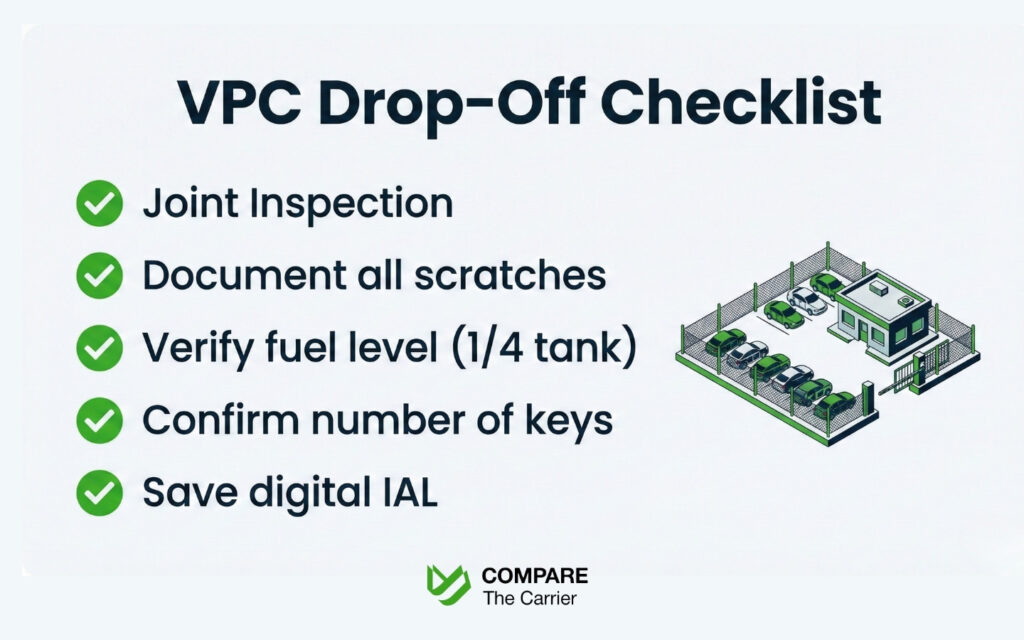
A common misconception is that the government “insures” your car. Technically, the government’s contracted carrier assumes liability for loss or damage caused by them during transit. This sounds like total protection, but there are nuances you need to understand to avoid being left out of pocket.
| Feature | Government/Carrier Liability | Private Supplemental Insurance |
| Coverage Basis | Replacement value for transit damage. | Full policy coverage (comprehensive). |
| Exclusions | “Inherent vice” (mechanical failure not caused by shipping). | Often covers “Acts of God” (storms at sea). |
| Deductibles | Usually zero for the service member. | Depends on your personal policy. |
| Claims Process | Handled via the VPC/MCO (Military Claims Office). | Handled directly with your provider. |
If your car arrives at the destination with a blown transmission but no exterior scratches, the carrier will likely claim “inherent vice.” This means they argue the part failed due to age or poor maintenance, not the shipping process. This is why a pre-shipment mechanical check-up (documented with a receipt) is vital evidence if you ever need to fight a claim.
Gone are the days of calling a dusty office in New Jersey to ask, “Where’s my car?” In 2026, the logistics chain is transparent, provided you know where to look.
Many modern vehicles (Tesla, Ford, BMW, etc.) have built-in GPS. However, be aware that once a car enters the “hold” of a massive RORO (Roll-on/Roll-off) vessel, the steel structure acts as a Faraday cage. Your app will likely show the car’s last location at the port of embarkation for 2-3 weeks. Don’t panic. This is normal.
You will use the official 2026 POV tracking portal. Here’s what the status updates actually mean:
| Portal Status | What’s Actually Happening | Avg. Duration |
| Received at VPC | Car is in the lot, waiting for transport slot | 3–7 days |
| In Transit to Port | On a car carrier heading to the coast | 2–5 days |
| Loaded on Vessel | Officially on the ship (GPS goes dark here) | 14–30 days |
| Discharged at Port | Off the ship, clearing customs | 5–14 days (longest phase) |
| Ready for Pickup | At destination VPC, 21-day clock starts | Your action required |
The “Car-less” period can last anywhere from 10 days (CONUS) to 60 days (OCONUS). Managing this requires a tactical approach to your budget and daily life.
The military typically does not provide a rental car for the entire duration of your POV’s transit. You may be entitled to a “Relocation Income Tax Allowance” (RITA) or specific temporary lodging allowances (TLA) that help, but the actual rental car cost is often a personal expense.
Pro Tip:
Look into “long-term” rental rates or car-sharing apps (like Turo) at your destination. Often, buying a “beater” car for $2,000 and reselling it two months later is cheaper than renting a compact car for $60 a day.
If you are a one-car family and that car is on a boat, the stress on the non-military spouse is immense, especially if you’re living in a hotel or temporary housing. When planning your PCS budget for 2026, set aside a “Mobility Fund.” This isn’t for the move itself, but for the Ubers, buses, and rentals that keep the family sane while your SUV is halfway across the Atlantic.
To successfully finalize a POV shipment, service members must schedule a pickup appointment at the destination VPC immediately upon notification, conduct a meticulous joint inspection to identify any new damage, and ensure all discrepancies are noted on the IAL before leaving the lot. If damage is found, claims should be initiated on-site or through the official Military Claims portal within the 48-hour “hidden damage” window. For moves not covered by the government, private door-to-door carriers remain the most efficient alternative for CONUS-to-CONUS relocations.
After weeks of checking tracking numbers and relying on Uber, the notification finally hits your inbox: “Your vehicle is ready for pickup.” In 2026, the arrival process is designed to be quick, but it is exactly there that many people let their guard down.
Don’t just drive to the VPC the moment you get the email. Most centers require you to book a specific “Pickup Appointment” via their digital portal.
This is the mirror image of your drop-off. You are looking for anything that wasn’t there before.
Despite logistics professionals’ best efforts, cars occasionally get damaged during a transoceanic move. Knowing how to handle a claim in the 2026 military ecosystem is the difference between a free repair and a massive bill.
Most claims are now processed through an integrated digital portal.
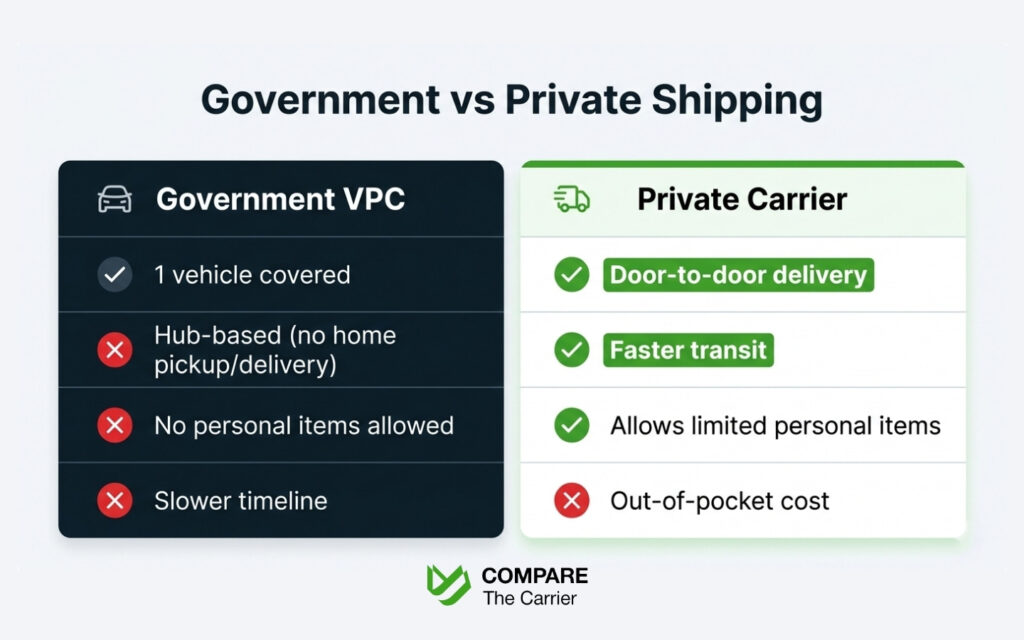
For many service members in 2026, especially those moving within CONUS (state-to-state), the government won’t pay for POV shipping. This is where private auto transport comes in. While it’s an out-of-pocket expense, it offers several advantages over the “drive it yourself” or “VPC” methods.
The private transport market is highly competitive. Look for companies that use AI-driven dispatching. These companies are more efficient at matching your car with a driver already heading that way, which often results in lower “Military Special” rates. Always ask for a “PCS Discount.” Most reputable brokers will shave $50–$150 off the price just for your service.
The secret to a stress-free POV move isn’t luck; it’s documentation. In an era where AI and digital portals manage the logistics, your physical evidence, your photos, your receipts, and your meticulously checked IAL form are your only leverage.
PCSing is inherently chaotic. You are moving your family, your career, and your home all at once. By treating your vehicle move as a separate, tactical operation, you ensure that when you finally arrive at your new duty station, you’ll have your own wheels ready to start the next chapter of your military journey.
Stay on schedule, keep your paperwork organized in the cloud, and don’t be afraid to demand a thorough inspection. You’ve earned the right to have your vehicle arrive in the same condition it left.
Typically, no. For moves within the continental United States, the military expects you to drive the vehicle and will reimburse you for mileage (MALT). However, exceptions exist for physically separated families or medical reasons. Most families moving multiple vehicles choose to hire a private carrier for the second car to avoid long cross-country drives.
No. The government-contracted VPCs have a very strict policy: the car must be empty. You may only leave the spare tire, jack, and permanent car seats. Items like GPS units, dash cams, and even air fresheners should be removed. For private shipping, rules are more flexible, often allowing small amounts of personal goods in the trunk.
For OCONUS moves, expect a timeline of 30 to 60 days. This includes VPC processing, transit to the port, the ocean voyage, and customs clearance at the destination. Factors like port congestion and seasonal demand (May–August) can extend these windows, so always schedule your drop-off as early as your orders allow.
Identify the damage before you sign the final inspection form and leave the VPC lot. Ensure the inspector notes the specific scratch or dent on the digital IAL. Take clear photos on-site. You must then file a formal claim through the carrier’s portal or the Military Claims Office to receive reimbursement for repairs.
If your PCS orders are delayed or cancelled after your POV has already been dropped off at a VPC, contact the Vehicle Processing Center immediately with your updated orders. The government will typically store your vehicle at no cost for a short grace period, usually 30 days. If orders are permanently cancelled, you are responsible for retrieving the vehicle. Always notify the VPC in writing and keep a copy of all amended orders to avoid abandonment fees or unauthorized disposal of your vehicle.
Yes, but only with the correct legal documentation. Your spouse must present a Power of Attorney (POA) that specifically references the vehicle’s VIN number. A general POA is often rejected at destination VPCs. The spouse must also bring a valid government-issued photo ID and a copy of the original IAL signed at drop-off. Without a VIN-specific POA, the VPC will not release the vehicle to anyone other than the registered owner on the orders.
The following vehicles are ineligible for government-funded POV shipping: inoperable or non-running vehicles, vehicles with open safety recalls that have not been resolved, oversized vehicles exceeding VPC dimensional limits, vehicles with fluid leaks, and any vehicle without a clear title matching the service member’s name. Heavily modified vehicles, including lifted trucks or custom builds, may also be rejected at inspection. Always verify eligibility directly with your assigned VPC at least 60 days before your scheduled drop-off date.







Don't have time to fill out the form?
Call a transport company directly to get a quote now!
Select the category you need
Partner with Compare The Carrier & Grow!
We're open to collaborations, partnerships, and mutual growth! Whether you're an individual or a business, we offer exciting opportunities to work together. Fill out the form below to explore how we can collaborate.
Something Went Wrong
We're sorry, but something went wrong. Please briefly describe the problem you experienced in the text area below. Providing your contact information will allow us to follow up if needed.

Thank you,
your form has been accepted.
Your form has been successfully submitted. We appreciate your effort — our team will review it shortly and take the next steps.


