

Auto Transport Companies To Avoid
A car is a valuable thing, in relation to which all decis...
9 December 2022
Let’s be honest for a second. The auto transport market may be the Wild West. You place your car on a lead board, and your phone is blowing up in a couple of minutes. SMSs, emails and telephone calls by individuals offering the world at a price that looks a bit too good to be true. In fact, when a quote to transport your car to the other end of the country appears to be a good offer, it is a trap.
Calculate Shipping Quotes
How do I check if an MC number is active? To verify an MC number’s status, search the FMCSA SAFER System or the Licensing & Insurance (L&I) database. An active carrier must show “Authorized” under the Operating Authority section and have updated BIPD (Public Liability) insurance on file. If the status is “Dismissed” or “Revoked,” the company is legally prohibited from performing interstate auto transport services for hire.
This has happened to me a dozen times. The cheapest choice gets their keys handed over by a customer and then their car gets sucked into a black hole of double-brokering and “ghost” carriers. It is a nightmare to any human being who cares about his or her car. The thing is, however, that you can put an end to a scam before it begins. It only requires one to know how to look at a few digits.
The DNA of the trucking company is known as the Motor Carrier (MC) number. It is their license to work, their safety record and their insurance history all rolled into one. Unless you know how to check this number you are just flying blind. We are digging in to the mudslinging of FMCSA databases in this guide and revealing to you how exactly you can determine a professional and a pretender.
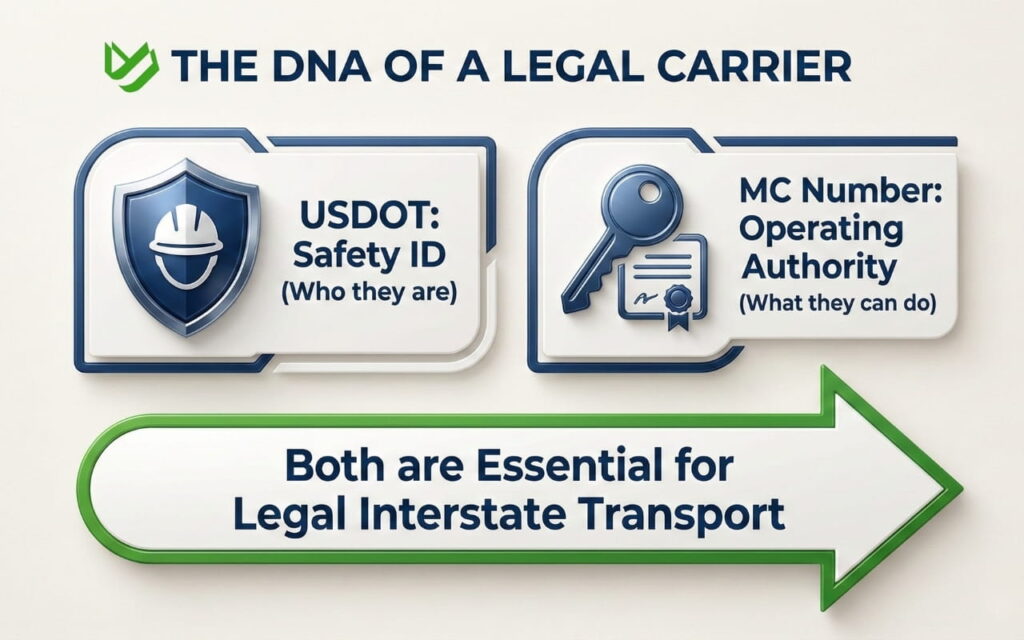
Before we get into the “how,” we need to understand the “what.” In the United States, the Federal Motor Carrier Safety Administration (FMCSA) oversees the industry. They issue two main types of identification: the USDOT number and the MC number. A USDOT number is like a Social Security number for a truck. It identifies the company for safety audits and inspections. However, the MC number (Motor Carrier number) is what gives them “Operating Authority.” This is the legal permission to haul freight for hire across state lines.
If a company is moving your car for money, they must have an active Operating Authority. If they only have a DOT number, they might only be allowed to move their own equipment. Actually, from a buyer’s point of view, checking the MC number is the single most important step in vetting a company. It’s the difference between a legitimate business and a guy with a trailer and a dream.
The most powerful tool you have is completely free. It’s called the SAFER System (Safety and Fitness Electronic Records). This is the official government snapshot of a carrier’s life.
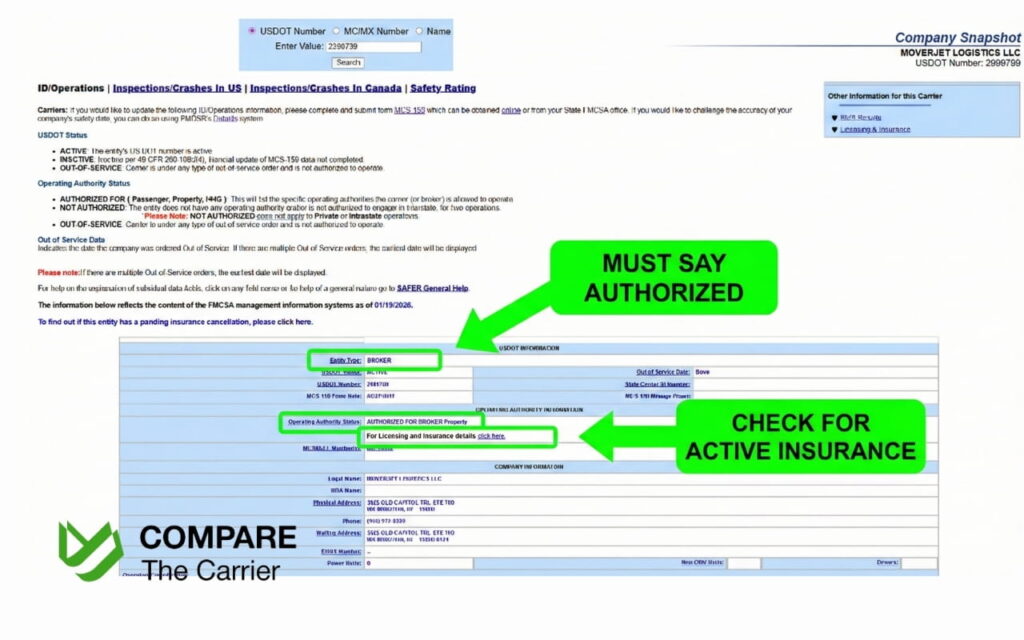
When you get a quote from acar shipping company, they should be more than happy to provide their MC number. If they hesitate? That’s your first red flag. Once you have that number, you head to the SAFER website and look for the “Company Snapshot.”
What to look for in the Snapshot:
I’ve seen “certificates of insurance” that were clearly made in Photoshop. It’s a total nightmare. A carrier can tell you they have a $1,000,000 policy, but if they haven’t paid their premiums, that piece of paper is worthless.
To truly verify insurance, you need to use the FMCSA Licensing & Insurance (L&I) database. This is where the insurance companies themselves have to file proof of coverage.
If the insurance is “Pending” or “Dismissed,” the carrier is driving uninsured. If they hit a bump and your car gets damaged, you are the one left holding the bag. This is especially critical if you are doing hybrid vehicle shipping, as the repair costs for high-voltage battery systems are astronomical. You need to know that the carrier has the cargo limits to cover a total loss.
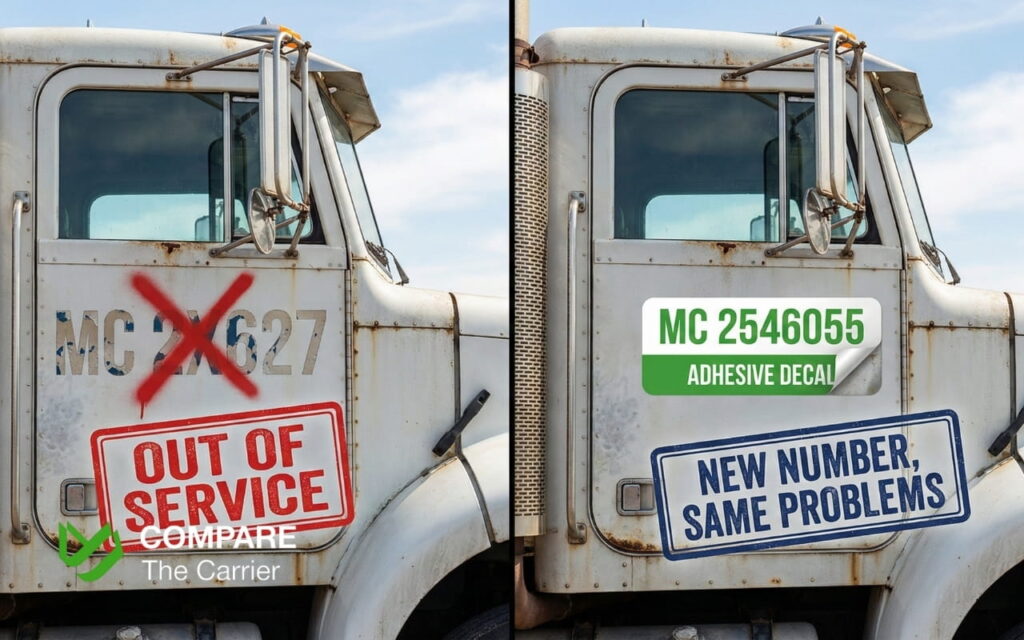
Is the MC number brand new? According to the date of the authority. In case it had been granted two weeks ago, run. Why? Due to the existence of such carriers as chameleon. They accumulate safety violations. They crashed a truck. They lose their insurance. Then they close it, and a new company with a new MC number appears the following day. It’s a circus. It’s a carnival of bad actors. I hate it when people complain that they were so pleasant on the telephone! Of course they were. They want your deposit. But look at the “Power Units.” When they report that they are a huge national fleet, yet only 1 truck is registered in the SAFER system? They are lying to you.
Check the phone number. Is it a cell phone? A VOIP line? When you are unable to locate a physical landline or the actual physical address of an office, then you are working with a ghost. Logistics… I do not even want to start. It is a craft of clinical obsessiveness. Should the beat of their narrative seem disrupted, should they not know the reason why their insurance is pending, walk away. Being the guy who white-knuckles the phone, because your car is on a trailer with an expired MC number, is unwarranted.
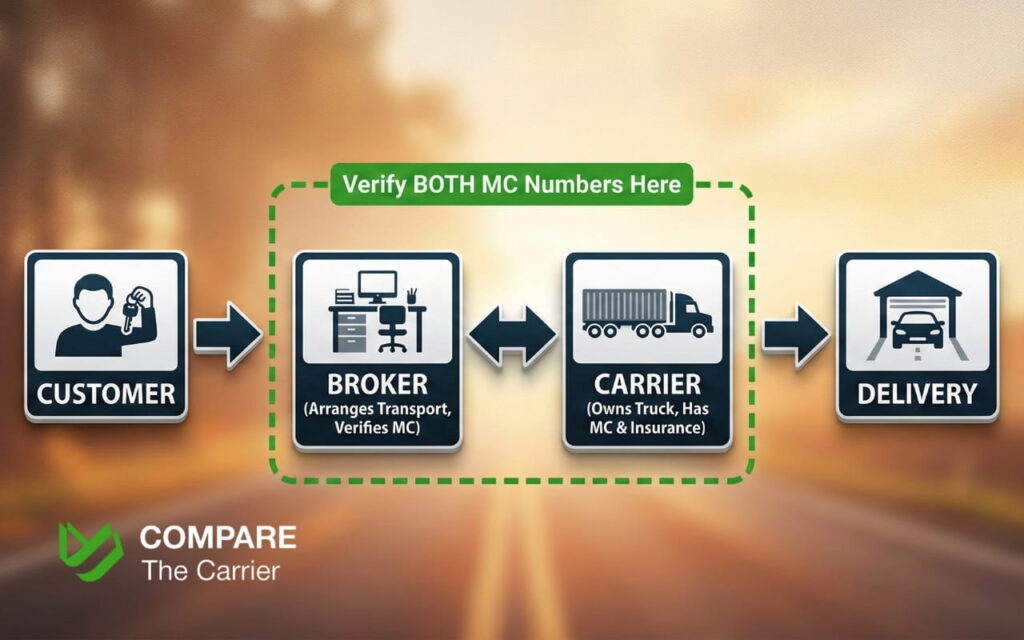
This is a point of massive confusion for most people. Actually, about 90% of the companies you find online are brokers, not carriers.
A broker (like the ones you’ll find in our online car buying guide) doesn’t own trucks. They are the middlemen. They have an MC number that authorizes them to “arrange” transportation.
A carrier is the one with the actual truck and trailer.
Why does this matter?
If you hire a broker, you need to verify their MC number first. But then, once they assign a driver, you must verify the carrier’s MC number too. Scammers love to play the “double broker” game. They take a load from a legit broker and then hand it off to an unauthorized, uninsured driver. It’s a recipe for disaster.
If you are opting for open auto transport, you might feel like the risk is lower because the car is visible. It’s not. A stolen car is a stolen car, regardless of whether it’s in a box or on a rack.
If you really want to dig in, check out the Safety Measurement System (SMS). This is where the FMCSA keeps track of all violations.
If a company has a lot of red “baselines,” that’s a big red flag. I’ve seen carriers with “authorized” status that still rack up dozens of violations bald tires, broken lights, you name it. Honestly, I wouldn’t trust them with a bicycle, let alone a car.
This is why people fall for the myth that any licensed company is automatically safe. It’s just not true.
If you find a discrepancy, don’t try to “work it out” with the agent. They will have a million excuses. “Oh, the system is just slow to update,” or “We just changed our name.”
Actually, the FMCSA system is quite fast. If it’s not there, it’s not legit.
If you’re worried about a car you already bought don’t rush the shipping. It’s better to pay a few days of storage fees than to lose the car entirely to a scammer.
The stakes are higher for specialized vehicles. If you are learning how to ship your hybrid vehicle, you have to realize these cars are heavy and have unique fire risks if handled improperly. A “legit” carrier will have specific experience with EVs and hybrids.
Similarly, if you are looking for flooded car care tips because you’re shipping a salvage title, you need a carrier with a winch. A lot of “ghost” carriers show up with a standard ramp and then realize they can’t even load your car. Verifying their MC number helps you see if they are actually rated for “Secondary Towing” or “Salvage” categories.
One of the biggest myths about auto transport is that every truck comes with some fancy GPS you can watch in real-time. The truth? Most “tracking” just means the driver’s phone and only if they feel like answering it.
A legit company with a verified MC number will have a real dispatch office. They won’t give you the “he’s in a tunnel” excuse for three days straight. When you check a carrier, you’re really checking their accountability. If they know you’ve looked up their SAFER record, they know you’re not someone they can mess around with.
Verifying an MC number is the foundation, but it’s not the whole house. You also need to look at:
At Compare The Carrier, we take this vetting process seriously. We don’t just look at the numbers; we look at the people behind them. Because at the end of the day, you aren’t just shipping a car; you’re trusting someone with a piece of your life.

Checking the carrier MC number is not some so-called pro tip that you can afford not to follow. In fact, it is the only actual safeguard you get in an industry where too many individuals are willing to economize on your costs. There are just too many horror tales, stolen vehicles, bogus carriers and insurance claims that go nowhere before I realized that five minutes spent on the FMCSA site will be the best investment you will ever make.
If you are willing to move your car, the price of that steak dinner may sound good, yet it will practically end in a “scrap metal” catastrophe. Do not the one who was blindsided, as they were too busy to run a background check. It is not a matter of numbers on a screen but of ensuring that the person on the other end of the wheel is the one who is allowed to be there, is insured, is not just responsible for getting the car but that he is, indeed, the one responsible to you. (And don’t think I do not value your peace of mind more than a 100 dollar discount with a crooked broker).
And you earned your car. Trust the keys of your passenger car or your expensive investment to a ghost. Get the numbers, confirm the status of Authorized and only then, ship it with complete confidence. It pays to be smart today so as to avoid victimization in the future.
A USDOT number is a unique identifier used by the FMCSA to track a company’s safety records, crash investigations, and compliance audits. In contrast, an MC (Motor Carrier) number grants legal authority to transport regulated passengers or federally regulated commodities across state lines. While a USDOT number focuses on safety oversight, the MC number represents commercial operating authority for interstate commerce.
A company can only operate without an MC number if it hauls “exempt” commodities or operates exclusively within a single state (intrastate commerce). However, for interstate auto transport, an active MC number is a federal requirement. Companies solely engaged in intrastate moves still require a USDOT number and must comply with specific state-level commercial vehicle regulations and insurance mandates.
A Conditional safety rating indicates that an FMCSA audit found the carrier lacks adequate safety management controls or has violated 49 CFR safety regulations. While the carrier may still legally operate, this rating signals a higher risk profile for accidents or delays. Many freight brokers and insurance companies refuse to work with “Conditional” carriers until they complete a formal Safety Management Plan to regain “Satisfactory” status.
Verification is performed through the FMCSA L&I website, where users can identify the carrier’s insurance provider and policy number. A legally compliant auto transporter must have a Form BMC-91 or BMC-91X on file, typically providing a minimum of $750,000 in public liability coverage. It is essential to confirm that the policy is active and matches the legal name registered with the DOT.
Using a licensed broker is standard practice in auto transport, provided the broker maintains a mandatory $75,000 surety bond (Form BMC-84) or trust fund. Brokers facilitate logistics by vetting carriers for active MC numbers and valid insurance coverage. To ensure safety, confirm the broker is registered with the FMCSA and possesses the legal authority to arrange, rather than perform, interstate transportation.
To check if an MCS-150 is active, search for the carrier’s USDOT number in the FMCSA SAFER System. Look for the “MCS-150 Form Date” or the biennial update status. Federal law requires carriers to update this report every 24 months. If the update is overdue, the USDOT number can be deactivated, making it illegal for the company to operate in interstate commerce.






Don't have time to fill out the form?
Call a transport company directly to get a quote now!
Select the category you need
Partner with Compare The Carrier & Grow!
We're open to collaborations, partnerships, and mutual growth! Whether you're an individual or a business, we offer exciting opportunities to work together. Fill out the form below to explore how we can collaborate.
Something Went Wrong
We're sorry, but something went wrong. Please briefly describe the problem you experienced in the text area below. Providing your contact information will allow us to follow up if needed.

Thank you,
your form has been accepted.
Your form has been successfully submitted. We appreciate your effort — our team will review it shortly and take the next steps.


