1 Vehicle Shipping Lead Source, Zero Broker Waste
Let’s cut to the chase. If you’re in the business of movi...
14 March 2025
Google Ads can be profitable for auto transport brokers, but cost per lead alone does not tell you whether the channel works. The more useful metric is cost per booked order, because it connects advertising spend to actual shipments and margin — and the two numbers frequently move in opposite directions.
Contact Us Now
That distinction matters, because you will find a well-known calculation in this industry that concludes paid search simply doesn’t pay for brokerages. The arithmetic behind it is sound. The inputs are where it falls apart.
This guide sets out that calculation fairly, shows which assumptions break, explains how to work out cost per booked order for a brokerage, and shares what campaigns we manage in this vertical have actually produced. Brokers will also see this service described as car shipping PPC, auto transport PPC, or Google Ads for car shipping companies — the underlying model is the same: paid search campaigns built to generate vehicle shipping enquiries and booked shipments.
Want Google Ads That Generate Booked Orders?
Stop measuring campaign success by cheap leads alone. CTC Stack builds Google Ads campaigns specifically for auto transport brokerages, with lead tracking that connects advertising activity to booked shipments.
See how we build, manage and optimise campaigns around your brokerage’s vehicles, budget and sales capacity.
Explore Google Ads for Auto Transport or call +1 (202) 980-8343
In this guide
Stated fairly, the case against running your own campaigns looks like this:
ut together, it looks like the entire margin goes into acquiring the customer. For brokerages running broad, unoptimised campaigns, that is frequently what happens — so the calculation describes a real outcome. The question is whether it describes an unavoidable one.
None of this is an argument against buying leads. Compare The Carrier sells them, and for a brokerage with an empty pipeline they are the fastest way to fill it. The risk is not in buying leads; it is in buying them as the only source. A brokerage that scales on purchased leads alone has its customer acquisition tied to one supplier’s volume, pricing and terms, with no channel of its own to fall back on.
The rules around lead generation and consent also keep shifting, which makes a single-source setup more fragile than it looks. The safer position is more than one source: keep buying while the owned channel is being built, then let the numbers decide the balance. Both options should be judged on the same measure — what it costs to acquire a booked shipment.
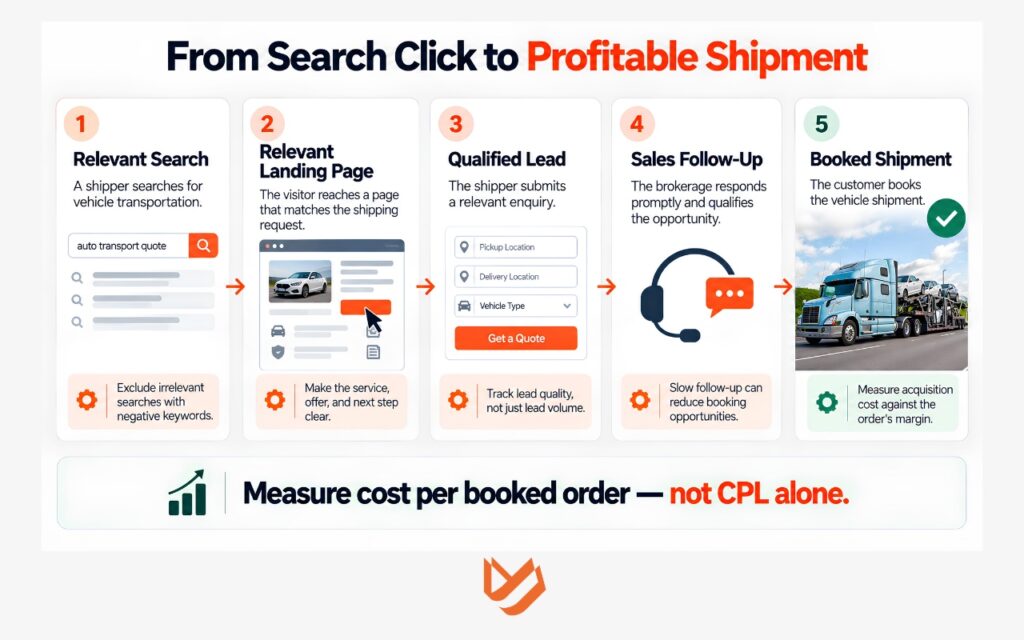
Three assumptions carry most of the weight.
The wide click-cost range is real, but it covers the entire transport keyword space – including terms no brokerage should be bidding on. Broad transport keywords attract people looking for driving jobs, CDL schools, trailer rentals, tow trucks, parts, and international shipping. Each of those clicks bills at the same rate as a genuine shipper enquiry.
A campaign built specifically for auto transport bids on commercial, bookable searches and excludes the rest through a detailed negative keyword list. That difference alone moves the effective cost per click into a different band, which is why campaigns built specifically for auto transport brokers look structurally different from generic freight campaigns.
The first month is often one of the least efficient periods of a new campaign. Automated bidding can perform more effectively once the account has accumulated enough reliable conversion data to distinguish higher-value searches from lower-quality traffic. Efficiency typically improves as that data builds.
How we plan cost per lead.
The table below is the trajectory we plan against, built from results on accounts we have managed. It is a planning model, not an average observed across a population of accounts.
| Month | Cost per lead (our managed accounts) |
| Month 1 | ~$16 |
| Month 2 | ~$14 |
| Month 3 | ~$12 |
| Month 4+ | ~$10-12 |
| Month 6+ | ~$8-10 |
Every account is different. A result achieved for one brokerage does not guarantee the same result for another with its own lanes, budget, vehicle types and lead-quality requirements — these figures are a starting point for planning, not a forecast.
Assessing paid search on month-one figures measures the period before optimisation has had anything to work with.
This is the most consequential assumption. Every figure in the calculation above is a cost-per-lead figure — and cost per lead says nothing about whether those leads book.
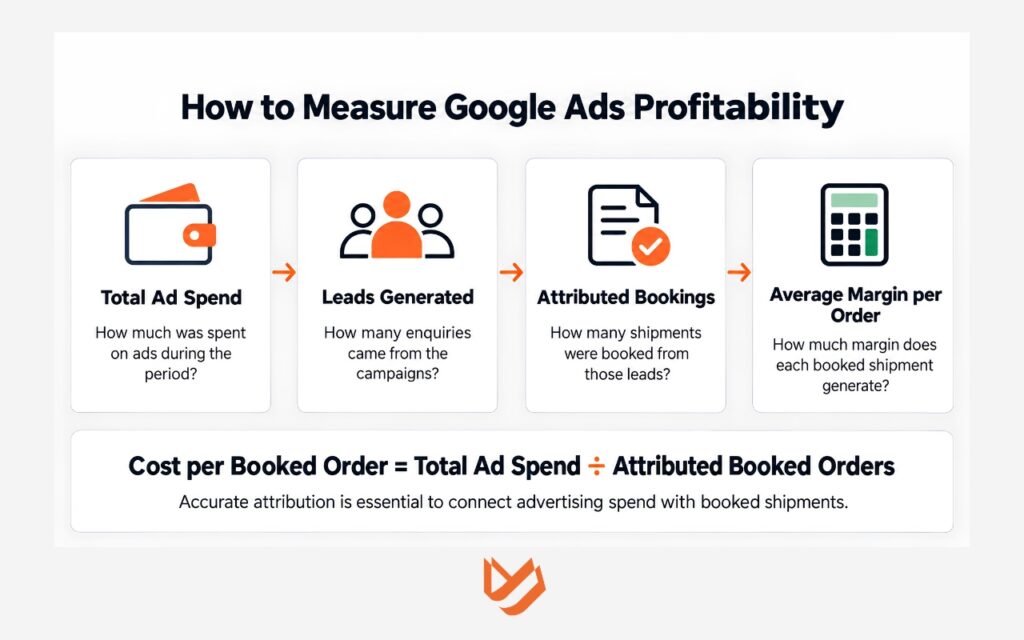
Cost per booked order is the total advertising spend divided by the number of shipments actually booked from that spend.
Cost per booked order = total ad spend ÷ booked orders attributed to ads
Cost per lead measures what you pay for a contact. Cost per booked order measures what you pay for revenue. The two move independently, and often in opposite directions: widening targeting and loosening match types will usually lower cost per lead while raising cost per booked order, because the sales team spends more hours on enquiries that were never going to ship.
Example calculation. Two campaigns, identical budgets:
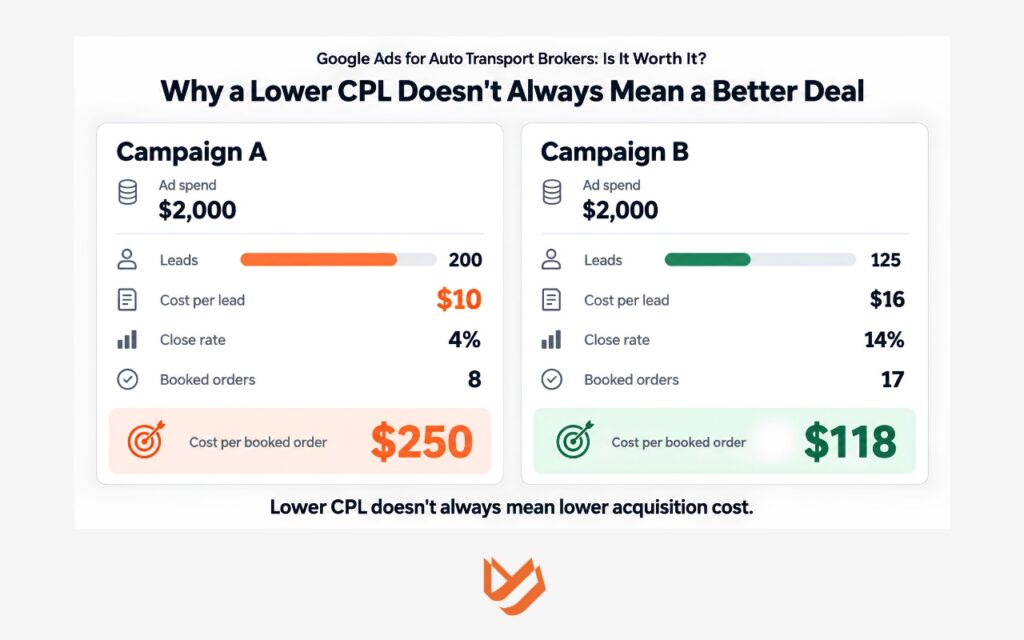
Campaign A has the better cost per lead. Campaign B produces roughly twice the revenue. A brokerage optimising on cost per lead would have cut the campaign that was working.
For this reason, our target in managed auto transport accounts is stated as a cost per booked shipping order of $65-$100 rather than as a cost per lead. This is our internal target, not a published industry benchmark. When cost per lead falls while cost per booked order rises, we treat that as deteriorating lead quality and adjust the campaign – even though that makes the cost-per-lead line look worse on a report.
For the cost side in more depth, see our guide to auto transport lead cost.
Who “we” are. Compare The Carrier is where people and companies go to ship vehicles. CTC Stack is the team behind it — the same people who build and run the advertising, tracking and systems described here, both for Compare The Carrier and for brokerages that hire us directly. The cases below are CTC Stack engagements.
Published case data. The figures below are from documented auto transport engagements run by our team. They are specific to those accounts and their market conditions, and are not presented as industry averages.
| Engagement | Duration | Result |
| Rebuilding an underperforming account (case study) | 6 months | Cost per lead $63.26 → $7.02; monthly leads ~25 → ~704; conversion rate under 2% → 8.25% |
| Launching an account from zero (case study) | 6 months | ~7,000 leads at an average $5.89 per lead; average conversion rate 26% |
| Scaling an established account (case study) | 20 months, 2024-2025 | Monthly leads 2,000 → 7,500 (+275%); average cost per lead $8 → $5; budget scaled toward $60K/month; expanded from car shipping into motorcycles, RVs and ATVs |
| Landing page redesign, ad spend unchanged (case study) | 2 months | Conversion rate 2% → 26%; 19x more qualified leads per month; +32% average engagement time |
Source: published case studies for auto transport accounts managed by our team. In the first case, the measured starting figures were $63.26 per lead, roughly 25 leads a month and a conversion rate below 2%; the closing figures are derived from the stated 9x, 32x and 13x improvements.
Four details are worth drawing out.
The sceptical calculation describes a real account – before it was fixed. $63.26 per lead is close to the upper end of the figures the sceptical case uses, and at that cost its conclusion was correct for that brokerage. The same channel, same market and same vehicle types produced $7.02 after the account was rebuilt. The disagreement is not about the arithmetic; it is about whether $63 is a property of the channel or of the setup.
Cost per lead in a working account sits an order of magnitude below the assumption. Across these engagements, mature accounts produced leads between $5 and $8. The sceptical case assumes 50-115.
Scale and efficiency moved together, not against each other. In the third case, lead volume grew nearly fourfold while cost per lead fell. That is not what happens when a campaign is simply given more budget; it is what happens when structure, targeting and tracking improve alongside the spend.
The landing page changed nothing about the ads. Conversion moved from 2% to 26% with ad spend held constant. If the clicks you pay for land on a page that was not built to convert shippers, bidding strategy has limited room to compensate.
Two caveats worth stating plainly. The turnaround took six months, and the scaling engagement 20 months – these are sustained programmes, not first-quarter results. And the conversion rates differ widely between accounts (8.25% against 26%), which reflects how much the destination page and the market matter.
The sceptical case is not wrong for everyone. There are brokerages for which paid search is a poor fit, and it is worth being direct about which.
Paid search tends not to work when:
If the underlying unit economics do not work, better advertising will not repair them – it will only reveal the problem sooner.
To determine whether ads pay for your brokerage, you need four figures. Most brokerages can readily produce two of them.
With those four figures, cost per booked order is a division, and the answer becomes arithmetic rather than opinion. If cost per booked order sits comfortably below your margin, the channel pays. If it does not, the same figures indicate where the problem sits — traffic quality, landing page conversion, or follow-up speed — and each has a different remedy.
Putting that measurement in place is usually worth doing before any bid is adjusted.
Google Ads is neither inherently profitable nor inherently unprofitable for auto transport brokers. It tends to pay when the campaign is built for this specific vertical, measured on booked orders rather than lead count, given enough runway to optimise, and paired with a landing page and sales process that convert. It tends not to pay when it is built broadly, judged on month-one figures, and optimised toward whichever metric reports best.
Buying leads and building your own channel are not opposing choices — most brokerages do both, and the sensible balance shifts over time. Judge them on the same measure: what it costs to acquire a booked shipment. Run that number on your own account and the question stops being a matter of opinion.
If you would rather not run and optimise that process in-house, you can see how our managed Google Ads service for auto transport approaches it.
It can be, but profitability depends on cost per booked order, not cost per lead alone. Campaigns built broadly across the transport keyword space tend to spend heavily on job seekers, trailer rentals and tow enquiries, which is the source of most negative experiences. Campaigns built specifically for auto transport, with detailed negative keywords and conversion tracking tied to bookings, produce materially different economics.
Cost per booked order is total ad spend divided by the shipments actually booked from it. It matters more because cost per lead ignores quality: accepting lower-intent traffic can halve cost per lead while increasing what each booking costs. It is the figure that connects advertising directly to revenue and margin.
The trajectory we plan against starts near $16 in month one and declines toward 8-12 by months four to six as conversion data accumulates. In one documented turnaround, an account at $63.26 per lead reached roughly $20.75 within the first three months and $7.02 by month six. Lower figures are achievable on mature accounts, but these are our own results rather than an independent industry benchmark, and any first-month promise of single-digit costs should be treated with caution.
Leads often begin arriving within the first week, but meaningful efficiency usually appears around month three. Automated bidding requires conversion volume before it can prioritise searches that book, so the early months largely fund the data that makes later months efficient. Campaigns stopped at week six absorb the least efficient phase without reaching the payoff.
Many brokerages do both, and that is usually the right answer rather than a compromise. Purchased leads provide immediate, predictable volume, which matters when the pipeline is empty; owned campaigns cost more to establish but reduce dependence on a single supply and can lower blended acquisition cost over time. The practical approach is to buy while building, then shift the balance as campaigns mature — comparing both on cost per booked order rather than on lead price.










Select the category you need
Partner with Compare The Carrier & Grow!
We're open to collaborations, partnerships, and mutual growth! Whether you're an individual or a business, we offer exciting opportunities to work together. Fill out the form below to explore how we can collaborate.
Something Went Wrong
We're sorry, but something went wrong. Please briefly describe the problem you experienced in the text area below. Providing your contact information will allow us to follow up if needed.

Thank you,
your form has been accepted.
Your form has been successfully submitted. We appreciate your effort — our team will review it shortly and take the next steps.