

Commercial Trucks Hauling In 2026
Commercial truck transportation requires additional atten...
30 March 2022
Moving heavy machinery isn’t something you can leave to chance. Whether you’re hauling a 40-ton excavator for a new construction site or shipping a brand-new combine harvester for your farm, hiring the wrong heavy equipment mover can cost you thousands in delays and uncovered damages.
Calculate Shipping Quotes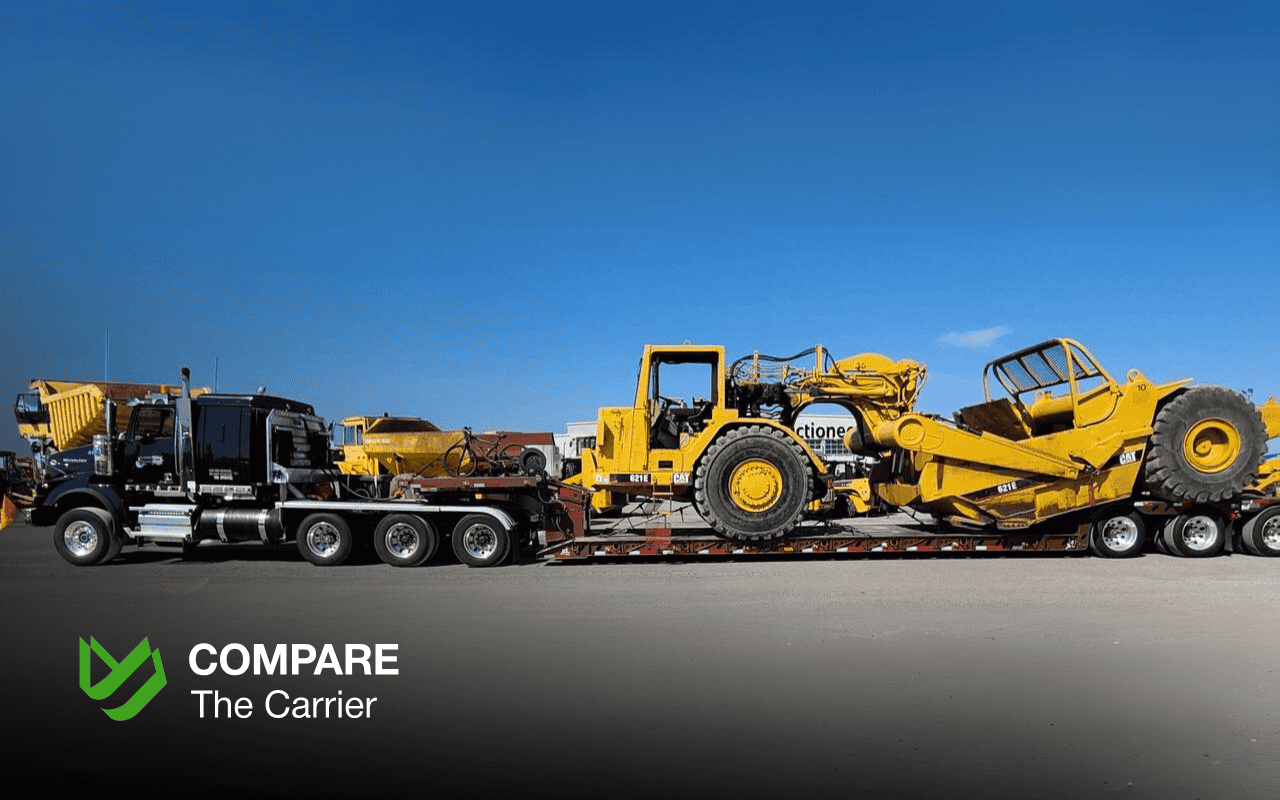
Heavy hauling is a complex logistical challenge, especially if you are a first-time buyer scaling your business. In 2026, with changing FMCSA regulations and fluctuating insurance premiums, navigating oversized loads and finding a reliable carrier is harder than ever.
You don’t just need a truck; you need an experienced transport partner. In this guide, we break down the critical pitfalls of heavy equipment transport, reveal how to spot hidden fees, and show you exactly how to compare and choose top-rated hauling companies that protect your assets.
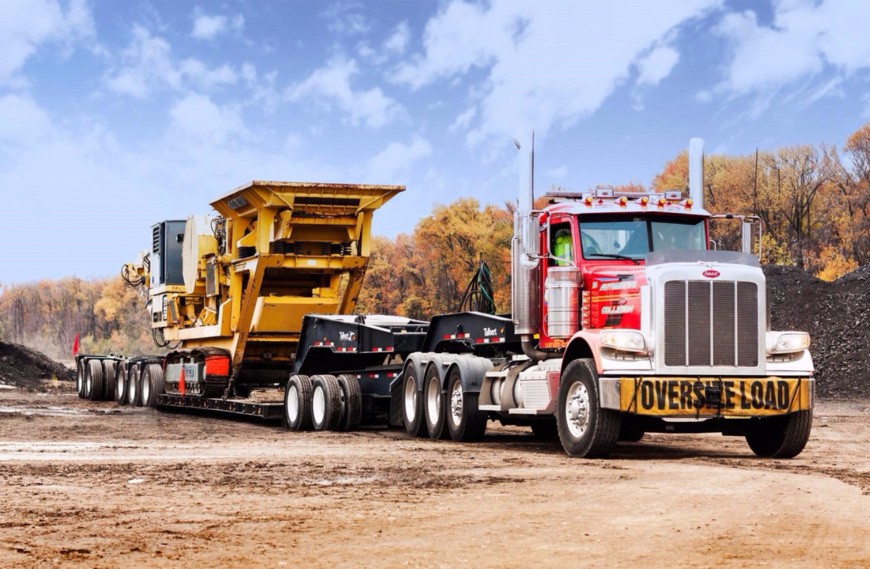
In the transport industry, “heavy hauling” refers to moving freight that exceeds standard legal size and weight limits set by the DOT. You aren’t just shipping a heavy box; you’re moving a non-standard load that requires specialized trailers, specific routing, and often, state-issued permits.
As a general rule, any cargo that exceeds the following standard legal dimensions requires heavy haul services:
The logistics of moving massive machinery depend entirely on your destination. Shipping a bulldozer a few states over requires a completely different strategy and different paperwork than putting a combine harvester on an ocean vessel. Below, we break down the two main transportation scenarios you’ll face and exactly how the process works.
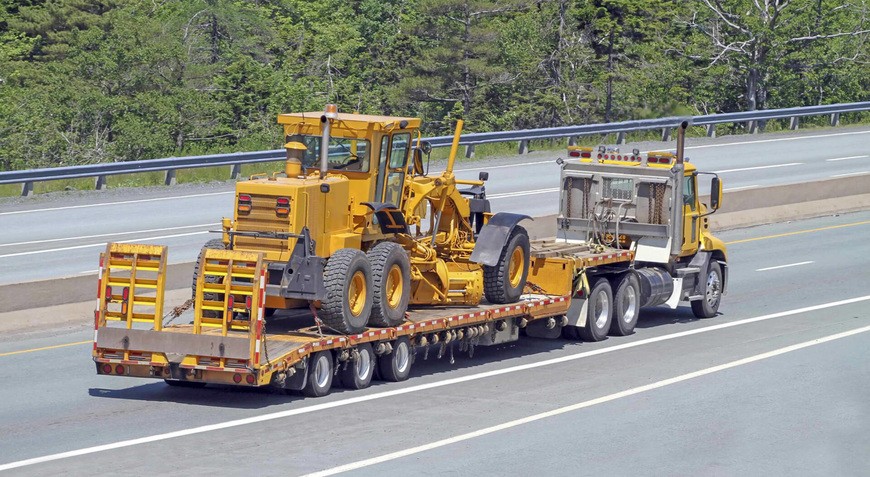
Cross country shipping standard freight across the country is relatively straightforward, but heavy machinery introduces a logistical maze. Shipping a regular pickup truck doesn’t require calculating bridge clearances, securing overweight permits, or hiring pilot cars to guide the trailer through tight routes.
When you partner with an experienced heavy hauler, they handle this complex groundwork for you. Here is exactly how the process works when you use a platform like Compare The Carrier to find top US transportation companies:
Whether you are moving your equipment to our overseas territories or internationally, there are only 3 main methods of shipping it on a vessel: Roll-on/Roll-off, Container transportation, and Flat-rack.
Let’s take a closer look at each method:
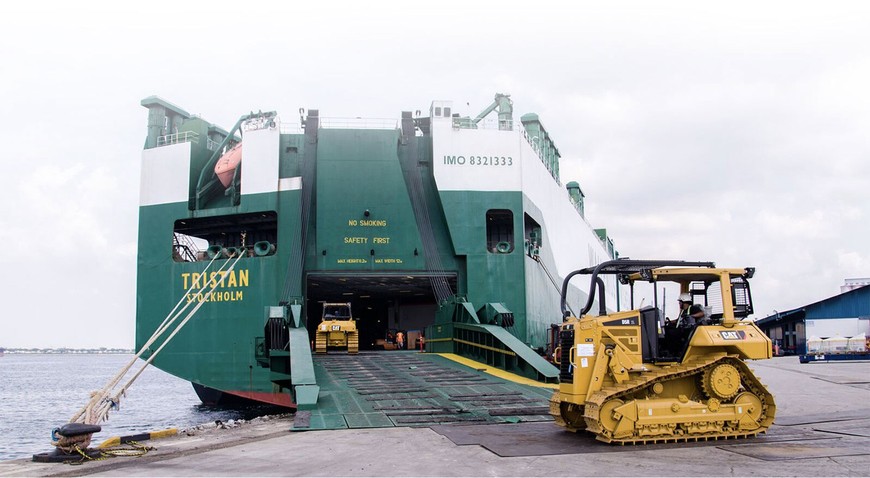
This is the most affordable and frequently used method. It can be used for shipping any kind of equipment that has wheels or treads and is lower than 15 ft as sometimes shipping companies have height restrictions. When this method is used, the vehicle is simply driven on and off the vessel. When the machine is driven onto the ship, it is fixed to the deck with special straps to ensure its immobility and safety.
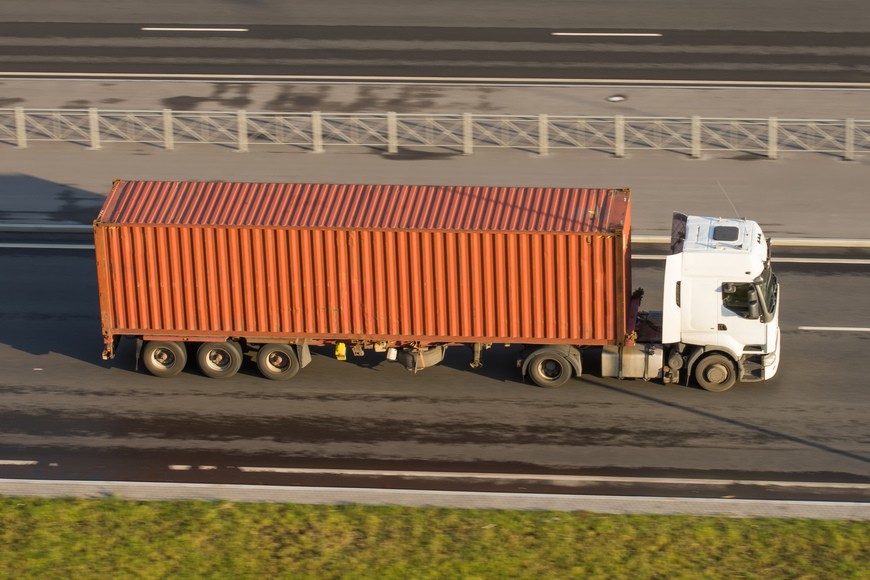
It is not a very popular method like the previous one as it can only be used if the equipment can fit in an enclosed container. They may be of different sizes: 20 ft long, 8 ft wide, 7 ft high; 40 or 45 ft long, 9 ft wide, 8 ft high. The container shipping method is mostly used for shipping regular vehicles or different kinds of things (like furniture, for example). The containers are loaded and unloaded with a crane, being stacked onto the vessel until delivered to the destination port.
Besides the size limits, this method also has another disadvantage: before the equipment is shipped, the customer has to disassemble it into separate parts that will fit in a container and properly fix all the parts. And of course, when the equipment arrives, the customer has to put the equipment back together.
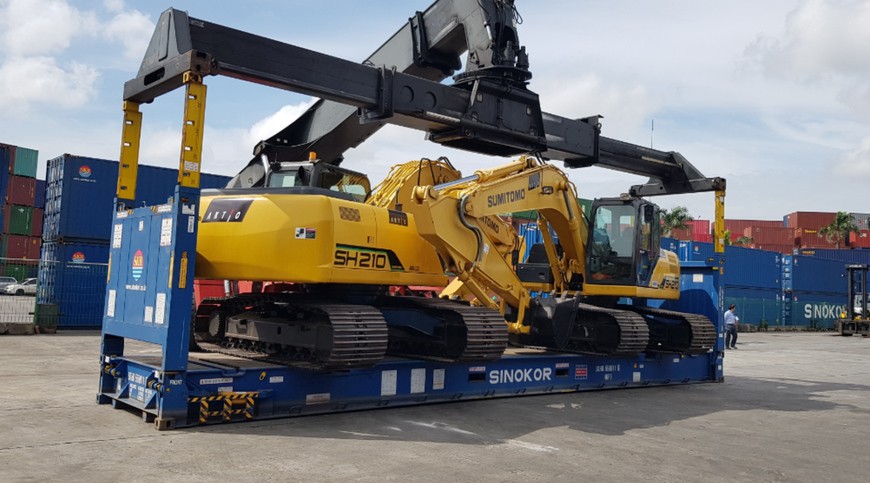
This one is mostly used when the equipment cannot be driven onto the vessel on its own (if it’s inoperable or does not have wheels). In such cases, the equipment is loaded onto a special rack that is stacked on the deck of the vessel using special loading equipment.
The heavy hauling process demands great attention to all details, and it is important to work with a shipping company that is experienced in heavy hauling and knows all the requirements, permits, and equipment that are needed for loading and unloading.
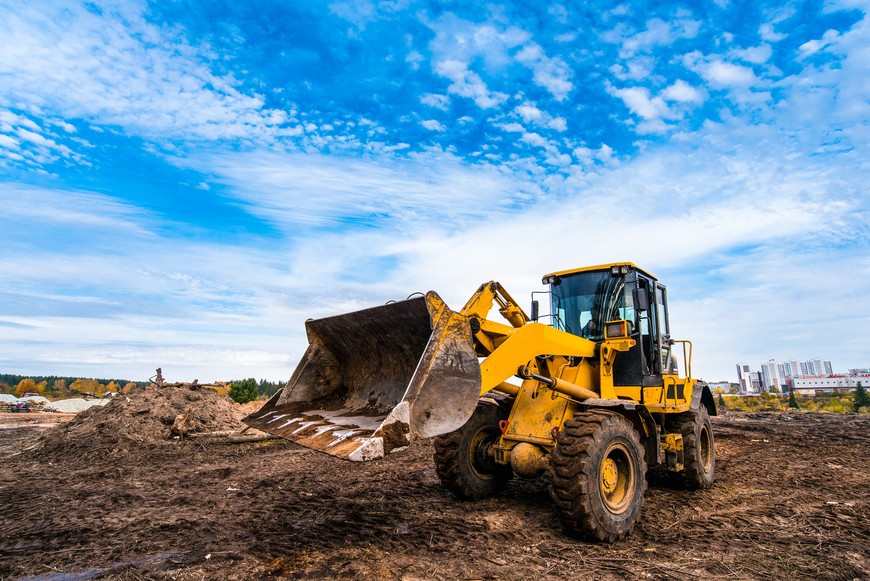
Our company has been in business for quite a long time and we are working with a number of professional carriers specializing in heavy hauling. We can help you with moving any type of oversize cargo from tractors to all kinds of bulldozers or other construction or farm equipment.
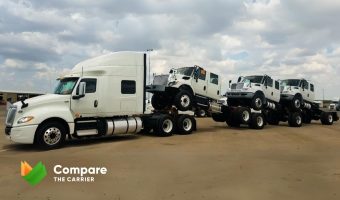
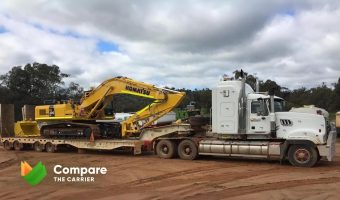
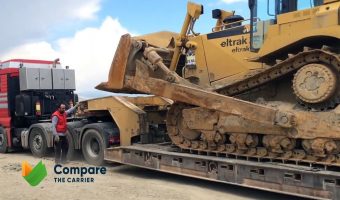
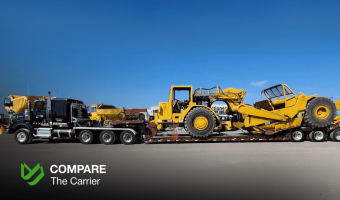
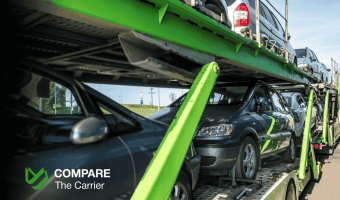
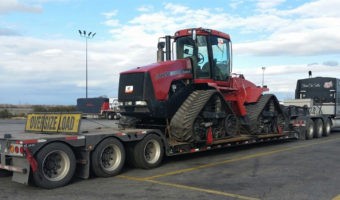
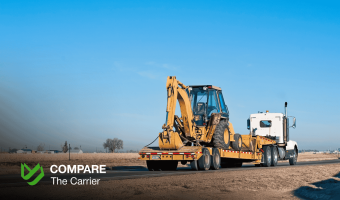
Here are some of the equipment and oversize cargo we have transported before:
If you haven’t seen the type of vehicle you want to ship, do not hesitate – request the quote at Compare The Carrier and we will be happy to assist you.
Any detail in the shipping of heavy equipment is very important, but choosing the right trailer is crucial for a safe move.
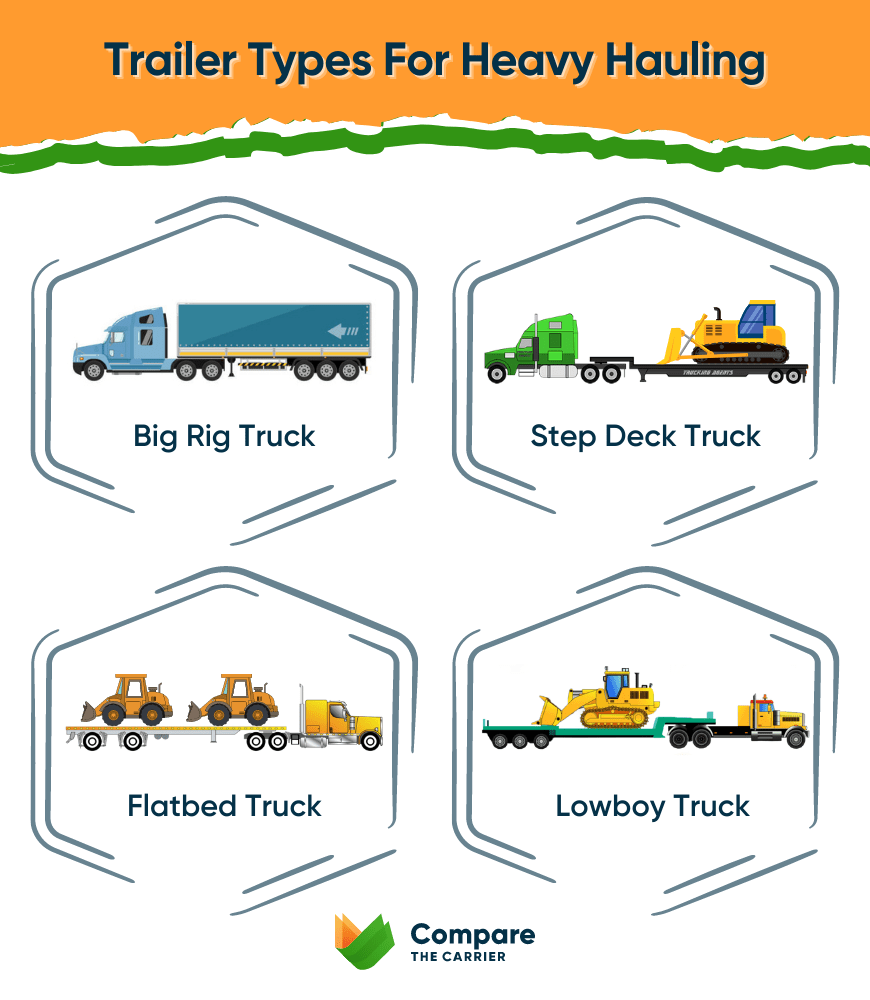
4 Common Trailer Types for Heavy Equipment Transport
When shipping machinery, the type of equipment dictates the trailer. Here are the four standard setups heavy haulers use:
When Do You Need Pilot Cars (Escort Services)? If your loaded equipment exceeds standard legal dimensions (often higher than 12 feet, or wider than 8.5–10 feet depending on the state), pilot cars are legally mandated. These lead and chase vehicles act as the eyes of the operation. Equipped with flashing amber lights, CB radios, and mandatory “Oversize Load” banners, they secure intersections, warn oncoming traffic, and ensure the load safely clears bridges and tight road conditions.
Shipping heavy equipment is not something you need to save money on. This job is very responsible and if it’s done by a novice company it may have a number of not-so-good consequences.
To give you an idea of a more or less realistic rate, we advise you to check the factors that the price always depends on:

The larger the vehicle is, the more expensive it is to get it transported. As we mentioned in the previous paragraph the type of trailer required also depends on the size of the equipment. Big rig truck and lowboy are the most expensive type of trailer, while step deck truck and flatbed are cheaper. And if the size of the vehicle exceeds any of the following parameters 80 000 lbs in weight, 48-53 ft in length, 13.6 ft in height, 8.6 ft in width, the escort service is required that will also affect the rate of transportation.
Another thing you need to pay attention to is the condition of the equipment you are shipping: if it cannot be driven onto the trailer, additional loading equipment is required and it will also add to the total cost.
This factor is quite clear as everyone understands that the longer the route is, the more it affects the price and shipping becomes more expensive.
Usually, the dates do not matter when you are shipping heavy equipment, but we still advise you to plan the transportation in advance especially if it is a long-distance move. Heavy haulers usually plan their routes far in advance as they need to be sure they have a job to do and they may ask for extra shipping equipment urgently. Furthermore, the earlier you plan it, the more time the company will have to schedule a driver for the most reasonable price and you will not have to pay extra.
Transportation of any kind of equipment that exceeds regular dimensions requires an individual approach and as we mentioned before, a number of factors affect the total rate.
Below you can see the estimated rate for heavy hauling, but we would highly recommend you to request a quote on our website and we will send you a more precise rate.
Mileage | Time in transit | Cost |
Up to 500 mi | 1-2 days | $4-5 per mile |
500 – 900 mi | 3-4 days | $3-4 per mile |
900 – 1500 mi | 4-5 days | $2.5-3.5 per mile |
1500 – 2000 mi | 5-7 days | $2-3 per mile |
More than 2000 mi | 7- 10 days | $1.75 per mile |
Transportation of heavy equipment overseas may vary from a few thousand dollars (for example, moving drilling equipment from Los Angeles, CA to Honolulu, HI costs $4 700) to hundred thousands of dollars (for example, moving a tower crane from New York, NJ to Germany costs $84 000). That is why if you are planning to move any kind of equipment overseas, we recommend you request a quote and your shipping agent will help you find the best way to transport the equipment overseas and of course, provide you with the total rate (fees included).
Heavy equipment shipping is more challenging than shipping a regular cargo as it requires more attention to the special preparation process.
Before shipping the heavy equipment you have to prepare it according to the standards required for its type. If the equipment is prepared incorrectly, it may result in an accident while shipping and if the carrier’s insurance company proves that equipment was not prepared properly, the claim will be denied.
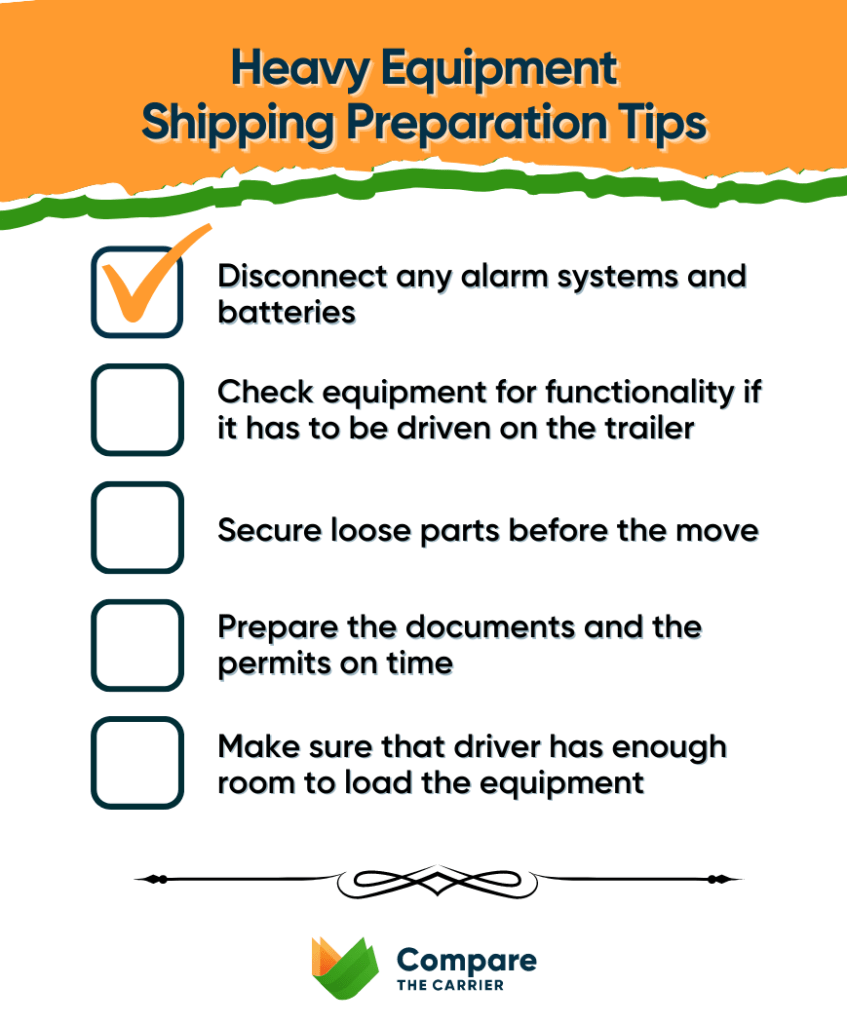
To avoid such situations we advise you to check the tips below that help you to get the equipment ready:
In addition to these steps, it’s essential to consider the packaging and crating needs for your heavy equipment. Proper packaging is crucial, especially for delicate components or machinery that requires extra protection during transportation. This is where industrial crating services come into play. Opting for professional industrial crating ensures that your equipment is securely enclosed in custom-built crates, offering optimal protection against potential damages during transit.
For a comprehensive understanding of the entire heavy equipment shipping process, we highly recommend watching our informative video, that dives deeper into each preparation step, providing valuable visual demonstrations and expert insights.
Most heavy machinery requires an open trailer (like a flatbed, step-deck, or lowboy) due to its massive size, weight, and awkward dimensions. Enclosed trailers are only suitable for smaller, weather-sensitive equipment like forklifts or loose engine parts. Open transport is the industry standard and generally more cost-effective.
Loading inoperable heavy equipment requires specialized rigging and lifting machinery. Transport companies typically use heavy-duty cranes, boom trucks, or heavy-duty winches to safely hoist or pull the machinery onto the trailer. Because this requires extra labor and specialized gear, loading non-running equipment will increase your overall transportation costs.
For standard heavy hauling, you should book your carrier at least one to two weeks in advance. However, if your equipment is exceptionally large and requires specialized trailers, pilot cars, or complex state-by-state oversize permits, booking three to four weeks ahead ensures optimal carrier availability and prevents costly project delays.
Heavy hauling services can move virtually any large-scale asset. Common loads include construction machinery (excavators, bulldozers, cranes), agricultural gear (combine harvesters, large tractors), and industrial components (manufacturing presses, wind turbine blades). If the equipment exceeds standard legal highway dimensions, a specialized heavy haul carrier must transport it.
The standard legal gross vehicle weight limit in the US is 80,000 lbs. However, heavy hauling specifically deals with exceeding these limits. With the correct multi-axle trailers and state-issued oversize/overweight permits, specialized carriers can safely transport massive industrial loads weighing well over 150,000 lbs across the country.
Heavy hauling rates are highly customized. The final cost depends on the equipment’s exact dimensions and weight, the total transport distance, and current diesel fuel prices. Additional critical cost factors include specialized trailer requirements, route surveys, state permit fees, toll costs, and the need for mandatory pilot cars.





Don't have time to fill out the form?
Call a transport company directly to get a quote now!
Select the category you need
Partner with Compare The Carrier & Grow!
We're open to collaborations, partnerships, and mutual growth! Whether you're an individual or a business, we offer exciting opportunities to work together. Fill out the form below to explore how we can collaborate.
Something Went Wrong
We're sorry, but something went wrong. Please briefly describe the problem you experienced in the text area below. Providing your contact information will allow us to follow up if needed.

Thank you,
your form has been accepted.
Your form has been successfully submitted. We appreciate your effort — our team will review it shortly and take the next steps.


