

Top Safety-Rated Cars In The U.S.: Latest Rankings
This guide goes beyond rankings to explain how modern saf...
15 January 2026
Let’s be real. Nobody likes the old-school car-buying process. And everyone has been there on a perfectly good Saturday, pacing across a cold showroom floor in front of a salesperson, nodding yes to salespeople and taking to your coffee, probably one of the worst lukewarm any time we’ve ever had a whole weekend. It’s exhausting.
Calculate Shipping Quotes
But in 2026, all that circus seems like a fossil. Think about it. You’re out on your patio on a Tuesday afternoon. Clicks on your phone, a quick digital signature and you’ve just purchased a car sitting on a lot 800 miles away. Forty-eight hours later, a customized carrier pulls up to your curb, and your new car is lowered straight onto your driveway.
That sounds like a high-tech dream, but it is now the gold standard at automotive retail. But from the buyer’s perspective, the car industry’s “Amazon-ification” has complicated matters under the hood a little. That’s not just a question of “Will they deliver it?” anymore. The biggest issue is: how can you deliver the car to the destination in one piece without being cheated on shipping?
In this guide, we’ll dig into the nitty-gritty of how dealership delivery exactly operates today. We’ll unearth the secret fees that dealers love to bury in the fine print and discuss why savvy buyers are now cutting out the dealership’s transportation altogether. Too often, the best you can do when it comes to putting a stake in your business is to arrange your own professional door-to-door car transport.
For years, automobile dealerships practiced “geographical friction.” If you resided in a small town, then the dealer in that town was the place to buy because the logistics hurdle of going to another place to buy in was too cumbersome.
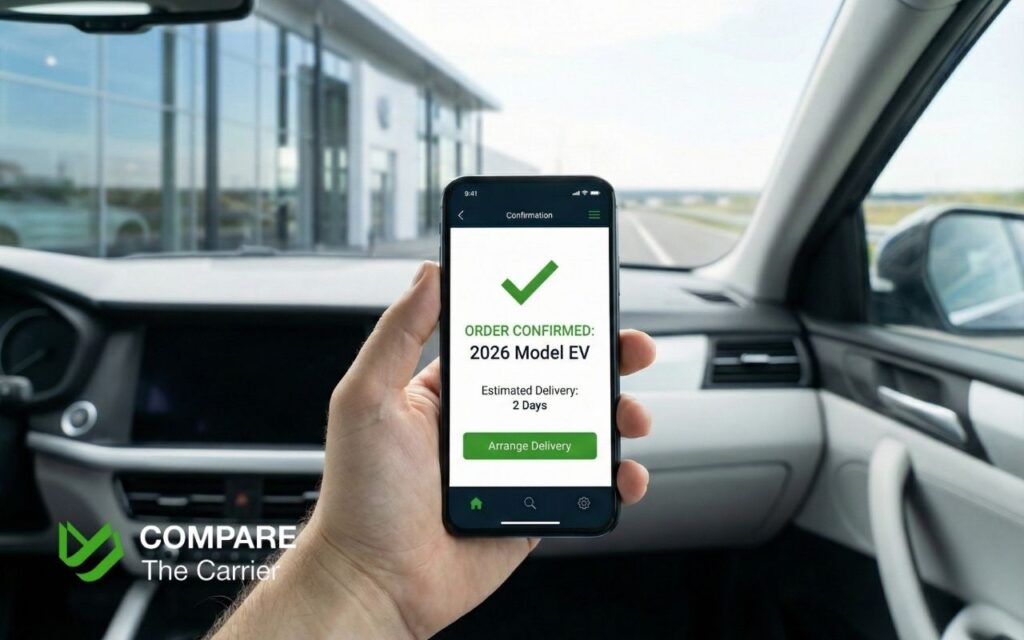
But the mid-2020s acceleration of digital transformation has broken those barriers. Now, dealerships exist in a borderless market. A Ford dealer in rural Ohio has now moved on to compete with a Ford dealer downtown in Los Angeles. Such competition has made dealers increasingly logistics adept. More than 80% of franchised dealerships offer home delivery, according to recent statistics provided by the National Automobile Dealers Association (NADA).
Membership-based programs like the Costco Auto Program have made this even simpler – connecting members with pre-negotiated dealer prices and arranging transport through a partner network.
In 2026, the car-buying journey nearly always starts online. Through 360-degree high-definition walkarounds, VR headset virtual test drives and digital financing documents, the physical shop itself is becoming a “delivery center.”
As a result, vehicle shipping has become a fundamental part of the sales chain. Whether you are purchasing a new Electric Vehicle or a certified pre-owned SUV, the “last mile” of that journey is how the customer experience is actually won or lost. No one has to worry about the customer journey anymore. But here’s the rub: being a dealer still means they have a right to deliver and not do so most efficiently or safely.
Distance is the No. 1 factor that affects how a dealership handles your delivery. Most will opt to “ship anywhere,” but they are guided to use the methods they do by distance.
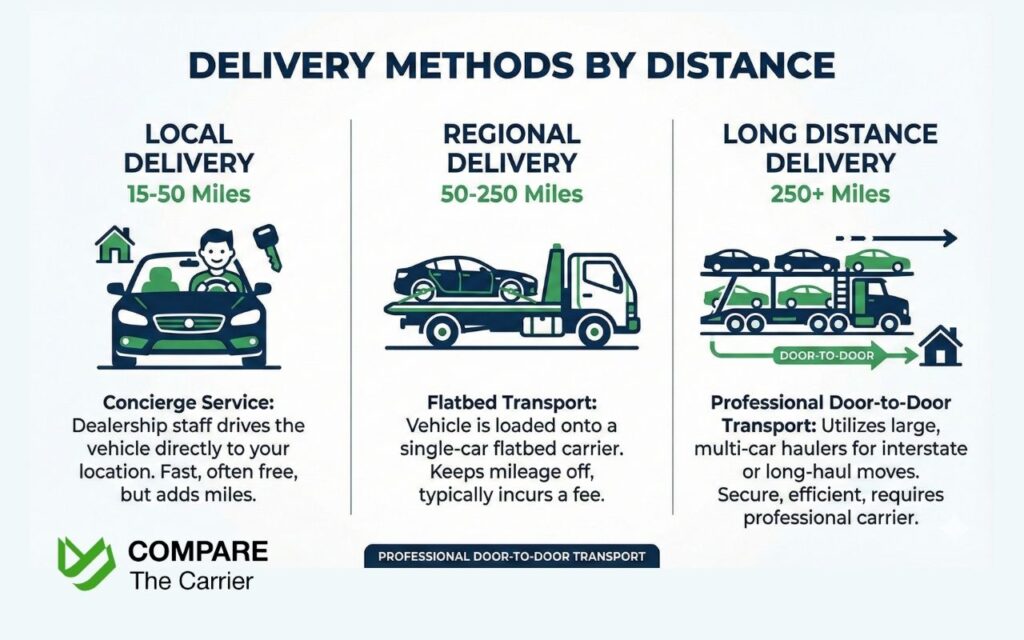
Local delivery, which is generally defined as a 15 to 50-mile radius, is often advertised as a free perk. Here, a dealership employee who will likely be a junior salesperson or even a “lot runner” will literally drive the car to your home.
These dealers regularly use a “flatbed” or “tow-away” service within that range. This is typical for luxury brands, and customers only expect the car to arrive via “delivery miles” (typically less than 20). It is at this distance that dealers start charging fees that begin to fluctuate between $150 and $400.
In case any of those matters are interstate or something that’s a few hours’ drive out of state, a dealer changes from hiring your own staff to employing third-party logistics providers. This is the world of professional door-to-door car transport.
For such hauls, the vehicle is loaded onto a multi-car hauler. In 2026, interstate delivery is a particular favorite among buyers seeking targeted EV configurations or tax-friendly deals in neighboring states. But this is also where the most pressing logistical challenges and the risk of hidden fees lie. Have you looked up the state reciprocity laws recently? If not, you could be greeted by a surprise at the DMV.
To understand car delivery costs, look beyond the single line item on your sales contract. Dealerships are businesses, and many people perceive shipping as a “profit center.”
Modern transportation has created a new environment in which shipping costs fluctuate with fuel prices, carrier availability, and vehicle weight.
A dealership will be a broker when they arrange shipping for you. They call a transport company, get a quote of $900, and then bill you $1,200. That $300 “convenience fee” is pure profit for them. And that is exactly why experienced buyers often seek to compare car shipping quotes on their own.
And the middleman-less approach means that you can often find a higher-rated carrier for significantly less in the end. In practice, the $300 you saved could fund your first half-year’s worth of insurance or a high-quality detailing job.
This increase in vehicle weight reflects the significant addition in EV battery packs to our fleet as we travel deeper into 2026. A Ford F-150 Lightning weighs significantly more than its internal combustion counterpart. Because carriers are constrained by weight limits imposed by the Department of Transportation (DOT), heavier cars cost more to ship. For an EV, expect a 10-15% “weight surcharge” on your delivery fee.
Buying a car from a new state introduces another layer of bureaucratic complexity. You are not merely bringing a piece of metal for sale; you are transmitting a legal title and a tax obligation.
A common misconception is that you have to pay the state sales tax of your car purchase. In reality, you almost always pay the sales tax of the state where the car will be registered. Software is used to calculate this at most dealerships, but the numbers need to be verified with your local State DMV.
For example, if the dealership delivers the car, they should be responsible for supplying you with the “MSO” (Manufacturer’s Statement of Origin) or signed-over title. In 2026, numerous states passed the Uniform Electronic Transactions Act (UETA), making e-titling a reality.
As tempting as it may be to have your dealer “handle it all,” there are compelling reasons to start taking ownership of the logistics yourself. From the market perspective, a dealer’s primary goal is to sell; you’re focused on the car’s safety.
If you hire your own professional door-to-door car transport service, you are the customer when it comes to business. You receive a driver’s cell phone number, live GPS tracking, and a direct line to the dispatcher.
When the dealer arranges it, you are “second-tier” by priority. If there is a delay, you will be in the dark more often because the dealer and the carrier are pointing fingers at each other. Have you ever sought a straight answer from a busy salesperson over a truck they didn’t hire directly? It’s not something I would recommend.
The limits vary, but every carrier must have cargo insurance. A dealer may hire the cheapest carrier with a $100,000 policy to move a $90,000 car; that’s a potentially dicey margin. When you reserve your own transportation, you can review the insurance certificates and ensure your coverage provides replacement value for your vehicle.
On the flip side, for purchases in the real world, knowing your investment is covered with a $250,000 or $500,000 policy gives you peace of mind that those vague “it’s covered” assurances can’t.
Dealerships typically “bundle” shipments. They may wait three days until they have another vehicle going in your direction so they can save money. If you arrange your own transport, you can dictate the “ready date.” This is especially important if you are timing the delivery with the end of a current lease or the beginning of a move to a new home.
To deliver smoothly, you need a protocol. Even the top dealerships can mess up when they hand off. See this from the lens of a logistics specialist.
Make sure all financing is cleared before the car is even loaded. In 2026, the vast majority of dealers use secure portals to sign documents in compliance with the ESIGN Act. When the “Funding Notice” is provided, the car is yours by law. This is the time to receive a final shipping quote.
The Bill of Lading is paramount in the vehicle shipping sector. It functions as the receipt but also provides a reference for an examination.
Don’t simply sign the paperwork when the truck arrives. Use a flashlight to inspect the car, regardless of whether it is raining or dark.

Important: Prior to leaving, state any damage on the BOL if this is found. If you sign a “clean” BOL, you’re legally proving the car arrived perfectly in working order, which makes insurance claims almost infeasible down the road.
Many of those customers are considering the “Fly and Drive” method. You buy a one-way ticket, Uber to the dealer, and drive the car back home. Let us do some math here for an 800-mile trip.
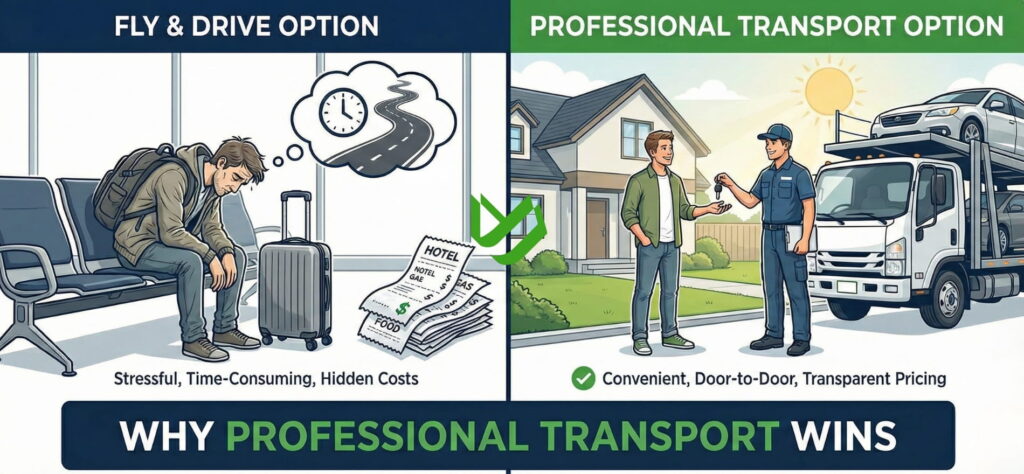
Compare this to a professional door-to-door car transport quote of $850. The professional option is also in the same pricing range, saving you 15+ hours of driving and the chance of a breakdown or crash on a new highway! As you understand the theory, buying a specific car from the suppliers requires only two different choices: delivery and repair. It is obvious for anyone who wants to make time on their radar app for this decision.
Many car buyers often do not realize that when they buy, it directly affects how their car comes off the dealership lot. The car transport sector is also extremely seasonal.
The growing industry has also meant growing numbers of “middleman” scams and poor brokers. Look out for these alert signs:
Delivery makes it easy to buy a car you’ve never touched. To minimize risk, treat the dealership like a partner but verify everything they say.
Before agreeing to delivery, hire a local mobile mechanic in the dealer’s city to perform a Pre-Purchase Inspection (PPI). For $150–$250, they will go to the lot, lift the car, and give you an unbiased report. This is the single best way to avoid “buyer’s remorse” when the delivery truck arrives.
In 2026, many “digital-first” dealerships offer a 3-day or 7-day money-back guarantee. However, read the fine print. Usually, the “shipping fee” is non-refundable, and you may be responsible for the cost of shipping the car back to the dealer if you change your mind. This can be an $1,800 mistake if you aren’t careful.
Before arranging delivery, always run a vehicle history check. Wondering whether Carfax delivers cars directly? Our guide explains exactly what Carfax does and doesn’t do – and how to arrange the actual transport separately.
The logistics industry has not stood still. Key technologies that have secured the future of professional door-to-door car transport are as follows:
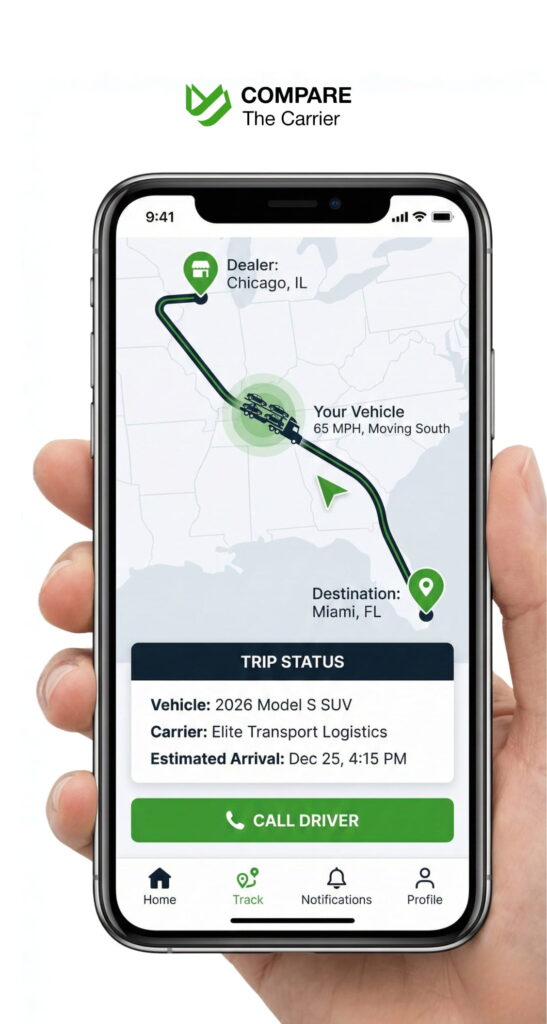
Sustainability is a hot topic in 2026. Many buyers are concerned about the carbon footprint of shipping a vehicle across the country.
Don’t assume the first price you see is the final one. Everything in a car deal is negotiable including the shipping.
The ability to have a dealership deliver a car to your doorstep is one of the greatest conveniences of the modern age. It opens a national inventory, enables better price negotiation, and saves you countless hours of travel.
However, as we’ve explored, the “set it and forget it” approach offered by dealerships often comes with hidden costs, lack of transparency, and reduced protection for your new asset. In 2026, the smartest buyers are those who separate the purchase from the logistics. By opting for professional door-to-door car transport through a trusted independent provider, you ensure that your vehicle is handled by experts who answer directly to you, not the dealership’s bottom line.
Whether you’re shipping a brand-new Tesla, a vintage Mustang, or the family’s next reliable SUV, the key to a successful delivery is preparation, documentation, and choosing the right partner.
Ready to see how much you can save compared to dealership rates? Use our instant shipping calculator to get an accurate, transparent quote and take the first step toward a stress-free car-buying experience.
While not every small, independent lot offers delivery, nearly all major franchise dealers (Ford, Toyota, BMW, etc.) and large national chains like CarMax and AutoNation have robust delivery programs as of 2026. If a dealer says they “don’t ship,” you can always arrange your own transport to pick the car up from their lot.
On paper, a gas and a plane ticket might look cheaper. However, when you factor in the cost of your time, hotel stays, meals, and the depreciation caused by adding 1,000+ miles to a new car, professional door-to-door car transport is often the more economical choice for distances over 400 miles.
If you arrange transport through a modern provider, yes. Most carriers in 2026 use GPS-enabled ELD (Electronic Logging Devices) that allow customers to see the vehicle’s location via a web link or app.
This is rare, but if it happens, it’s usually because the dealer wants to force you into their marked-up shipping service. Remind them that the car is legally your property once the paperwork is signed and that you have the right to choose who handles it.
The manufacturer’s warranty covers mechanical defects and workmanship. It does not cover damage caused by external factors during transport (like a rock hitting the windshield). This is why the carrier’s cargo insurance and your own personal auto insurance are so critical during the delivery phase.
Absolutely. Professional door-to-door car transport means the driver will get as close to your specified address as legally and physically possible. If your office has a large enough parking lot for a car hauler to maneuver, they can drop it off right at your desk.
Most independent transport services require a small deposit via credit card to secure the spot, with the remaining balance (COD – Cash on Delivery) paid to the driver upon arrival by certified check or through a secure digital payment portal.
Typically, it takes 1–2 days to pick up the vehicle once it’s ready, and another 3–5 days for the actual transit. Factors like weather and driver rest requirements (mandated by the FMCSA) can influence these windows.










Don't have time to fill out the form?
Call a transport company directly to get a quote now!
Select the category you need
Partner with Compare The Carrier & Grow!
We're open to collaborations, partnerships, and mutual growth! Whether you're an individual or a business, we offer exciting opportunities to work together. Fill out the form below to explore how we can collaborate.
Something Went Wrong
We're sorry, but something went wrong. Please briefly describe the problem you experienced in the text area below. Providing your contact information will allow us to follow up if needed.

Thank you,
your form has been accepted.
Your form has been successfully submitted. We appreciate your effort — our team will review it shortly and take the next steps.


