2026's Top Online Marketing Strategies for Logistics
The most effective online marketing strategies for logist...
20 August 2024
Buckle up! We’re about to turbocharge your transport company with proven tactics and insider tips on how to promote your business.
Contact Us Now
The transport industry is more competitive than ever, with companies jostling for attention in a crowded marketplace. Whether you’re figuring out how to start a shipping company or how to promote your business, standing out is key.
It’s not just about delivering on time; it’s about making sure people know who you are, trust your services, and choose you over the competition. From crafting a compelling brand to leveraging digital marketing strategies for transport business that work, like those discussed in our article on Brokerage Growth Strategies: Supercharge Your Marketing in 2026, promoting your company the right way can significantly impact your success.
In this article, we’ll dive into actionable tactics designed to increase your visibility, attract more customers, and keep you ahead of the competition. From understanding your market to embracing the latest trends in logistics marketing strategy, we’ve got you covered. And if you’re looking for a partner to supercharge your efforts, Compare The Carrier Digital Agency is here to help you navigate the road to success.
Whether you’re looking for transportation marketing tips to boost local visibility or need help with your broader logistics marketing strategy, this article will equip you with the knowledge to grow your business and navigate the complex world of transportation industry growth.

You wouldn’t hit the road without a map, right? The same goes for marketing your transport business. Before you rev up any promotional campaigns or embark on how to start a shipping company, you need to understand the terrain – your market and your place in it.
First, clearly define who you are hauling for. Are you targeting individuals needing cross-country auto transport, or B2B clients requiring specialized heavy haul logistics? Once you pinpoint the audience, identify their operational pain points.
To gain a true competitive edge, you must map out the landscape. Investing in professional growth opportunities research helps you size up competitors, understand their positioning, and identify unserved niches in the market.
Tip: Use surveys, social media polls, or even good old-fashioned conversations to gather insights.
Next, size up the competition. Who else is vying for your customers’ attention? What are their strengths and weaknesses? How do they position themselves in the market? This intel will help you spot opportunities to differentiate your transport business, whether you’re looking into how to start a shipping company or expand an existing one, and carve out your own niche.
What makes your transport business the obvious choice? Do you offer lightning-fast deliveries, unbeatable prices, or specialized handling for delicate cargo? Whatever it is, that’s your Unique Value Proposition (UVP) – the core reason customers should choose you over the competition.
Your UVP must be the cornerstone of your messaging. Furthermore, how your company looks and sounds matters. Shippers want to partner with professional, stable entities. Investing in expert logistics branding and design ensures your logo, assets, and overall identity communicate reliability and authority before you even pitch your services.
Remember: Your brand is more than just a logo. It’s the feeling customers get when they interact with your business.
According to the latest data from the American Trucking Associations, the U.S. trucking industry generated a massive $906 billion in revenue, moving over 11.27 billion tons of freight. While the market has seen recent capacity shifts and rate fluctuations, the sheer volume of available freight highlights a massive opportunity for carriers positioned correctly. By deeply understanding your target market and establishing an authoritative brand presence, you lay a bulletproof foundation for your marketing efforts. In a $900+ billion industry, it’s not about finding freight it’s about making sure the best-paying shippers find you.
Think of your online presence as the digital equivalent of a well-maintained fleet of trucks: it’s essential for getting your business where it needs to go in today’s world. Whether you’re figuring out how to start a shipping company or growing an established business, a strong online presence is your 24/7 storefront, information hub, and customer service center, all rolled into one.

Building a strong online presence is a cornerstone of any successful logistics marketing strategy. Remember, 97% of people learn more about a local company online than anywhere else, making it crucial whether you’re in the early stages of how to start a shipping company or scaling up. Invest in your digital presence, and you’ll be well on your way to mastering how to promote your business in today’s competitive landscape.
Scaling your transport operations doesn’t require a massive ad budget right out of the gate. If you are operating on tight margins or bootstrapping a new brokerage, you need high-ROI tactics that drive actual freight volume without burning through cash.
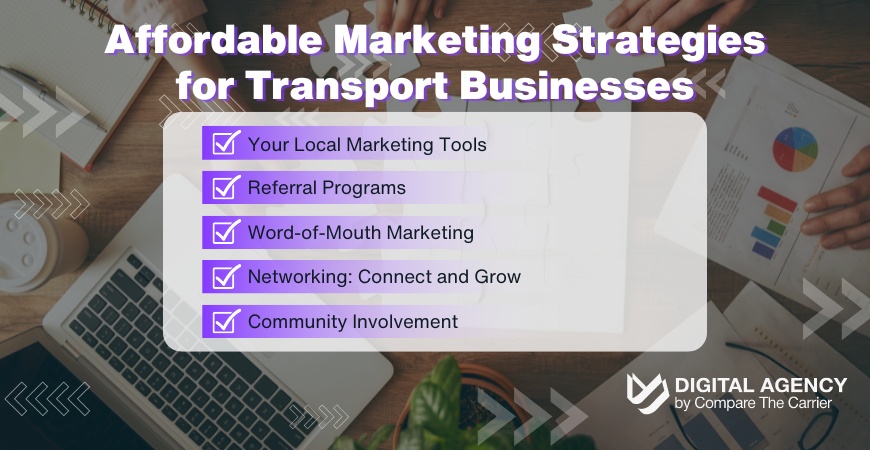
We cannot overstate the value of a dialed-in local search presence. Your Google Business Profile is a free asset that acts as a direct pipeline to local shippers. Optimize your profile and website content around high-intent local keywords think “freight capacity Chicago” or “heavy haul Los Angeles” so you capture demand exactly when shippers are looking to move freight. Instead of constantly paying for leads, building a strong local SEO foundation through professional SEO strategy execution generates inbound volume on autopilot.
Your current book of business is your best sales team. A structured referral program motivates satisfied shippers to introduce you to their network. By offering credit on future loads, volume discounts, or tiered perks for successful introductions, you tap into highly qualified, high-trust leads. To maximize this, consider proper sales and marketing integration so your team tracks these referrals seamlessly without letting potential revenue slip through the cracks.
In logistics, reputation is currency. Consistently delivering on-time, damage-free freight with transparent communication naturally forces your clients to talk about you. Capitalize on this by actively securing testimonials and case studies from your top accounts. Showcase these wins on your website and leverage targeted SMM for social networks to amplify that social proof and build instant credibility with new prospects.
Freight is still a relationship business. Get out from behind the screen and attend industry trade shows, local chamber of commerce meetings, and supply chain association events. Face-to-face networking builds the kind of trust that secures dedicated lanes and long-term contracts. Equipping your team with practical logistics sales training ensures they know exactly how to turn those casual handshakes into closed deals.
Sponsoring a local youth team or providing logistics support for community charity events does more than build goodwill; it humanizes your brand. It shows prospective clients that you are an established, invested fixture in the local market, not just a faceless carrier. Combining these offline community efforts with a smart inbound marketing strategy for logistics can effectively convert that local goodwill into website traffic and actual shipping quotes.
Marketing your fleet is not a set-it-and-forget-it task; it requires consistent execution. Keep this statistic in mind:
83% of buyers trust recommendations from their network more than any other form of advertising. This highlights why word-of-mouth and referral systems are the most lucrative, budget-friendly growth levers in logistics. Let Compare The Carrier help you navigate this space. Contact us today to explore how we can implement a custom digital marketing strategy for logistics companies that targets your specific ideal shipper profile and drives sustainable growth.
This highlights the incredible value of word-of-mouth marketing and referral programs, strategies that are both effective and budget-friendly.
Let Compare The Carrier help you navigate the world of logistics marketing strategy and propel your transport business forward.
The transport industry is constantly evolving, and so are the ways to market your business within it. To stay competitive and fuel transportation industry growth, you need to keep your finger on the pulse of the latest trends and technologies.
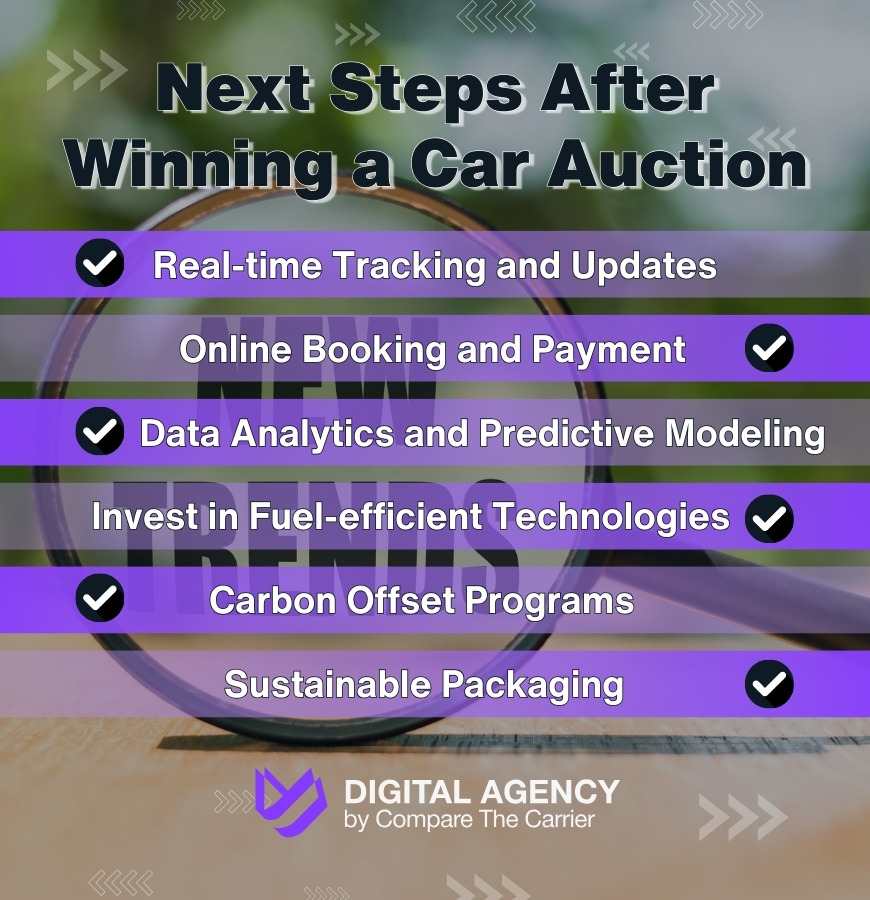
Here are a couple of game-changers to watch:
Technology is revolutionizing the way we do business, and the transport sector is no exception. Embracing digital tools and automation, such as AI in logistics, can streamline your operations, improve efficiency, and enhance the customer experience. Think about incorporating features like:
In an era of growing environmental awareness, sustainability is becoming a key factor in consumer decision-making. Highlighting your commitment to eco-friendly practices can attract environmentally conscious customers and enhance your brand reputation. Consider:
By staying ahead of these trends and incorporating them into your logistics marketing strategy, you can position your transport business for continued growth and success in the years to come.
Figuring out how to promote your business in the transport sector is an ongoing journey, not a destination. In this fast-paced industry, staying ahead requires constant adaptation and a willingness to embrace new marketing strategies.
By understanding your market, building a strong online presence, leveraging cost-effective tactics, and staying ahead of innovative trends, you can position your business for continued growth. Remember, effective transportation marketing isn’t just about getting your name out there—it’s about building relationships, establishing trust, and delivering value to your customers.
Whether you’re just learning how to start a shipping company or looking to expand an existing logistics business, the right marketing strategies can fuel your success. With a little creativity, persistence, and a solid logistics marketing strategy, you can navigate the complexities of transportation industry growth and reach new heights. Partnering with the top digital agencies specializing in logistics can also provide expert support to accelerate your success.
So, what are you waiting for? It’s time to hit the road and promote your business like a pro!
In 2026, differentiation requires moving beyond basic reliability. Shippers expect real-time freight visibility and seamless API integrations. You must specialize in a specific niche, such as hazardous materials or temperature-controlled freight, and utilize predictive analytics to guarantee capacity. Highlighting a tech-forward approach and verifiable sustainability metrics immediately separates your fleet from legacy carriers.
Claim and fully optimize your Google Business Profile to capture local “near me” freight queries. Implement a structured referral program incentivizing your current shipper network. Additionally, publishing highly specific, data-backed market updates on LinkedIn establishes industry authority and drives targeted B2B inbound leads without requiring a massive advertising budget.
Starting a successful shipping company in 2026 demands a robust digital-first foundation. Prioritize securing your operating authority and adequate insurance. Immediately invest in a modern Transportation Management System (TMS) and launch a conversion-optimized website. Establishing an integrated logistics marketing strategy from day one is essential to secure initial freight contracts and stabilize cash flow.
Industry growth intensifies competition and accelerates shipper expectations. Marketing must shift from static brochures to dynamic, data-driven campaigns. Carriers must actively promote their technological capabilities, such as automated quoting and AI-driven route optimization. Adapting your messaging to highlight supply chain resilience and ESG (Environmental, Social, and Governance) compliance is now mandatory to win enterprise contracts.
Online reputation directly dictates your ability to close high-paying freight. In 2026, B2B shippers and AI procurement tools heavily analyze digital footprints before onboarding new carriers. Consistent, positive reviews on Google and industry-specific platforms validate your reliability. Actively managing feedback and showcasing verifiable case studies builds the critical trust required for long-term logistics partnerships.
Modern logistics SEO focuses on capturing specific search intent rather than broad keywords. Optimize your site for long-tail, high-conversion queries like “flatbed capacity in Chicago” or “cross-border freight brokers.” Ensure your website is technically sound, mobile-responsive, and structured to provide direct, factual answers. This strategy secures visibility in traditional search results and emerging AI Overviews.











Select the category you need
Partner with Compare The Carrier & Grow!
We're open to collaborations, partnerships, and mutual growth! Whether you're an individual or a business, we offer exciting opportunities to work together. Fill out the form below to explore how we can collaborate.
Something Went Wrong
We're sorry, but something went wrong. Please briefly describe the problem you experienced in the text area below. Providing your contact information will allow us to follow up if needed.

Thank you,
your form has been accepted.
Your form has been successfully submitted. We appreciate your effort — our team will review it shortly and take the next steps.