

Best MPG Hybrid Cars of 2025/26: Top Picks for Fuel Efficiency
The automotive landscape of 2026 has made one thing clear...
20 March 2026
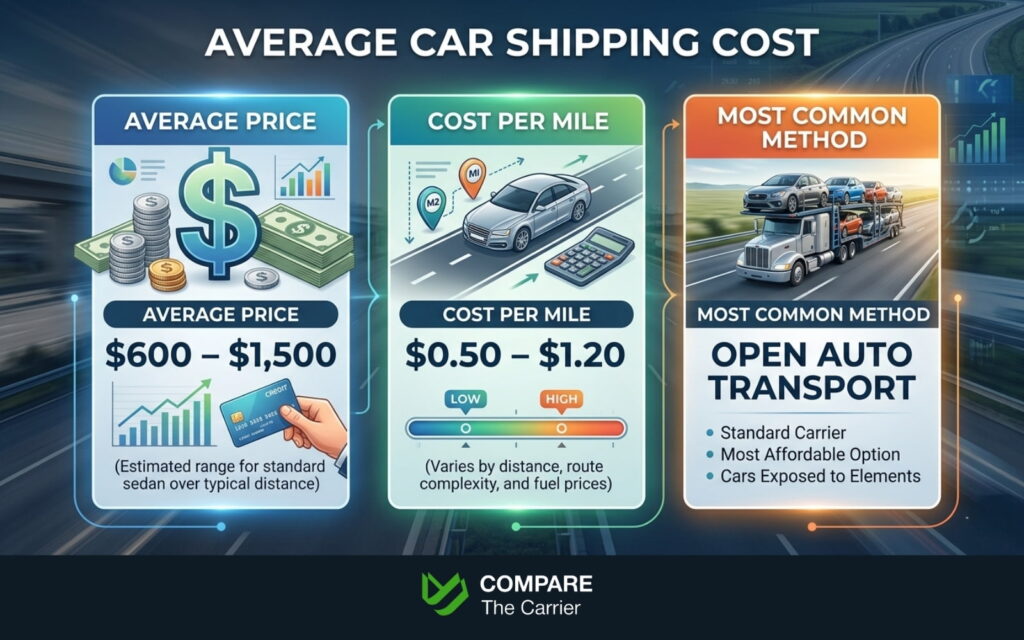
Shipping a car to another state costs between $600 and $1,500 on average, which breaks down to roughly $0.50 to $1.20 per mile. The most affordable and common method is open transport via a licensed auto carrier with door-to-door delivery. Your final quote will fluctuate based on the total distance, vehicle dimensions, and seasonal market demand.
Calculate Shipping Quotes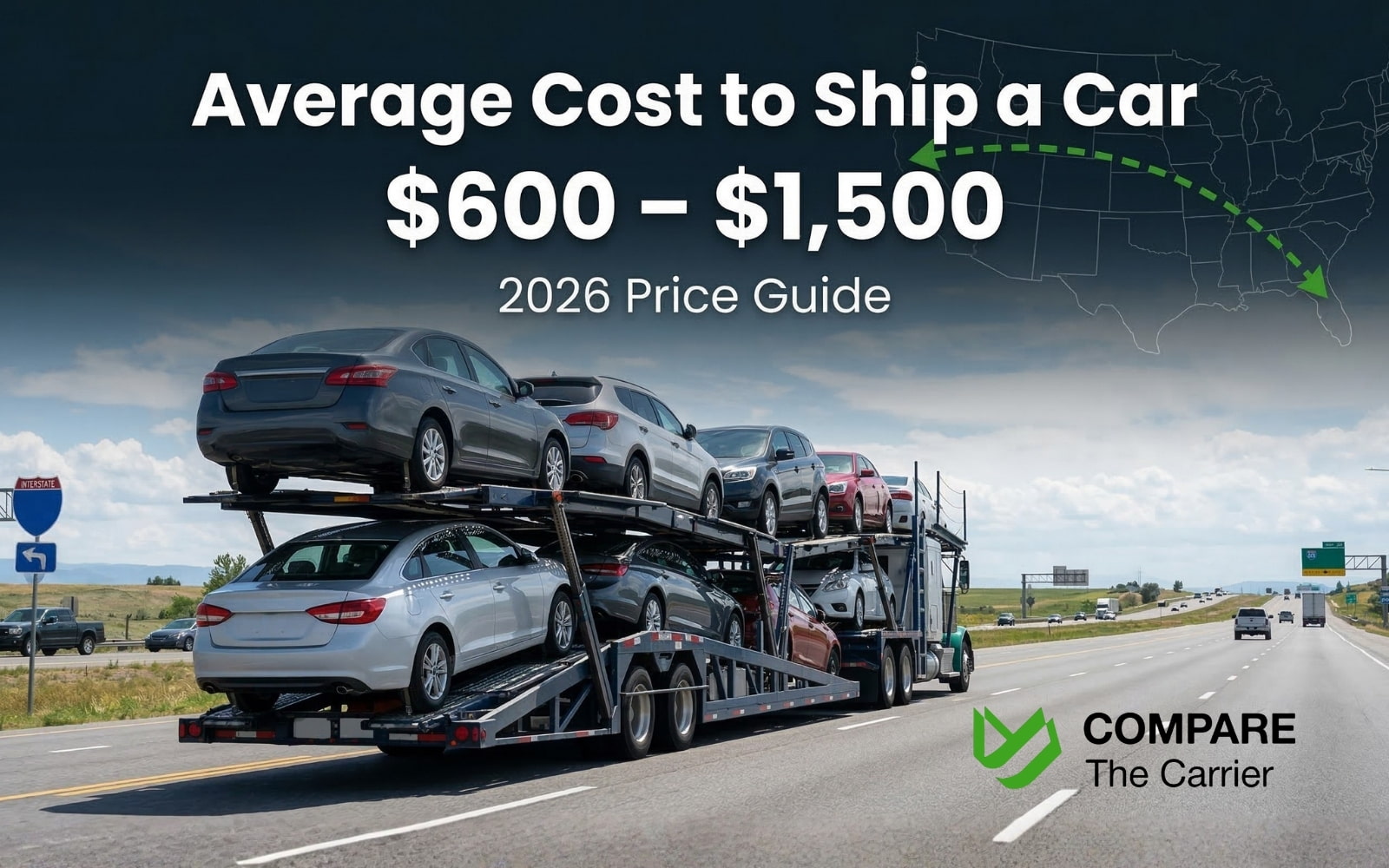
When I first had to coordinate a cross-country move, the sheer number of moving parts was overwhelming. You’re packing boxes, arguing with utility companies, and suddenly you realize: how am I actually getting my car there? You might assume driving it yourself is the cheapest route. But once you sit down and add up the gas, two nights in a roadside motel, and three days of sheer driving exhaustion, handing the keys to a professional transport carrier often makes a lot more sense.
The immediate next hurdle, though, is figuring out the money. The auto transport industry is notoriously murky. You request a quote online and your phone instantly blows up with texts from twenty different brokers, all throwing wildly different numbers at you. It is frustrating to figure out what is a fair market rate and what is just a sales pitch trying to drain your moving budget.
In this guide, we are going to strip away the industry jargon. I’ll show you exactly how these prices are calculated behind the scenes, where you can cut corners to save money, and where going cheap will actually cost you more.
The average cost to ship a car to another state ranges from $400 to $2000+, depending on distance, vehicle size, and transport method. Open transport is the cheapest way to move a vehicle, typically costing between $0.50 and $1.20 per mile. Enclosed transport adds 30% to 50% to the base price. Rates consistently fluctuate based on current fuel prices, route availability, and seasonal carrier demand.
When I talk to people looking to move their vehicles across state lines, the very first question is always about the bottom line. It’s natural to want a single, flat price tag. You go to a store, look at a price tag, and that’s what you pay.
But the auto transport industry doesn’t operate like a retail store or the post office. It functions on a dynamic bidding system. Carriers accept loads based on route efficiency, fuel costs, and what the current market will bear.
This means the price to ship a Honda Civic from Ohio to Texas in July will look very different from the price to ship a Ford F-150 on the exact same route in December. To get the best deal, you have to look under the hood of how these quotes are actually built.
Distance is the most obvious factor in your quote, but it doesn’t scale exactly the way most people assume. Take a look at these real-world averages:
| Distance | Average Cost | Approx. Cost Per Mile |
| Short (0 – 500 miles) | ~$600 | $0.80 – $1.20 |
| Medium (500 – 1,000 miles) | ~$800 | $0.75 – $1.00 |
| Long (1,000 – 2,000 miles) | ~$1,200 | $0.60 – $0.85 |
| Cross-Country (2,000+ miles) | ~$1,600 | $0.50 – $0.75 |
Notice a trend here? The further your car travels, the lower your cost per mile drops.
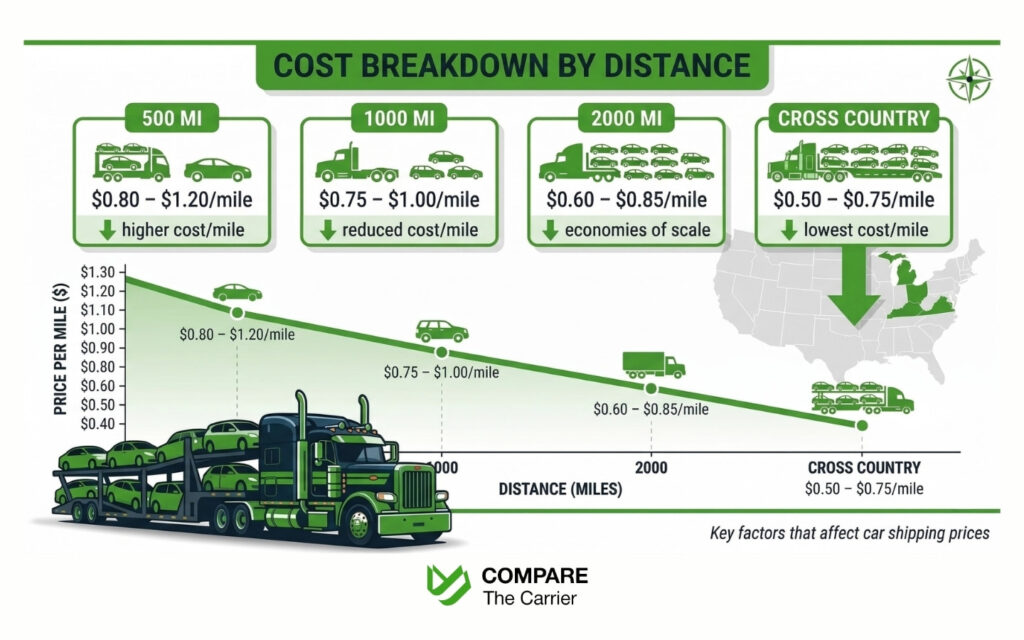
This happens because the carrier has fixed costs associated with every single job. Loading the car, securing it, completing the inspection paperwork, and taking the time to route the truck all happen regardless of whether the car is going 100 miles or 3,000 miles. On a cross-country trip, the driver gets to spread those fixed costs out over days of highway driving, which drops the per-mile rate.
A quote from a broker isn’t just a random number pulled from thin air to see what you’ll pay. Dispatchers calculate your final rate using a specific set of variables. If you want to find the cheapest way to ship a car to another state, you need to know how these levers work and which ones you can control.
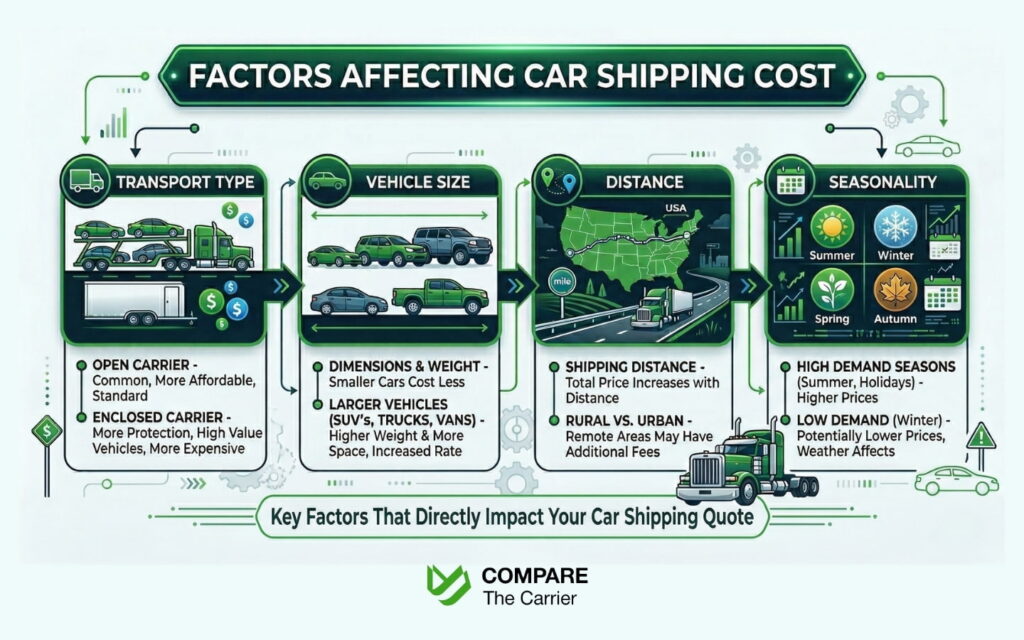
How your car rides makes the biggest dent in your budget.
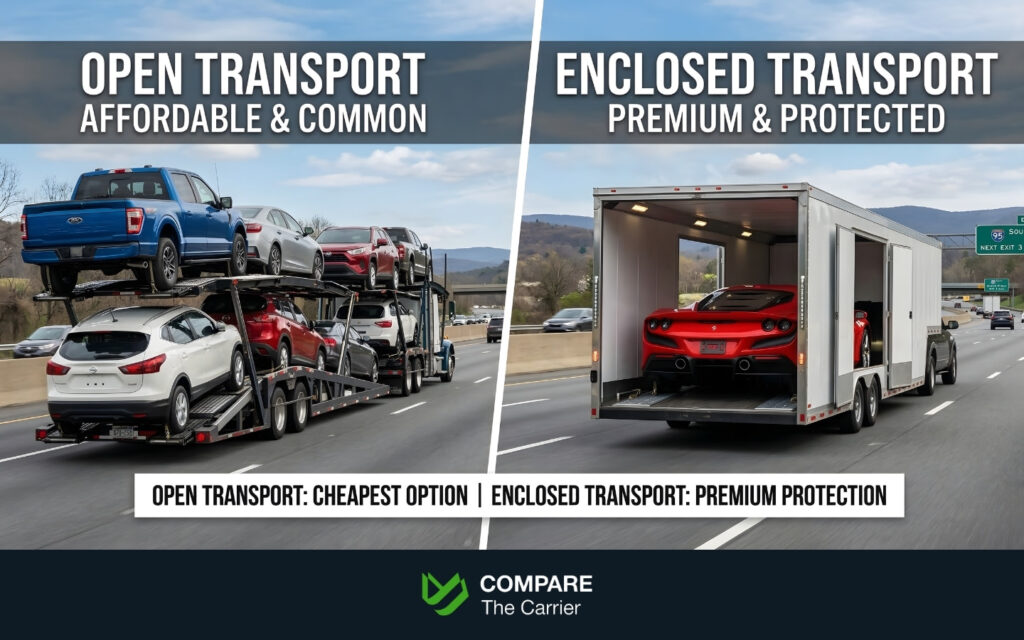
Open transport is the industry standard. This is what you see on the highway every day: a massive, multi-level trailer loaded with up to nine or ten vehicles. Because your car shares the space with so many others, the carrier can afford to charge you less. It’s the cheapest way to ship a car, period. Dealerships use it for brand-new inventory, and it is perfectly safe for standard daily drivers. The only real trade-off is that your car is exposed to rain, dust, and the occasional highway bug. It will arrive looking like it just drove the distance itself.
Enclosed transport, on the other hand, is a premium service. The truck has soft canvas or hard metal walls, completely shielding the vehicles inside from the elements. Because these trailers hold fewer cars (usually two to six) and require specialized lift-gate equipment, you will pay a premium. Enclosed shipping typically costs 30% to 50% more than open transport.
I usually tell folks to skip enclosed transport unless they are shipping a classic car, a high-end exotic, or a custom build where a single rock chip would be a disaster. For a standard Toyota Camry, open transport is exactly what you need.
Carriers are strictly regulated by the Department of Transportation regarding how much weight their trucks can legally haul. A heavy-duty pickup truck or a large SUV takes up more physical space on the trailer and pushes the truck closer to its legal weight limit than a compact sedan.
As a result, larger vehicles command higher shipping rates. Expect to pay a $100 to $300 premium if you’re shipping a Chevy Tahoe compared to a standard car.
Condition matters just as much as size. If your car doesn’t run, the driver can’t just drive it onto the ramp. It requires a winch or a forklift to load and unload safely. That extra labor and specialized equipment result in an “inoperable vehicle” fee, which generally adds another $150 to $200 to your bill. If the car doesn’t steer or brake, the logistics become even more complicated, and the price goes up accordingly. Keep it running if you can.
Where the truck picks up and drops off your car changes the price, though maybe not as much as it used to.
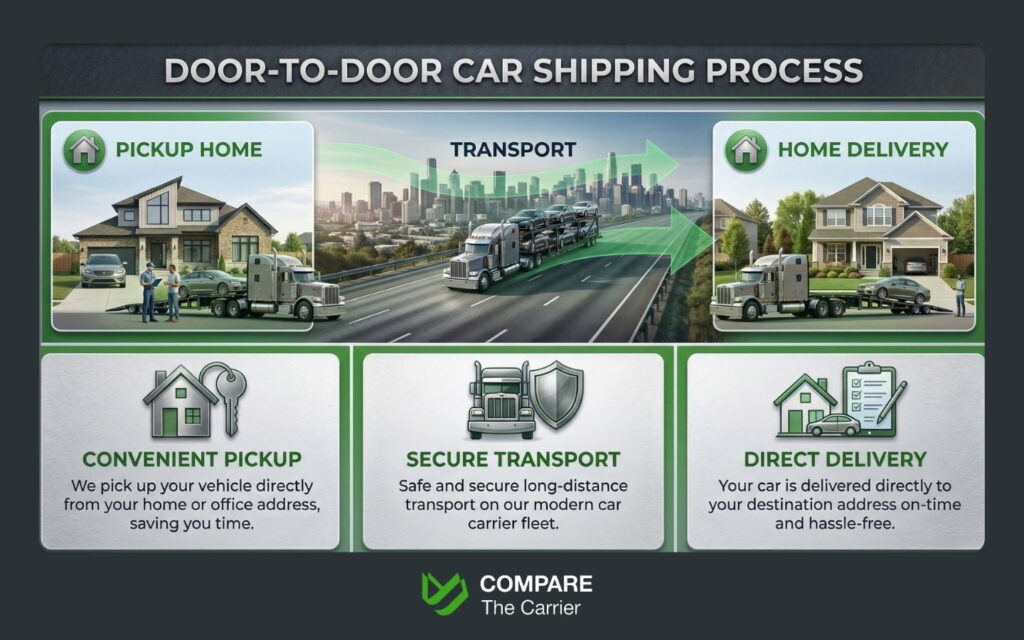
Door-to-door delivery is exactly what it sounds like. The driver gets as close to your specified address as legally and physically possible. (Keep in mind, an 80-foot truck can’t turn around in a tight suburban cul-de-sac, so you might have to meet them at a nearby grocery store parking lot). It’s incredibly convenient, but because it takes the driver off their main highway route, you pay for that convenience.
Terminal-to-terminal shipping requires you to drop off and pick up the vehicle at designated regional storage lots. Years ago, this was the ultimate budget hack. Today? Not always.
While the baseline shipping rate might be lower because the driver just drops off a bunch of cars at one hub, those terminals are essentially parking garages. They charge daily storage fees. If the car sits there for five days before you can pick it up, those storage fees will quickly wipe out any savings you got on the transport rate. It’s a valid option, but you have to do the math carefully.
When you ship matters almost as much as where you ship.
The auto transport industry has distinct peak seasons. During the summer, everyone is moving. Families are relocating while kids are out of school, and college students are moving to their university towns. High demand means high prices.
Then there is the “Snowbird” season. Every autumn, thousands of retirees move from colder northern states (like New York or Michigan) down to warmer climates (like Florida or Arizona). If you are trying to ship a car south in October, you are competing with thousands of other people for the same truck space. Carriers know this and raise their rates on those specific southbound routes.
The reverse happens in the spring when everyone heads back north. If you can swim against the current — say, shipping northbound in November you can often negotiate a surprisingly cheap rate, because carriers are desperate to fill their trucks for the return trip north.
The most effective way to lower car shipping costs is by booking open transport, maintaining flexible pickup dates, and comparing at least three quotes from licensed auto transport brokers. Preparing your vehicle properly such as keeping it operable and removing heavy personal items also prevents unexpected carrier fees at the time of pickup.
While you can’t control the price of diesel fuel or the distance between Chicago and Phoenix, you actually have quite a bit of leverage when it comes to the final price on your contract. The trick is knowing where carriers are willing to negotiate and where they won’t budge.
Most people approach car shipping like booking a flight: they pick a specific date and expect a set price. If you want the cheapest way to ship a car, you have to throw that mindset out the window.
Flexibility is your biggest bargaining chip. If you tell a broker, “I absolutely need my car picked up this Friday,” you are paying a premium for expedited service. The broker now has to scramble to find a truck driver who happens to be passing through your exact zip code on that exact day with an empty spot on their trailer.
Instead, offer a pickup window of five to seven days. This allows the broker to place your vehicle on a load board and wait for a carrier who is trying to fill the last remaining spot on their truck before hitting the highway. Drivers hate traveling with empty spots and it’s lost revenue. If they are desperate to leave town fully loaded, they will often accept a lower bid for your car just to get moving.
I always tell my clients: if you can take the bus to work for a few days or use a rental car, that slight inconvenience can easily shave $150 to $300 off your shipping quote.
Car shipping companies rarely advertise massive sales, but almost all of them have standard discounts baked into their pricing models. You just have to ask for them.
It is incredibly tempting to treat your car’s trunk like a free moving box. Throwing some heavy coats or a few boxes of books in the back seat seems harmless, right?
Don’t do it.
Auto transport carriers are licensed by the Department of Transportation to haul vehicles, not household goods. If a truck gets pulled over at a weigh station and is found to be overweight because the cars are packed full of personal items, the driver gets hit with a massive fine.
Because of this risk, most carriers strictly limit personal items to 100 pounds, and it must be secured in the trunk, below the window line. If the driver shows up and your car is visibly loaded down, they will do one of two things: refuse to take the car (leaving you stranded) or slap you with a heavy overweight fee on the spot. Keep the car empty and keep the gas tank at about a quarter full to minimize excess weight.
Understanding who you are actually paying is crucial to figuring out the true cost of shipping a car to another state. The auto transport industry has two main players, and confusing them is how most people end up overpaying or getting scammed.
When you search for “cheapest way to ship a car” online, 95% of the websites you find belong to brokers.
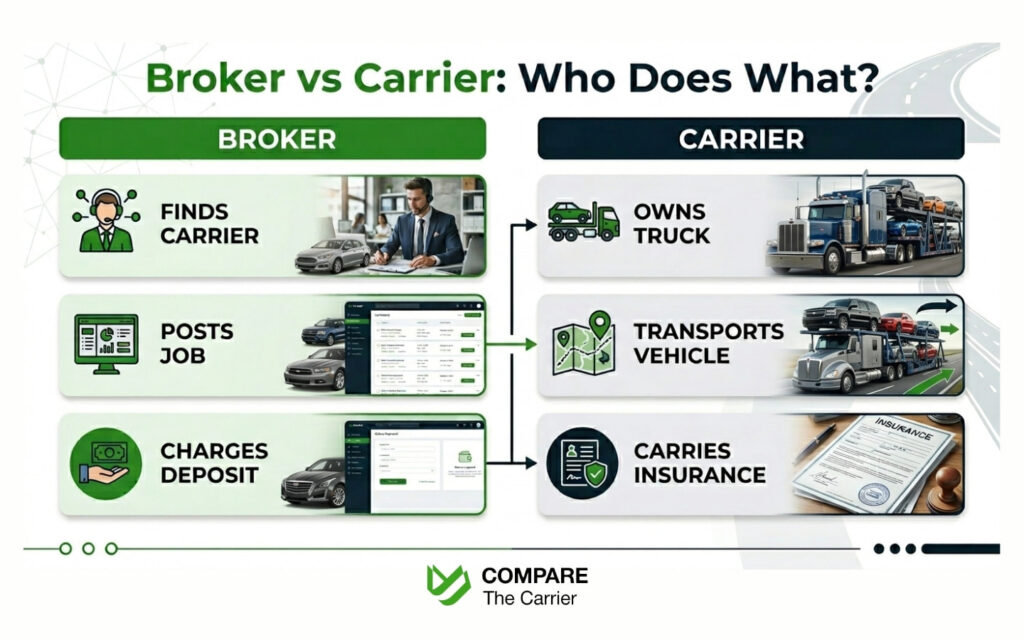
A broker does not own any trucks. They do not employ drivers. Think of them like a travel agent for your car. Their job is to find your vehicle, post it to a national dispatch system (called Central Dispatch), and negotiate with the actual truck drivers to take your load. For this service, the broker charges a fee usually between $100 and $250. This fee is the “deposit” you pay upfront when you book.
The carrier is the person actually driving the truck. They are the ones who show up at your house, load the car, and deliver it. You typically pay the carrier their portion of the money in cash or by certified check upon delivery.
| Feature | Auto Transport Broker | Auto Transport Carrier |
| Role | Coordinates the shipment, finds the truck. | Owns the truck, physically moves the car. |
| Payment | Upfront deposit (credit card usually accepted). | Payment on delivery (cash or certified funds). |
| Pricing | Provides the initial estimate/quote. | Dictates the final accepted price on the route. |
| Insurance | Checks the carrier’s insurance validity. | Carries the actual cargo insurance policy. |
Why does this matter for your cost? Because the quote a broker gives you is just an estimate of what they think a carrier will accept. It is not a guaranteed price until a carrier actually signs the contract.
This brings us to the biggest financial trap in the industry: the lowball quote.
Let’s say you request quotes from four different companies. Three of them tell you it will cost $1,200 to ship your SUV. The fourth company promises they can do it for $700.
It feels like a massive win, so you book with the $700 company and pay a $150 deposit.
Here is what happens next: The broker posts your car to the load board for $550 (the $700 total minus their $150 fee). But every carrier on that route knows the going rate is actually around $1,000. So, drivers ignore your car. It sits on the board for weeks. Your pickup date comes and goes.
Suddenly, the broker calls you, sounding apologetic. “The route is really tough right now,” they’ll say. “I can get a truck there tomorrow, but the driver wants $1,300.” Because you are desperate and out of time, you agree. You ended up paying more than the honest brokers quoted you in the first place.
If a price looks too good to be true in auto transport, it always is. Look for the median price among your quotes; that is the real market rate.
Legally, every auto transport carrier must carry valid cargo insurance to cover your vehicle during transit, and this cost is already baked into your final shipping quote. You do not need to purchase a separate transport policy, but you must verify the carrier’s coverage limits before handing over your keys.
A lot of folks get nervous about their car spending a week on an open highway. What if a rock flies up and cracks the windshield? What if the truck encounters a severe hail storm?
It’s completely normal to worry, but paying for extra third-party shipping insurance is almost always a waste of money. The carrier’s policy is designed specifically for these scenarios. If the truck driver damages your bumper while loading the car, or if a tree branch falls on the trailer during a storm, the carrier’s cargo insurance pays for the repairs.
However, there is a catch you need to be aware of: carrier insurance covers negligence and equipment failure, not “Acts of God” or road debris. If a pebble gets kicked up by a passing semi-truck and chips your paint, that is generally considered a standard road hazard.
This is where your personal auto insurance policy comes in. I always recommend calling your own insurance provider before the driver arrives. Ask them if your comprehensive coverage extends to transit. Most major providers do cover it, meaning that in the rare event of a dispute with the carrier’s insurance, your own policy acts as a safety net without you having to spend an extra dime upfront.
If you want to protect your wallet, you need to treat the Bill of Lading (BOL) like a winning lottery ticket.
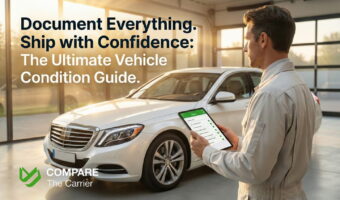
The BOL is a formal inspection document. When the driver arrives to pick up your car, you will both walk around the vehicle and document every single existing scratch, dent, and chip. The driver notes these on the BOL. You then sign it, agreeing on the car’s current condition.
When the car is delivered to your new state, you do the exact same walkaround before you pay the driver their final balance. You compare the car’s condition to the original BOL.
If there is a new massive dent in the driver-side door that isn’t on the paperwork, the carrier’s insurance is responsible. But if you sign that delivery BOL without inspecting the car first, maybe because it’s raining, or you’re in a hurry, you release the carrier from all liability. If you find damage the next morning, you are paying out of pocket. Taking ten minutes to properly inspect your car with a flashlight is the cheapest insurance policy in the world.
Driving your car across the country instead of shipping it is only cheaper if you ignore the hidden costs of travel, wear and tear, and the value of your own time. While gas alone might cost less than a broker’s quote, adding hotels, meals, and vehicle depreciation often makes shipping the more economical choice.
People often do a quick mental calculation: “Gas is $3.50 a gallon, my car gets 30 miles to the gallon, so driving 1,500 miles will only cost me $175!”
Then they look at a $900 shipping quote and decide driving is a no-brainer. But that math is dangerously incomplete. Let’s break down what a cross-country drive actually costs:
When you put all those numbers on paper, paying a carrier $900 to move the car while you take a cheap three-hour flight suddenly looks like a brilliant financial decision.
Finding the cheapest way to ship a car to another state requires a mix of realistic expectations and strategic planning. The auto transport industry isn’t trying to trick you, but it does operate on a supply-and-demand curve that you have to navigate carefully.
For the vast majority of people, booking open transport is the safest and most affordable choice. By skipping the enclosed trailers, avoiding the urge to pack your car full of heavy boxes, and giving brokers a flexible pickup window, you can confidently secure a fair market rate.
Always compare at least three quotes to weed out the unrealistic lowball offers, and remember that paying a slightly higher rate for a reputable, communicative carrier is often cheaper in the long run than dealing with a delayed or damaged vehicle. With a little preparation, you can move your car across state lines without blowing your entire relocation budget.
If you’re ready to estimate your shipment, use our car shipping cost calculator to get an instant quote.
The cheapest way to ship a car is by using an open transport carrier. This method places your vehicle on a standard 8-to-10-car trailer, allowing you to share fuel and labor costs with other shippers. Booking 2–4 weeks in advance and offering flexible pickup dates maximizes savings.
Shipping a standard sedan 1,000 miles typically costs between $600 and $1,000 on an open carrier. This averages out to $0.75 to $1.00 per mile. Larger vehicles like SUVs or trucks will cost an additional $100 to $300 due to their heavier weight and larger dimensions.
Most carriers allow up to 100 pounds of personal items stored securely in the trunk below the window line. However, auto transport trucks are not legally licensed to haul household goods. Packing heavy boxes can result in overweight fees or the driver refusing to load the vehicle.
No, you can ship an inoperable vehicle, but it will cost more. Carriers charge an additional $150 to $200 “inoperable fee” because loading a non-running car requires specialized equipment like winches or forklifts, along with extra labor from the driver.
Terminal-to-terminal shipping can sometimes offer lower base rates, but it is rarely the cheapest option overall. Regional storage terminals charge daily holding fees. If your car sits at the facility for several days waiting for pickup, those storage fees quickly eliminate any upfront savings you gained.








Don't have time to fill out the form?
Call a transport company directly to get a quote now!
Select the category you need
Partner with Compare The Carrier & Grow!
We're open to collaborations, partnerships, and mutual growth! Whether you're an individual or a business, we offer exciting opportunities to work together. Fill out the form below to explore how we can collaborate.
Something Went Wrong
We're sorry, but something went wrong. Please briefly describe the problem you experienced in the text area below. Providing your contact information will allow us to follow up if needed.

Thank you,
your form has been accepted.
Your form has been successfully submitted. We appreciate your effort — our team will review it shortly and take the next steps.


