

World’s Best Car Collections in 2026: Top 10 Must-See Garages
Okay, be honest with me for a moment, the entire luxury c...
12 February 2026
Shipment of a race car is not as simple as sending an ordinary sedan nationwide. These are not ordinary cars; they are fine-tuned machines, perhaps a culmination of years of careful labor, large amounts of money, and a love of speed. In the case of a high-performance asset, the typical approach to shipping will not do. This guide will take you through all you need to learn about professional race car shipping, including the factors of the nuances of types of transportation and the prices, along with the factors of assuring that your now-valued possession will reach its destination securely.
Calculate Shipping Quotes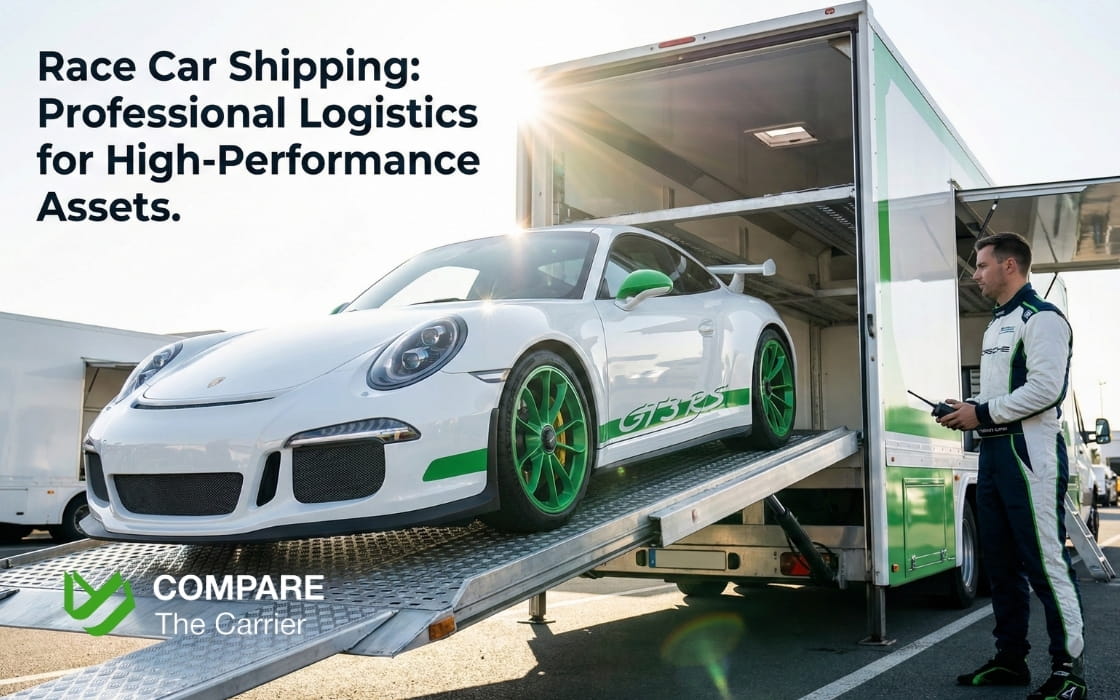
At Compare The Carrier, we are aware of the special needs of motorsport logistics. Our platform will match you with professional and licensed carriers who specialize in the art of race car transportation, and as such will find you the best service and also prevent some of the traps of less specialised carriers.
Shipping race cars is a monster by itself. It is a specialized delivery of cars designed to do one thing: to be fast. We are discussing circuit racers, rally cars, dragsters, and those exotic prototypes that would make someone feel that they were in a sci-fi movie.
So, why does this matter? This is important since the rules of car moving are not applicable in this case. Normal transportation is of volume. It is all about crowding as many SUVs as possible on a rack and rolling on the highway. Race car transportation is concerned with the fine art of handling. It needs some special equipment, such as hydraulic lift gates.
As a buyer, you do not simply pay something to be placed on a trailer. What you are paying for is a driver who realizes that a 2-inch clearance translates to you not being able to just gun it up a ramp. We serve a customer base of both large-scale and small-scale. Not only do we have clients in the professional race team with huge budgets, but also the individual driver bringing his or her pride and joy to a one-day event. The aim is never different: impeccable arrival. Track-ready. No excuses.
The American interstate is carried on open trailers. They are everywhere, ten miles apart, big, two-decker racks with eight to ten SUVs or rental sedans. They are ideal for a dealership that is transitioning to mid-sized crossovers. For a track-tuned machine? They are a trap.
The Advantages (Even to call them that) are:
It’s cheap.
You can get a place almost immediately since there are thousands of such rigs on the highway.
The Reality:
You have a sitting duck on an open rack. Rain, hail, the blistering sun, and road salt are only the beginning. Road debris is the actual murderer. I have witnessed a pebble, kicked up by a semi-truck like a bullet, break a Lexan windshield that was more expensive than the shipping charge. Convince your team owner or your head mechanic at the racetrack. It’s a nightmare.
There is a clearance issue, then. Race cars are low. Normally, open ramps are slanted. Practically speaking, attempting to put a 911 on an open trailer that is track-ready normally results in the mind-wrenching sound of costly carbon fiber banging against steel. You will never forget that noise.
The catch is the human factor. Most open-carrier drivers lack any aerodynamic or front splitter strength training. Your GT3 is only another unit to be pressed into a tight time schedule for them. You will spend hours describing the dirt of the highway, and you will have a custom wrap, sensitive telemetry sensors, or uncovered mechanicals, and you will only be lucky not to have been damaged.
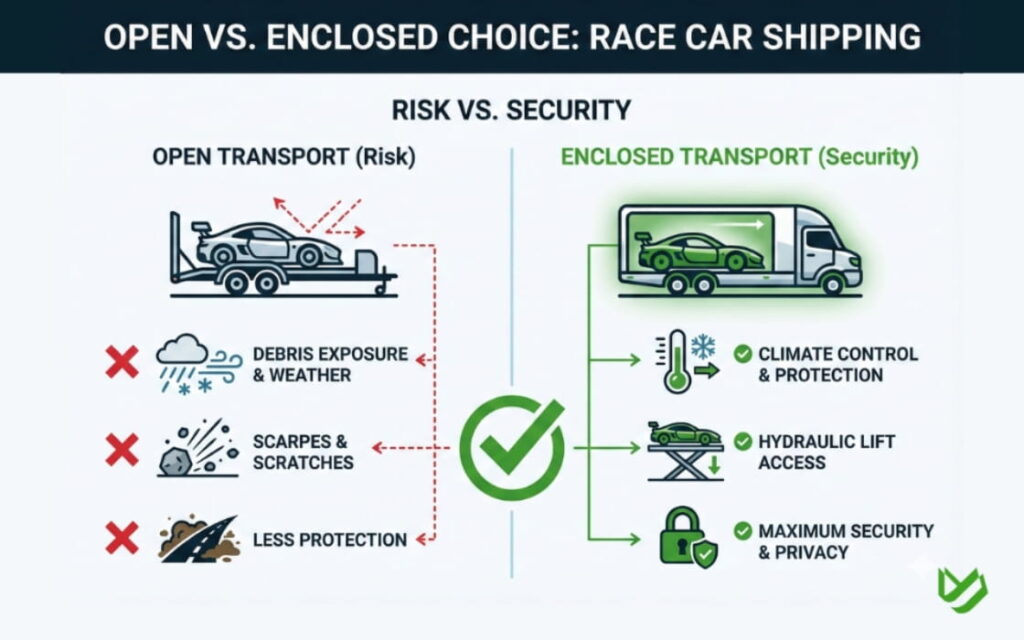
This is the only real choice. An enclosed trailer is a rolling vault, but it is not the magic of the walls only; it is the magic of the equipment.
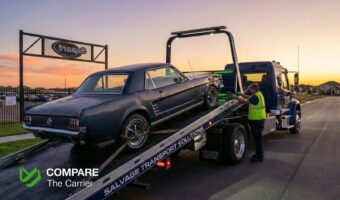
In fact, when a carrier does not state that it has a hydraulic lift gate, move on. The lift gate is unlike the ramps; the platform remains at the ground level. You press on, and the platform raises straight up, and the car glides in the trailer. No angles. No scraping. No heart attacks.
The car is mounted on an air-ride. Normal trailers are bouncing; air-ride trailers float. This is very important to shield against thousands of miles of road vibration that will harm your dampers and your delicate electronics. And, there is the aspect of security. Out of sight, out of mind. Open trailers have high-value items that draw the attention of the wrong individuals at the truck stops. Your engineering secrets (and your investment) are kept safe inside a hard-sided trailer.
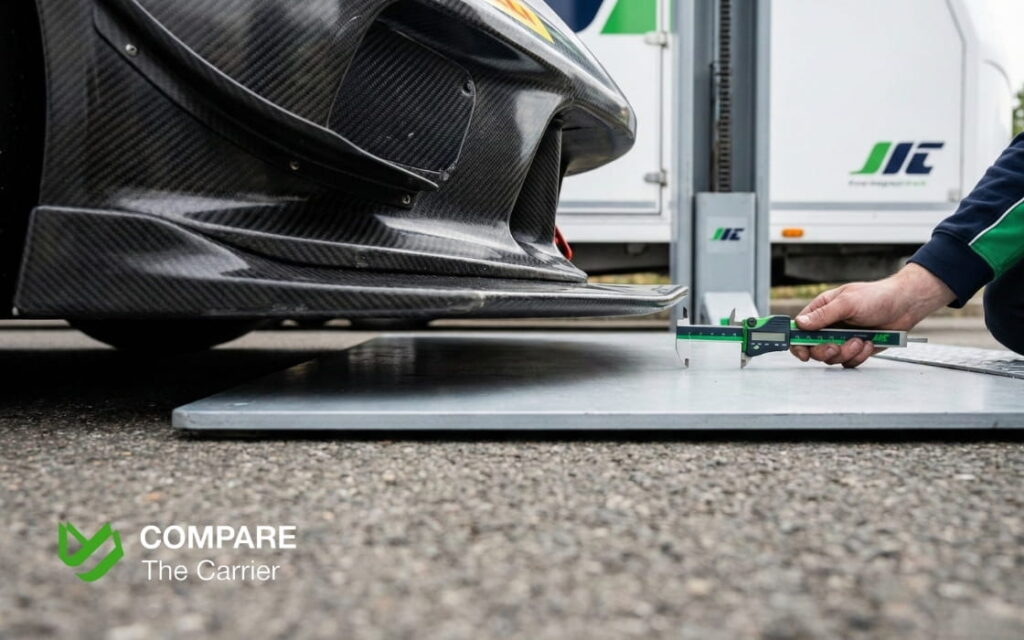
Enclosed auto transport means your car is in a hard-sided, weather-tight vault.
Actually, the peace of mind you get from knowing your car is in a hard-sided, air-ride trailer with a $1 million insurance policy is worth every extra penny. Don’t leave your high-performance asset to chance.
Situations in which a vehicle arrives with previously undocumented damage are more common than many owners expect. In such cases, the absence of proper preparation and documentation can make it difficult to determine when the damage occurred. Preparation is therefore not only a safety measure, but also an important part of protecting the owner’s interests during transport.
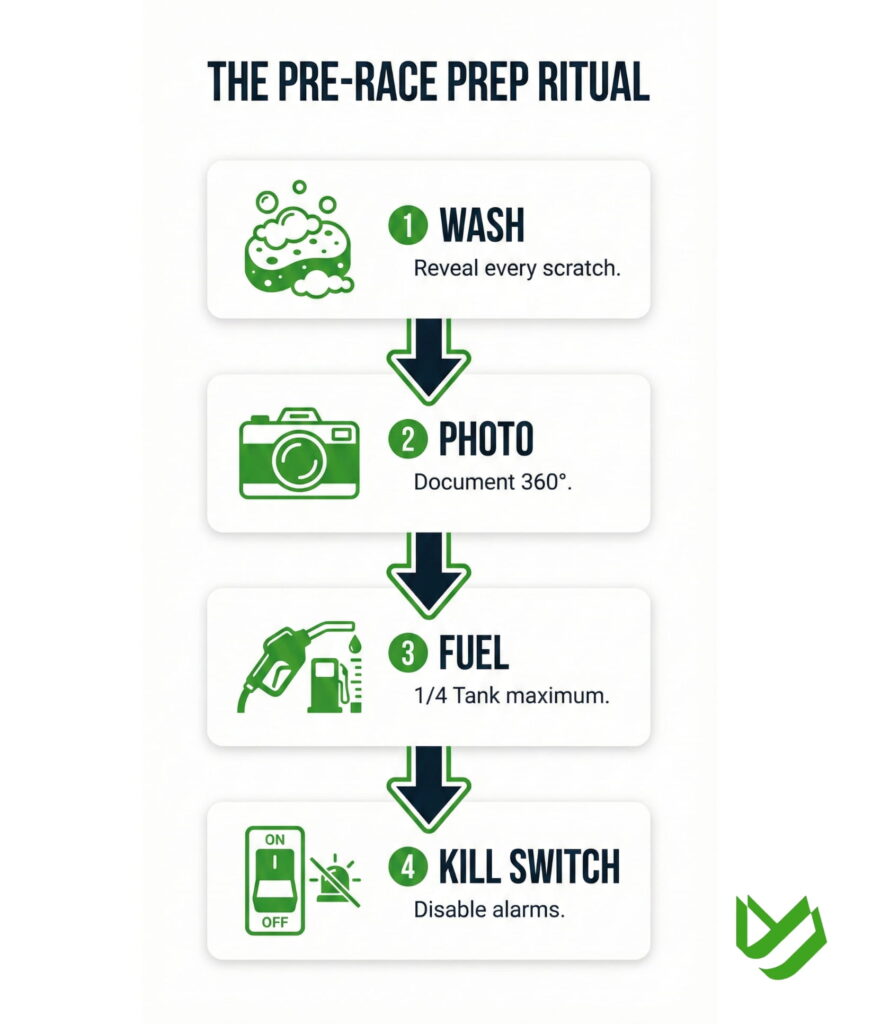
Cleaning the vehicle prior to transport may appear optional, but it plays a critical role in the inspection process. Dirt, brake dust, and track residue can obscure scratches, chips, or small cracks that may already exist.
A clean surface allows both the owner and the carrier to accurately assess the vehicle’s condition before loading. This ensures that the Bill of Lading (BOL) reflects the true state of the car at pickup and reduces the likelihood of disputes after delivery.
Visual documentation is one of the most effective tools available to vehicle owners prior to transport. High-quality photographs should be taken from multiple angles to capture the full exterior condition of the car.
In addition to exterior images, it is recommended to:
This level of documentation provides a clear reference point should any questions arise during or after transport.
By law, carriers can’t transport personal items inside the vehicle. And it’s not just a technicality. If you leave items like a helmet bag, spare tires, or a heavy toolbox in the car, the driver may be fined. Worse than that, anything loose inside the cabin becomes a problem the moment the truck has to brake hard.
I’ve seen it happen. A loose jack handle sliding forward and turning a custom carbon-fiber seat into an expensive mistake. It takes one sudden stop for that to go very wrong. If it’s not bolted down, it doesn’t belong in the car.
Keep the fuel level at about a quarter tank or less. Fuel adds weight and poses a fire risk. More importantly, take a few minutes to check for leaks before pickup.
If your car is dripping oil or coolant, a professional enclosed carrier won’t load it. And that’s not them being difficult. They’re protecting every vehicle on the trailer. No one wants fluids leaking onto a seven-figure vintage car parked underneath yours. At that level, it’s about professionalism as much as safety.
Disable the alarm before transport. Trailer vibrations over hundreds or thousands of miles can trigger it repeatedly, killing the battery and wearing out everyone’s patience.
If your car has a master kill switch, make sure the driver knows exactly where it is and how it works. Better yet, label it. A simple piece of tape on the dashboard can save a lot of confusion if something needs to be shut down quickly.
What does this have to do with your wallet? In fact, even when using a car shipping calculator, the calculation is more complicated than a flat fee. It is expensive not only because you are buying the gas but the hydraulic lift gate is specialized and the driver is knowledgeable on how not to squash your suspension.
Practically, race car shipments in the U.S. in enclosed transport normally begin at approximately 800 dollars on brief routes and simply skyrocket to over three thousand dollars on long-range routes.
Distance: The further the road, the more the fuel and labor expenses. However, a secret herein lies, the rate per-mile actually decreases on long journeys. You shell out money on the inconvenience of packing on short journeys.
Vehicle Size: Vehicles with a wide-body kit or an enormous GT wing occupy more space in the trailer. In case your car is larger than a normal lane, then you may be paying a premium. Space is money.
Inoperability: When the car does not roll, steer, or brake, then it is inop. This takes a winch, additional time and in most cases a second individual. Expect a $150-$500 surcharge. Always be upfront about this. A car owner who arrives with no winch to a dead car will kill a pickup faster than anything.
Seasonality: Delivery in the middle of winter across the Rockies? Or in Florida in the snowbird season? Prices will spike.
So, why does this matter? You have to know what you are paying. When you are offered a half-price quote by somebody, then they are clipping at the end somewhere. It is normally the insurance or the equipment.
The Master Vetting Guide: Questions to Ask the carrier.
But do not take the first quote. You must roast these chaps like you are getting a lead mechanic your season to the championship. (Trust me, it is a huge red flag to say the opposite.
“Are you a carrier or a broker?” A broker (as in the case with CompareTheCarrier.com) handles the logistics and introduces you to a network of the checked. A carrier owns the trucks. The buyer has more flexibility and insurance oversight in brokers and a direct connection to the driver in carriers. In fact, brokers with a specific motorsport specialization tend to have the highest yield.
How is your cargo insurance limit and deductible? Basic cargo cover could be 250000 dollars. That is a lot considering that the limit is divided among all the cars in the trailer. At 200k of car value, you are grossly underinsured in case you have five more cars on board.
The Nabiscotch: Request the Certificate of Insurance (COI)
The Deductible: This is based on the deductible and the loss incurred in the case. Say the deductible is 5,000 and the loss is 3,000 but you would pay 5,000 of the amount. Who is to blame about that initial dollar of damage?
“What equipment do you use for low-clearance loading?” If they say “long ramps and some wooden planks,” hang up. You want to hear “Hydraulic Lift Gate” and “Air-Ride Suspension.” Ramps are a gamble with your chassis that you simply shouldn’t take.
“What is your driver’s experience level with carbon fiber and aero?” You don’t want a rookie who was hauling used Corollas last week. You want a veteran who has moved cars for pro teams or major auction houses like Barrett-Jackson. Ask them if they know how to handle a master kill switch or an electronic parking brake that won’t release without power.
“Do you use ‘Soft-Tie’ or ‘Chain’ securement?” Chains are for scrap cars and bulldozers. For a race car, you want Soft-Tie Wheel Straps. These secure the car to the tires, allowing the car’s suspension to work naturally without stressing the chassis or tie-rod ends. Actually, I’ve seen suspensions snapped because a driver used chains on a delicate aluminum control arm.
Let us mention the elephant in the room: insurance. The majority of the population happens to encounter the word insured on the profile of a carrier and believes they are insured. In fact, that is a risky assumption for a buyer.
The Federal Motor Carrier Safety Administration (FMCSA) requires carriers to be insured in terms of liability and cargo. The thing is, however, the standard cargo insurance by a generic hauler is often limited to 250,000. Now, do the math. When that trailer is transporting six high-end cars and your race car is worth more money than that car, in single settings, that is, 150,000, what will occur if the trailer crashes down?
The $250,000 is split. You aren’t getting your $150k back. You are receiving a portion of it.
In fact, I have observed this occur dozens of times. An expert race car is regarded as a used SUV during the insurance claim procedure. Horror of horrors, to escape this nightmare, you should request the Certificate of Insurance (COI). Then do not merely look at the total; look at the amount per vehicle. In case your car can fetch more than their limit, there are two options that you have: to find another carrier or to purchase Supplemental Gap Insurance.
What about the deductible? Certain carriers only carry a deductible of 5000. When a rock cracks your personal paint, and you need to get it repaired at 3000 dollars, the insurance will not even come into effect by the carrier. You have to pay that out of pocket.
So, why does this matter? Since a race car shipping company at the pro level will provide the full value coverage. Policies will be offered to the tune of up to 1,000,000 or more per load. If they don’t? Walk away. You are glad you pay the extra premium.
The Bill of Lading (BOL) is not a simple receipt. It is your shipment bible. It is the only paper that separates you from a rejected insurance claim.
As a matter of fact, the pickup check is usually hurried. The driver is on a schedule. You are eager to have the car running. However, there is a twist here: when a scratch is not on that BOL at pickup, the assumption in the law is that the car was perfect. In case they have the same scratch on the BOL on delivery, the carrier must pay.
And for the love of speed, do not sign the delivery BOL until you have walked around the car three times. Once the driver leaves with your signature on a clean BOL, you are on your own. (Believe me, no insurance company will listen to you twenty-four hours later.
For a race team, “fashionably late” doesn’t exist. If the car shows up two hours late, you miss the practice session. If it’s a day late, you’ve wasted thousands in entry fees and crew salaries.
Motorsport logistics is about the “Hard Date.” Standard shipping is flexible. Race car shipping is rigid.
Standard shipping is door-to-door. But tracks like Road Atlanta or Sebring are massive. You don’t want your car dropped off at the main gate. You need a carrier that offers Paddock Delivery. This means the driver has the skills to maneuver a 53-foot enclosed rig through a crowded infield packed with people, golf carts, and million-dollar motorhomes.
Actually, this is where specialized experience pays off. A driver who has been to the track before knows where the credential office is. They know which gates have the clearance for a high-roof trailer. They speak the language of the track marshals.
I’ve seen pro teams use the transport trailer as an extension of their pit. Some enclosed carriers will allow you to keep the car in the trailer overnight at the track. It’s a secure, weather-proof garage on wheels. If you’re shipping pit equipment, spare engines, or sets of slicks along with the car, this “all-in-one” approach is the only way to fly.
Shipping a car to a race in Spa, Monza, or Le Mans? Now you’re entering the world of International Motorsport Logistics. This isn’t just a truck ride; it’s a bureaucratic gauntlet.
The most important term you’ll learn is the ATA Carnet.
Think of it as a “Passport for Goods.” It’s an international customs document that allows you to temporarily export your race car and equipment without paying duties or taxes. Without a Carnet, customs officials in Europe or Asia will assume you’re “importing” the car to sell it. They will demand a massive bond, often 30-50% of the car’s value, before they let it off the ship.
Actually, the paperwork for an international race is more complex than the engine tuning. Don’t try to DIY this. Use a platform like CompareTheCarrier.com to find specialists who do nothing but international motorsport freight.
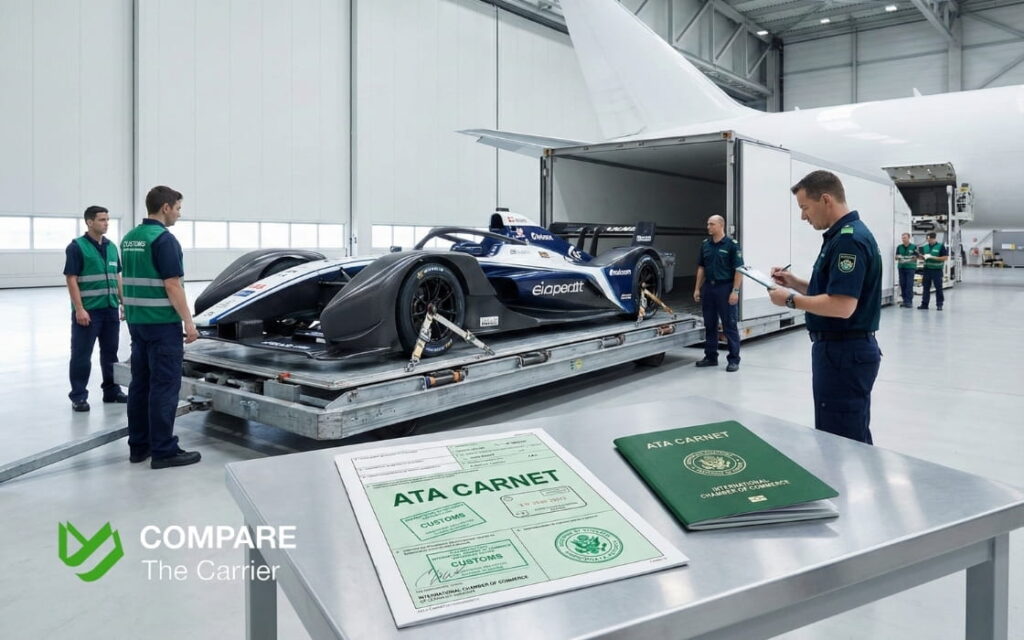
Even with the best intentions, things can go sideways. I’ve seen a dozen times where a simple oversight led to a disaster.
In fact, just one more time, we should be real. Shipping a race car is not a thing on your to-do list; it is the initial step to your subsequent win or a loss. I have witnessed seasons being terminated before they had begun because a car was shipped with a crooked car arm of suspension or a carbon splitter was shattered, all because their owner valued a $300 saving over equipment of professional quality.
Practically, the premium transport industry is small. Those drivers who understand how to drive a million-dollar prototype are a rarer breed. When you find one, hold onto it. Until then, however, make use of what we have discussed. There is nothing to be afraid of being the guy who asks too many questions. In fact, the industry players, the professional carriers that are proud of their rigs and their safety record, will welcome your efforts. They desire to work with clients who appreciate their professionalism.
The trick is that you are always what you buy. By 2026, as the prices of special parts are expected to rise and with the increasing complexity of aero-heavy machines, compromising on transport is a bet with astronomical odds.
So, what does this mean for you? It consists of thinking of your shipping partner as part of your pit crew. Equip them with the right data, tune the car to the nth degree, and spend money on the quality that the machine should have.
We do not simply get you a truck at Compare The Carrier. We get you an associate for your racing season. The insurance is vetted, the equipment is checked, and the driver is made familiar with navigation around a paddock.
So, what does this mean for you? It is the ability to quit being concerned with the interstate and begin worrying about your lap times.
Go do your homework. Ask the hard questions. And I’ll see you at the grid.
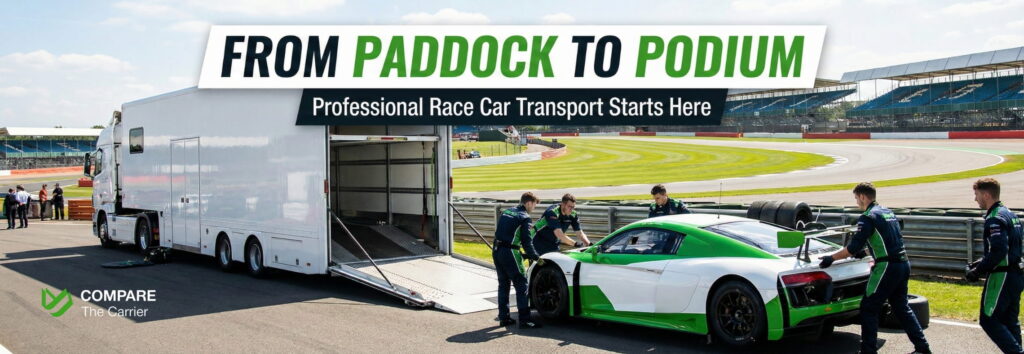
The sphere of professional logistics regards safety as a complex of specialized equipment and professional skills of the drivers. In the case of race cars, this specifically needs enclosed trailers that have hydraulic lift gates that enable the vehicle to be kept perfectly level when loading, and the use of air-ride suspension to overcome road vibrations. We use soft-tie wheel straps instead of the traditional metal chains; this will make sure that the car is firmly in place without causing an unnecessary load on the fragile suspension parts or expensive dampers.
The accuracy needed is represented in the pricing in this niche. In the example of short-haul and regional deliveries, the rates begin with approximately $800. Professional enclosed service costs between $2,500 and $3,500 and above, depending on whether it is a cross-country route (e.g., New York to California). Although the per-mile charge tends to reduce when the distance is covered over extended distances, the cost of special equipment and high-value cargo insurance is necessary for the provision of the vehicle to the track in excellent condition.
The decision is obvious in the case of a high-performance asset. Open transportation exposes the car to weather, road salts, and debris, which readily destroy custom wraps or Lexan windshields. Enclosed transportation is a weather-proof, safe deposit box. It is also the standard used in the industry by motorsport professionals to ensure the aerodynamics of their cars are not exposed to the elements, and their engineering secrets remain confidential.
Yes, but it needs a high level of regulatory skills. To prevent paying more in the form of importation fees, we make use of the ATA Carnet system, which is, in essence, a passport to your car that enables you to bring it into and out of the country momentarily without duty. We handle all logistics, including safe sea containers and speedy air transport, according to your schedule and budget, without interfering with all the required documentation to avoid time wastage at the border.
In most cases, moving a race car across the country takes about 5 to 10 days. That said, racing schedules don’t leave much room for delays. When timing really matters, expedited shipping is an option. It puts your car at the front of the route, with fewer stops and no unnecessary detours, so it arrives at the track in time for practice or qualifying instead of sitting on a terminal somewhere.
Efficient preparation is a significant factor, particularly when one has to check anything later. Start with a thorough wash. By having a clean car, it is easier to document the status of the vehicle prior to its pickup. Photograph the whole vehicle in clear and high-resolution images, but carefully record splitters and diffusers, and other aero items.
Maintain the level of fuel in a quarter tank – not more, but enough to load the car. Lastly, clean up the cabin and get rid of loose objects, tools, or spares. Anything that is capable of moving on transit will sooner or later.
Yes, the licensed carriers are insured, but there is a point most people overlook. The coverage limit advertised is normally limited to the whole trailer and not to your own car only. On a multi-car load, it can ensure high-value race cars are underinsured.
We ensure that you have a Certificate of Insurance and take you through the insurance prior to picking up. We can also provide extra coverage in case required because your car is insured to its full appraised value during pickup to delivery.
Yes. In the case of enclosed race car transportation, real-time GPS tracking can be used. You will get a reliable tracking system or application notifications that allow you to track the shipment in real-time. This facilitates easy planning of your arrival at the track and coordination with your crew, since you are not always calling to get some updates. The advantage of knowing your whereabouts is to be able to concentrate on the race rather than the logistics.









Don't have time to fill out the form?
Call a transport company directly to get a quote now!
Select the category you need
Partner with Compare The Carrier & Grow!
We're open to collaborations, partnerships, and mutual growth! Whether you're an individual or a business, we offer exciting opportunities to work together. Fill out the form below to explore how we can collaborate.
Something Went Wrong
We're sorry, but something went wrong. Please briefly describe the problem you experienced in the text area below. Providing your contact information will allow us to follow up if needed.

Thank you,
your form has been accepted.
Your form has been successfully submitted. We appreciate your effort — our team will review it shortly and take the next steps.


