Logistics Application Development: How Win in 2026

In 2026, logistics application development is the mandatory infrastructure for auto transport brokers to protect profit margins and scale operations. The industry has moved entirely beyond manual load matching; today, success requires automated data execution. With current industry data indicating that over 75% of commercial logistics providers now rely on custom, AI-integrated applications to streamline their supply chains, utilizing legacy or off-the-shelf software is a direct competitive disadvantage.

Contact Us Now

Logistics Application Development, How Brokers Win in 2025

Custom logistics application development is the true backbone of modern auto transport management. By seamlessly integrating real-time ELD vehicle tracking, automated eBOL (electronic Bill of Lading) processing, and predictive pricing models directly into a broker’s TMS, these custom applications eliminate human error and drastically accelerate the cash conversion cycle. At Compare The Carrier, we engineer tailored digital solutions that transition brokerages from manual workflows to highly automated, scalable systems.

This guide breaks down exactly why investing in custom logistics application development is the definitive strategy for securing capacity and dominating the auto transport market in 2026.

Importance of Application Development in Auto Transport and Logistics
Essential Logistics App Features for Auto Transport Brokers
Common Challenges in Logistics Application Development
Choosing the Right Tools for Your Auto Transport App
Designing an App for Auto Transport Brokers That Converts
Compare The Carrier: Your Partner in Auto Transport App Development
FAQ

Importance of Application Development in Auto Transport and Logistics

The logistics and auto transport industries are at a crossroads. Rising fuel costs, driver shortages, and skyrocketing customer expectations are pushing businesses to rethink how they operate. Enter logistics application development the secret weapon for brokers and logistics companies looking to not just survive, but thrive.

By 2026, over 65% of logistics companies are expected to invest in custom apps, and it’s easy to see why.

Custom apps are more than just a tech upgrade; they’re a complete transformation of auto transport management. Here’s why they’re essential:
Importance of Application Development in Auto Transport and Logistics

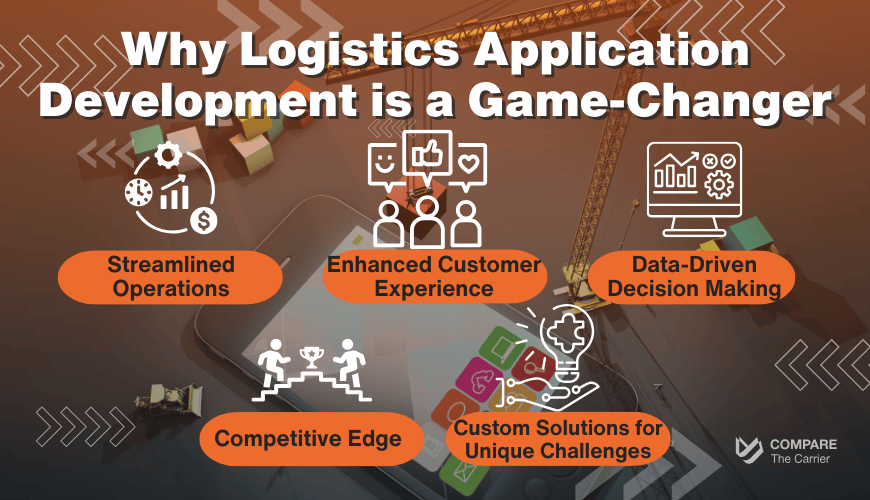
Why Logistics Application Development is a Game-Changer

Streamlined Operations: You need to eliminate data entry. Implementing business process automation within your app handles carrier matching, document generation (eBOLs), and invoicing instantly, allowing your team to focus on sales rather than paperwork.
Enhanced Customer Experience: Enhancing customer experience starts with acquiring your first clients using proven strategies. Provide customers with real-time updates, secure payment options, and 24/7 support through chatbots. Simplify document management with e-signatures and digital Bill of Lading (BOL) tracking.
Data-Driven Decision Making: Stop guessing freight rates. A custom app allows you to deploy performance tracking and analytics to monitor your exact cost-per-load, carrier performance metrics, and seasonal demand shifts in real-time.
Competitive Edge: Stay ahead of the curve by adopting digital solutions that meet the growing demands of e-commerce and vehicle shipments. According to a 2026 report by McKinsey & Company, companies investing in logistics apps see a 20-30% boost in operational efficiency within the first year.
Custom Solutions for Unique Challenges: Tailor apps to address specific pain points, from carrier management to compliance with industry regulations. Unlike off-the-shelf software, custom apps are designed to grow with your business.

By investing in logistics application development, auto transport brokers can streamline operations, delight customers, and stay ahead in an increasingly competitive market. The question isn’t whether you can afford to develop an app it’s whether you can afford not to.

Essential Logistics App Features for Auto Transport Brokers

When it comes to logistics application development, the right features can make or break your app. For auto transport brokers, the goal is simple: create a tool that simplifies operations, delights customers, and drives growth. But what exactly does that look like? Let’s break it down.

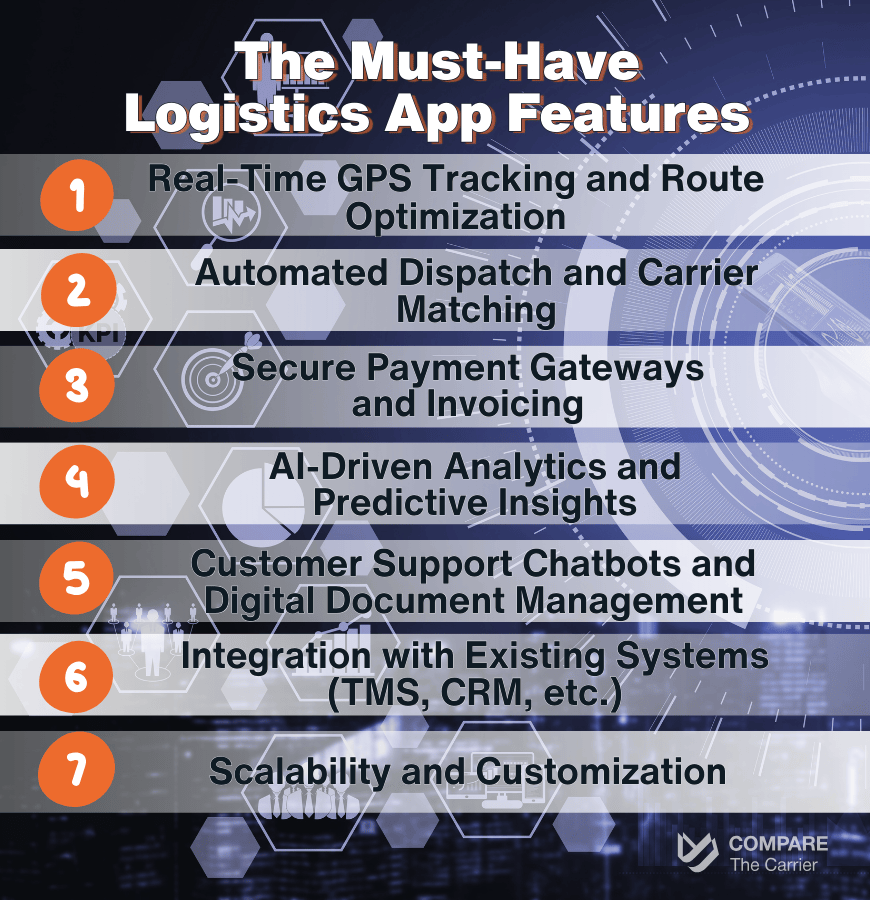
Here are the must-have logistics app features that every auto transport broker should consider:
Essential Logistics App Features for Auto Transport Brokers, application for auto transport brokers

1. Real-Time GPS Tracking and Route Optimization

Why It Matters: In 2026, shippers do not ask for updates; they expect a live dashboard. Relying on driver check-calls is a guaranteed way to lose enterprise contracts.
The 2026 Edge: Modern apps move beyond basic dots on a map. By integrating ELD data and geofencing, your app can trigger automated SMS alerts to shippers when a truck is 50 miles out. Predictive ETA models account for real-time traffic and weather, dropping inbound “Where is my freight?” calls to near zero.
Example: Apps like ShipTrack have set the standard for real-time tracking in logistics.

2. Automated Dispatch and Carrier Matching

Why It Matters: Manual load board posting and carrier vetting kill your margins and slow down your pipeline.
The 2026 Edge: Implementing business process automation allows your app to instantly scrape carrier databases, verify FMCSA safety scores, and tender loads to preferred carriers based on historical lane data all without human intervention. Your dispatchers can secure capacity in seconds, not hours.
Example: Platforms like Truckstop use automation to streamline carrier assignments.

3. Secure Payment Gateways and Invoicing

Why It Matters: Cash flow is the lifeblood of an auto transport brokerage. Any friction in payments means delayed revenue and frustrated carriers.
The 2026 Edge: Modern broker apps feature integrated B2B payment rails and automated factoring portal connections. Once a digital POD (Proof of Delivery) is uploaded by the driver, the invoice is auto-generated and sent to the shipper, while the carrier immediately receives a QuickPay option. This seamless financial routing drastically cuts days sales outstanding (DSO).
Example: Platforms like Truckstop use automation to streamline carrier assignments.

4. AI-Driven Analytics and Predictive Insights

Why It Matters: Quoting based on “gut feeling” or yesterday’s load board averages will price you out of the market.
The 2026 Edge: By utilizing logistics AI integration, your app dynamically adjusts quoting models based on real-time capacity, seasonality, and competitor pricing. Coupled with performance tracking and analytics, you know your exact Cost Per Acquisition (CPA) and profit margin on every single lane, protecting your bottom line during market shifts.
Example: Platforms like Example: Companies like Transporeon use AI to provide predictive analytics for logistics. use automation to streamline carrier assignments.

5. Customer Support Chatbots and Digital Document Management

Why It Matters: The era of paper BOLs is dead. Lost paperwork means disputed damage claims and delayed payouts.
The 2026 Edge: Standard chatbots are frustrating; 2026 requires LLM-powered virtual assistants that can actually read a shipper’s contract and provide specific load statuses. Furthermore, mandatory e-signatures and digital Bill of Lading (eBOL) generation with timestamped photo uploads ensure instant, dispute-free handoffs at pickup and drop-off.
Example: Platforms like Zendesk offer chatbot solutions for customer support.

6. Integration with Existing Systems (TMS, CRM, etc.)

Why It Matters: A custom app that does not talk to your existing software is just another data silo that requires double-entry.
The 2026 Edge: Two-way API synchronization is non-negotiable. Through expert website and systems development, your new app must instantly push load data to your TMS and sync shipper interactions directly with your CRM. You enter data once, and it updates across your entire tech stack instantly.
Example: Apps like Samsara excel at integrating with existing logistics tools.

7. Scalability and Customization

Why It Matters: A rigid app architecture breaks when your brokerage scales from 50 to 500 loads a day.
The 2026 Edge: Cloud-native development ensures your app handles massive data loads during peak seasons without crashing. Furthermore, while your custom app scales your internal operations, combining it with professional SEO strategy execution scales your market visibility ensuring your tech investment is matched by a continuous influx of inbound leads.
Example: Custom development platforms like Mendix allow for highly personalized app solutions.

According to Gartner’s Supply Chain Technology projections, over 60% of commercial logistics providers have now transitioned to cloud-based, custom-integrated applications to maintain profitability and meet shipper demands. The right features don’t just make your app functional they make it your strongest operational asset.

At Compare The Carrier, we specialize in building auto transport apps with these exact revenue-generating features. Our goal is to deploy tools that automate your dispatch, secure your margins, and position your brokerage to dominate the market.

Common Challenges in Logistics Application Development

While logistics application development offers immense benefits, it’s not without its hurdles. For auto transport brokers, navigating these challenges is key to building an app that delivers real value.

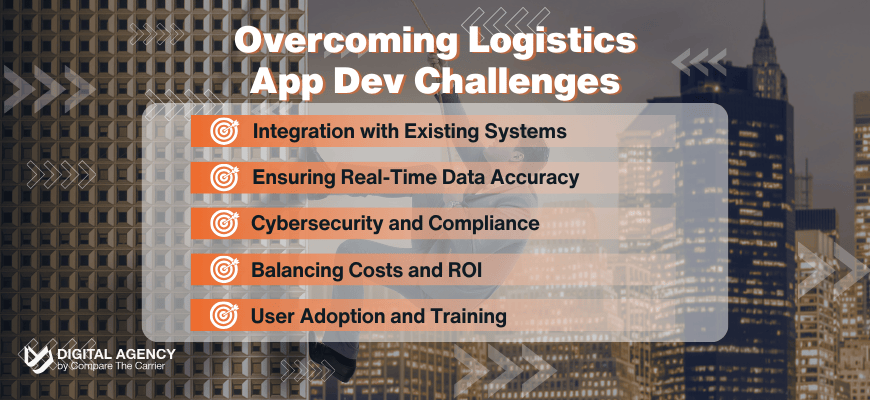
Here are the most common roadblocks and how to overcome them:
Common Challenges in Logistics Application Development and how to overcome them
1. Integration with Existing Systems: Many brokers already use tools like TMS and different logistics CRM. Ensuring your new app works seamlessly with these systems can be tricky. Work with developers who specialize in API integrations and have experience in auto transport management. Platforms like Zapier can also simplify integration.
2. Ensuring Real-Time Data Accuracy: Real-time tracking and analytics rely on accurate, up-to-date data. Any discrepancies can lead to operational inefficiencies and frustrated customers. Invest in robust data validation tools and cloud-based platforms like Google Cloud to ensure data consistency.
3. Cybersecurity and Compliance: With sensitive customer and financial data at stake, cybersecurity is a top concern. Brokers must also comply with industry regulations like the Federal Motor Carrier Safety Administration (FMCSA) guidelines. Implement encryption, secure authentication, and regular security audits. Tools like Okta can help manage access and compliance.
4. Balancing Costs and ROI: Developing a custom app can be expensive, and brokers need to ensure a strong return on investment (ROI). Balance the costs of application development by maximizing ROI from your logistics leads. Start with a Minimum Viable Product (MVP) to test core features before scaling. Platforms like Mendix offer cost-effective development options.
5. User Adoption and Training: Even the best app won’t succeed if your team and customers don’t know how to use it. Provide comprehensive training and user-friendly interfaces. Tools like WalkMe can guide users through the app’s features.

A 2026 report by Deloitte found that 60% of logistics companies face delays in app development due to these challenges. But with the right strategies and partners, these hurdles can be turned into opportunities for growth.

At Compare The Carrier, we’ve helped countless brokers navigate these challenges. Our expertise in logistics application development ensures your app is not only functional but also future-proof.

Choosing the Right Tools for Your Auto Transport App

Building a successful app for auto transport brokers isn’t just about great ideas it’s about choosing the right tools to bring those ideas to life. The tech stack you select can make or break your app’s performance, scalability, and user experience. Here’s what you need to consider:
Choosing the Right Tools for Your application for auto transport brokers

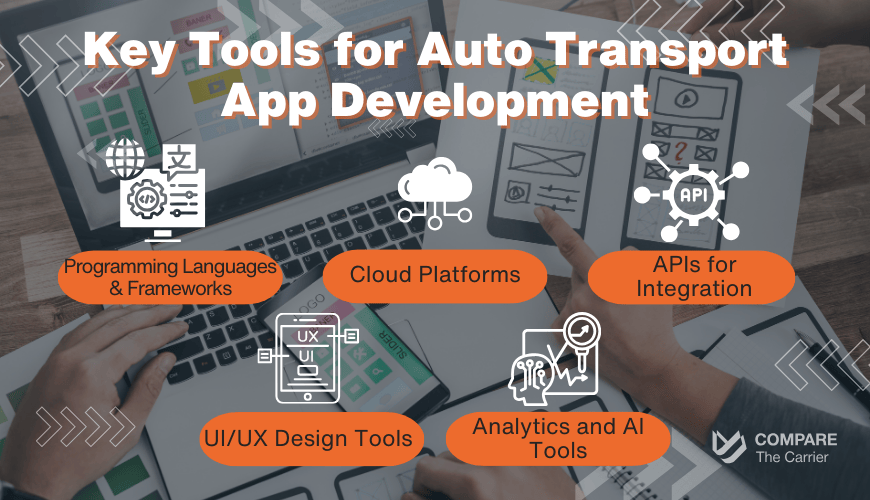
Key Tools for Auto Transport App Development

Programming Languages and Frameworks: For cross-platform apps, consider React Native or Flutter. They allow you to build for both iOS and Android with a single codebase.
Cloud Platforms: Leveraging cloud platforms for data processing complements other digital strategies, such as quickly setting up efficient Google Ads campaigns. Cloud services like AWS or Microsoft Azure provide the infrastructure needed for real-time data processing and storage.
APIs for Integration: Use APIs to connect your app with existing systems like TMS, CRM, or payment gateways. Tools like Postman can help streamline API testing and integration.
UI/UX Design Tools: Platforms like Figma or Sketch are essential for creating intuitive, user-friendly interfaces.
Analytics and AI Tools: Leverage tools like Google Analytics for user behavior insights and TensorFlow for AI-driven features like predictive analytics.

Choosing the right tools is just the first step. The real magic happens when these tools are used to create an app that’s not only functional but also tailored to the unique needs of auto transport brokers.

With the right tools in place, the next step is designing an app that not only works well but also converts users into loyal customers. Let’s dive into designing an app for auto transport brokers that converts.

Designing an App for Auto Transport Brokers That Converts

A well-designed app isn’t just about looking good it’s about driving results.

For auto transport brokers, the goal is to create an app that not only simplifies operations but also converts users into loyal customers. Here’s how to design an app that delivers:
Designing an App for Auto Transport Brokers That Converts

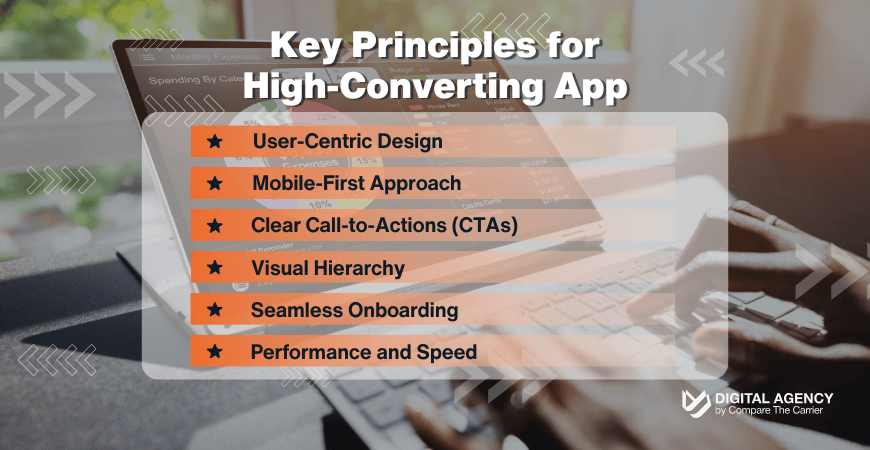
Key Principles for a High-Converting App

User-Centric Design: Adopting proven web design principles can significantly enhance the user interface of your logistics app. Focus on the needs of your users—brokers, carriers, and customers. Simplify navigation, prioritize key features, and ensure the app is intuitive for all user levels.
Mobile-First Approach: Over 70% of logistics professionals use mobile devices for work. Design your app with mobile users in mind, ensuring fast load times and responsive layouts.
Clear Call-to-Actions (CTAs): Whether it’s booking a shipment, tracking a vehicle, or making a payment, CTAs should be bold, clear, and easy to find.
Visual Hierarchy: Use design elements like color, typography, and spacing to guide users’ attention to the most important features and information.
Seamless Onboarding: A smooth onboarding process can make or break user adoption. Use tutorials, tooltips, and easy sign-up options to get users up and running quickly.
Performance and Speed: Slow apps frustrate users. Just as email deliverability is crucial, so is app performance; optimize your logistics app to deliver data efficiently, even with heavy data usage.

Designing a high-converting app is about more than aesthetics it’s about creating an experience that users trust and rely on. By focusing on usability, speed, and personalization, you can build an app that not only meets user needs but also drives business growth.

Compare The Carrier: Your Partner in Auto Transport App Development

At Compare The Carrier, we don’t just build apps — we create solutions that solve real-world problems for auto transport brokers.

With years of experience in logistics and digital marketing, we’ve helped businesses streamline operations, enhance customer experiences, and achieve measurable growth. Here’s how we’ve made an impact:
we create solutions that solve real-world problems for auto transport brokers

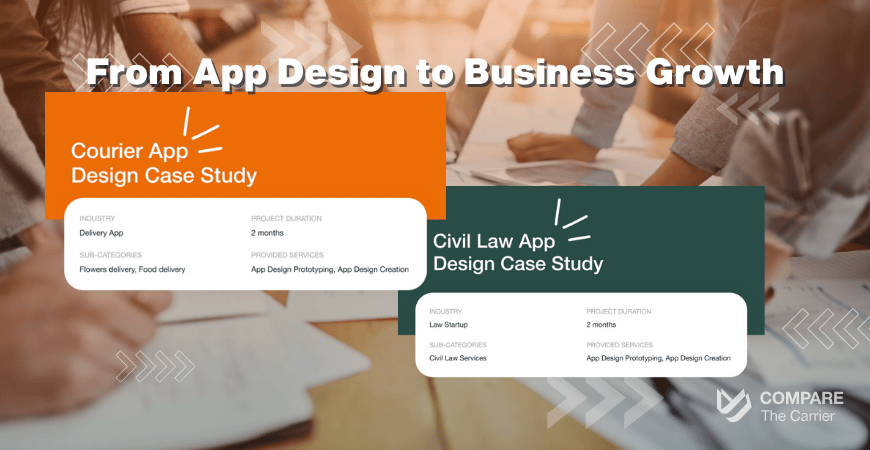
Case Study 1: Courier App Design

A mid-sized courier company approached us with a challenge: their manual dispatch system was slowing them down, and customers were frustrated with the lack of real-time updates. We developed a custom app featuring:

Real-time GPS tracking for shipments.
Automated dispatch and route optimization.
A user-friendly interface for both drivers and customers.

The Result: Operational efficiency improved by 25%, and customer satisfaction scores increased by 30%. Read the full case study here.

Case Study 2: Civil Law App Design

A legal logistics provider needed a solution to manage sensitive document deliveries securely and efficiently. We designed an app with:

Secure document tracking and e-signature capabilities.
A robust compliance framework to meet industry regulations.

The Result: Delivery accuracy improved by 40%, and the client saw a 20% reduction in operational costs. Explore the full case study here.
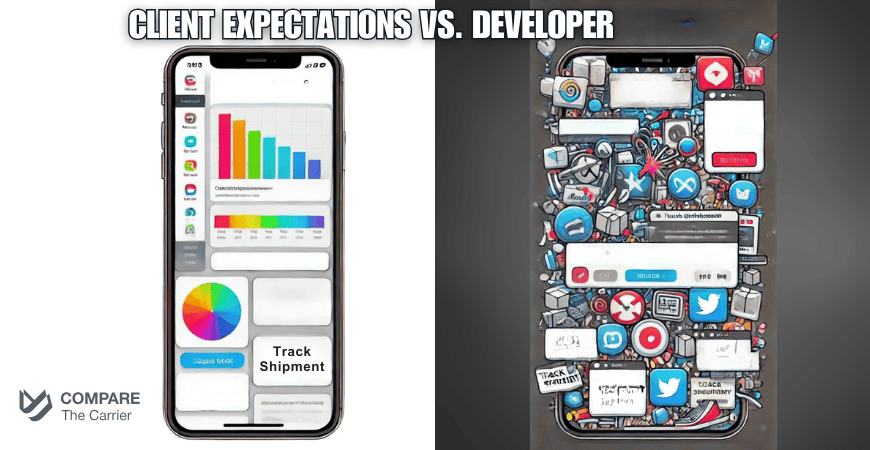
Bridging the Gap Between Expectations and Reality

Bridging the Gap Between Expectations and Reality of auto transport management

At Compare The Carrier, we make sure your app doesn’t end up as a meme. We work closely with you to understand your needs, set realistic expectations, and deliver a solution that’s both functional and elegant— no chaos, just results.

Conclusion

The logistics and auto transport industries are evolving rapidly, and logistics application development is at the heart of this transformation. From streamlining operations to enhancing customer experiences, custom apps are no longer optional they’re essential for staying competitive.

At Compare The Carrier, we’re committed to helping brokers navigate this digital shift. Whether you’re looking to build a new app or optimize an existing one, our expertise ensures you get a solution that works as hard as you do.

Ready to take your business to the next level? Let’s build the future of logistics together.

FAQ

What is logistics application development?

Logistics application development is the process of building custom software specifically for freight brokers, carriers, and 3PLs. These applications automate manual workflows, such as load matching, route optimization, and digital document processing (eBOL). In 2026, custom logistics apps heavily integrate AI to predict freight rates and provide real-time GPS tracking for shippers.

How long does it take to develop a custom logistics application?

Developing a custom logistics application typically takes between three to nine months. Building a Minimum Viable Product (MVP) with core features like automated dispatch and GPS tracking usually requires 12 to 16 weeks. Fully integrated enterprise solutions featuring AI-driven analytics, custom carrier portals, and complex TMS integrations generally take six to nine months to deploy.

How much does it cost to build an auto transport application?

The cost of developing an auto transport app ranges from $40,000 for a basic MVP to over $150,000 for an enterprise-grade platform. Pricing depends entirely on feature complexity, such as ELD integrations, real-time API syncing, and AI-powered pricing algorithms. Investing in custom architecture eliminates recurring per-user software licensing fees, offering long-term financial scalability.

Can custom logistics apps integrate with existing TMS and CRM platforms?

Yes, modern custom logistics applications are designed to integrate seamlessly with existing Transportation Management Systems (TMS) and Customer Relationship Management (CRM) software. Utilizing secure REST APIs and webhooks, developers ensure two-way data synchronization. This eliminates manual double-entry, allowing brokers to manage leads, carrier compliance, and accounting within a single unified digital ecosystem.

How does a custom logistics app improve auto transport ROI?

A custom auto transport app directly improves ROI by drastically reducing administrative overhead and accelerating the cash conversion cycle. Features like automated carrier matching decrease the time spent covering loads. Additionally, integrated digital PODs (Proof of Delivery) and automated invoicing systems allow brokers to bill shippers immediately upon delivery, significantly reducing days sales outstanding.

What security standards are required for auto transport applications in 2026?

In 2026, auto transport applications must comply with strict data protection frameworks, including FMCSA guidelines and SOC 2 standards. Required security protocols involve end-to-end data encryption, role-based access control, and multi-factor authentication (MFA). Because these apps process sensitive carrier tax IDs and B2B payment transactions, bank-level security architecture is mandatory to prevent data breaches.

Review us on Trustpilot
5 1 vote
Article Rating
Subscribe
Notify of
guest
0 Comments
Oldest
Newest Most Voted
Inline Feedbacks
View all comments

Pass It Along!

If you found this article useful, share it with your friends